A previously healthy 61-year-old man comes to the physician because of a 3-month history of intermittent fever, easy fatiguability, and a 4.4-kg (9.7-lb) weight loss. Physical examination shows conjunctival pallor. The spleen is palpated 5 cm below the left costal margin. Laboratory studies show a leukocyte count of 75,300/mm3 with increased basophils, a platelet count of 455,000/mm3, and a decreased leukocyte alkaline phosphatase score. A peripheral blood smear shows increased numbers of promyelocytes, myelocytes, and metamyelocytes. Which of the following is the most likely diagnosis?
Q212
A 52-year-old Caucasian male presents to your office with an 8 mm dark lesion on his back. The lesion, as seen below, has irregular borders and marked internal color variation. Upon excisional biopsy, the presence of which of the following would best estimate the risk of metastasis in this patient's lesion?

Q213
A 24-year-old man comes to the physician because of 2 episodes of bleeding from the rectum over the past month. The patient’s father died of colon cancer at the age of 42. The patient has no history of any serious illness and takes no medications. He does not smoke. His vital signs are within normal limits. Physical examination shows a small hard mass over the right mandible that is nontender and fixed to the underlying bone. A similarly hard and painless 5 × 5 mass is palpated over the rectus abdominis muscle. On examination of the rectum, a polypoid mass is palpated at fingertip. Proctosigmoidoscopy shows numerous polyps. Which of the following best explains these findings?
Q214
A 53-year-old female visits her physician with watery diarrhea and episodic flushing. The patient reports that she is often short of breath, and a pulmonary exam reveals bilateral wheezing. A CT scan shows a mass in the terminal ileum. 24-hour urine collection shows abnormally elevated 5-hydroxyindoleacetic acid (HIAA) levels. Ultrasound demonstrates a tricuspid valve with signs of fibrosis with a normal mitral valve. A metastatic disease to which organ is most commonly associated with the patient's syndrome?
Q215
A 14-year-old boy presents to his pediatrician with a 5-day history of abdominal pain and bloody stool. He denies having a fever and says that he has not experienced any other symptoms associated with the abdominal pain. He has no past medical history and does not take any medications or supplements. His family history is significant for a grandfather who developed Alzheimer disease at age 80 and a cousin who died at age 21 from colon cancer. Physical exam is unremarkable. Based on clinical suspicion a colonoscopy is obtained showing hundreds of small polyps in the colon. A mutation of a gene on which of the following chromosomes is most likely responsible for this patient's symptoms?
Q216
A 72-year-old and his caregiver present for a follow-up after a transthoracic needle biopsy of one of the large lesions in his chest was reported as non-small cell carcinoma of the lung. Previously, a chest CT revealed numerous nodules in the lungs bilaterally. The chest CT was ordered after the patient experienced a persistent cough with hemoptysis and a history of multiple episodes of pneumonia over the past year. The patient has a history of dementia and is a poor historian. The caregiver states that the patient has no history of smoking and that he was a lawyer before he retired, 10 years ago. The caregiver can only provide a limited medical history, but states that the patient sees another doctor “to monitor his prostate”. Which of the following is true regarding the pathogenesis of the nodules seen in this patient?
Q217
A 34-year-old patient with a history of anxiety, chronic constipation, chronic headaches, and chronic hypertension presents to the emergency room with severe right flank pain radiating to his scrotum. A urinalysis with stone analysis is performed and the results are shown in figure A. Prior to discharge, it is noted that the patients BP is still 170/110 mmHg. Furthermore, his calcium and PTH levels were both found to be increased. Which of the following representative histology slides of thyroid tissue represents a potential complication of the patients condition?
Q218
An 82-year-old man is brought to the emergency department after he was found down by his daughter. On presentation, he is alert and oriented with no obvious signs of trauma. He says that he felt lightheaded shortly before passing out and that he has been feeling extremely fatigued over the last few weeks. He has a known diagnosis of colorectal adenocarcinoma and had it surgically removed 2 months ago; however, recently he has been feeling increasingly short of breath. He has a 60-pack-year smoking history and drinks 2-3 beers a night. He worked as an insulation technician and shipyard laborer for 40 years prior to retiring at age 65. Radiographs reveal approximately a dozen new nodules scattered throughout his lungs bilaterally. Biopsy of these lesions would most likely reveal which of the following?
Q219
A 22-year-old man comes to the physician because of headaches and blurry vision for the past 6 months. He also reports frequent episodes of vomiting over the last month. His father has died of renal cell carcinoma at the age of 37 years. Examination shows 20/40 vision bilaterally. Fundoscopic examination shows bilateral optic disc swelling and growth of capillary vessels in the temporal peripheral retina. An MRI of the brain shows an infratentorial mass. The patient undergoes surgical resection of the mass. A photomicrograph of the resected specimen is shown. Which of the following is the most likely diagnosis?
Q220
A 16-year-old boy is brought to the physician because of a lesion that has been growing on his jaw over the past several months. He recently immigrated to the USA from Kenya with his family. Physical examination shows a 3-cm solid mass located above the left mandible. There is cervical lymphadenopathy. Biopsy of the mass shows sheets of lymphocytes and interspersed reactive histiocytes with abundant, clear cytoplasm and phagocytosed debris. Which of the following mechanisms is most likely directly responsible for the malignant transformation of this patient's cells?
Neoplasia US Medical PG Practice Questions and MCQs
Question 211: A previously healthy 61-year-old man comes to the physician because of a 3-month history of intermittent fever, easy fatiguability, and a 4.4-kg (9.7-lb) weight loss. Physical examination shows conjunctival pallor. The spleen is palpated 5 cm below the left costal margin. Laboratory studies show a leukocyte count of 75,300/mm3 with increased basophils, a platelet count of 455,000/mm3, and a decreased leukocyte alkaline phosphatase score. A peripheral blood smear shows increased numbers of promyelocytes, myelocytes, and metamyelocytes. Which of the following is the most likely diagnosis?
A. Chronic myeloid leukemia (Correct Answer)
B. Acute promyelocytic leukemia
C. Essential thrombocythemia
D. Chronic lymphocytic leukemia
E. Leukemoid reaction
Explanation: ***Chronic myeloid leukemia***
- The combination of **leukocytosis (75,300/mm3)**, **splenomegaly**, **increased basophils**, and a **low leukocyte alkaline phosphatase (LAP) score** is highly characteristic of CML
- The presence of immature myeloid forms (promyelocytes, myelocytes, metamyelocytes) on peripheral smear, referred to as a **"left shift"**, further supports this diagnosis
- CML is typically associated with the **Philadelphia chromosome [t(9;22)]** resulting in the BCR-ABL fusion gene
*Acute promyelocytic leukemia*
- This acute leukemia is characterized by a high number of **abnormal promyelocytes** with prominent Auer rods and is associated with the **t(15;17)** chromosomal translocation
- It typically presents with severe **cytopenias** (not leukocytosis) and a high risk of **disseminated intravascular coagulation (DIC)**, which are not described here
- The chronic course and marked leukocytosis make this diagnosis unlikely
*Essential thrombocythemia*
- This myeloproliferative neoplasm primarily involves **excessive platelet production**, leading to consistently high platelet counts (typically >450,000/mm3)
- While this patient has mild thrombocytosis, the prominently elevated **white blood cell count** (75,300/mm3) with myeloid left shift and **splenomegaly** point to a different myeloproliferative disorder
*Chronic lymphocytic leukemia*
- CLL is characterized by a proliferation of mature **B lymphocytes**, resulting in **lymphocytosis** with small, mature lymphocytes on peripheral smear
- The peripheral smear in this case shows increased **immature myeloid forms** (not lymphocytes), making CLL incompatible with this presentation
- CLL typically has a normal or elevated LAP score
*Leukemoid reaction*
- A leukemoid reaction is a reactive (non-malignant) process causing marked leukocytosis, usually in response to severe infection, inflammation, or malignancy
- It is characterized by a **normal or elevated LAP score**, which is the key distinguishing feature from CML
- The **decreased LAP score** in this patient makes a leukemoid reaction unlikely and strongly supports a diagnosis of CML
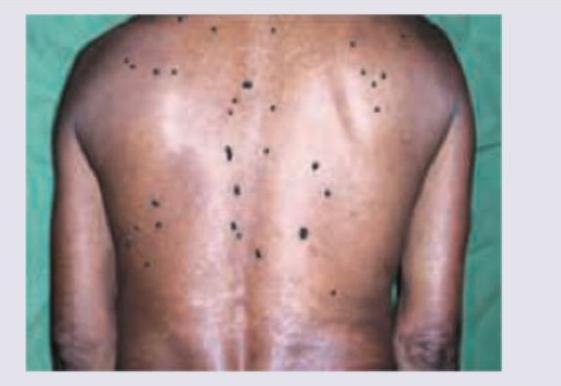
Question 212: A 52-year-old Caucasian male presents to your office with an 8 mm dark lesion on his back. The lesion, as seen below, has irregular borders and marked internal color variation. Upon excisional biopsy, the presence of which of the following would best estimate the risk of metastasis in this patient's lesion?
A. Palisading nuclei
B. Cellular atypia
C. Vertical tumor growth (Correct Answer)
D. Keratin pearls
E. Increased production of melanosomes
Explanation: ***Vertical tumor growth***
- The presence and depth of **vertical tumor growth** directly correlate with the **Breslow thickness**, which is the most important prognostic factor for melanoma metastasis.
- Deeper invasion into the dermis indicates a greater potential for lymphatic and hematogenous spread, hence a higher risk of metastasis.
*Palisading nuclei*
- **Palisading nuclei** are characteristic of basal cell carcinoma, where cells arrange in a palisade along the tumor periphery.
- This finding is not typically associated with melanoma or used as a prognostic indicator for its metastatic potential.
*Cellular atypia*
- **Cellular atypia** refers to abnormal cell morphology and is a general feature of malignancy across many cancers.
- While present in melanoma, it is not as specific or as strong an indicator of metastatic risk as the depth of vertical invasion.
*Keratin pearls*
- **Keratin pearls** are central nests of keratinizing cells found in well-differentiated squamous cell carcinoma.
- This feature is unrelated to melanoma and its metastatic risk.
*Increased production of melanosomes*
- **Melanosomes** are pigment-producing organelles within melanocytes, and their increased production is a feature of pigmented lesions, including benign nevi and melanoma.
- This finding primarily relates to the hyperpigmented appearance of the lesion, not its metastatic potential.
Question 213: A 24-year-old man comes to the physician because of 2 episodes of bleeding from the rectum over the past month. The patient’s father died of colon cancer at the age of 42. The patient has no history of any serious illness and takes no medications. He does not smoke. His vital signs are within normal limits. Physical examination shows a small hard mass over the right mandible that is nontender and fixed to the underlying bone. A similarly hard and painless 5 × 5 mass is palpated over the rectus abdominis muscle. On examination of the rectum, a polypoid mass is palpated at fingertip. Proctosigmoidoscopy shows numerous polyps. Which of the following best explains these findings?
A. Familial polyposis of the colon
B. Peutz-Jeghers syndrome
C. Turcot’s syndrome
D. Gardner’s syndrome (Correct Answer)
E. Lynch’s syndrome
Explanation: ***Gardner's syndrome***
- This syndrome is a variant of **familial adenomatous polyposis (FAP)**, characterized by numerous **colonic polyps** (leading to rectal bleeding) in conjunction with **extra-intestinal manifestations**.
- The extra-intestinal features described, such as **osteomas** (small hard mass over the mandible) and **desmoid tumors** (painless 5 × 5 mass over the rectus abdominis muscle), are classic findings of Gardner's syndrome. The family history of colon cancer further supports this diagnosis.
*Familial polyposis of the colon*
- Familial adenomatous polyposis (FAP) primarily involves the development of **hundreds to thousands of adenomatous colonic polyps**, leading to a high risk of colorectal cancer.
- While it explains the rectal polyps and family history, it does **not account for the extra-intestinal manifestations** like osteomas and desmoid tumors, which are key to Gardner's syndrome.
*Peutz-Jeghers syndrome*
- This syndrome is characterized by **hamartomatous polyps** throughout the gastrointestinal tract and **mucocutaneous hyperpigmentation** (dark spots) on the lips, buccal mucosa, and digits.
- The patient's presentation does not include hamartomatous polyps or mucocutaneous pigmentation.
*Turcot's syndrome*
- Turcot's syndrome is a rare condition involving the co-occurrence of **colorectal polyps** (often adenomatous) and **central nervous system (CNS) tumors**, such as medulloblastoma or glioblastoma.
- The patient presents with osteomas and desmoid tumors, which are not CNS manifestations central to Turcot's syndrome.
*Lynch's syndrome*
- Lynch syndrome (hereditary nonpolyposis colorectal cancer, HNPCC) is characterized by an increased risk of developing **colorectal cancer** and other cancers (e.g., endometrial, ovarian) due to defects in **DNA mismatch repair genes**.
- It typically involves fewer polyps than FAP and does not present with the specific extra-intestinal symptoms like osteomas or desmoid tumors seen in this patient.
Question 214: A 53-year-old female visits her physician with watery diarrhea and episodic flushing. The patient reports that she is often short of breath, and a pulmonary exam reveals bilateral wheezing. A CT scan shows a mass in the terminal ileum. 24-hour urine collection shows abnormally elevated 5-hydroxyindoleacetic acid (HIAA) levels. Ultrasound demonstrates a tricuspid valve with signs of fibrosis with a normal mitral valve. A metastatic disease to which organ is most commonly associated with the patient's syndrome?
A. Liver (Correct Answer)
B. Pancreas
C. Kidney
D. Brain
E. Lung
Explanation: ***Liver***
- The combination of **watery diarrhea**, **episodic flushing**, **bilateral wheezing**, a **terminal ileum mass**, elevated **5-HIAA**, and **tricuspid valve fibrosis** points to **carcinoid syndrome**. This syndrome typically occurs when neuroendocrine tumors, often originating in the gut, metastasize to the liver.
- The **liver** is usually the site of metastasis that allows hormones like **serotonin** (metabolized to 5-HIAA) to bypass hepatic metabolism and enter systemic circulation, causing the characteristic symptoms.
*Pancreas*
- While neuroendocrine tumors can originate in the **pancreas**, **metastasis to the liver** is still the most common scenario for systemic symptoms in carcinoid syndrome.
- Pancreatic neuroendocrine tumors (PNETs) primarily produce other hormones (e.g., insulin, glucagon, VIP), and the classic carcinoid syndrome with flushing and wheezing from serotonin is less typical unless **liver metastases** are present.
*Kidney*
- **Kidney** metastasis from neuroendocrine tumors is less common than liver involvement and would not typically explain the systemic symptoms of **carcinoid syndrome** due to bypass of first-pass metabolism.
- While some neuroendocrine tumors can metastasize to the kidney, it is not the most common organ associated with systemic carcinoid features.
*Brain*
- **Brain** metastases from neuroendocrine tumors, while possible, are less frequent than liver metastases and rarely cause the systemic symptoms of **carcinoid syndrome**.
- **Serotonin** does not readily cross the blood-brain barrier in significant amounts systemically to cause brain-specific symptoms related to its peripheral overproduction.
*Lung*
- **Primary lung carcinoid tumors** can cause carcinoid syndrome without liver metastasis, but the presence of a **terminal ileum mass** in this case strongly suggests a gut origin.
- When lung metastases occur from a gut primary, they are usually a consequence of widespread disease, and the **liver** is still the primary site enabling systemic symptom onset due to its role in metabolizing gut hormones.
Question 215: A 14-year-old boy presents to his pediatrician with a 5-day history of abdominal pain and bloody stool. He denies having a fever and says that he has not experienced any other symptoms associated with the abdominal pain. He has no past medical history and does not take any medications or supplements. His family history is significant for a grandfather who developed Alzheimer disease at age 80 and a cousin who died at age 21 from colon cancer. Physical exam is unremarkable. Based on clinical suspicion a colonoscopy is obtained showing hundreds of small polyps in the colon. A mutation of a gene on which of the following chromosomes is most likely responsible for this patient's symptoms?
A. 5 (Correct Answer)
B. 7
C. X
D. 17
E. 19
Explanation: ***Correct: Chromosome 5***
- The patient's presentation with hundreds of small colon polyps on colonoscopy strongly suggests **Familial Adenomatous Polyposis (FAP)**
- FAP is an **autosomal dominant** disorder caused by a mutation in the **adenomatous polyposis coli (APC) gene**, which is located on **chromosome 5 (5q21-q22)**
- The family history of a cousin dying at age 21 from colon cancer supports this diagnosis
*Incorrect: Chromosome 7*
- Mutations on chromosome 7 are not typically associated with FAP or extensive colonic polyposis
- While other genetic conditions are linked to chromosome 7 (e.g., cystic fibrosis), they do not present with this specific phenotype
*Incorrect: Chromosome X*
- Mutations on the X chromosome cause **X-linked disorders**, affecting males disproportionately
- Hereditary colorectal cancer syndromes are generally autosomal, not X-linked
*Incorrect: Chromosome 17*
- Chromosome 17 is associated with several genetic conditions, including **Neurofibromatosis type 1 (NF1)** and mutations in **TP53 (Li-Fraumeni syndrome)**
- While Li-Fraumeni syndrome increases cancer risk, it typically presents with a broader spectrum of cancers and not primarily with hundreds of colonic polyps in adolescence
*Incorrect: Chromosome 19*
- Chromosome 19 contains genes linked to various conditions, but not typically to FAP or other hereditary polyposis syndromes of the colon
- For instance, **myotonic dystrophy type 1** is linked to chromosome 19, which does not involve extensive colonic polyps
Question 216: A 72-year-old and his caregiver present for a follow-up after a transthoracic needle biopsy of one of the large lesions in his chest was reported as non-small cell carcinoma of the lung. Previously, a chest CT revealed numerous nodules in the lungs bilaterally. The chest CT was ordered after the patient experienced a persistent cough with hemoptysis and a history of multiple episodes of pneumonia over the past year. The patient has a history of dementia and is a poor historian. The caregiver states that the patient has no history of smoking and that he was a lawyer before he retired, 10 years ago. The caregiver can only provide a limited medical history, but states that the patient sees another doctor “to monitor his prostate”. Which of the following is true regarding the pathogenesis of the nodules seen in this patient?
A. Proliferation of cells that contain glands that produce mucin (Correct Answer)
B. Tumors seeded via the pulmonary arteries
C. Infection of the lung parenchyma with a gram-negative bacteria grown on charcoal yeast agar
D. Aspergillus infection leading to a formation of a 'fungus ball'
E. Malignant transformation of neuroendocrine cells
Explanation: ***Proliferation of cells that contain glands that produce mucin***
- This describes **adenocarcinoma**, the most common subtype of non-small cell lung carcinoma (NSCLC), which was confirmed by the **transthoracic needle biopsy**.
- Adenocarcinoma is characterized by **glandular differentiation** and **mucin production**, and is the **most common lung cancer in non-smokers**.
- The presentation of **numerous bilateral nodules** is consistent with **primary lung adenocarcinoma with intrapulmonary metastases** (spread within the lungs via lymphatics or hematogenous routes). Adenocarcinoma has a propensity for early hematogenous spread.
- The persistent cough, hemoptysis, and recurrent pneumonias are all consistent with advanced lung adenocarcinoma.
*Malignant transformation of neuroendocrine cells*
- This describes **small cell lung carcinoma** or **neuroendocrine tumors** (carcinoid tumors, large cell neuroendocrine carcinoma).
- The biopsy explicitly reported **non-small cell carcinoma**, which rules out small cell lung cancer.
- While large cell neuroendocrine carcinoma is technically classified under NSCLC, the classic description of neuroendocrine transformation typically refers to small cell carcinoma.
*Tumors seeded via the pulmonary arteries*
- This describes **hematogenous metastases** to the lungs from an extrapulmonary primary tumor.
- However, the biopsy showed **non-small cell carcinoma of the lung**, not metastatic carcinoma from another organ (such as prostate, breast, colon, etc.).
- If these were metastases from prostate cancer, the pathology report would indicate **metastatic prostatic adenocarcinoma**, not primary lung carcinoma. Pathologists can distinguish lung primary from metastases using morphology and immunohistochemistry.
- While the patient "monitors his prostate," this likely refers to benign prostatic hyperplasia or PSA surveillance, not active prostate cancer.
*Infection of the lung parenchyma with a gram-negative bacteria grown on charcoal yeast agar*
- This describes **Legionella pneumophila**, which causes Legionnaires' disease and is grown on buffered charcoal yeast extract (BCYE) agar.
- This is an **infectious process**, not a neoplastic one. The biopsy confirmed **malignancy** (non-small cell carcinoma), definitively ruling out infection as the cause of the nodules.
*Aspergillus infection leading to a formation of a 'fungus ball'*
- An **aspergilloma** (fungus ball) is a saprophytic colonization of **pre-existing lung cavities** (from TB, sarcoidosis, etc.) by *Aspergillus* species.
- This is an **infectious/fungal process**, not malignancy. The biopsy showed **non-small cell carcinoma**, confirming a neoplastic process.
- Aspergillomas typically present as a **single cavity with a mobile mass**, not numerous bilateral nodules.
Question 217: A 34-year-old patient with a history of anxiety, chronic constipation, chronic headaches, and chronic hypertension presents to the emergency room with severe right flank pain radiating to his scrotum. A urinalysis with stone analysis is performed and the results are shown in figure A. Prior to discharge, it is noted that the patients BP is still 170/110 mmHg. Furthermore, his calcium and PTH levels were both found to be increased. Which of the following representative histology slides of thyroid tissue represents a potential complication of the patients condition?
A. Papillary thyroid cancer
B. Lymphoma
C. Anaplastic thyroid cancer
D. Medullary thyroid cancer (Correct Answer)
E. Follicular thyroid cancer
Explanation: ***Medullary thyroid cancer***
- The patient presents with **severe right flank pain** radiating to the scrotum and **calcium oxalate stones**, indicative of **nephrolithiasis** likely due to **hypercalcemia**. His elevated calcium and **parathyroid hormone (PTH)** levels point to **primary hyperparathyroidism**.
- **Medullary thyroid cancer (MTC)** is a feature of **Multiple Endocrine Neoplasia type 2A (MEN2A)**, which also includes **primary hyperparathyroidism** and **pheochromocytoma**. The patient's **chronic hypertension** could be a sign of an undiagnosed pheochromocytoma, making MTC a potential complication.
*Papillary thyroid cancer*
- This is the **most common type of thyroid cancer**, but it is generally **not associated with hyperparathyroidism** or MEN syndromes.
- While it can be caused by **radiation exposure**, there's no information suggesting this etiology in the patient.
*Lymphoma*
- **Thyroid lymphoma** is generally associated with **Hashimoto's thyroiditis** and presents with a rapidly enlarging goiter, which is not described.
- It does not typically cause **hypercalcemia** or is part of a multiple endocrine neoplasia syndrome.
*Anaplastic thyroid cancer*
- This is a rare, **highly aggressive form of thyroid cancer** that typically affects older individuals and presents with rapid growth and compressive symptoms.
- It is **not associated with hyperparathyroidism** or stone formation.
*Follicular thyroid cancer*
- **Follicular thyroid cancer** is more common in areas of **iodine deficiency** and often spreads hematogenously to distant sites.
- It is **not linked to hyperparathyroidism** or the MEN syndromes.
Question 218: An 82-year-old man is brought to the emergency department after he was found down by his daughter. On presentation, he is alert and oriented with no obvious signs of trauma. He says that he felt lightheaded shortly before passing out and that he has been feeling extremely fatigued over the last few weeks. He has a known diagnosis of colorectal adenocarcinoma and had it surgically removed 2 months ago; however, recently he has been feeling increasingly short of breath. He has a 60-pack-year smoking history and drinks 2-3 beers a night. He worked as an insulation technician and shipyard laborer for 40 years prior to retiring at age 65. Radiographs reveal approximately a dozen new nodules scattered throughout his lungs bilaterally. Biopsy of these lesions would most likely reveal which of the following?
A. Pleomorphic giant cells
B. Small dark blue cells that stain for chromogranin
C. Flat cells with keratin pearls and intercellular bridges
D. Psammoma bodies
E. Mucin-producing glandular structures (Correct Answer)
Explanation: ***Mucin-producing glandular structures***
- The patient has a history of **colorectal adenocarcinoma**, and the numerous new lung nodules suggest **metastatic spread** from the primary tumor.
- **Adenocarcinoma of the colon** is characterized by the formation of glands that typically produce mucin.
*Pleomorphic giant cells*
- This description is characteristic of **undifferentiated giant cell carcinoma**, a rare and aggressive subtype of **lung cancer**.
- While lung cancer is possible given the patient's smoking and occupational history, the history of colorectal adenocarcinoma and findings of multiple nodules strongly point towards metastasis rather than a primary lung tumor of this specific subtype.
*Small dark blue cells that stain for chromogranin*
- These features describe **small cell carcinoma**, a type of neuroendocrine tumor often found in the lungs, strongly associated with smoking.
- However, the patient's primary diagnosis of **colorectal adenocarcinoma** makes metastatic colorectal cancer to the lung a more direct and probable explanation for the new lung nodules.
*Flat cells with keratin pearls and intercellular bridges*
- This is the histological description of **squamous cell carcinoma**, which can occur in the lung and is also strongly associated with smoking and occupational exposures.
- While possible as a new primary lung cancer, the established diagnosis of **colorectal adenocarcinoma** and the pattern of multiple nodules make metastatic disease more likely.
*Psammoma bodies*
- These concentric calcifications are characteristic of several tumors, including **papillary thyroid carcinoma**, **meningiomas**, and **serous ovarian adenocarcinoma**.
- They are not typically associated with **colorectal adenocarcinoma** or its common metastatic presentations.
Question 219: A 22-year-old man comes to the physician because of headaches and blurry vision for the past 6 months. He also reports frequent episodes of vomiting over the last month. His father has died of renal cell carcinoma at the age of 37 years. Examination shows 20/40 vision bilaterally. Fundoscopic examination shows bilateral optic disc swelling and growth of capillary vessels in the temporal peripheral retina. An MRI of the brain shows an infratentorial mass. The patient undergoes surgical resection of the mass. A photomicrograph of the resected specimen is shown. Which of the following is the most likely diagnosis?
A. Hemangioblastoma (Correct Answer)
B. Medulloblastoma
C. Glioblastoma
D. Oligodendroglioma
E. Ependymoma
Explanation: ***Hemangioblastoma***
- The patient's presentation with an **infratentorial mass** causing headaches, blurry vision, and vomiting, combined with **retinal hemangiomas** (growth of capillary vessels in the temporal peripheral retina) and a family history of **renal cell carcinoma** (especially at a young age), is highly suggestive of **Von Hippel-Lindau (VHL) disease**. Hemangioblastomas are the most common CNS tumors in VHL disease and are typically found in the cerebellum, brainstem, or spinal cord.
- The photomicrograph would typically show characteristic foamy **stromal cells** with high vascularity, which are hallmarks of a hemangioblastoma.
*Medulloblastoma*
- This is a common **malignant cerebellar tumor** in children, but it typically presents in younger individuals (ages 3-8) and is less common in adults.
- While it can cause similar symptoms due to an infratentorial mass, it is not associated with **retinal hemangiomas** or **renal cell carcinoma** in the family history.
*Glioblastoma*
- Glioblastoma is a highly aggressive **supratentorial tumor** (located above the tentorium cerebelli), primarily affecting the cerebral hemispheres in older adults.
- It is uncommon in the cerebellum of young adults and does not typically present with the retinal findings or the characteristic family history seen in this case.
*Oligodendroglioma*
- Oligodendrogliomas are typically **supratentorial tumors** of the cerebral hemispheres, commonly found in the frontal lobe, and are not usually associated with retinal hemangiomas or a family history of renal cell carcinoma.
- Histologically, they are characterized by cells with clear halos (**"fried egg" appearance**) and a delicate capillary network, which would not match the expected photomicrograph features of this case.
*Ependymoma*
- Ependymomas can occur in the **fourth ventricle** (an infratentorial location), especially in children and young adults, and can cause hydrocephalus and associated symptoms.
- However, they are not typically associated with **retinal hemangiomas** or a family history of **renal cell carcinoma**, which are strong indicators of VHL disease and hemangioblastoma.
Question 220: A 16-year-old boy is brought to the physician because of a lesion that has been growing on his jaw over the past several months. He recently immigrated to the USA from Kenya with his family. Physical examination shows a 3-cm solid mass located above the left mandible. There is cervical lymphadenopathy. Biopsy of the mass shows sheets of lymphocytes and interspersed reactive histiocytes with abundant, clear cytoplasm and phagocytosed debris. Which of the following mechanisms is most likely directly responsible for the malignant transformation of this patient's cells?
A. Defect in DNA repair
B. Impairment of receptor function
C. Inhibition of cell cycle arrest
D. Integration of viral DNA (Correct Answer)
E. Activation of transcription
Explanation: **Integration of viral DNA**
- The clinical presentation (rapidly growing jaw mass in a young boy from Kenya) and histological findings (sheets of lymphocytes, "starry sky" appearance due to macrophages) are classic for **endemic Burkitt lymphoma**.
- Endemic Burkitt lymphoma is strongly associated with **Epstein-Barr virus (EBV)** infection. EBV DNA integrates into the host cell genome, promoting the characteristic **t(8;14) translocation** of *MYC* oncogene, leading to its overexpression and uncontrolled cell proliferation.
*Defect in DNA repair*
- While defects in DNA repair can lead to malignancy (e.g., in Lynch syndrome, xeroderma pigmentosum), it is not the primary mechanism of oncogenesis in Burkitt lymphoma.
- The hallmark of Burkitt lymphoma is a specific chromosomal translocation, not a generalized DNA repair defect.
*Impairment of receptor function*
- Impaired receptor function is associated with certain diseases (e.g., some autoimmune conditions, diabetes insipidus) but is not a direct mechanism for malignant transformation in Burkitt lymphoma.
- Malignancy typically arises from uncontrolled cell growth and division, not directly from receptor dysfunction.
*Inhibition of cell cycle arrest*
- While Burkitt lymphoma cells do evade cell cycle arrest, this is a **consequence** of the *MYC* oncogene overexpression, not the primary mechanism of malignant transformation itself.
- The **integration of viral DNA** leading to the *MYC* translocation is the upstream event that *causes* the inhibition of cell cycle arrest.
*Activation of transcription*
- **Activation of transcription** (specifically of the *MYC* oncogene) is a crucial step in the pathogenesis of Burkitt lymphoma, leading to uncontrolled cell growth.
- However, the direct cause of this dysregulated transcriptional activation is the **chromosomal translocation** resulting from viral DNA integration.