
Apoptosis and cancer — MCQs

A 58-year-old woman presents to a physician with a painless swelling behind her right ear, which she noticed 1 month ago. She has no other complaint nor does she have any specific medical condition. On physical examination, her vital signs are stable. An examination of the right post-auricular area shows enlarged lymph nodes, which are non-tender and rubbery in consistency, with normal overlying skin. A detailed general examination reveals the presence of one enlarged axillary lymph node on the left side with similar features. Complete blood counts are within normal limits but atypical lymphocytes are present on the peripheral blood smear. The patient’s serum lactate dehydrogenase level is slightly elevated. Excisional biopsy of the lymph node is performed and histopathological examination of the tissue yields a diagnosis of follicular lymphoma. Further cytogenetic studies reveal that the condition is associated with overexpression of the BCL-2 gene. Which of the following cytogenetic abnormalities is most likely to be present?
Researchers are investigating the mechanism of cell apoptosis and host defense in mice. They have observed that mice with certain gene deletions are not able to fight the induced viral infection. They identify a cell that is able to destroy target cells infected with viruses by exocytosis of granule contents, which induces the activation of caspases. Which type of cell is responsible for this process?
A 34-year-old woman comes to the physician for evaluation of a breast lump she noticed 2 days ago while showering. She has no history of major illness. Her mother died of ovarian cancer at age 38, and her sister was diagnosed with breast cancer at age 33. Examination shows a 1.5-cm, nontender, mobile mass in the upper outer quadrant of the left breast. Mammography shows pleomorphic calcifications. Biopsy of the mass shows invasive ductal carcinoma. The underlying cause of this patient's condition is most likely a mutation of a gene involved in which of the following cellular events?
A 67-year-old man comes to the physician for a follow-up examination after he was diagnosed with mantle cell lymphoma. The physician recommends a chemotherapeutic regimen containing bortezomib. Which of the following best describes the effect of this drug?
A 56-year-old woman presents to a physician for evaluation of a lump in her left breast. She noticed the lump last week while taking a shower. She says that the lump seemed to be getting larger, which worried her. The lump is not painful. The medical history is unremarkable. She has smoked cigarettes for the last 30 years. On examination, bilateral small nodules are present that are non-tender and immobile. A mammography confirms the masses and fine needle aspiration cytology of the lesions reveals malignant cells arranged in a row of cells. What is the most likely diagnosis?
A 61-year-old Caucasian male presents to your office complaining of morning headaches of 6 weeks duration. A head MRI reveals a likely metastasis of unknown origin in the supratentorial region of the brain. On biopsy, the neoplastic mass is shown to have a mutation in BRAF, a protein kinase, in which a glutamic acid is substituted for valine at position 600 of the protein. Where did this metastasis most likely originate?
A cell biologist is studying the activity of a novel chemotherapeutic agent against a cancer cell line. After incubation with the agent and cell detachment from the tissue culture plate, the DNA is harvested from the cells and run on a gel. Of note, there are large bands at every multiple of 180 base pairs on the gel. Which of the following explains the pathophysiology of this finding?
A 58-year-old man presents with lower back pain that started a couple of weeks ago and is gradually increasing in severity. At present, he rates the intensity of the pain as 6/10. There is no radiation or associated paresthesias. There is no history of trauma. Past medical history is significant for aggressive squamous cell carcinoma of the right lung status post surgical resection followed by adjunct chemotherapy and radiation therapy that was completed 6 months ago. A technetium bone scan reveals metastatic lesions in the lumbar vertebrae at levels L2–L4. The physician explains to the patient that these are likely metastatic lesions from his primary lung cancer. Which of the following best describes the mechanism that most likely led to the development of these metastatic lesions?
A 58-year-old male undergoes a surveillance colonoscopy in which a 2 cm adenoma is identified and removed. Had this adenoma not been excised, the patient would have been at risk of progression to carcinoma. Which of the following is the final mutational step in the progression from adenoma to carcinoma?
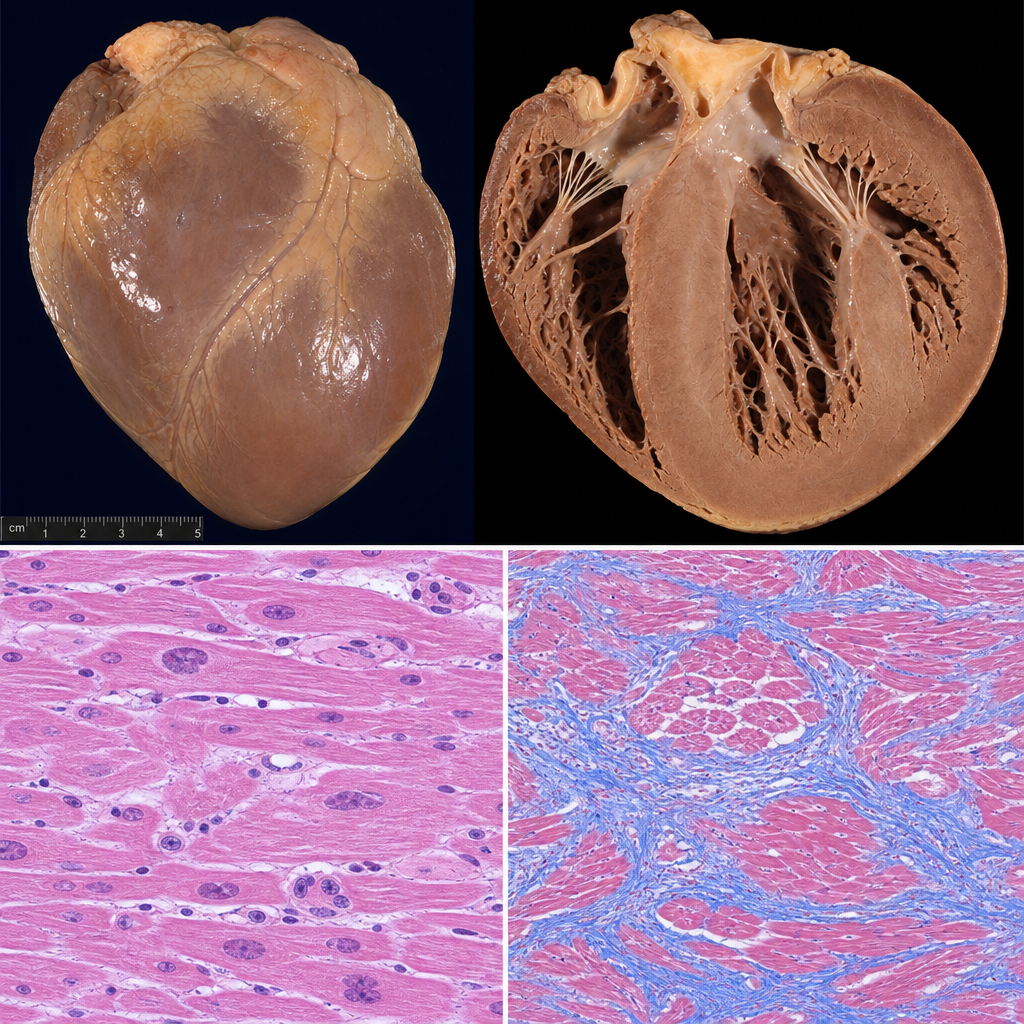
A 62-year-old man with a history of chronic alcohol use dies suddenly. At autopsy, the heart weighs 520 g (normal <400 g) and appears dilated with a flabby myocardium. Histological sections of the myocardium show hypertrophied cardiomyocytes with enlarged, irregular nuclei, and prominent interstitial fibrosis. There is no significant vacuolization of cardiomyocytes. Which of the following best describes the primary histopathologic mechanism underlying the cardiac enlargement and dysfunction in this condition?
Want unlimited practice?
Get full access to all questions, explanations, and performance tracking.
Scan to download app