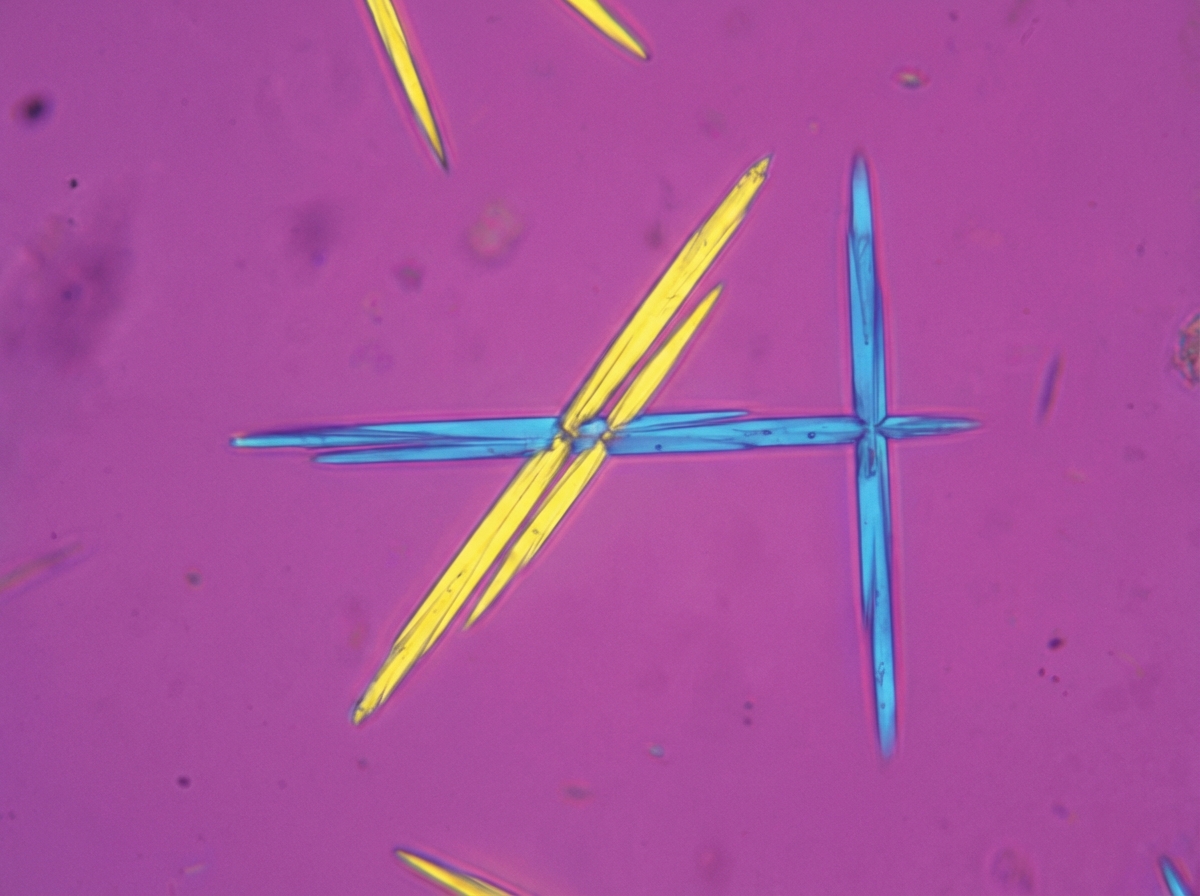
A 45-year-old construction worker presents to his primary care physician with a painful and swollen wrist joint. A joint aspiration shows crystals, which are shown in the accompanying picture. Which of the following is the most likely diagnosis?
Q42
A 23-year-old woman comes to the physician because of right-sided blurry vision and eye pain for 4 days. She has a 6-day history of low-grade fever, headache, and malaise. One year ago, she was diagnosed with Crohn disease. Her only medication is prednisone. Her temperature is 38°C (100.4°F), pulse is 84/min, and blood pressure is 112/75 mm Hg. The right eyelid is erythematous and tender; there are multiple vesicles over the right forehead and the tip of the nose. Visual acuity is 20/20 in the left eye and 20/80 in the right eye. Extraocular movements are normal. The right eye shows conjunctival injection and reduced corneal sensitivity. Fluorescein staining shows a corneal lesion with a tree-like pattern. Which of the following is the most likely diagnosis?
Q43
A 4-year-old Caucasian boy is brought by his mother to the pediatrician with a red and swollen elbow. He was playing outside a few days prior to presentation when he fell and lightly scraped his elbow on the sidewalk. He was born at 34 weeks' gestation and was in the neonatal ICU for 2 days. His temperature is 102.1°F (38.9°C), blood pressure is 105/65 mmHg, pulse is 110/min, and respirations are 20/min. On exam, he has a swollen, erythematous, fluctuant, and exquisitely tender mass on his right elbow. There is expressible purulence coming from his wound. A peripheral blood smear in this patient would most likely reveal which of the following findings?
Q44
Two days after being admitted for acute myocardial infarction, a 61-year-old man has sharp, substernal chest pain that worsens with inspiration and improves when leaning forward. Cardiac examination shows a scratchy sound best heard over the left sternal border. Histopathological examination of the infarcted myocardial tissue is most likely to show which of the following findings?
Q45
A 42-year-old man comes to the physician because of a 6-week history of intermittent fever, abdominal pain, bloody diarrhea, and sensation of incomplete rectal emptying. He also has had a 4.5-kg (10-lb) weight loss over the past 3 months. Abdominal examination shows diffuse tenderness. Colonoscopy shows circumferential erythematous lesions that extend without interruption from the anal verge to the cecum. A biopsy specimen taken from the rectum shows mucosal and submucosal inflammation with crypt abscesses. This patient is most likely at risk of developing colon cancer with which of the following characteristics?
Q46
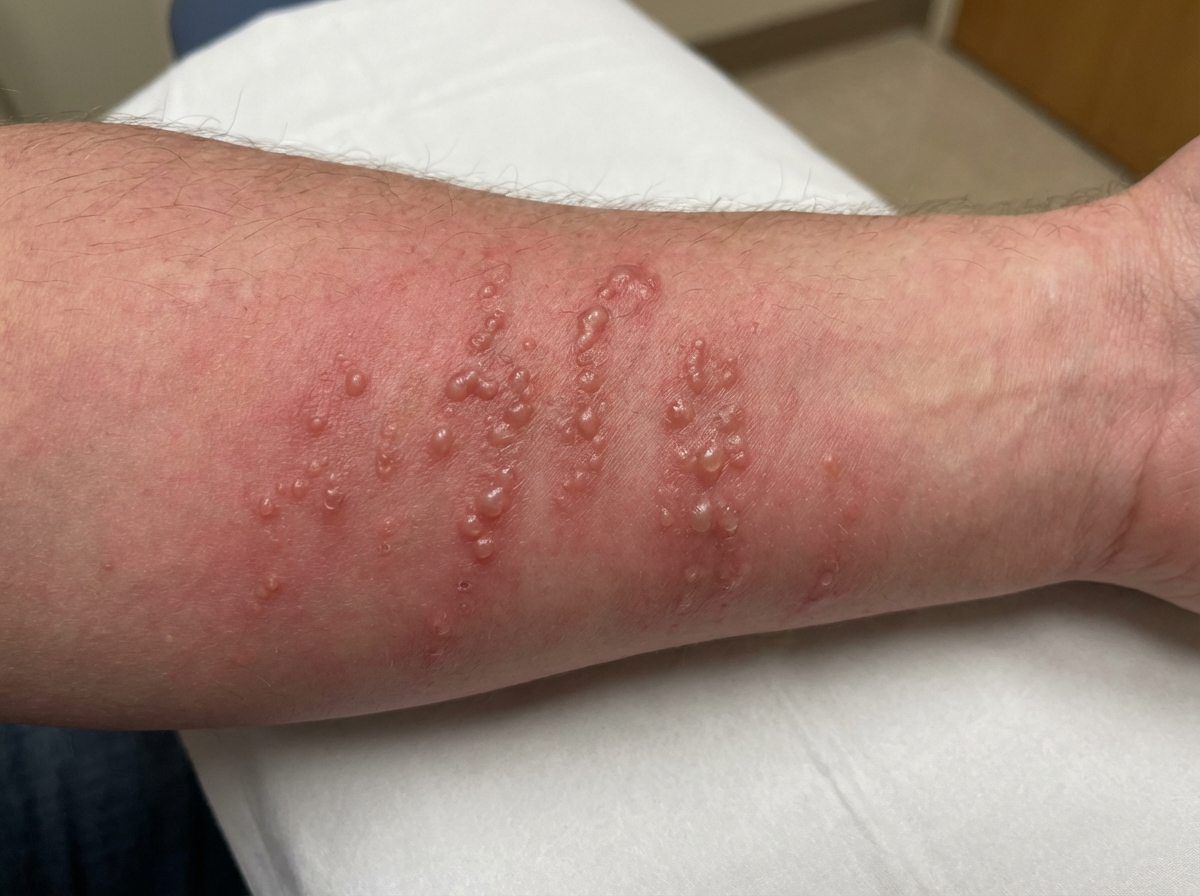
A 42-year-old woman comes to the clinic with a complaint of a severely itchy and painful rash on her hands and legs for a day. On further questioning, she revealed that she loves nature and goes on trekking to the woods frequently. She just returned from a similar trip, 2 days ago. On physical examination, a prominent rash along with multiple blisters is noted on the ventral aspect of her right forearm. A photograph of the rash is shown. Which of the following is the most likely reaction that the patient is experiencing?
Q47
A 12-month-old boy is brought to the physician by his parents for a 4-week history of fever, malaise, cough, and difficulty breathing. He has had recurrent episodes of gastroenteritis since birth. Cardiopulmonary examination shows subcostal retractions and crackles bilaterally. There is enlargement of the cervical, axillary, and inguinal lymph nodes. An x-ray of the chest shows bilateral consolidations. A sputum culture shows colonies of Burkholderia cepacia. A blood sample is obtained and after the addition of nitroblue tetrazolium to the sample, neutrophils remain colorless. A defect in which of the following is the most likely cause of this patient's condition?
Q48
A 33-year-old woman comes to the physician because of a 4-day history of fever, anterior neck pain, and throat swelling. She has no history of serious illness. Her temperature is 38.1°C (100.6°F) and pulse is 109/min. Physical examination shows diaphoresis and a fine tremor of the outstretched hands. The thyroid gland is enlarged, firm, and tender to palpation. Serum thyroid stimulating hormone level is 0.06 μU/mL and erythrocyte sedimentation rate is 65 mm/h. 123I scan shows an enlarged thyroid gland with diffusely decreased uptake. Histologic examination of a thyroid biopsy specimen is most likely to show which of the following findings?
Q49
A 9-year-old boy from Eritrea is admitted to the hospital for lethargy and increased work of breathing. He has had recurrent episodes of fever, shortness of breath, and fatigue in the past 3 years. His pulse is 132/min and blood pressure is 90/66 mm Hg. Pulse oximetry on room air shows an oxygen saturation of 82%. Auscultation of the chest shows coarse crackles in both lungs and a diastolic murmur at the cardiac apex. Despite appropriate lifesaving measures, he dies. A photomicrograph of a section of myocardium obtained at autopsy is shown. Which of the following is the most likely underlying cause of this patient's cardiac disease?
Q50
A 61-year-old-male underwent deceased donor liver transplantation 3 weeks ago. During his follow up visit he complains of nausea and abdominal pain. He has been taking all of his medications as prescribed. He has a history of alcohol abuse and his last drink was one year ago. He does not smoke cigarettes and lives at home with his wife. On physical examination temperature is 98.6°F (37°C), blood pressure is 115/80 mmHg, pulse is 90/min, respirations are 18/min, and pulse oximetry is 99% on room air. He has scleral icterus and a positive fluid wave. Liver function tests are as follows:
Alkaline phosphatase: 110 U/L
Aspartate aminotransferase (AST, GOT): 100 U/L
Alanine aminotransferase (ALT, GPT): 120 U/L
Bilirubin total: 2.2 mg/dL
Liver biopsy shows mixed dense interstitial lymphocytic infiltrates in the portal triad. What is the mechanism of this reaction?
Inflammation US Medical PG Practice Questions and MCQs
Question 41: A 45-year-old construction worker presents to his primary care physician with a painful and swollen wrist joint. A joint aspiration shows crystals, which are shown in the accompanying picture. Which of the following is the most likely diagnosis?
A. Cholesterol crystals
B. Charcot Leyden crystals
C. Monosodium urate crystals (Correct Answer)
D. Hydroxyapatite crystals
E. Calcium pyrophosphate crystals
Explanation: ***Monosodium urate crystals***
- The image (not provided here, but implied to be given in the actual question) typically shows **needle-shaped, negatively birefringent crystals**.
- These crystals are characteristic of **gout**, which presents as acute, painful, and swollen joints, often in middle-aged men with a history of joint stress (like a construction worker's wrist).
*Cholesterol crystals*
- These are typically **large, flattened, rhomboid plates** with notched corners, found in chronic effusions or synovial cysts, not acute arthritis.
- They are usually **birefringent**, but their morphology is distinctly different from the classic **needle shape** of urate.
*Charcot Leyden crystals*
- These are **bipyramidal or hexagonal crystals** formed from eosinophil proteins, commonly found in sputum and stool in allergic conditions or parasitic infections.
- They are not typically associated with **arthritic joint effusions** or conditions like gout.
*Hydroxyapatite crystals*
- These crystals are **too small to be seen by light microscopy** and require electron microscopy for visualization.
- They are associated with **calcific periarthritis** and **Milwaukee shoulder syndrome**, presenting differently than acute gout.
*Calcium pyrophosphate crystals*
- These crystals are typically **rhomboid or rod-shaped** and display **positive birefringence** under polarized light.
- They are characteristic of **pseudogout (calcium pyrophosphate deposition disease)**, which is distinct from gout in crystal morphology and birefringence.
Question 42: A 23-year-old woman comes to the physician because of right-sided blurry vision and eye pain for 4 days. She has a 6-day history of low-grade fever, headache, and malaise. One year ago, she was diagnosed with Crohn disease. Her only medication is prednisone. Her temperature is 38°C (100.4°F), pulse is 84/min, and blood pressure is 112/75 mm Hg. The right eyelid is erythematous and tender; there are multiple vesicles over the right forehead and the tip of the nose. Visual acuity is 20/20 in the left eye and 20/80 in the right eye. Extraocular movements are normal. The right eye shows conjunctival injection and reduced corneal sensitivity. Fluorescein staining shows a corneal lesion with a tree-like pattern. Which of the following is the most likely diagnosis?
A. Angle-closure glaucoma
B. Herpes zoster keratitis (Correct Answer)
C. Anterior uveitis
D. Herpes simplex keratitis
E. Pseudomonas keratitis
Explanation: ***Herpes zoster keratitis***
- The presence of **vesicles on the forehead and tip of the nose** (Hutchinson sign) indicates involvement of the nasociliary nerve, pathognomonic for ophthalmic herpes zoster.
- **Tree-like pattern** on fluorescein staining, along with reduced corneal sensitivity and unilateral blurry vision, are characteristic features of herpes zoster keratitis.
*Angle-closure glaucoma*
- Typically presents with **sudden, severe eye pain**, blurred vision, headache, and sometimes nausea/vomiting, usually without a preceding viral prodrome or skin lesions.
- While it can cause blurry vision, it would not explain the **vesicular rash** or **tree-like corneal ulcer** observed in this patient.
*Anterior uveitis*
- Often associated with Crohn disease and features eye pain, photophobia, and blurred vision, but typically **lacks the characteristic vesicular rash** on the skin.
- Fluorescein staining would not show a **tree-like lesion**; inflammation of the iris and ciliary body is seen.
*Herpes simplex keratitis*
- Can cause dendritic or tree-like corneal lesions and reduced corneal sensitivity, but typically **does not present with a rash on the forehead and tip of the nose** (Hutchinson sign).
- Herpes simplex usually affects the eye directly without dermatomal involvement.
*Pseudomonas keratitis*
- A highly aggressive bacterial infection, often associated with **contact lens use**, presents with rapid onset of severe pain, purulent discharge, and a dense corneal infiltrate, usually an ulcer.
- It would not cause a **vesicular rash** on the forehead or a tree-like pattern on fluorescein staining, which points to a viral etiology.
Question 43: A 4-year-old Caucasian boy is brought by his mother to the pediatrician with a red and swollen elbow. He was playing outside a few days prior to presentation when he fell and lightly scraped his elbow on the sidewalk. He was born at 34 weeks' gestation and was in the neonatal ICU for 2 days. His temperature is 102.1°F (38.9°C), blood pressure is 105/65 mmHg, pulse is 110/min, and respirations are 20/min. On exam, he has a swollen, erythematous, fluctuant, and exquisitely tender mass on his right elbow. There is expressible purulence coming from his wound. A peripheral blood smear in this patient would most likely reveal which of the following findings?
A. Absence of dark blue cytoplasmic staining upon nitroblue tetrazolium administration
B. Neutrophils with peroxidase-negative granules
C. Neutrophils with pale cytoplasm without granules
D. Neutrophils with abundant peroxidase-positive granules (Correct Answer)
E. Macrocytic erythrocytes and acanthocytes
Explanation: ***Neutrophils with abundant peroxidase-positive granules***
- This patient presents with a **typical acute bacterial skin and soft tissue infection** (abscess) following minor trauma. This is a **normal, age-appropriate scenario** in a healthy child.
- In response to acute bacterial infection, the peripheral blood smear would show **normal, mature neutrophils with abundant peroxidase-positive (myeloperoxidase-positive) granules**. This is the **standard appearance of healthy, functioning neutrophils** responding to infection.
- Additional findings might include **leukocytosis** with a **left shift** (increased band forms), but the neutrophils themselves would have normal morphology with prominent azurophilic (primary) and specific (secondary) granules that stain positive for peroxidase.
- This is the expected finding in any patient with an acute bacterial infection and a normal immune system.
*Absence of dark blue cytoplasmic staining upon nitroblue tetrazolium administration*
- The **nitroblue tetrazolium (NBT) test** is a specialized diagnostic test for **Chronic Granulomatous Disease (CGD)**, where neutrophils cannot produce a respiratory burst due to defective NADPH oxidase.
- However, this patient shows **no clinical evidence of CGD**: this is a **first-time infection** (not recurrent), occurring after **significant environmental exposure** (playing outside, scraping elbow on sidewalk), and the infection is responding as expected to inflammation.
- Additionally, NBT testing is a **functional assay**, not a routine finding on peripheral blood smear examination.
*Neutrophils with peroxidase-negative granules*
- **Myeloperoxidase deficiency** is a rare neutrophil disorder where granules lack myeloperoxidase enzyme.
- There is **no clinical indication** for this diagnosis in a child with a straightforward post-traumatic bacterial infection.
- Most patients with myeloperoxidase deficiency are **asymptomatic** or have only mild infection susceptibility.
*Neutrophils with pale cytoplasm without granules*
- **Hypogranular or agranular neutrophils** are seen in **Chediak-Higashi syndrome** (which includes oculocutaneous albinism and neurologic abnormalities) or **myelodysplastic syndromes**.
- This patient has an **acute infection with normal inflammatory response**, making these conditions extremely unlikely.
- Chediak-Higashi syndrome would present with additional features like partial albinism and easy bruising.
*Macrocytic erythrocytes and acanthocytes*
- **Macrocytic erythrocytes** suggest vitamin B12/folate deficiency, liver disease, or hypothyroidism.
- **Acanthocytes** (spur cells) are associated with severe liver disease, abetalipoproteinemia, or neuroacanthocytosis.
- These red blood cell abnormalities are **completely unrelated** to this patient's presentation of acute bacterial skin infection.
Question 44: Two days after being admitted for acute myocardial infarction, a 61-year-old man has sharp, substernal chest pain that worsens with inspiration and improves when leaning forward. Cardiac examination shows a scratchy sound best heard over the left sternal border. Histopathological examination of the infarcted myocardial tissue is most likely to show which of the following findings?
A. Neutrophilic infiltration
B. Collagenous scar tissue
C. Normal myocardium
D. Coagulative necrosis (Correct Answer)
E. Granulation tissue with macrophages
Explanation: ***Coagulative necrosis***
- The patient's clinical presentation (sharp, substernal chest pain, worsening with inspiration, improving while leaning forward, and a scratchy pericardial friction rub) indicates **post-MI fibrinous pericarditis**, a common complication occurring 2-4 days after myocardial infarction.
- At **day 2 post-MI**, the infarcted myocardium demonstrates **coagulative necrosis** as the primary and most characteristic histopathological finding, representing irreversible ischemic cell death with preserved tissue architecture.
- While neutrophilic infiltration is also present at this timepoint, coagulative necrosis of the cardiomyocytes themselves is the defining pathological feature that distinguishes irreversible myocardial injury.
*Neutrophilic infiltration*
- **Neutrophilic infiltration** is indeed present at day 2 post-MI (peaks at days 1-3) as part of the acute inflammatory response to clear necrotic debris.
- However, neutrophils represent the **reactive inflammatory response** rather than the primary pathological change in the infarcted cardiomyocytes themselves.
- The question asks about the most characteristic histopathological finding, which is the **coagulative necrosis** of the myocardial cells, not the secondary inflammatory infiltrate.
*Collagenous scar tissue*
- **Collagenous scar tissue** forms much later during the remodeling phase, typically **7 weeks or more** after MI, representing the final stage of healing.
- At day 2, the tissue is still in the acute phase of coagulative necrosis and early inflammation, far too early for mature fibrous scar formation.
*Normal myocardium*
- The patient has sustained an **acute myocardial infarction** with irreversible injury to cardiac tissue.
- Histopathological examination of the infarcted region would show clear abnormalities, not **normal myocardium**.
*Granulation tissue with macrophages*
- **Granulation tissue** with fibroblasts, new capillaries, and macrophages begins forming during the proliferative phase, typically starting around **days 5-7** post-MI.
- At day 2, it is too early for granulation tissue formation; the tissue is still dominated by coagulative necrosis and acute neutrophilic inflammation.
Question 45: A 42-year-old man comes to the physician because of a 6-week history of intermittent fever, abdominal pain, bloody diarrhea, and sensation of incomplete rectal emptying. He also has had a 4.5-kg (10-lb) weight loss over the past 3 months. Abdominal examination shows diffuse tenderness. Colonoscopy shows circumferential erythematous lesions that extend without interruption from the anal verge to the cecum. A biopsy specimen taken from the rectum shows mucosal and submucosal inflammation with crypt abscesses. This patient is most likely at risk of developing colon cancer with which of the following characteristics?
A. Low-grade lesion
B. Unifocal lesion
C. Non-polypoid dysplasia (Correct Answer)
D. Late p53 mutation
E. Early APC mutation
Explanation: ***Non-polypoid dysplasia***
- The patient's symptoms (bloody diarrhea, abdominal pain, crypt abscesses, continuous inflammation extending to the cecum) are highly suggestive of **ulcerative colitis (UC)**.
- In UC, the chronic inflammation causes a field defect across the colonic mucosa, leading to a higher risk of **non-polypoid (flat) dysplasia** and subsequent colon cancer (colitis-associated cancer).
*Low-grade lesion*
- While dysplasia can be low-grade, the primary characteristic of colon cancer development in UC is the **type of growth** (flat/non-polypoid) rather than simply its grade.
- The presence and progression of **dysplasia** (regardless of initial grade) are critical for risk stratification in UC.
*Unifocal lesion*
- Colitis-associated cancer in UC often arises from widespread field changes due to chronic inflammation, making **multifocal or diffuse dysplasia** more common than a single, isolated lesion.
- The diffuse nature of UC inflammation across the colon makes a unifocal cancerous change less typical compared to sporadic colon cancer.
*Late p53 mutation*
- **p53 mutations** are commonly found in colitis-associated colon cancer and are generally considered an **early event** in the progression from dysplasia to invasive carcinoma, rather than a late one.
- Mutations in tumor suppressor genes like **p53** contribute to genomic instability early in the neoplastic process.
*Early APC mutation*
- **APC mutations** are a hallmark of **sporadic colorectal cancer** and familial adenomatous polyposis (FAP), where they typically initiate the adenoma-carcinoma sequence.
- In **colitis-associated cancer**, APC mutations are less frequently the initiating event and often occur later, with other pathways (e.g., p53, microsatellite instability) being more prominent in early carcinogenesis.
Question 46: A 42-year-old woman comes to the clinic with a complaint of a severely itchy and painful rash on her hands and legs for a day. On further questioning, she revealed that she loves nature and goes on trekking to the woods frequently. She just returned from a similar trip, 2 days ago. On physical examination, a prominent rash along with multiple blisters is noted on the ventral aspect of her right forearm. A photograph of the rash is shown. Which of the following is the most likely reaction that the patient is experiencing?
A. Bullous pemphigoid
B. Type II hypersensitivity reaction
C. Type III hypersensitivity reaction
D. Type I hypersensitivity reaction
E. Type IV hypersensitivity reaction (Correct Answer)
Explanation: ***Type IV hypersensitivity reaction***
- The patient's symptoms (itchy, painful rash with blisters on hands and legs, occurring after a recent trip to the woods) are highly suggestive of **contact dermatitis**, commonly caused by exposure to plants like poison ivy or oak.
- **Contact dermatitis** is a classic example of a **Type IV hypersensitivity reaction**, characterized by a **delayed cell-mediated immune response** involving T lymphocytes.
*Bullous pemphigoid*
- Characterized by **large, tense blisters** on an erythematous or non-erythematous base, primarily affecting the elderly, without a clear history of environmental exposure.
- This is an **autoimmune blistering disease** where antibodies target hemidesmosomes in the basement membrane, not directly related to allergen exposure.
*Type II hypersensitivity reaction*
- Involves **IgG or IgM antibodies** directed against antigens on cell surfaces or in the extracellular matrix, leading to cell destruction, functional deregulation, or inflammation.
- Examples include **hemolytic anemia** and **Goodpasture syndrome**, which do not present with a localized, itchy blistering rash from environmental contact.
*Type III hypersensitivity reaction*
- Caused by the formation of **immune complexes** (antigen-antibody complexes) that deposit in tissues, leading to inflammation and tissue damage.
- Examples include **serum sickness** and **lupus nephritis**, which typically involve systemic symptoms and different rash morphologies than seen in this case.
*Type I hypersensitivity reaction*
- An **immediate hypersensitivity reaction** mediated by **IgE antibodies** binding to mast cells and basophils, leading to histamine release upon re-exposure to an allergen.
- Presents with symptoms like **urticaria (hives)**, angioedema, or anaphylaxis, which develop rapidly (minutes to hours) and differ from the delayed blistering rash described.
Question 47: A 12-month-old boy is brought to the physician by his parents for a 4-week history of fever, malaise, cough, and difficulty breathing. He has had recurrent episodes of gastroenteritis since birth. Cardiopulmonary examination shows subcostal retractions and crackles bilaterally. There is enlargement of the cervical, axillary, and inguinal lymph nodes. An x-ray of the chest shows bilateral consolidations. A sputum culture shows colonies of Burkholderia cepacia. A blood sample is obtained and after the addition of nitroblue tetrazolium to the sample, neutrophils remain colorless. A defect in which of the following is the most likely cause of this patient's condition?
A. Microtubule polymerization
B. NADPH oxidase complex (Correct Answer)
C. Actin filament assembly
D. T cell CD40 ligand
E. B cell maturation
Explanation: ***NADPH oxidase complex***
- The presentation with recurrent infections, particularly with **Burkholderia cepacia**, and the **colorless nitroblue tetrazolium (NBT) test result** are classic findings for **chronic granulomatous disease (CGD)**.
- CGD is caused by a defect in the **NADPH oxidase complex** within phagocytes, impairing their ability to generate reactive oxygen species (*respiratory burst*) necessary to kill certain bacteria and fungi.
*Microtubule polymerization*
- A defect in microtubule polymerization is associated with conditions like **Chédiak-Higashi syndrome**, which involves impaired lysosome function and neutropenia, leading to recurrent infections.
- However, Chédiak-Higashi syndrome typically presents with **partial oculocutaneous albinism**, peripheral neuropathy, and Giant granules on blood smears, none of which are described here.
*Actin filament assembly*
- Defects in actin filament assembly can cause conditions like **Wiskott-Aldrich syndrome**, characterized by immunodeficiency, thrombocytopenia, and eczema.
- This patient's presentation with specific infection types and a positive NBT test points away from a primary actin defect.
*T cell CD40 ligand*
- A defect in the **T cell CD40 ligand** causes **X-linked hyper-IgM syndrome**, characterized by recurrent bacterial infections and very low levels of IgG, IgA, and IgE, with normal or elevated IgM.
- While this is an immunodeficiency, the specific infection with *Burkholderia cepacia* and the NBT test result are not characteristic of hyper-IgM syndrome.
*B cell maturation*
- Defects in B cell maturation, such as **X-linked agammaglobulinemia (XLA)**, lead to a lack of mature B cells and significantly reduced levels of all immunoglobulin classes.
- Patients with XLA typically suffer from recurrent bacterial infections, but *Burkholderia cepacia* and the NBT test result are not specific to this condition.
Question 48: A 33-year-old woman comes to the physician because of a 4-day history of fever, anterior neck pain, and throat swelling. She has no history of serious illness. Her temperature is 38.1°C (100.6°F) and pulse is 109/min. Physical examination shows diaphoresis and a fine tremor of the outstretched hands. The thyroid gland is enlarged, firm, and tender to palpation. Serum thyroid stimulating hormone level is 0.06 μU/mL and erythrocyte sedimentation rate is 65 mm/h. 123I scan shows an enlarged thyroid gland with diffusely decreased uptake. Histologic examination of a thyroid biopsy specimen is most likely to show which of the following findings?
A. Undifferentiated giant cells with areas of necrosis and hemorrhage
B. Noncaseating granulomas with multinucleated giant cells (Correct Answer)
C. Lymphocytic infiltration with germinal follicle formation
D. Follicular epithelial cell hyperplasia
E. Concentric intracellular lamellar calcifications
Explanation: ***Noncaseating granulomas with multinucleated giant cells***
- This finding is characteristic of **subacute granulomatous (de Quervain) thyroiditis**, which is supported by the patient's symptoms: anterior neck pain, fever, elevated ESR, and tender thyroid.
- The **low TSH and decreased radioactive iodine uptake** indicate thyroid damage with release of preformed thyroid hormones, typical of the initial thyrotoxic phase of this condition.
*Undifferentiated giant cells with areas of necrosis and hemorrhage*
- This description is more consistent with **anaplastic thyroid carcinoma**, a highly aggressive malignancy, which is unlikely in a 33-year-old woman presenting with a 4-day history of symptoms.
- Anaplastic carcinoma would typically cause a rapidly enlarging, fixed, and firm mass, often with obstructive symptoms, rather than a tender gland with signs of thyrotoxicosis.
*Lymphocytic infiltration with germinal follicle formation*
- This is the histological hallmark of **Hashimoto's thyroiditis**, an autoimmune condition leading to hypothyroidism.
- Patients with Hashimoto's typically present with hypothyroidism, goiter, and positive thyroid antibodies, not acute pain, fever, or the transient thyrotoxicosis seen here.
*Follicular epithelial cell hyperplasia*
- This is seen in conditions causing chronic stimulation of the thyroid gland, such as **diffuse toxic goiter (Graves' disease)** or in patients with iodine deficiency.
- Graves' disease would present with hyperthyroidism and diffuse uptake on a radioactive iodine scan, which contradicts the "diffusely decreased uptake" seen in this patient.
*Concentric intracellular lamellar calcifications*
- These are known as **Psammoma bodies** and are characteristic of **papillary thyroid carcinoma**.
- Papillary thyroid carcinoma is typically a slow-growing, painless mass and is not associated with acute inflammatory symptoms like fever, pain, and a very elevated ESR.
Question 49: A 9-year-old boy from Eritrea is admitted to the hospital for lethargy and increased work of breathing. He has had recurrent episodes of fever, shortness of breath, and fatigue in the past 3 years. His pulse is 132/min and blood pressure is 90/66 mm Hg. Pulse oximetry on room air shows an oxygen saturation of 82%. Auscultation of the chest shows coarse crackles in both lungs and a diastolic murmur at the cardiac apex. Despite appropriate lifesaving measures, he dies. A photomicrograph of a section of myocardium obtained at autopsy is shown. Which of the following is the most likely underlying cause of this patient's cardiac disease?
A. Type II hypersensitivity reaction (Correct Answer)
B. Beta-myosin heavy chain defect
C. Non-caseating granulomatous inflammation
D. Exotoxin-mediated myonecrosis
E. Amastigote infiltration
Explanation: ***Type II hypersensitivity reaction***
- This patient has **acute rheumatic fever (ARF)** leading to **rheumatic heart disease (RHD)**, a classic **Type II hypersensitivity reaction**
- ARF occurs 2-4 weeks after **Group A Streptococcal pharyngitis** due to **molecular mimicry** between streptococcal M protein and cardiac myosin
- Antibodies cross-react with cardiac tissue, causing **pancarditis** with characteristic **Aschoff bodies** (granulomas with Anitschkow cells) seen on histology
- **Chronic valvulitis** leads to **mitral stenosis** (diastolic murmur at apex), the most common valve lesion in RHD
- Recurrent episodes and geographic origin (Eritrea - endemic area) support this diagnosis
*Beta-myosin heavy chain defect*
- This genetic defect causes **hypertrophic cardiomyopathy (HCM)**, presenting with **asymmetric septal hypertrophy**
- HCM typically presents with **dyspnea on exertion, syncope, or sudden death**, not recurrent fevers
- Does not cause **mitral stenosis** or the diastolic murmur seen in this patient
*Non-caseating granulomatous inflammation*
- Characteristic of **sarcoidosis**, which can involve the heart causing **arrhythmias** and **conduction blocks**
- Does not cause **valvular disease** or mitral stenosis
- Would not explain the **recurrent fevers** or the specific clinical presentation
*Exotoxin-mediated myonecrosis*
- **Diphtheria toxin** can cause toxic myocarditis through **ADP-ribosylation of elongation factor-2**
- Presents acutely with **heart failure** and **arrhythmias**, not chronic valvular disease
- Does not cause **mitral stenosis** or the diastolic murmur at the apex
*Amastigote infiltration*
- Refers to **Chagas disease** (Trypanosoma cruzi), endemic in Latin America, not Eritrea
- Causes **dilated cardiomyopathy** with **conduction abnormalities** and **megaesophagus/megacolon**
- Does not cause **valvular disease** or mitral stenosis
Question 50: A 61-year-old-male underwent deceased donor liver transplantation 3 weeks ago. During his follow up visit he complains of nausea and abdominal pain. He has been taking all of his medications as prescribed. He has a history of alcohol abuse and his last drink was one year ago. He does not smoke cigarettes and lives at home with his wife. On physical examination temperature is 98.6°F (37°C), blood pressure is 115/80 mmHg, pulse is 90/min, respirations are 18/min, and pulse oximetry is 99% on room air. He has scleral icterus and a positive fluid wave. Liver function tests are as follows:
Alkaline phosphatase: 110 U/L
Aspartate aminotransferase (AST, GOT): 100 U/L
Alanine aminotransferase (ALT, GPT): 120 U/L
Bilirubin total: 2.2 mg/dL
Liver biopsy shows mixed dense interstitial lymphocytic infiltrates in the portal triad. What is the mechanism of this reaction?
A. Grafted T lymphocytes reacting against host
B. CD4+ T lymphocytes reacting against recipient APCs
C. CD8+ T lymphocytes reacting against donor MHCs (Correct Answer)
D. Acute viral infection
E. Pre-existing recipient antibodies
Explanation: ***CD8+ T lymphocytes reacting against donor MHCs***
- This scenario describes **acute cellular rejection** following liver transplantation, mediated primarily by **recipient CD8+ T lymphocytes** recognizing donor major histocompatibility complex (MHC) class I molecules on donor hepatocytes.
- The **lymphocytic infiltrates** in the portal triad are characteristic of acute rejection, where activated cytotoxic T cells attack the transplanted organ.
*Grafted T lymphocytes reacting against host*
- This mechanism describes **graft-versus-host disease (GVHD)**, which is much more common after hematopoietic stem cell transplantation.
- While liver allografts contain donor lymphocytes, **GVHD from liver transplant is rare** and typically only seen in highly immunosuppressed patients or specific transplant settings.
*CD4+ T lymphocytes reacting against recipient APCs*
- This describes a reaction of donor CD4+ T cells against recipient antigen-presenting cells (APCs), which is part of the mechanism for **graft-versus-host disease (GVHD)**.
- The primary pathology in this patient, with liver damage and lymphocytic infiltration of the portal triad, points to a rejection of the transplanted liver, not GVHD.
*Acute viral infection*
- While possible in transplant recipients, an acute viral infection would typically present with different patterns of liver injury and biopsy findings, such as **viral cytopathic effects** or more widespread inflammation distinct from the dense portal triad infiltrates typical of rejection.
- The clinical presentation and biopsy findings are classic for organ rejection rather than a viral infection.
*Pre-existing recipient antibodies*
- **Pre-existing recipient antibodies** are primarily responsible for **hyperacute rejection**, which occurs minutes to hours after transplant and leads to rapid graft failure.
- This patient is presenting 3 weeks post-transplant, which is too late for hyperacute rejection; this mechanism generally leads to thrombosis and necrosis, not the interstitial lymphocytic infiltrates seen here.