
Organ-specific autoimmune diseases — MCQs

A 34-year-old woman comes to the physician because of a 3-month history of fatigue and a 4.5-kg (10-lb) weight loss despite eating more than usual. Her pulse is 115/min and blood pressure is 140/60 mm Hg. Physical examination shows warm, moist skin, and a diffuse, non-tender swelling over the anterior neck. Ophthalmologic examination shows swelling of the eyelids and proptosis bilaterally. Which of the following is the most likely cause of this patient's symptoms?
A 32-year-old woman presents with a 3-month history of intermittent blurred vision and problems walking. The patient states that she often feels “pins and needles” in her legs that cause her problems when she’s walking. The patient is afebrile, and her vital signs are within normal limits. An autoimmune disorder is suspected. Which of the following findings would most likely be present in this patient?
A 43-year-old woman presents to the physician with the complaint of worsening fatigue over the past several months. She has found that she requires nearly double the amount of coffee consumption each day to stay awake at work and that despite maintaining a balanced, healthy diet, she has experienced significant weight gain. A blood test confirms the presence of anti-thyroid peroxidase antibodies. Which of the following additional findings would be most consistent with the underlying pathophysiology of her condition?
A 21-year-old female presents to her obstetrician because she has stopped getting her period, after being irregular for the last 3 months. Upon further questioning, the patient reveals that she has had a 17 lb. unintended weight loss, endorses chronic diarrhea, abdominal pain, and constipation that waxes and wanes. Family history is notable only for an older brother with Type 1 Diabetes. She is healthy, and is eager to gain back some weight. Her OBGYN refers her to a gastroenterologist, but first sends serology laboratory studies for IgA anti-tissue transglutaminase antibodies (IgA-tTG). These results come back positive at > 10x the upper limit of normal. Which of the following is the gastroenterologist likely to find on endoscopy and duodenal biopsy?
A 35-year-old man presents with large tense blisters on the flexor surfaces of the upper extremities and trunk. The histologic findings show subepidermal blisters with an eosinophil-rich infiltrate. What is the most likely underlying pathology?
A 35-year-old woman comes to the physician because of a 1-month history of double vision, difficulty climbing stairs, and weakness when trying to brush her hair. She reports that these symptoms are worse after she exercises and disappear after she rests for a few hours. Physical examination shows drooping of her right upper eyelid that worsens when the patient is asked to gaze at the ceiling for 2 minutes. There is diminished motor strength in the upper extremities. The remainder of the examination shows no abnormalities. Which of the following is the most likely diagnosis?
A 58-year-old woman presents with tense bullae on an erythematous base, primarily affecting her trunk and extremities. The lesions developed over the past 3 weeks. Nikolsky sign is negative. Skin biopsy shows subepidermal bullae with eosinophilic infiltrate. Direct immunofluorescence shows linear deposits of IgG and C3 at the basement membrane zone. Which of the following is the target antigen in this condition?
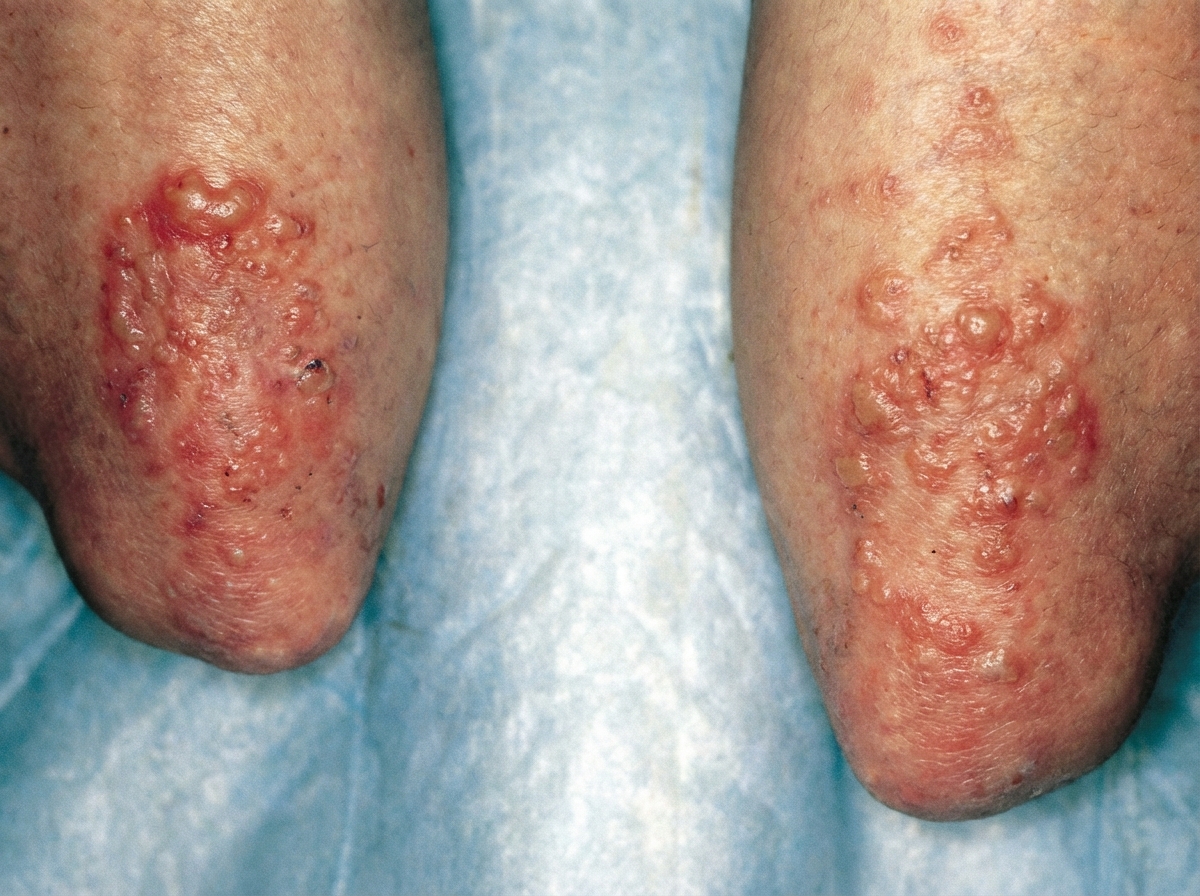
A 23-year-old woman comes to the physician because of a 2-month history of diarrhea, flatulence, and fatigue. She reports having 3–5 episodes of loose stools daily that have an oily appearance. The symptoms are worse after eating. She also complains of an itchy rash on her elbows and knees. A photograph of the rash is shown. Further evaluation of this patient is most likely to show which of the following findings?
A 47-year-old woman presents to her physician for difficulty swallowing. She states that she intentionally delayed seeing a physician for this issue. She says her primary issue with swallowing is that her mouth always feels dry so she has difficulty chewing food to the point that it can be swallowed. On physical examination, her oral mucosa appears dry. Both of her eyes also appear dry. Several enlarged lymph nodes are palpated. Which of the following patterns of reactive lymphadenitis is most commonly associated with this patient’s presentation?
A 51-year-old woman with hyperlipidemia comes to the physician because of weakness for one month. At the end of the day, she feels too fatigued to cook dinner or carry a laundry basket up the stairs. She also complains of double vision after she reads for long periods of time. All of her symptoms improve with rest. Her only medication is pravastatin. Physical examination shows drooping of the upper eyelids. Strength is initially 5/5 in the upper and lower extremities but decreases to 4/5 after a few minutes of sustained resistance. Sensation to light touch is intact and deep tendon reflexes are normal. Which of the following best describes the pathogenesis of this patient's condition?
Want unlimited practice?
Get full access to all questions, explanations, and performance tracking.
Scan to download app