
Immune checkpoint pathways — MCQs

A medical student is reading about a specific type of T cells that plays an important role in immunologic tolerance. Most of these cells develop in the thymus, but some of them also develop in peripheral lymphoid organs. Usually, they are CD4+ cells and also express CD25 molecules. The functions of these cells are dependent on forkhead box P3 (Foxp3). Their function is to block the activation of lymphocytes that could react with self-antigens in a potentially harmful manner. Which of the following interleukins is secreted by these cells?
A research team develops a new monoclonal antibody checkpoint inhibitor for advanced melanoma that has shown promise in animal studies as well as high efficacy and low toxicity in early phase human clinical trials. The research team would now like to compare this drug to existing standard of care immunotherapy for advanced melanoma. The research team decides to conduct a non-randomized study where the novel drug will be offered to patients who are deemed to be at risk for toxicity with the current standard of care immunotherapy, while patients without such risk factors will receive the standard treatment. Which of the following best describes the level of evidence that this study can offer?
A researcher is studying the interactions between foreign antigens and human immune cells. She has isolated a line of lymphocytes that is known to bind antigen-presenting cells. From this cell line, she has isolated a cell surface protein that binds to class I major histocompatibility complex molecules. The continued activation, proliferation and survival of this specific cell line requires which of the following signaling molecules?
A 56-year-old African American presents to the emergency department due to abdominal pain, fatigue, and weight loss over the past 3 months. He has a long-standing history of chronic hepatitis B virus infection complicated by cirrhosis. On examination, he has jaundice, leg edema, and a palpable mass in the right upper abdominal quadrant. Abdominal ultrasound shows a 3-cm liver mass with poorly defined margins and coarse, irregular internal echoes. Blood investigations are shown: Aspartate aminotransferase (AST) 90 U/L Alanine aminotransferase (ALT) 50 U/L Total bilirubin 2 mg/dL Albumin 3 g/dL Alkaline phosphatase 100 U/L Alpha fetoprotein 600 micrograms/L Which of the following targeted agents is approved for advanced-stage hepatoma?
A 55-year-old Caucasian male presents for a routine colonoscopy. A polyp is found in the patient's transverse colon and is found to be cancerous on histological evaluation. Upon examination, it is found that these cancerous cells have decreased MHC class I expression on their surface. Which immune system cell is most capable of killing these tumor cells?
A researcher is studying the circulating factors that are released when immune cells are exposed to antigens. Specifically, she is studying a population of CD2+ cells that have been activated acutely. In order to determine which factors are secreted by these cells, she cultures the cells in media and collects the used media from these plates after several days. She then purifies a small factor from this media and uses it to stimulate various immune cell types. She finds that this factor primarily seems to increase the growth and prolong the survival of other CD2+ cells. Which of the following is most likely the factor that was purified by this researcher?
A 57-year-old man presents to his oncologist to discuss management of small cell lung cancer. The patient is a lifelong smoker and was diagnosed with cancer 1 week ago. The patient states that the cancer was his fault for smoking and that there is "no hope now." He seems disinterested in discussing the treatment options and making a plan for treatment and followup. The patient says "he does not want any treatment" for his condition. Which of the following is the most appropriate response from the physician?
A 12-year-old child is exposed to pollen while playing outside. The allergen stimulates TH2 cells of his immune system to secrete a factor that leads to B-cell class switching to IgE. What factor is secreted by the TH2 cell?
A 33-year-old woman comes to the emergency department because of a 3-day history of lower abdominal pain and severe burning with urination. Two years ago, she was diagnosed with cervical cancer and was successfully treated with a combination of radiation and chemotherapy. She has systemic lupus erythematosus and finished a course of cyclophosphamide 3 weeks ago. She is sexually active with multiple male and female partners and uses a diaphragm for contraception. She has smoked two packs of cigarettes daily for 12 years. Current medication includes hydroxychloroquine. Her temperature is 36.6°C (97.9°F), pulse is 84/min, and blood pressure is 136/84 mm Hg. The abdomen is soft and there is tenderness to palpation over the pelvic region. Laboratory studies show: Hemoglobin 13.1 g/dL Leukocyte count 7,400/mm3 Platelet count 210,000/mm3 Urine pH 7 WBC 62/hpf RBC 12/hpf Protein negative Nitrites positive Which of the following is the most likely underlying mechanism of this patient's condition?
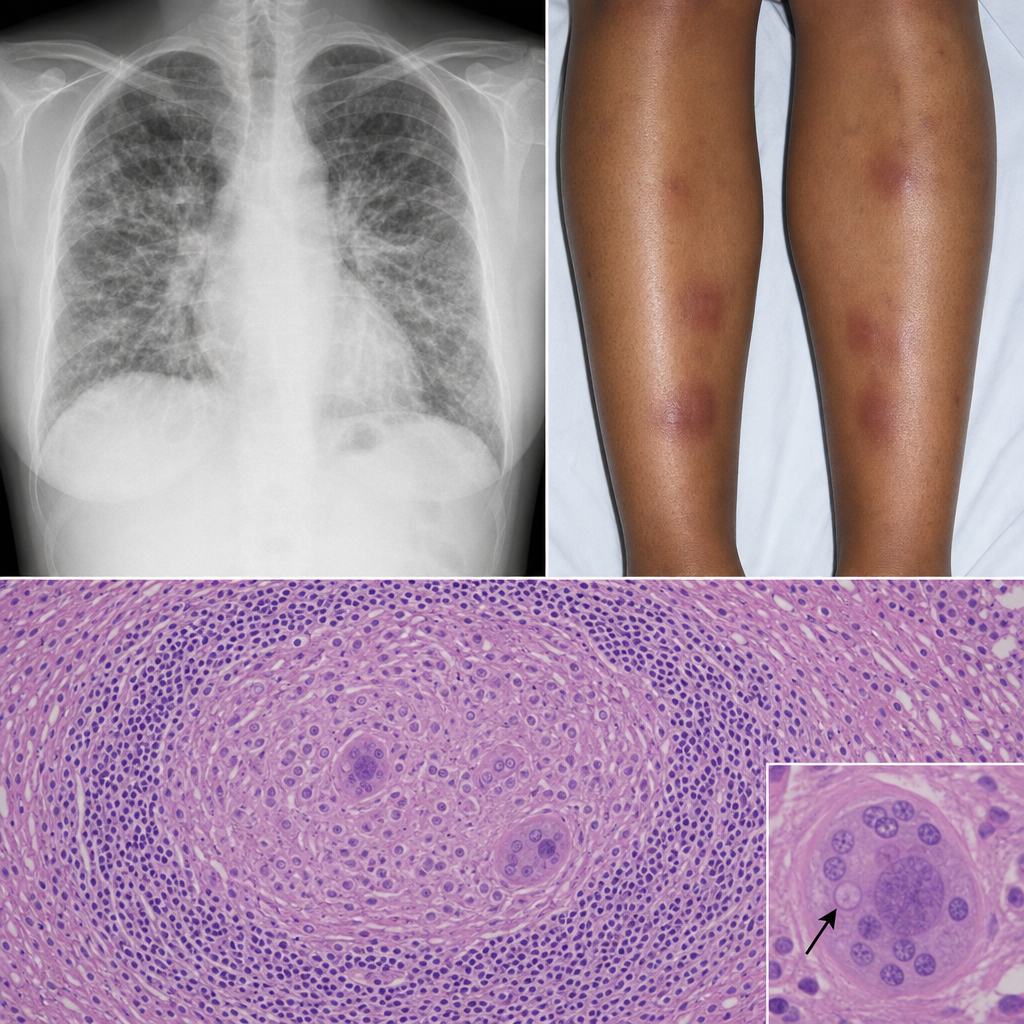
A 32-year-old Black woman with no occupational exposures presents with progressive dyspnea, fatigue, and bilateral ankle swelling. She also reports erythema nodosum on her shins. A chest radiograph shows bilateral hilar enlargement and diffuse interstitial infiltrates. Bronchoscopic biopsy is performed. The biopsy shows discrete, well-formed granulomas without central necrosis, surrounded by a rim of lymphocytes, with occasional Schaumann bodies and asteroid inclusions within giant cells. No organisms are identified on special stains. Which of the following best describes the predominant immunological mechanism driving this morphological pattern?
Want unlimited practice?
Get full access to all questions, explanations, and performance tracking.
Scan to download app