
White blood cell disorders — MCQs

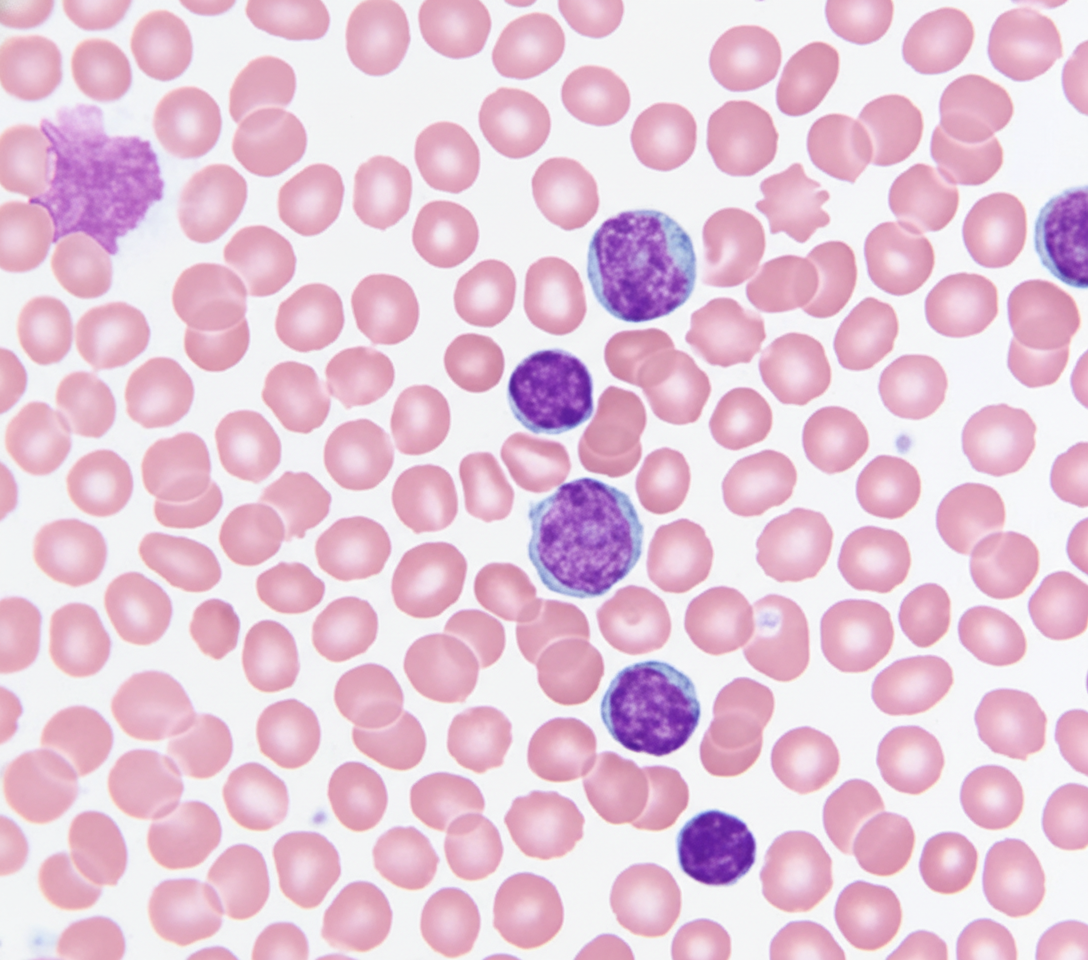
A 69-year-old Caucasian man presents for a routine health maintenance examination. He feels well. He has no significant past medical history. He takes aspirin for the occasional headaches that he has had for over several years. He exercises every day and does not smoke. His father was diagnosed with a hematologic malignancy at 79 years old. The patient’s vital signs are within normal limits. Physical examination shows no abnormalities. The laboratory test results are as follows: Hemoglobin 14.5 g/dL Leukocyte count 62,000/mm3 Platelet count 350,000/mm3 A peripheral blood smear is obtained (shown on the image). Which of the following best explains these findings?
A 61-year-old woman presents to her primary care physician for a routine check-up. Physical examination demonstrates asymmetric peripheral neuropathy in her feet. The patient has no previous relevant history and denies any symptoms of diabetes. Routine blood work shows normal results, and she is referred to a hematologist. Subsequent serum protein electrophoresis demonstrates a slightly elevated gamma globulin level, and monoclonal gammopathy of undetermined significance is diagnosed. Which of the following diseases is most likely to develop over the course of this patient’s condition?
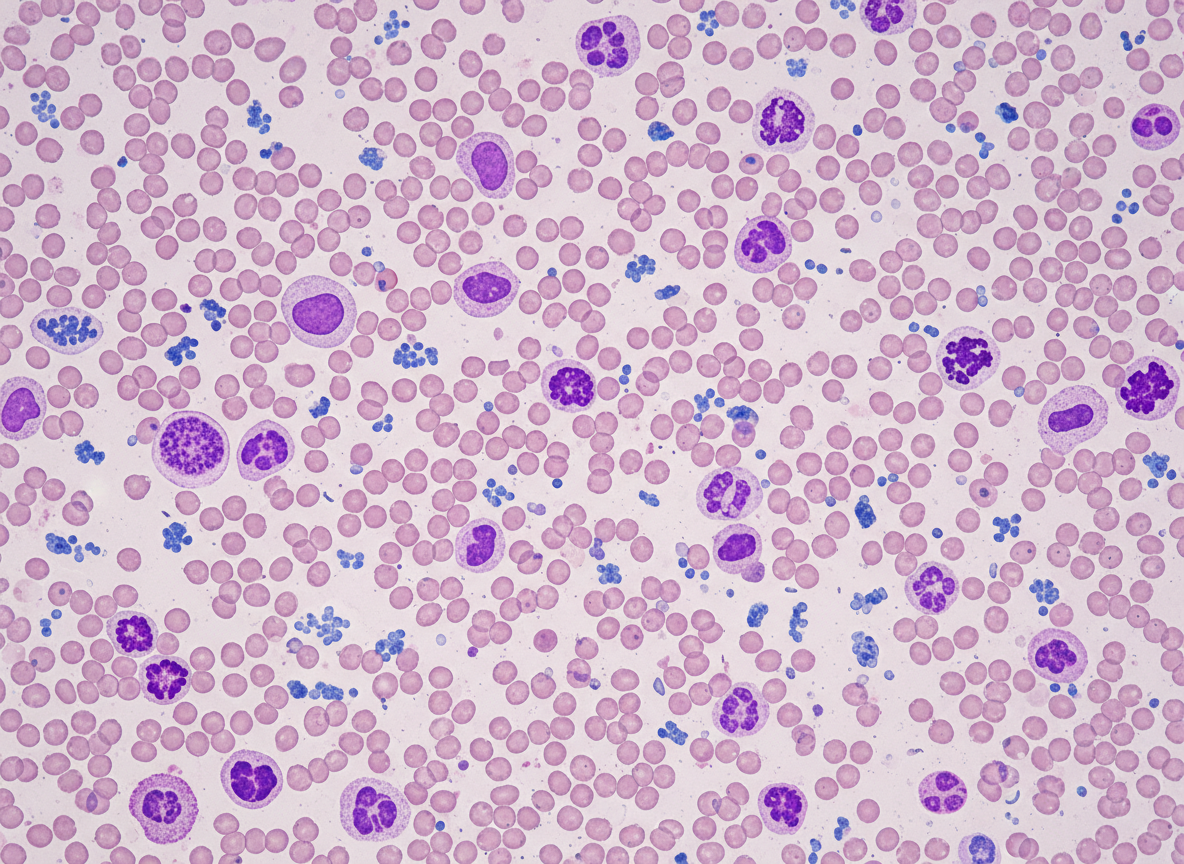
A 64-year-old woman comes to the physician for her routine health maintenance examination. She feels well. She had cervical cancer and received radiotherapy 8 years ago. Her vital signs are within normal limits. On percussion, the spleen size is 15 cm. Otherwise, the physical examination shows no abnormalities. The laboratory test results are as follows: Hemoglobin 10 g/dL Mean corpuscular volume 88 μm3 Leukocyte count 65,000/mm3 Platelet count 500,000/mm3 Two images of the peripheral blood smear are shown on the image. Which of the following is the most appropriate next step in management?
A 72-year-old man goes to his primary care provider for a checkup after some blood work showed lymphocytosis 3 months ago. He says he has been feeling a bit more tired lately but doesn’t complain of any other symptoms. Past medical history is significant for hypertension and hyperlipidemia. He takes lisinopril, hydrochlorothiazide, and atorvastatin. Additionally, his right hip was replaced three years ago due to osteoarthritis. Family history is noncontributory. He drinks socially and does not smoke. Today, he has a heart rate of 95/min, respiratory rate of 17/min, blood pressure of 135/85 mm Hg, and temperature of 36.8°C (98.2°F). On physical exam, he looks well. His heartbeat has a regular rate and rhythm and lungs that are clear to auscultation bilaterally. Additionally, he has mild lymphadenopathy of his cervical lymph nodes. A complete blood count with differential shows the following: Leukocyte count 5,000/mm3 Red blood cell count 3.1 million/mm3 Hemoglobin 11.0 g/dL MCV 95 um3 MCH 29 pg/cell Platelet count 150,000/mm3 Neutrophils 40% Lymphocytes 40% Monocytes 5% A specimen is sent for flow cytometry that shows a population that is CD 5, 19, 20, 23 positive. Which of the following is the most likely diagnosis?
A 39-year-old man presents to the emergency department with the complaint of ‘cola-colored’ urine that he noticed this morning. Additionally, he complains of malaise and reports that he has not been able to be productive at work since last week. Lab results revealed a hemoglobin of 6.7 g/dL, leukocyte total count of 1,000 cells/mm3, and a reticulocyte count of 6%. Coomb test is negative and flow cytometry shows CD55/CD59-negative red blood cells. Concerned about the results of his complete blood count, his physician explains the diagnosis to the patient. Which of the following sets of events best describes the mechanism underlying the development of neutropenia?
A 30-year-old man is admitted to the hospital with a presumed pneumonia and started on antibiotics. Two days later, the patient shows no improvement. Blood cultures reveal yeast with pseudophyphae. Which of the following cell types is most likely deficient or dysfunctional in this patient?
A 59-year-old man presents to his primary care physician for fatigue. In general, he has been in good health; however, he recently has experienced some weight loss, abdominal pain, and general fatigue. He has a past medical history of anxiety, diabetes, a fracture of his foot sustained when he tripped, and a recent cold that caused him to miss work for a week. His current medications include metformin, insulin, buspirone, vitamin D, calcium, and sodium docusate. His temperature is 99.5°F (37.5°C), blood pressure is 150/100 mmHg, pulse is 90/min, respirations are 18/min, and oxygen saturation is 98% on room air. Physical exam reveals a calm gentleman. A mild systolic murmur is heard in the left upper sternal region. The rest of the physical exam is within normal limits. Laboratory values are ordered as seen below. Hemoglobin: 12 g/dL Hematocrit: 36% Leukocyte count: 66,500/mm^3 with normal differential Platelet count: 177,000/mm^3 Leukocyte alkaline phosphatase: elevated Serum: Na+: 139 mEq/L Cl-: 100 mEq/L K+: 4.3 mEq/L BUN: 20 mg/dL Glucose: 120 mg/dL Creatinine: 1.1 mg/dL Ca2+: 10.9 mEq/L AST: 12 U/L ALT: 10 U/L Which of the following is the most likely diagnosis?
A 79-year-old woman who lives alone is brought to the emergency department by her neighbor because of worsening confusion over the last 2 days. Due to her level of confusion, she is unable to answer questions appropriately. She has had type 2 diabetes mellitus for 29 years for which she takes metformin. Vital signs include: blood pressure 111/72 mm Hg, temperature 38.5°C (101.3°F), and pulse 100/min. Her fingerstick blood glucose is 210 mg/dL. On physical examination, she is not oriented to time or place and mistakes the nursing assistant for her cousin. Laboratory results are shown: Hemoglobin 13 g/dL Leukocyte count 16,000/mm3 Segmented neutrophils 70% Eosinophils 1% Basophils 0.3% Lymphocytes 25% Monocytes 4% Which of the following is the most likely diagnosis?
A 14-year-old boy presents with abdominal pain and diarrhea after returning from an East Asian vacation. Stool sample reveals the presence of red and white blood cells. Stool culture shows growth of immobile, non-lactose fermenting gram-negative rods. The attending physician explains to the medical students that the bacteria function by invading intestinal M-cells. The bacterium responsible for this patient's infection is:
A 42-year-old man comes to his physician with a history of fever, non-bloody diarrhea, and headache for 10 days. He also complains of anorexia and abdominal pain. He returned from a trip to India 3 weeks ago. His temperature is 40.0°C (104.0°F), pulse is 65/min, respirations are 15/min, and blood pressure is 135/80 mm Hg. He has developed a blanchable rash on his chest and trunk. A photograph of the rash is shown. Examination of the heart, lungs, and abdomen show no abnormalities. Laboratory studies show: Hemoglobin 15 g/dL Mean corpuscular volume 95 μm3 White blood cell count 3400/mm3 Percent segmented neutrophils 40% Which of the following is the most likely diagnosis?

Want unlimited practice?
Get full access to all questions, explanations, and performance tracking.
Scan to download app