
Platelet disorders — MCQs

A previously healthy 17-year-old boy is brought to the emergency department by his mother for further evaluation after elective removal of his wisdom teeth. During the procedure, the patient had persistent bleeding from the teeth's surrounding gums. Multiple gauze packs were applied with minimal effect. The patient has a history of easy bruising. The mother says her brother had similar problems when his wisdom teeth were removed, and that he also has a history of easy bruising and joint swelling. The patient takes no medications. His temperature is 37°C (98.6°F), pulse is 90/min, and blood pressure is 108/74 mm Hg. Laboratory studies show: Hematocrit 35% Leukocyte count 8,500/mm3 Platelet count 160,000/mm3 Prothrombin time 15 sec Partial thromboplastin time 60 sec Bleeding time 6 min Fibrin split products negative Serum Urea nitrogen 20 mg/dL Creatinine 1.0 mg/dL Bilirubin Total 1.0 mg/dL Direct 0.5 mg/dL Lactate dehydrogenase 90 U/L Peripheral blood smear shows normal-sized platelets. Which of the following is the most likely diagnosis?
A 38-year-old woman comes to the physician for a follow-up examination. She was diagnosed with immune thrombocytopenic purpura at the age of 37 years and has been treated with glucocorticoids and intravenous immune globulin. She has visited the emergency department 3 times in the past 4 months for nose bleeds, which required cauterization. Her platelet counts on her previous visits were 18,320/mm3, 17,500/mm3, and 19,100/mm3. Current medications include dexamethasone and a multivitamin. She has no children. Her immunizations are up-to-date. Vital signs are within normal limits. Examination shows petechiae on the bilateral lower extremities. Cardiopulmonary examination shows no abnormalities. The abdomen is soft and nontender; there is no organomegaly. Her hemoglobin concentration is 13.3 g/dL, leukocyte count is 8,100/mm3, and platelet count is 13,000/mm3. Her blood type is A negative. Serology for hepatitis C and HIV is negative. Which of the following is the most appropriate next step in management?
A 13-year-old girl is brought to the pediatrician due to a 4-month history of heavy vaginal bleeding during menstrual periods. She endorses episodes of bleeding gums after brushing her teeth and experienced prolonged bleeding after tonsillectomy 6 years ago. Her mother states that she bled significantly during childbirth and that the girl’s older brother has similar symptoms including easy bruising. Vitals were stable and physical exam was not revealing. Laboratory studies show: Platelet count: 72,000/mm^3 Bleeding time: 14 min Prothrombin time: 12 secs (INR = 1) Partial thromboplastin time: 40 secs Blood smear demonstrates increased megakaryocytes and enlarged platelets. Platelets do not aggregate to ristocetin. Which of the following is the most likely diagnosis?
A 23-year-old woman presents to the emergency department with a 3-day history of fever and headache. She says that the symptoms started suddenly after she woke up 3 days ago, though she has been feeling increasingly fatigued over the last 5 months. On presentation, her temperature is 102°F (38.9°C), blood pressure is 117/74 mmHg, pulse is 106/min, and respirations are 14/min. Physical exam reveals diffuse petechiae and conjunctival pallor and selected laboratory results are shown as follows: Bleeding time: 11 minutes Platelet count: 68,000/mm^3 Lactate dehydrogenase: 105 U/L Which of the following would also most likely be true for this patient?
A 3-year-old girl is brought to her pediatrician because of a nosebleed that will not stop. Her parents say that she started having a nosebleed about 1 hour prior to presentation. Since then they have not been able to stop the bleeding. Her past medical history is remarkable for asthma, and she has a cousin who has been diagnosed with hemophilia. Physical exam reveals diffuse petechiae and purpura. A panel of bleeding tests are obtained with the following results: Bleeding time: 11 minutes Prothrombin time: 14 seconds Partial thromboplastin time: 32 seconds Platelet count: 195,000/mm^3 Peripheral blood smear shows normal cell morphology. Which of the following characteristics is most likely true about this patient?
A 47-year-old woman presents for a routine wellness checkup. She complains of general fatigue and lethargy for the past 6 months. She does not have a significant past medical history and is currently not taking any medications. The patient reports that she drinks “socially” approx. 6 nights a week. She says she also enjoys a “nightcap,” which is 1–2 glasses of wine before bed every night. She denies any history of drug use or smoking. The patient is afebrile, and her vital signs are within normal limits. A physical examination reveals pallor of the mucous membranes. Her laboratory findings are significant for a mean corpuscular volume of 72 fL, leukocyte count of 5,300/mL, hemoglobin of 11.0 g/dL, and platelet count of 420,000/mL. Which of the following is the most likely cause of this patient’s thrombocytosis?
A previously healthy 38-year-old woman is brought to the emergency department by her husband because of left-sided weakness. As she was getting dressed this morning, she was suddenly unable to button up her shirt. When she showed her husband, he noticed that she seemed confused. She has a 3-year history of diabetes mellitus, for which she takes metformin. She had a knee operation 2 days ago. Her temperature is 38.9°C (102°F), pulse is 98/min, respirations are 17/min, and blood pressure is 138/85 mm Hg. She is confused and oriented only to person. Neurologic examination shows diminished muscle strength on the left side. There are scattered petechiae over the chest, arms, and legs. Laboratory studies show: Hemoglobin 7.5 g/dL Leukocyte count 10,500/mm3 Platelet count 40,000/mm3 Prothrombin time 15 seconds Partial thromboplastin time 36 seconds Serum Bilirubin Total 3.5 mg/dL Direct 0.3 mg/dL Urea nitrogen 35 mg/dL Creatinine 2.5 mg/dL Lactate dehydrogenase 1074 U/L A peripheral smear shows numerous schistocytes. Further evaluation is most likely going to show which of the following findings?
A previously healthy 40-year-old woman comes to the physician because of a 3-day history of fever, headaches, and fatigue. She also reports a persistent tingling sensation in her right hand and numbness in her right arm that started this morning. Physical examination shows pallor, mild scleral icterus, and petechiae on her forearms and legs. On mental status examination, she appears confused and is only oriented to person. Laboratory studies show: Hemoglobin 11.1 g/dL Platelet count 39,500/mm3 Bleeding time 9 minutes Prothrombin time 14 seconds Partial thromboplastin time 35 seconds Serum Creatinine 1.7 mg/dL Total bilirubin 2.1 mg/dL A peripheral blood smear shows fragmented erythrocytes. Which of the following is the most likely underlying cause of this patient's condition?
A mother brings her 6-year-old daughter in to the pediatrician’s clinic for a wellness visit. The mother has a history of von Willebrand’s disease (vWD) and is concerned that her daughter may be affected as well. The mother tells you that she has noticed that her daughter bruises very easily, and her bruises typically are visible for a longer period of time than those of her brother. She denies any personal history of blood clots in her past, but she says that her mother has had to be treated for pulmonary embolism in the recent past. Her birth history is significant for preeclampsia, preterm birth at 32 weeks, a NICU stay of two and a half weeks, and retinopathy of prematurity. She currently eats a diet full of green vegetables, fruits, and french fries. Her vital signs include: temperature, 36.7°C (98.0°F); blood pressure, 106/54 mm Hg; heart rate, 111/min; and respiratory, rate 23/min. On physical examination, her pulses are bounding, complexion is pale, scattered bruises throughout all extremities that are specifically scattered around the knees and elbows. After ordering a coagulation panel, which of the following would one expect to see in the lab panel of a patient with vWD?
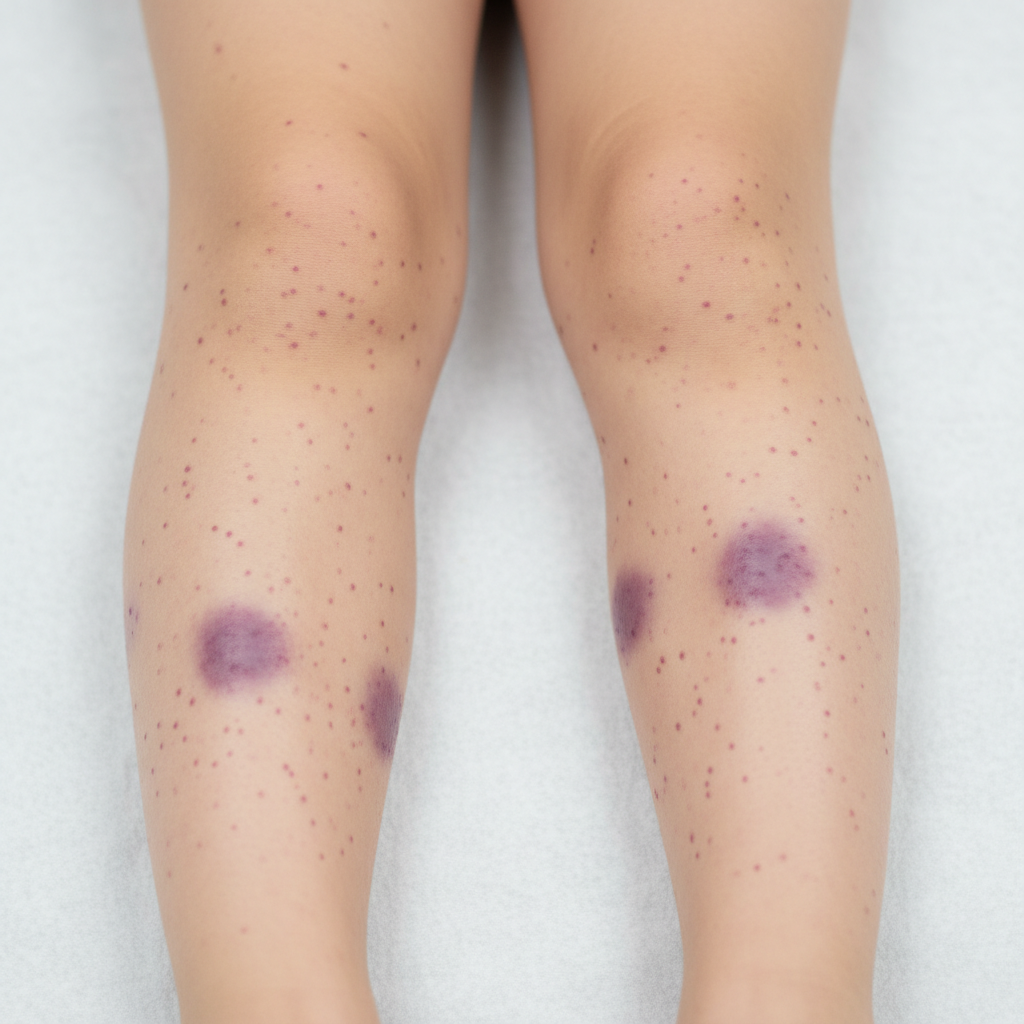
A 12-year-old boy, otherwise healthy, presents with frequent nosebleeds and lower extremity bruising. His mother reports that his symptoms started about 2 weeks ago and have not improved. The patient received the Tdap vaccine 2 weeks ago. He has no current medications. The review of systems is significant for the patient having a stomach ache after winning a hamburger eating competition 2 weeks ago. The vital signs include: temperature 37.0°C (98.6°F), blood pressure 110/75 mm Hg, pulse 95/min, respirations 15/min, and oxygen saturation 99% on room air. On physical exam, the patient is alert and cooperative. The cardiac exam is normal. The lungs are clear to auscultation bilaterally. The lower extremities findings are shown in the image. Laboratory results are pending. Which of the following best describes the pathogenesis of this patient’s condition?
Want unlimited practice?
Get full access to all questions, explanations, and performance tracking.
Scan to download app