
Non-Hodgkin lymphomas — MCQs

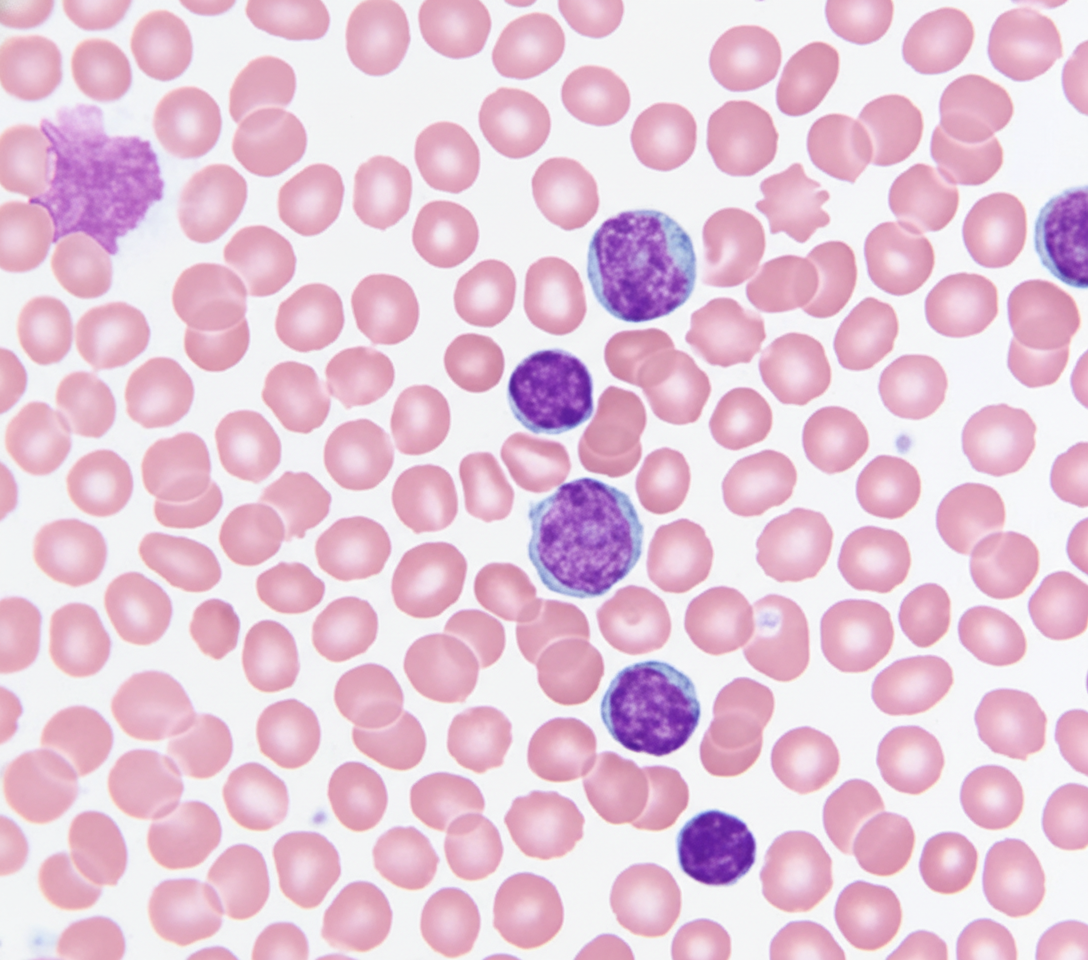
A 69-year-old Caucasian man presents for a routine health maintenance examination. He feels well. He has no significant past medical history. He takes aspirin for the occasional headaches that he has had for over several years. He exercises every day and does not smoke. His father was diagnosed with a hematologic malignancy at 79 years old. The patient’s vital signs are within normal limits. Physical examination shows no abnormalities. The laboratory test results are as follows: Hemoglobin 14.5 g/dL Leukocyte count 62,000/mm3 Platelet count 350,000/mm3 A peripheral blood smear is obtained (shown on the image). Which of the following best explains these findings?
A 55-year-old man presents with severe fatigue and fever. His past medical history is significant for a recent history of mononucleosis from which he fully recovered 8 weeks ago. On physical examination, the patient seems pale. A chest radiograph shows multiple enlarged mediastinal lymph nodes. A biopsy of one of the enlarged mediastinal lymph nodes is performed and shows the presence of multinucleated cells with an 'owl-eye' appearance in a hypocellular background. Which of the following is the most likely diagnosis in this patient?
A medical research study is beginning to evaluate the positive predictive value of a novel blood test for non-Hodgkin’s lymphoma. The diagnostic arm contains 700 patients with NHL, of which 400 tested positive for the novel blood test. In the control arm, 700 age-matched control patients are enrolled and 0 are found positive for the novel test. What is the PPV of this test?
A 29-year-old man comes to the physician because of a 3-month history of fatigue, weight loss, and multiple painless swellings on his neck and axilla. He reports that his swellings become painful after he drinks alcohol. Physical examination shows nontender cervical and axillary lymphadenopathy. A lymph node biopsy specimen shows giant binucleate cells. Which of the following is the most likely diagnosis?
A 65-year-old man presents with painless swelling of the neck over the past week. He also has noted severe night sweats, which require a change of clothes and bed linens the next day. His medical history is significant for long-standing hypertension. He received a kidney transplant 6 years ago. His current medications include amlodipine, metoprolol, furosemide, aspirin, tacrolimus, and mycophenolate. His family history is significant for his sister, who died last year from lymphoma. A review of systems is positive for a 6-kg (13.2-lb) unintentional weight loss over the past 2 months. His vital signs include: temperature 37.8°C (100.0°F) and blood pressure 120/75 mm Hg. On physical examination, there are multiple painless lymph nodes, averaging 2 cm in diameter, palpable in the anterior and posterior triangles of the neck bilaterally. Axillary and inguinal lymphadenopathy is palpated on the right side. Abdominal examination is significant for a spleen of 16 cm below the costal margin on percussion. Laboratory studies are significant for the following: Hemoglobin 9 g/dL Mean corpuscular volume 88 μm3 Leukocyte count 12,000/mm3 Platelet count 130,000/mm3 Creatinine 1.1 mg/dL Lactate dehydrogenase (LDH) 1,000 U/L A peripheral blood smear is unremarkable. Which of the following is the most likely diagnosis in this patient?
A 7-year-old boy presents to his primary care physician for a general checkup. The patient has been feeling poorly for the past several weeks and has been losing weight. He states that he often feels weak and too tired to play with his friends. He is no longer interested in many recreational activities he used to be interested in. The patient's parents state that a few of their child's friends have been sick lately. His temperature is 102°F (38.9°C), blood pressure is 77/48 mmHg, pulse is 110/min, respirations are 24/min, and oxygen saturation is 98% on room air. On exam, you note a fatigued appearing child who has lost 10 pounds since his last appointment. Left upper quadrant tenderness and a mass is noted on abdominal exam. Which of the following best describes the most likely diagnosis?
An 82-year-old man presents with painless swelling of the neck for the past week. He reports no recent fever, night sweats, or weight loss. He has no significant medical history, and his only medication is daily aspirin. His temperature is 36.8℃ (98.2℉). On physical examination, there are several non-tender lymph nodes, each averaging 2 cm in diameter, which are palpable in the right anterior cervical triangle. No other palpable lymphadenopathy is noted. The remainder of the physical exam is unremarkable. Laboratory studies show the following: Hemoglobin 10 g/dL Leukocyte count 8000/mm3 with a normal differential Platelet count 250,000/mm3 Erythrocyte sedimentation rate 30 mm/h An excisional biopsy of a cervical lymph node reveals the presence of Reed-Sternberg (RS) cells. Computed tomography (CT) scans and positron emission tomography (PET) scans reveal no mediastinal mass or signs of additional disease. Which of the following aspects most strongly indicates a good prognosis for this patient?
A 70-year-old man is at his dermatologist’s office for the treatment of a severely pruritic erythroderma with scaling on his buttocks that has been slowly progressing over the past two weeks. The patient works as a truck driver and has a history of hypertension treated with enalapril. The patient reports having tried an over-the-counter cream on the rash without improvement. The vital signs are within normal range. On physical exam, he has multiple confluent and well-demarcated pink patches on his buttocks and legs with some scaling and enlarged inguinal lymph nodes. The dermatologist orders a skin biopsy that reveals Pautrier microabscesses. What is the most likely diagnosis?
A 67-year-old woman comes to the physician because of a 3-week history of fatigue and worsening back and abdominal pain. During this period, she has also had excessive night sweats and a 4.6-kg (10-lb) weight loss. She has had swelling of the neck for 3 days. She does not smoke or drink alcohol. Vital signs are within normal limits. Physical examination shows a 4-cm, supraclavicular, nontender, enlarged and fixed lymph node. The spleen is palpated 2 cm below the left costal margin. Laboratory studies show: Hemoglobin 10.4 g/dL Mean corpuscular volume 87 μm3 Leukocyte count 5,200/mm3 Platelet count 190,000/mm3 Serum Lactate dehydrogenase 310 U/L A CT scan of the thorax and abdomen shows massively enlarged paraaortic, axillary, mediastinal, and cervical lymph nodes. Histopathologic examination of an excised cervical lymph node shows lymphocytes with a high proliferative index that stain positive for CD20. Which of the following is the most likely diagnosis?
A 72-year-old man goes to his primary care provider for a checkup after some blood work showed lymphocytosis 3 months ago. He says he has been feeling a bit more tired lately but doesn’t complain of any other symptoms. Past medical history is significant for hypertension and hyperlipidemia. He takes lisinopril, hydrochlorothiazide, and atorvastatin. Additionally, his right hip was replaced three years ago due to osteoarthritis. Family history is noncontributory. He drinks socially and does not smoke. Today, he has a heart rate of 95/min, respiratory rate of 17/min, blood pressure of 135/85 mm Hg, and temperature of 36.8°C (98.2°F). On physical exam, he looks well. His heartbeat has a regular rate and rhythm and lungs that are clear to auscultation bilaterally. Additionally, he has mild lymphadenopathy of his cervical lymph nodes. A complete blood count with differential shows the following: Leukocyte count 5,000/mm3 Red blood cell count 3.1 million/mm3 Hemoglobin 11.0 g/dL MCV 95 um3 MCH 29 pg/cell Platelet count 150,000/mm3 Neutrophils 40% Lymphocytes 40% Monocytes 5% A specimen is sent for flow cytometry that shows a population that is CD 5, 19, 20, 23 positive. Which of the following is the most likely diagnosis?
Want unlimited practice?
Get full access to all questions, explanations, and performance tracking.
Scan to download app