
Chronic leukemias — MCQs

A 64-year-old woman comes to the physician for her routine health maintenance examination. She feels well. She had cervical cancer and received radiotherapy 8 years ago. Her vital signs are within normal limits. On percussion, the spleen size is 15 cm. Otherwise, the physical examination shows no abnormalities. The laboratory test results are as follows: Hemoglobin 10 g/dL Mean corpuscular volume 88 μm3 Leukocyte count 65,000/mm3 Platelet count 500,000/mm3 Two images of the peripheral blood smear are shown on the image. Which of the following is the most appropriate next step in management?
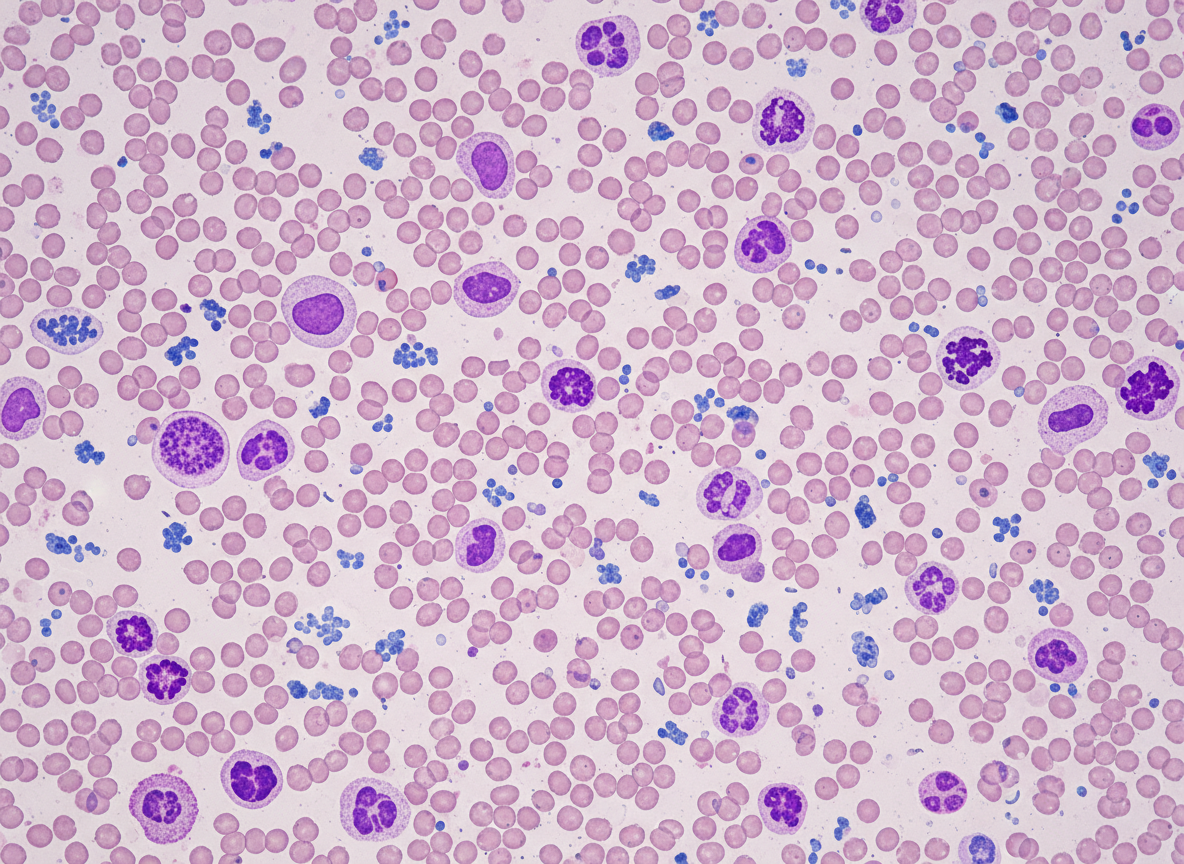
A 70-year-old man presents to his physician for evaluation of fullness and swelling of the left side of the abdomen over the last month. During this time, he has had night sweats and lost 2 kg (4.4 lb) unintentionally. He has no history of severe illness and takes no medications. The vital signs include: blood pressure 115/75 mm Hg, pulse 75/min, and temperature 36.8℃ (98.2℉). The abdomen has asymmetric distention. Percussion and palpation of the left upper quadrant reveal splenomegaly. No lymphadenopathy is detected. Heart and lung examination shows no abnormalities. The laboratory studies show the following: Hemoglobin 9.5 g/dL Mean corpuscular volume 95 μm3 Leukocyte count 8,000/mm3 Platelet count 240,000/mm3 Ultrasound shows a spleen size of 15 cm, mild hepatomegaly, and mild ascites. The peripheral blood smear shows teardrop-shaped and nucleated red blood cells (RBCs) and immature myeloid cells. Marrow is very difficult to aspirate but reveals hyperplasia of all 3 lineages. The tartrate-resistant acid phosphatase (TRAP) test is negative. The cytogenetic analysis is negative for translocation between chromosomes 9 and 22. Which of the following laboratory findings is most likely to be present in this patient?
A 72-year-old man with chronic lymphocytic leukemia (CLL) comes to the physician with a 2-day history of severe fatigue and dyspnea. He regularly visits his primary care physician and has not required any treatment for his underlying disease. His temperature is 36.7°C (98.1°F), pulse is 105/min, respiratory rate is 22/min, and blood pressure is 125/70 mm Hg. The conjunctivae are pale. Examination of the heart and lungs shows no abnormalities. The spleen is palpable 3 cm below the costal margin. No lymphadenopathy is palpated. Laboratory studies show: Hemoglobin 7 g/dL Mean corpuscular volume 105 μm3 Leukocyte count 80,000/mm3 Platelet count 350,000/mm3 Serum Bilirubin Total // Direct 6 mg/dL / 0.8 mg/dL Lactate dehydrogenase 650 U/L (Normal: 45–90 U/L) Based on these findings, this patient’s recent condition is most likely attributable to which of the following?
A 71-year-old man comes to the physician for a routine health maintenance examination. He has occasional fatigue but otherwise feels well. He has a history of hypertension and type 2 diabetes mellitus. He is a retired chemist. His only medication is ramipril. His temperature is 37.8°C (100°F), pulse is 72/min, respirations are 18/min, and blood pressure is 130/70 mm Hg. Physical examination shows nontender cervical and axillary lymphadenopathy. The spleen is palpated 7 cm below the costal margin. Laboratory studies show a leukocyte count of 12,000/mm3 and a platelet count of 210,000/mm3. Further evaluation is most likely to show which of the following?
A 71-year-old man presents to the primary care clinic with non-specific complaints of fatigue and malaise. His past medical history is significant for diabetes mellitus type II, hypertension, non-seminomatous testicular cancer, and hypercholesterolemia. He currently smokes 1 pack of cigarettes per day, drinks a glass of wine per day, and he currently denies any illicit drug use. His vital signs include: temperature, 36.7°C (98.0°F); blood pressure, 126/74 mm Hg; heart rate, 87/min; and respiratory rate, 17/min. On examination, his physician notices cervical and inguinal lymphadenopathy bilaterally, as well as splenomegaly. The patient comments that he has lost 18.1 kg (40 lb) over the past 6 months without a change in diet or exercise, which he was initially not concerned about. The physician orders a complete blood count and adds on flow cytometry. Based on his age and overall epidemiology, which of the following is the most likely diagnosis?
A 6-year-old boy is brought to the emergency department due to a severe infection. Laboratory work shows leukocytosis of 60 × 109/L with marked left shift, but no blast cells. The patient is febrile and dehydrated. The physician believes that this is a severe reaction to the infection and orders a leukocyte alkaline phosphatase (LAP) stain on a peripheral smear. The LAP score is elevated. Which of the following statements best describes an additional characteristic of the condition this child is suffering from?
A 64-year-old woman comes to the physician because of a 7-month history of abdominal discomfort, fatigue, and a 6.8-kg (15-lb) weight loss. Physical examination shows generalized pallor and splenomegaly. Laboratory studies show anemia with pronounced leukocytosis and thrombocytosis. Cytogenetic analysis shows a BCR-ABL fusion gene. A drug with which of the following mechanisms of action is most appropriate for this patient?
A 67-year-old man comes to the physician because of a 2-month history of generalized fatigue. On examination, he appears pale. He also has multiple pinpoint, red, nonblanching spots on his extremities. His spleen is significantly enlarged. Laboratory studies show a hemoglobin concentration of 8.3 g/dL, a leukocyte count of 81,000/mm3, and a platelet count of 35,600/mm3. A peripheral blood smear shows immature cells with large, prominent nucleoli and pink, elongated, needle-shaped cytoplasmic inclusions. Which of the following is the most likely diagnosis?
A 55-year-old male presents with complaints of intermittent facial flushing. He also reports feeling itchy after showering. On review of systems, the patient says he has been having new onset headaches recently. On physical exam, his vital signs, including O2 saturation, are normal. He has an abnormal abdominal mass palpable in the left upper quadrant. A complete blood count reveals: WBCs 6500/microliter; Hgb 18.2 g/dL; Platelets 385,000/microliter. Which of the following is most likely responsible for his presentation?
A previously healthy 61-year-old man comes to the physician because of a 3-month history of intermittent fever, easy fatiguability, and a 4.4-kg (9.7-lb) weight loss. Physical examination shows conjunctival pallor. The spleen is palpated 5 cm below the left costal margin. Laboratory studies show a leukocyte count of 75,300/mm3 with increased basophils, a platelet count of 455,000/mm3, and a decreased leukocyte alkaline phosphatase score. A peripheral blood smear shows increased numbers of promyelocytes, myelocytes, and metamyelocytes. Which of the following is the most likely diagnosis?
Want unlimited practice?
Get full access to all questions, explanations, and performance tracking.
Scan to download app