
Vascular disorders of bowel — MCQs

A 75-year-old male is hospitalized for bloody diarrhea and abdominal pain after meals. Endoscopic work-up and CT scan lead the attending physician to diagnose ischemic colitis at the splenic flexure. Which of the following would most likely predispose this patient to ischemic colitis:
A 30-year-old man comes to the physician because of an episode of bloody vomiting this morning and a 1-week history of burning upper abdominal pain. Two weeks ago, he sustained a head injury and was in a coma for 3 days. An endoscopy shows multiple, shallow hemorrhagic lesions predominantly in the gastric fundus and greater curvature. Biopsies show patchy loss of epithelium and an acute inflammatory infiltrate in the lamina propria that does not extend beyond the muscularis mucosa. Which of the following is the most likely diagnosis?
A 57-year-old man presents with 2 days of severe, generalized, abdominal pain that is worse after meals. He is also nauseated and reports occasional diarrhea mixed with blood. Apart from essential hypertension, his medical history is unremarkable. His vital signs include a temperature of 36.9°C (98.4°F), blood pressure of 145/92 mm Hg, and an irregularly irregular pulse of 105/min. Physical examination is only notable for mild periumbilical tenderness. Which of the following is the most likely diagnosis?
A 52-year-old woman complains of intermittent diffuse abdominal pain that becomes worse after eating meals and several episodes of diarrhea, the last of which was bloody. These symptoms have been present for the previous 6 months but have worsened recently. She has had significant weight loss since the onset of symptoms. Her past medical history includes systemic lupus erythematosus (SLE), which has been difficult to manage medically. Vital signs include a blood pressure of 100/70 mm Hg, temperature of 37.1°C (98.8 °F), and pulse of 95/min. On physical examination, the patient appears to be in severe pain, and there is mild diffuse abdominal tenderness. Which of the following is the most likely diagnosis?
Three days after admission to the hospital with a clinical diagnosis of ischemic colitis, a 65-year-old man has recovered from his initial symptoms of bloody diarrhea and abdominal pain with tenderness. He feels well at this point and wishes to go home. He has a 15-year history of diabetes mellitus. Currently, he receives nothing by mouth, and he is on IV fluids, antibiotics, and insulin. His temperature is 36.7°C (98.1°F), pulse is 68/min, respiratory rate is 13/min, and blood pressure is 115/70 mm Hg. Physical examination of the abdomen shows no abnormalities. His most recent laboratory studies are all within normal limits, including glucose. Which of the following is the most appropriate next step in management?
A 65-year-old man presents to the emergency department with vague, constant abdominal pain, and worsening shortness of breath for the past several hours. He has baseline shortness of breath and requires 2–3 pillows to sleep at night. He often wakes up because of shortness of breath. Past medical history includes congestive heart failure, diabetes, hypertension, and hyperlipidemia. He regularly takes lisinopril, metoprolol, atorvastatin, and metformin. His temperature is 37.0°C (98.6°F), respiratory rate 25/min, pulse 67/min, and blood pressure 98/82 mm Hg. On physical examination, he has bilateral crackles over both lung bases and a diffusely tender abdomen. His subjective complaint of abdominal pain is more severe than the observed tenderness on examination. Which of the following vessels is involved in the disease affecting this patient?
An unconscious middle-aged man is brought to the emergency department. He is actively bleeding from the rectum. He has no past medical history. At the hospital, his pulse is 110/min, the blood pressure is 90/60 mm Hg, the respirations are 26/min, and the oxygen saturation is 96% at room air. His extremities are cold. Resuscitation is started with IV fluids and cross-matched blood arranged. His vitals are stabilized after resuscitation and blood transfusion. His hemoglobin is 7.6 g/dL, hematocrit is 30%, BUN is 33 mg/dL, and PT/aPTT is within normal limits. A nasogastric tube is inserted, which drains bile without blood. Rectal examination and proctoscopy reveal massive active bleeding, without any obvious hemorrhoids or fissure. The physician estimates the rate of bleeding at 2-3 mL/min. What is the most appropriate next step in diagnosis?
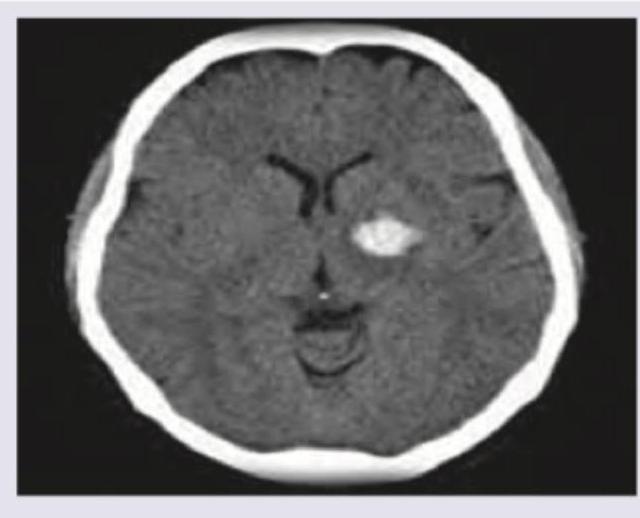
A 53-year-old man is brought to the emergency department for confusion. He was in his usual state of health until about 3 hours ago when he tried to use his sandwich to turn off the TV. He also complained to his wife that he had a severe headache. Past medical history is notable for hypertension, which has been difficult to control on multiple medications. His temperature is 36.7°C (98°F), the pulse is 70/min, and the blood pressure is 206/132 mm Hg. On physical exam he is alert and oriented only to himself, repeating over and over that his head hurts. The physical exam is otherwise unremarkable and his neurologic exam is nonfocal. The noncontrast CT scan of the patient's head is shown and reveals an acute intraparenchymal hemorrhage in the basal ganglia. Which of the following diagnostic tests would be most helpful in determining the underlying cause of this patient's hemorrhage?
A 27-year-old woman presents to her primary care physician for evaluation of involuntary weight loss and recurrent abdominal pain. She noticed blood in her stool several times. The medical history is significant for the polycystic ovarian syndrome. The vital signs are as follows: temperature, 38.0°C (100.4°F); heart rate, 78/min; respiratory rate, 14/min; and blood pressure, 110/80 mm Hg. The family history is notable for paternal colon cancer. A colonoscopy is performed and is presented in the picture. What findings are expected?
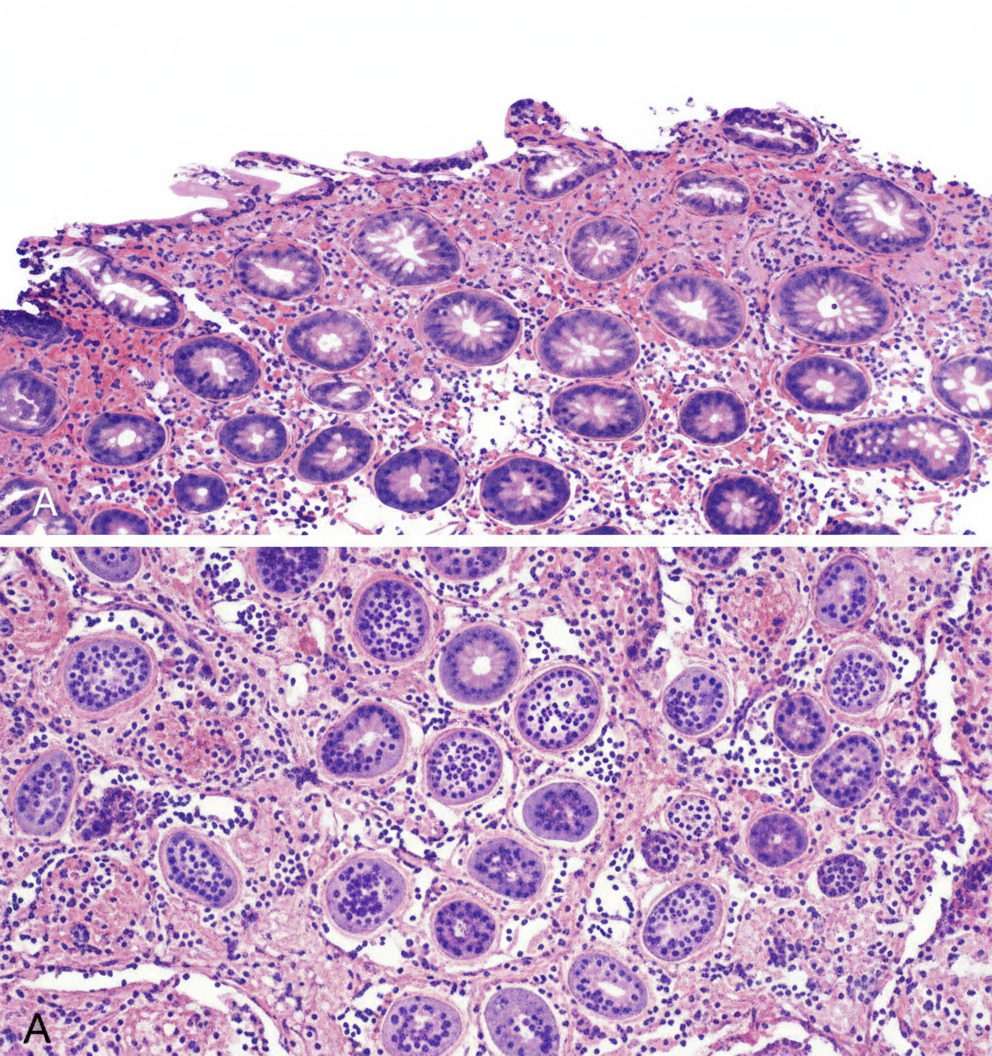
A 24-year-old woman comes to the physician because of progressively worsening episodes of severe, crampy abdominal pain and nonbloody diarrhea for the past 3 years. Examination of the abdomen shows mild distension and generalized tenderness. There is a fistula draining stool in the perianal region. Immunohistochemistry shows dysfunction of the nucleotide oligomerization binding domain 2 (NOD2) protein. This dysfunction most likely causes overactivity of which of the following immunological proteins in this patient?
Want unlimited practice?
Get full access to all questions, explanations, and performance tracking.
Scan to download app