A 22-year-old man comes to the physician because of a 3-week history of abdominal pain, loose, non-bloody stools, and intermittent nausea. He also reports intermittent fever. He has not had vomiting, tenesmus, or rectal pain. He has no history of serious illness and takes no medications. His vital signs are within normal limits. Rectal exam is unremarkable. Laboratory studies show a leukocyte count of 15,200/mm3 and an erythrocyte sedimentation rate of 44 mm/h. Test of the stool for occult blood and stool studies for infection are negative. A CT scan of the abdomen shows mural thickening and surrounding fat stranding of discrete regions of the terminal ileum and transverse colon. A colonoscopy is performed and biopsy specimens of the affected areas of the colon are taken. Which of the following findings is most specific for this patient's most likely diagnosis?
Q22
A 22-year-old woman presents to the emergency department with a 3-day history of fever and abdominal pain. She says that the pain is located in the left lower quadrant of the abdomen and feels crampy in nature. The pain has been associated with bloody diarrhea and joint tenderness. She has no past medical history but says that she returned 2 weeks ago from vacation in Asia where she tried many new foods. Her family history is significant for multiple cancers in close relatives. Physical exam reveals swollen ulcers on her legs, and colonoscopy reveals contiguous ulcerations from the rectum through the descending colon. Which of the following is associated with the most likely cause of this patient's symptoms?
Q23
A 45-year-old man comes to the physician for his routine health maintenance examination. He was diagnosed with diabetes mellitus 4 years ago. His medical history is otherwise unremarkable. He takes no medications other than daily metformin. He has consumed a can of beer every night for the past 10 years. His blood pressure is 145/90 mm Hg. His body mass index is 31 kg/m2. Physical examination shows no abnormalities. Laboratory studies show:
Partial thromboplastin time (activated) 30 seconds (N=25-40 seconds)
Prothrombin time 13 seconds (N=11-15 seconds)
International normalized ratio 1.2
Serum albumin 4 g/dL
Bilirubin, total 0.9 mg/dL
Direct 0.2 mg/dL
Alkaline phosphatase 45 U/L
Aspartate aminotransferase (AST, GOT) 43 U/L
Alanine aminotransferase (ALT, GPT) 56 U/L
γ-Glutamyltransferase (GGT) 43 U/L (N=5-50 U/L)
Hepatitis A antibody Negative
Hepatitis B surface antigen Negative
Hepatitis C antibody Negative
Liver biopsy shows excessive intracellular fat accumulation, hepatocyte ballooning, and perivenular infiltration of lymphocytes and neutrophils without significant fibrosis. Which of the following best describes these findings?
Q24
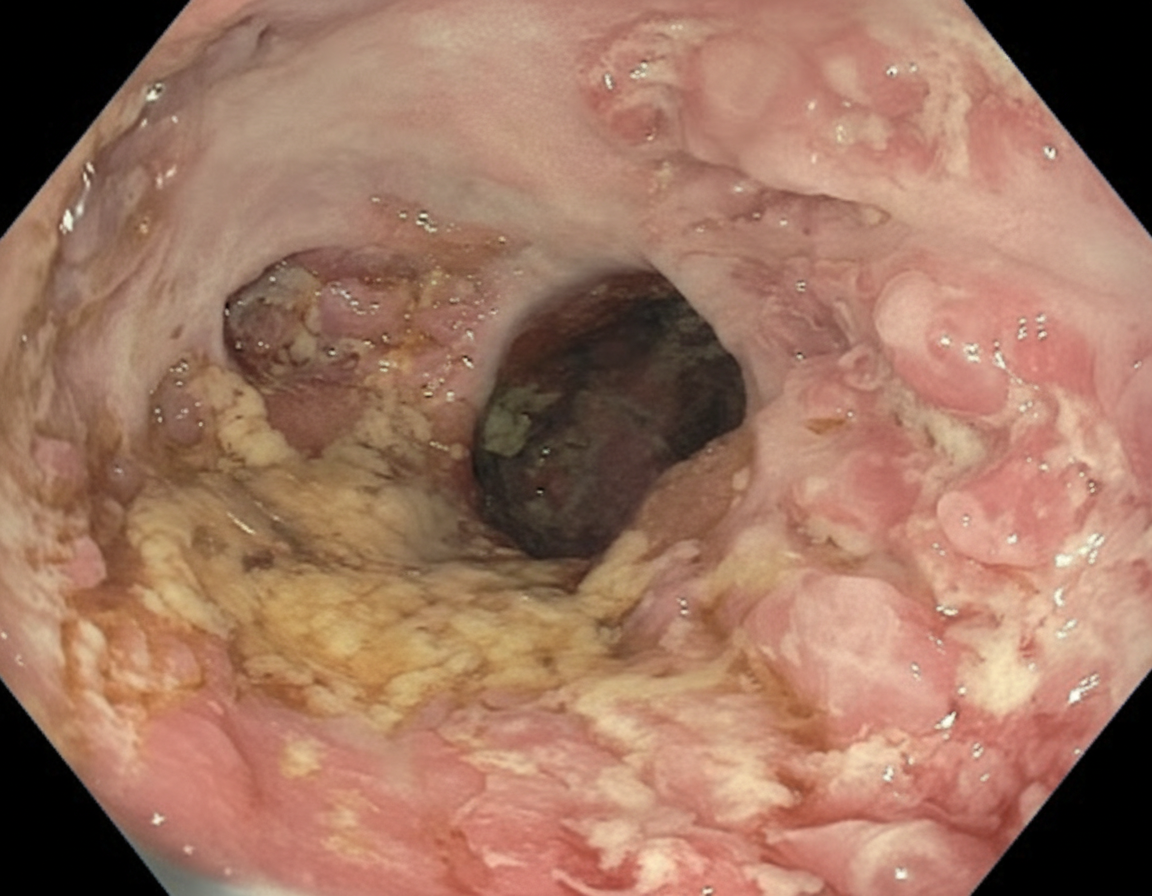
A 28-year-old man comes to the physician because of a 6-month history of progressive fatigue and intermittent diarrhea. During this time, he has had a 6-kg (13-lb) weight loss. Physical examination shows pale conjunctivae. Abdominal examination shows tenderness to palpation in the lower quadrants. An image from a colonoscopy of the descending colon is shown. Further evaluation is most likely to show which of the following findings?
Q25
A 35-year-old Caucasian female presents with anemia, malaise, bloating, and diarrhea. Past genetic testing revealed that this patient carries the HLA-DQ2 allele. The physician suspects that the patient's presentation is dietary in cause. Which of the following findings would definitively confirm this diagnosis?
Q26
A 55-year-old female presents to the emergency room complaining of severe abdominal pain. She reports a six-month history of worsening dull mid-epigastric pain that she had attributed to stress at work. She has lost fifteen pounds over that time. She also reports that her stools have become bulky, foul-smelling, and greasy. Over the past few days, her abdominal pain acutely worsened and seemed to radiate to her back. She also developed mild pruritus and yellowing of her skin. Her temperature is 101°F (38.3°C), blood pressure is 145/85 mmHg, pulse is 110/min, and respirations are 20/min. On examination, her skin appears yellowed and she is tender to palpation in her mid-epigastrium and right upper quadrant. She is subsequently sent for imaging. If a mass is identified, what would be the most likely location of the mass?
Q27
A 2-year-old boy is brought in to his pediatrician for a routine checkup. The parents mention that the child has been developing appropriately, although they have been noticing that the child appears to have chronic constipation. The parents report that their child does not routinely have daily bowel movements, and they have noticed that his abdomen has become more distended recently. In the past, they report that the patient was also delayed in passing meconium, but this was not further worked up. On exam, his temperature is 98.6°F (37.0°C), blood pressure is 110/68 mmHg, pulse is 74/min, and respirations are 14/min. The patient is noted to have a slightly distended abdomen that is nontender. Eventually, this patient undergoes a biopsy. Which of the following layers most likely reveals the causative pathologic finding of this disease?
Q28
A 12-month-old boy is brought to the emergency department by his mother for several hours of crying and severe abdominal pain, followed by dark and bloody stools in the last hour. The mother reports that she did not note any vomiting or fevers leading up to this incident. She does report that the boy and his 7-year-old sister recently had “stomach bugs” but that both have been fine and that the sister has gone back to school. The boy was born by spontaneous vaginal delivery at 39 weeks and 5 days after a normal pregnancy. His temperature is 100.4°F (38.0°C), blood pressure is 96/72 mmHg, pulse is 90/min, respirations are 22/min. Which of the following was most likely to play a role in the pathogenesis of this patient’s disease?
Q29
A 57-year-old man presents with fever and yellow discoloration of the skin for the past 4 days. He denies any recent weight loss or changes in urine or stool color. His past medical history is unremarkable. He admits to drinking about 130 g/day of alcohol and says he has been doing so for the past 25 years. His wife who is accompanying him during this visit adds that once her husband drank 15 cans of beer at a funeral. The patient also reports a 10-pack-year smoking history. His vital signs include: pulse 98/min, respiratory rate 13/min, temperature 38.2°C (100.8°F) and blood pressure 120/90 mm Hg. On physical examination, the patient appears jaundiced and is ill-appearing. Sclera is icteric. Abdominal examination reveals tenderness to palpation in the right upper quadrant with no rebound or guarding. Percussion reveals significant hepatomegaly extending 3 cm below the right costal margin. Laboratory studies are significant for the following:
Sodium 135 mEq/L
Potassium 3.5 mEq/L
ALT 240 U/L
AST 500 U/L
A liver biopsy is obtained but the results are pending. Which of the following would most likely be seen in this patient's biopsy?
Q30
A 30-year-old man comes to the physician because of an episode of bloody vomiting this morning and a 1-week history of burning upper abdominal pain. Two weeks ago, he sustained a head injury and was in a coma for 3 days. An endoscopy shows multiple, shallow hemorrhagic lesions predominantly in the gastric fundus and greater curvature. Biopsies show patchy loss of epithelium and an acute inflammatory infiltrate in the lamina propria that does not extend beyond the muscularis mucosa. Which of the following is the most likely diagnosis?
GI US Medical PG Practice Questions and MCQs
Question 21: A 22-year-old man comes to the physician because of a 3-week history of abdominal pain, loose, non-bloody stools, and intermittent nausea. He also reports intermittent fever. He has not had vomiting, tenesmus, or rectal pain. He has no history of serious illness and takes no medications. His vital signs are within normal limits. Rectal exam is unremarkable. Laboratory studies show a leukocyte count of 15,200/mm3 and an erythrocyte sedimentation rate of 44 mm/h. Test of the stool for occult blood and stool studies for infection are negative. A CT scan of the abdomen shows mural thickening and surrounding fat stranding of discrete regions of the terminal ileum and transverse colon. A colonoscopy is performed and biopsy specimens of the affected areas of the colon are taken. Which of the following findings is most specific for this patient's most likely diagnosis?
A. Intranuclear and cytoplasmic inclusion bodies
B. Neutrophil-rich pseudomembranes
C. Non-caseating granulomas (Correct Answer)
D. Neutrophilic inflammation of the crypts
E. Inflammation of the terminal ileum
Explanation: **Non-caseating granulomas**
- The clinical presentation (abdominal pain, loose stools, fever, elevated white blood cells and ESR), imaging findings (mural thickening, fat stranding in terminal ileum and transverse colon), and negative stool cultures strongly suggest **Crohn's disease**.
- **Non-caseating granulomas** are a hallmark histological feature found in approximately 50-70% of Crohn's disease cases and are highly specific for the diagnosis, distinguishing it from ulcerative colitis and other causes of colitis.
*Intranuclear and cytoplasmic inclusion bodies*
- These are characteristic histological findings in **cytomegalovirus (CMV) infection** of the gastrointestinal tract.
- While CMV colitis can cause similar symptoms, the presence of distinct inclusion bodies would be the primary diagnostic microscopic feature, which is not what we are looking for as the *most specific* for the suspected diagnosis.
*Neutrophil-rich pseudomembranes*
- These are characteristic of **Clostridioides difficile infection (CDI)**, also known as pseudomembranous colitis.
- The patient's negative stool studies for infection and absence of specific risk factors for CDI make this diagnosis less likely.
*Neutrophilic inflammation of the crypts*
- This describes **cryptitis** and **crypt abscesses**, which are common findings in various forms of colitis, including both **ulcerative colitis** and **Crohn's disease**, as well as infectious colitides.
- While present in Crohn's disease, it is not specific enough to definitively differentiate it from ulcerative colitis or other inflammatory conditions of the colon.
*Inflammation of the terminal ileum*
- While inflammation of the terminal ileum (ileitis) is a common and characteristic site of involvement in **Crohn's disease** and is consistent with the CT findings, it is a gross and macroscopic description of involvement rather than a specific microscopic finding on biopsy used for definitive diagnosis.
- Other conditions, such as **tuberculosis** or **Yersinia infection**, can also cause terminal ileitis, making it less specific as a *biopsy finding* for Crohn's disease compared to non-caseating granulomas.
Question 22: A 22-year-old woman presents to the emergency department with a 3-day history of fever and abdominal pain. She says that the pain is located in the left lower quadrant of the abdomen and feels crampy in nature. The pain has been associated with bloody diarrhea and joint tenderness. She has no past medical history but says that she returned 2 weeks ago from vacation in Asia where she tried many new foods. Her family history is significant for multiple cancers in close relatives. Physical exam reveals swollen ulcers on her legs, and colonoscopy reveals contiguous ulcerations from the rectum through the descending colon. Which of the following is associated with the most likely cause of this patient's symptoms?
A. Noncaseating granulomas
B. Severe aortic stenosis
C. Gram-negative rod
D. HLA-DQ2 positivity
E. Perinuclear anti-neutrophil cytoplasmic antibodies (Correct Answer)
Explanation: ***Perinuclear anti-neutrophil cytoplasmic antibodies***
- The patient's presentation with **bloody diarrhea**, low-grade fever, **crampy abdominal pain**, joint tenderness, and contiguous ulcerations in the colon is highly suggestive of **ulcerative colitis**.
- **Perinuclear anti-neutrophil cytoplasmic antibodies (p-ANCA)** are found in 50-70% of patients with ulcerative colitis and are associated with a more extensive disease.
*Noncaseating granulomas*
- **Noncaseating granulomas** are a characteristic histological finding in **Crohn's disease**, not ulcerative colitis.
- Crohn's disease typically presents with **skip lesions**, **transmural inflammation**, and affects any part of the GI tract, often with perianal disease.
*Severe aortic stenosis*
- **Severe aortic stenosis** is a condition of the heart valves that can lead to symptoms like chest pain, syncope, and heart failure, and is not directly associated with the patient's gastrointestinal and systemic symptoms.
- While inflammatory conditions can rarely have cardiac manifestations, there's no direct link between aortic stenosis and inflammatory bowel disease in this context.
*Gram-negative rod*
- While infections, especially from **Gram-negative rods** like *Shigella* or *Salmonella*, can cause acute bloody diarrhea, the 3-day history with joint tenderness and contiguous ulcers on colonoscopy points more towards an inflammatory bowel disease.
- The chronicity and systemic involvement are less typical for an acute bacterial enteritis, although such infections might trigger IBD.
*HLA-DQ2 positivity*
- **HLA-DQ2 positivity** is strongly associated with **celiac disease**, an immune-mediated enteropathy triggered by gluten.
- Celiac disease typically presents with malabsorption symptoms like fatty stools, weight loss, and iron deficiency, rather than bloody diarrhea and contiguous colonic ulcerations.
Question 23: A 45-year-old man comes to the physician for his routine health maintenance examination. He was diagnosed with diabetes mellitus 4 years ago. His medical history is otherwise unremarkable. He takes no medications other than daily metformin. He has consumed a can of beer every night for the past 10 years. His blood pressure is 145/90 mm Hg. His body mass index is 31 kg/m2. Physical examination shows no abnormalities. Laboratory studies show:
Partial thromboplastin time (activated) 30 seconds (N=25-40 seconds)
Prothrombin time 13 seconds (N=11-15 seconds)
International normalized ratio 1.2
Serum albumin 4 g/dL
Bilirubin, total 0.9 mg/dL
Direct 0.2 mg/dL
Alkaline phosphatase 45 U/L
Aspartate aminotransferase (AST, GOT) 43 U/L
Alanine aminotransferase (ALT, GPT) 56 U/L
γ-Glutamyltransferase (GGT) 43 U/L (N=5-50 U/L)
Hepatitis A antibody Negative
Hepatitis B surface antigen Negative
Hepatitis C antibody Negative
Liver biopsy shows excessive intracellular fat accumulation, hepatocyte ballooning, and perivenular infiltration of lymphocytes and neutrophils without significant fibrosis. Which of the following best describes these findings?
A. Alcoholic hepatitis
B. Nonalcoholic steatohepatitis (Correct Answer)
C. Alcoholic cirrhosis
D. Nonalcoholic-fatty-liver-disease-induced cirrhosis
E. Alcoholic fatty liver
Explanation: ***Nonalcoholic steatohepatitis***
- The patient has several risk factors for **nonalcoholic fatty liver disease (NAFLD)**, including **diabetes mellitus**, **obesity (BMI 31)**, and **hypertension**. The biopsy findings of **excessive intracellular fat accumulation**, **hepatocyte ballooning**, and **perivenular infiltration of lymphocytes and neutrophils without significant fibrosis** are characteristic of nonalcoholic steatohepatitis (NASH).
- The patient's modest alcohol intake of one can of beer per night for 10 years, while consistent, is generally not considered sufficient to cause alcoholic liver disease in the absence of other specific markers or severe presentation typically associated with alcoholic hepatitis or cirrhosis.
*Alcoholic hepatitis*
- **Alcoholic hepatitis** typically presents with a more significant history of **heavy alcohol consumption**, often leading to jaundice, fever, and a markedly elevated AST:ALT ratio (usually >2:1).
- While there is some alcohol intake, it is relatively modest (one can of beer daily), and the AST:ALT ratio is 43:56 (less than 1:1), which makes alcoholic hepatitis less likely.
*Alcoholic cirrhosis*
- **Alcoholic cirrhosis** requires a prolonged history of **heavy alcohol abuse**, which is not present here. It would also show significant **fibrosis** and architectural distortion on liver biopsy.
- The biopsy explicitly states **"without significant fibrosis,"** ruling out cirrhosis.
*Nonalcoholic-fatty-liver-disease-induced cirrhosis*
- While the patient has NAFLD, the biopsy specifically states **"without significant fibrosis"**.
- **Cirrhosis** by definition involves advanced fibrosis and architectural distortion, which are absent in this biopsy.
*Alcoholic fatty liver*
- **Alcoholic fatty liver (steatosis)** would primarily show **fat accumulation** without significant inflammation or hepatocyte ballooning.
- The presence of **hepatocyte ballooning** and **perivenular infiltration of lymphocytes and neutrophils** indicates inflammation and injury beyond simple steatosis, consistent with steatohepatitis.
Question 24: A 28-year-old man comes to the physician because of a 6-month history of progressive fatigue and intermittent diarrhea. During this time, he has had a 6-kg (13-lb) weight loss. Physical examination shows pale conjunctivae. Abdominal examination shows tenderness to palpation in the lower quadrants. An image from a colonoscopy of the descending colon is shown. Further evaluation is most likely to show which of the following findings?
A. PAS-positive cytoplasmic granules
B. Anti-Saccharomyces cerevisiae antibodies
C. Positive lactose hydrogen breath test
D. Perinuclear antineutrophil cytoplasmic antibodies (Correct Answer)
E. Anti-tissue transglutaminase antibodies
Explanation: ***Perinuclear antineutrophil cytoplasmic antibodies***
- The image provided, combined with symptoms of **fatigue**, **intermittent diarrhea**, **weight loss**, and **abdominal tenderness**, is highly suggestive of **ulcerative colitis**.
- **p-ANCA** are found in 60-70% of patients with **ulcerative colitis** and are a valuable diagnostic marker.
- The colonoscopy showing involvement of the descending colon with continuous inflammation is characteristic of UC.
*PAS-positive cytoplasmic granules*
- **PAS-positive macrophages** are characteristic of **Whipple's disease**, which typically presents with malabsorption and arthralgia.
- While Whipple's can cause GI symptoms, the endoscopic findings here are more consistent with **inflammatory bowel disease (IBD)** than with the diffuse mucosal changes of Whipple's disease.
*Anti-Saccharomyces cerevisiae antibodies*
- **Anti-Saccharomyces cerevisiae antibodies (ASCA)** are more commonly associated with **Crohn's disease**, where they are found in up to 60-70% of patients.
- The colonoscopy image, showing diffuse inflammation primarily in the descending colon without skip lesions, is more indicative of **ulcerative colitis** rather than Crohn's disease.
*Positive lactose hydrogen breath test*
- A positive lactose hydrogen breath test indicates **lactose intolerance**, which can cause diarrhea and abdominal discomfort.
- This does not explain the extensive inflammatory changes seen on colonoscopy or the progressive weight loss and anemia characteristic of IBD.
*Anti-tissue transglutaminase antibodies*
- **Anti-tissue transglutaminase antibodies** are highly specific for **celiac disease**, which presents with malabsorption, diarrhea, and weight loss.
- While celiac disease shares some symptoms, the colonoscopy findings are typical of **inflammatory bowel disease**, not celiac disease, which primarily affects the **small intestine** (duodenum and jejunum) rather than the colon.
Question 25: A 35-year-old Caucasian female presents with anemia, malaise, bloating, and diarrhea. Past genetic testing revealed that this patient carries the HLA-DQ2 allele. The physician suspects that the patient's presentation is dietary in cause. Which of the following findings would definitively confirm this diagnosis?
A. CT scan showing inflammation of the small bowel wall
B. Biopsy of the duodenum showing atrophy and blunting of villi (Correct Answer)
C. Biopsy of the colon showing epithelial cell apoptosis
D. Esophageal endoscopy showing lower esophageal metaplasia
E. Liver biopsy showing apoptosis of hepatocytes
Explanation: ***Biopsy of the duodenum showing atrophy and blunting of villi***
- This finding is the **gold standard** for diagnosing **celiac disease**, which aligns with the patient's symptoms (anemia, malaise, bloating, diarrhea), genetic predisposition (HLA-DQ2 allele), and suspected dietary cause.
- The characteristic **villous atrophy** and **crypt hyperplasia** seen in duodenal biopsies are hallmark pathological changes in celiac disease due to gluten exposure.
*CT scan showing inflammation of the small bowel wall*
- While a CT scan can show **inflammation**, it is not specific enough to definitively diagnose celiac disease, as many other conditions can cause small bowel inflammation.
- It does not provide the **histopathological detail** necessary to confirm villous atrophy, which is key for celiac diagnosis.
*Biopsy of the colon showing epithelial cell apoptosis*
- **Epithelial cell apoptosis** in the colon is not a primary diagnostic feature of celiac disease, which primarily affects the **small intestine**.
- This finding might be associated with other inflammatory bowel conditions or infections, not gluten-induced enteropathy.
*Esophageal endoscopy showing lower esophageal metaplasia*
- **Lower esophageal metaplasia**, or **Barrett's esophagus**, is a pre-cancerous condition of the esophagus, often caused by chronic acid reflux.
- This finding is unrelated to celiac disease and does not explain the patient's gastrointestinal symptoms or genetic predisposition.
*Liver biopsy showing apoptosis of hepatocytes*
- **Apoptosis of hepatocytes** (liver cell death) would indicate liver damage or disease, such as hepatitis or drug-induced injury.
- While celiac disease can sometimes have **hepatic manifestations**, liver apoptosis is not a primary or definitive diagnostic criterion for celiac disease itself.
Question 26: A 55-year-old female presents to the emergency room complaining of severe abdominal pain. She reports a six-month history of worsening dull mid-epigastric pain that she had attributed to stress at work. She has lost fifteen pounds over that time. She also reports that her stools have become bulky, foul-smelling, and greasy. Over the past few days, her abdominal pain acutely worsened and seemed to radiate to her back. She also developed mild pruritus and yellowing of her skin. Her temperature is 101°F (38.3°C), blood pressure is 145/85 mmHg, pulse is 110/min, and respirations are 20/min. On examination, her skin appears yellowed and she is tender to palpation in her mid-epigastrium and right upper quadrant. She is subsequently sent for imaging. If a mass is identified, what would be the most likely location of the mass?
A. Pancreatic duct
B. Common hepatic duct
C. Cystic duct
D. Common bile duct
E. Ampulla of Vater (Correct Answer)
Explanation: ***Ampulla of Vater***
- The patient's presentation represents classic **periampullary obstruction** with **"double duct" involvement** affecting both the pancreatic duct and common bile duct.
- **Steatorrhea** and **epigastric pain radiating to the back** indicate pancreatic duct obstruction causing exocrine pancreatic insufficiency and chronic pancreatitis.
- **Jaundice** and **pruritus** indicate common bile duct obstruction causing cholestasis.
- A mass at the **ampulla of Vater** (where the pancreatic duct and common bile duct merge before entering the duodenum) explains the entire clinical picture, including the **painless progressive jaundice** with a palpable gallbladder (Courvoisier's sign).
*Pancreatic duct*
- An obstruction solely in the **pancreatic duct** (e.g., in the body or tail of the pancreas) would cause steatorrhea, weight loss, and pain from pancreatic insufficiency and pancreatitis.
- However, it would **not cause jaundice or pruritus** unless the mass grew large enough to secondarily compress the common bile duct, which would be a late finding rather than a presenting feature.
*Common hepatic duct*
- Obstruction of the **common hepatic duct** would cause jaundice and pruritus from biliary obstruction.
- However, it would **not cause steatorrhea** or the chronic pancreatic pain radiating to the back that results from pancreatic duct obstruction.
- This location does not explain the pancreatic insufficiency symptoms that are prominent in this case.
*Cystic duct*
- Obstruction of the **cystic duct** leads to **acute cholecystitis** and biliary colic, not the chronic progressive symptoms described.
- It would **not cause jaundice** (the cystic duct only drains the gallbladder, not the hepatic bile flow) unless a stone migrated to the common bile duct.
- It does not explain the **steatorrhea** or pancreatic-type pain radiating to the back.
*Common bile duct*
- A mass in the **common bile duct** (proximal to the ampulla) could cause jaundice and pruritus by obstructing bile flow.
- However, it would **not directly obstruct the pancreatic duct**, so it would not explain the **steatorrhea** and **pancreatic pain radiating to the back** that are prominent features in this case.
- Only at the ampulla, where both ducts converge, would a single mass cause both sets of symptoms simultaneously.
Question 27: A 2-year-old boy is brought in to his pediatrician for a routine checkup. The parents mention that the child has been developing appropriately, although they have been noticing that the child appears to have chronic constipation. The parents report that their child does not routinely have daily bowel movements, and they have noticed that his abdomen has become more distended recently. In the past, they report that the patient was also delayed in passing meconium, but this was not further worked up. On exam, his temperature is 98.6°F (37.0°C), blood pressure is 110/68 mmHg, pulse is 74/min, and respirations are 14/min. The patient is noted to have a slightly distended abdomen that is nontender. Eventually, this patient undergoes a biopsy. Which of the following layers most likely reveals the causative pathologic finding of this disease?
A. Submucosa
B. Mucosa
C. Lamina propria
D. Muscularis mucosa
E. Muscularis propria (between muscle layers) (Correct Answer)
Explanation: ***Muscularis propria (between muscle layers)***
- This patient's presentation with **chronic constipation**, **abdominal distention**, and **delayed meconium passage** is highly suggestive of **Hirschsprung disease**.
- The causative pathology in Hirschsprung disease is the **absence of ganglion cells** in the **myenteric (Auerbach's) and submucosal (Meissner's) plexuses**, which is definitively diagnosed by a rectal biopsy showing this lack of innervation.
- The **myenteric plexus** is located **between the inner circular and outer longitudinal layers** of the **muscularis propria**, making this the primary layer examined for diagnostic findings.
*Submucosa*
- While the **submucosal (Meissner's) plexus** is also affected in Hirschsprung disease and the submucosa can show absent ganglion cells, the **myenteric plexus** in the muscularis propria is the primary diagnostic target in rectal biopsies.
- Both plexuses are affected, but the muscularis propria is considered the most definitive layer for diagnosis.
*Mucosa*
- The **mucosa** is the innermost layer of the gastrointestinal tract, consisting of epithelium, lamina propria, and muscularis mucosa.
- This layer does **not** contain the enteric nervous system plexuses (myenteric or submucosal) responsible for gut motility, so biopsy of this layer alone would not reveal the absent ganglion cells characteristic of Hirschsprung disease.
*Lamina propria*
- The **lamina propria** is a thin layer of connective tissue found within the **mucosa**, beneath the epithelium.
- This layer primarily contains blood vessels, lymphatics, and immune cells, and it is **not** where the ganglion cells of the enteric nervous system are located or where the primary pathology of Hirschsprung disease is found.
*Muscularis mucosa*
- The **muscularis mucosa** is a thin layer of smooth muscle that forms the outermost layer of the **mucosa**.
- It does not contain the enteric plexuses (myenteric or submucosal) responsible for gut motility, so its biopsy would not reveal the absent ganglion cells characteristic of Hirschsprung disease.
Question 28: A 12-month-old boy is brought to the emergency department by his mother for several hours of crying and severe abdominal pain, followed by dark and bloody stools in the last hour. The mother reports that she did not note any vomiting or fevers leading up to this incident. She does report that the boy and his 7-year-old sister recently had “stomach bugs” but that both have been fine and that the sister has gone back to school. The boy was born by spontaneous vaginal delivery at 39 weeks and 5 days after a normal pregnancy. His temperature is 100.4°F (38.0°C), blood pressure is 96/72 mmHg, pulse is 90/min, respirations are 22/min. Which of the following was most likely to play a role in the pathogenesis of this patient’s disease?
A. Vascular malformation
B. Hyperplasia of Peyer patches (Correct Answer)
C. Embolism to the mesenteric vessels
D. Intestinal mass
E. Failure of neural crest migration
Explanation: ***Hyperplasia of Peyer patches***
- The presentation of a 12-month-old with **severe abdominal pain**, **crying spells**, and **dark, bloody stools** (likely **currant jelly stools**) is highly suggestive of **intussusception**.
- In children, intussusception is most commonly idiopathic, but often associated with recent viral illnesses causing **lymphoid hyperplasia** (Peyer patches) in the ileum, which then acts as a lead point for telescoping.
*Vascular malformation*
- This condition is a less common cause of rectal bleeding in infants and children and typically presents with **painless rectal bleeding**.
- It does not explain the acute, severe abdominal pain and signs of obstruction seen in intussusception.
*Embolism to the mesenteric vessels*
- **Mesenteric ischemia** due to embolism is rare in this age group and usually associated with underlying cardiac conditions or clotting disorders.
- While it can cause severe abdominal pain and bloody stools, the cyclical nature of pain and absence of significant risk factors make it less likely.
*Intestinal mass*
- Although an intestinal mass can be a lead point for intussusception (especially in older children or adults), it is a less common cause in uncomplicated cases in infants compared to **Peyer patch hyperplasia**.
- An intestinal mass would typically remain a fixed mass, and symptoms might be more chronic or progress differently.
*Failure of neural crest migration*
- This describes the pathogenesis of **Hirschsprung disease**, which presents with constipation, abdominal distention, and failure to pass meconium, rather than acute severe abdominal pain and bloody stools.
- The symptoms in this patient are acute and more indicative of an obstructive process like intussusception.
Question 29: A 57-year-old man presents with fever and yellow discoloration of the skin for the past 4 days. He denies any recent weight loss or changes in urine or stool color. His past medical history is unremarkable. He admits to drinking about 130 g/day of alcohol and says he has been doing so for the past 25 years. His wife who is accompanying him during this visit adds that once her husband drank 15 cans of beer at a funeral. The patient also reports a 10-pack-year smoking history. His vital signs include: pulse 98/min, respiratory rate 13/min, temperature 38.2°C (100.8°F) and blood pressure 120/90 mm Hg. On physical examination, the patient appears jaundiced and is ill-appearing. Sclera is icteric. Abdominal examination reveals tenderness to palpation in the right upper quadrant with no rebound or guarding. Percussion reveals significant hepatomegaly extending 3 cm below the right costal margin. Laboratory studies are significant for the following:
Sodium 135 mEq/L
Potassium 3.5 mEq/L
ALT 240 U/L
AST 500 U/L
A liver biopsy is obtained but the results are pending. Which of the following would most likely be seen in this patient's biopsy?
A. Steatosis alone
B. Hürthle cells
C. 'Florid' bile duct lesion
D. Gaucher cells
E. Mallory-Denk bodies (Correct Answer)
Explanation: ***Mallory-Denk bodies***
- The patient's history of heavy alcohol consumption, fever, **jaundice**, elevated AST and ALT with an **AST:ALT ratio > 2:1**, and hepatomegaly are highly indicative of **alcoholic hepatitis**.
- **Mallory-Denk bodies (MDBs)**, or alcoholic hyaline, are characteristic histological findings in alcoholic liver disease, representing damaged intermediate filaments within hepatocytes.
*Steatosis alone*
- While **steatosis (fatty liver)** is the earliest and most common response to alcohol, the presence of fever, jaundice, and marked transaminitis (especially the **AST:ALT ratio**) suggests a more severe, active inflammatory process like alcoholic hepatitis rather than isolated steatosis.
- **Simple steatosis** typically yields milder symptoms and less pronounced liver enzyme elevations.
*Hürthle cells*
- **Hürthle cells** are typically found in the **thyroid gland** and are associated with thyroid conditions like Hashimoto's thyroiditis or Hürthle cell carcinoma.
- They are not a feature of liver biopsies or alcoholic liver disease.
*'Florid' bile duct lesion*
- A **"florid" bile duct lesion** is characteristic of **primary biliary cholangitis (PBC)**, an autoimmune liver disease affecting small bile ducts.
- The patient's clinical presentation (heavy alcohol use, AST:ALT ratio > 2) does not align with PBC.
*Gaucher cells*
- **Gaucher cells** are **lipid-laden macrophages** found in individuals with **Gaucher disease**, a lysosomal storage disorder.
- They are typically seen in the bone marrow, spleen, and liver in the context of this specific genetic disorder, not alcoholic hepatitis.
Question 30: A 30-year-old man comes to the physician because of an episode of bloody vomiting this morning and a 1-week history of burning upper abdominal pain. Two weeks ago, he sustained a head injury and was in a coma for 3 days. An endoscopy shows multiple, shallow hemorrhagic lesions predominantly in the gastric fundus and greater curvature. Biopsies show patchy loss of epithelium and an acute inflammatory infiltrate in the lamina propria that does not extend beyond the muscularis mucosa. Which of the following is the most likely diagnosis?
A. Type B gastritis
B. Cushing ulcer (Correct Answer)
C. Erosive gastritis
D. Dieulafoy lesion
E. Penetrating ulcer
Explanation: ***Cushing ulcer***
- A **Cushing ulcer** is a type of **stress ulcer** specifically associated with **intracranial injury**, which causes increased vagal stimulation leading to hypersecretion of gastric acid.
- The patient's history of a **head injury** followed by **bloody vomiting** and **upper abdominal pain**, along with endoscopic findings of shallow, hemorrhagic lesions, is highly consistent with a Cushing ulcer.
*Type B gastritis*
- **Type B gastritis** is primarily caused by **Helicobacter pylori infection**, often leading to chronic inflammation and sometimes ulcers, not acute stress-related lesions after a head injury.
- While it can cause epigastric pain and bleeding, the strong association with a recent head injury makes Cushing ulcer a more specific diagnosis.
*Erosive gastritis*
- **Erosive gastritis** is a broad term encompassing various causes of gastric mucosal erosions, including NSAIDs, alcohol, and stress.
- While Cushing ulcer represents a specific form of stress-related erosive gastritis, **Cushing ulcer is the most specific and accurate diagnosis** given the distinct history of intracranial injury and coma.
- The temporal relationship between head trauma and gastric symptoms is pathognomonic for Cushing ulcer.
*Dieulafoy lesion*
- A **Dieulafoy lesion** is characterized by an abnormally large submucosal artery that erodes the overlying mucosa, leading to sudden, massive gastrointestinal bleeding.
- This condition is typically isolated, not presenting with multiple, shallow hemorrhagic lesions across the gastric fundus and greater curvature, and is not directly linked to head injury.
*Penetrating ulcer*
- A **penetrating ulcer** is a complication of a chronic peptic ulcer where the ulcer extends beyond the muscularis propria into adjacent organs.
- The biopsy findings of inflammation not extending beyond the **muscularis mucosa** indicate superficial damage (erosions), not a deep penetrating ulcer.