
Inflammatory bowel diseases — MCQs

A 22-year-old woman comes to the physician because of abdominal pain and diarrhea for 2 months. The pain is intermittent, colicky and localized to her right lower quadrant. She has anorexia and fears eating due to the pain. She has lost 4 kg (8.8 lb) during this time. She has no history of a serious illness and takes no medications. Her temperature is 37.8°C (100.0°F), blood pressure 125/65 mm Hg, pulse 75/min, and respirations 14/min. An abdominal examination shows mild tenderness of the right lower quadrant on deep palpation without guarding. Colonoscopy shows small aphthous-like ulcers in the right colon and terminal ileum. Biopsy from the terminal ileum shows noncaseating granulomas in all layers of the bowel wall. Which of the following is the most appropriate pharmacotherapy at this time?
A 35-year-old man presents with yellow discoloration of his eyes and skin for the past week. He also says he has pain in the right upper quadrant for the past few days. He is fatigued constantly and has recently developed acute onset itching all over his body. The patient denies any allergies. Past medical history is significant for ulcerative colitis diagnosed 2 years ago, managed medically. He is vaccinated against hepatitis A and B and denies any recent travel abroad. There is scleral icterus present, and mild hepatosplenomegaly is noted. The remainder of the physical examination is unremarkable. Laboratory findings are significant for: Total bilirubin 3.4 mg/dL Prothrombin time 12 s Aspartate transaminase (AST) 158 IU/L Alanine transaminase (ALT) 1161 IU/L Alkaline phosphatase 502 IU/L Serum albumin 3.1 g/dL Perinuclear antineutrophil cytoplasmic antibodies (p-ANCA) positive Which of the following is the most likely diagnosis in this patient?
An 18-year-old man presents with bloody diarrhea and weight loss. He undergoes endoscopic biopsy which shows pseudopolyps. Biopsies taken during the endoscopy show inflammation only involving the mucosa and submucosa. He is diagnosed with an inflammatory bowel disease. Which of the following characteristics was most likely present?
A 38-year-old man presents to his primary care provider for abdominal pain. He reports that he has had a dull, burning pain for several months that has progressively gotten worse. He also notes a weight loss of about five pounds over that time frame. The patient endorses nausea and feels that the pain is worse after meals, but he denies any vomiting or diarrhea. He has a past medical history of hypertension, and he reports that he has been under an unusual amount of stress since losing his job as a construction worker. His home medications include enalapril and daily ibuprofen, which he takes for lower back pain he developed at his job. The patient drinks 1-2 beers with dinner and has a 25-pack-year smoking history. His family history is significant for colorectal cancer in his father and leukemia in his grandmother. On physical exam, the patient is moderately tender to palpation in the epigastrium. A fecal occult test is positive for blood in the stool. Which of the following in the patient’s history is most likely causing this condition?
A 22-year-old woman presents to the emergency department with a 3-day history of fever and abdominal pain. She says that the pain is located in the left lower quadrant of the abdomen and feels crampy in nature. The pain has been associated with bloody diarrhea and joint tenderness. She has no past medical history but says that she returned 2 weeks ago from vacation in Asia where she tried many new foods. Her family history is significant for multiple cancers in close relatives. Physical exam reveals swollen ulcers on her legs, and colonoscopy reveals contiguous ulcerations from the rectum through the descending colon. Which of the following is associated with the most likely cause of this patient's symptoms?
A 25-year-old man presents with abdominal pain and bloody diarrhea. His symptoms have been recurrent for the past few months, and, currently, he says he is having on average four bowel movements daily, often bloody. He describes the pain as cramping and localized to the left side of his abdomen. He also says that he has lost around 4.5 kg (10 lb) over the past 3 months. There is no other significant past medical history and the patient is not on current medications. His temperature is 37.7° C (100.0° F), pulse rate is 100/min, respiratory rate is 18/min, and blood pressure is 123/85 mm Hg. On physical examination, there is mild tenderness to palpation in the lower left quadrant of the abdomen with no rebound or guarding. Laboratory studies show anemia and thrombocytosis. Colonoscopy is performed, which confirms the diagnosis of ulcerative colitis (UC). What is the mechanism of action of the recommended first-line medication for the treatment of this patient’s condition?
A 31-year-old woman visits the clinic with chronic diarrhea on most days for the past four months. She also complains of lower abdominal discomfort and cramping, which is relieved by episodes of diarrhea. She denies any recent change in her weight. Bowel movements are preceded by a sensation of urgency, associated with mucus discharge, and followed by a feeling of incomplete evacuation. The patient went camping several months earlier, and another member of her camping party fell ill recently. Her temperature is 37° C (98.6° F), respiratory rate is 15/min, pulse is 67/min, and blood pressure is 122/98 mm Hg. Her physical examination is unremarkable. A routine stool examination is within normal limits and blood test results show: Hb% 13 gm/dL Total count (WBC): 11,000/mm3 Differential count: Neutrophils: 70% Lymphocytes: 25% Monocytes: 5% ESR: 10 mm/hr What is the most likely diagnosis?
A 52-year-old woman complains of intermittent diffuse abdominal pain that becomes worse after eating meals and several episodes of diarrhea, the last of which was bloody. These symptoms have been present for the previous 6 months but have worsened recently. She has had significant weight loss since the onset of symptoms. Her past medical history includes systemic lupus erythematosus (SLE), which has been difficult to manage medically. Vital signs include a blood pressure of 100/70 mm Hg, temperature of 37.1°C (98.8 °F), and pulse of 95/min. On physical examination, the patient appears to be in severe pain, and there is mild diffuse abdominal tenderness. Which of the following is the most likely diagnosis?
A 24-year-old woman comes to the physician because of progressively worsening episodes of severe, crampy abdominal pain and nonbloody diarrhea for the past 3 years. Examination of the abdomen shows mild distension and generalized tenderness. There is a fistula draining stool in the perianal region. Immunohistochemistry shows dysfunction of the nucleotide oligomerization binding domain 2 (NOD2) protein. This dysfunction most likely causes overactivity of which of the following immunological proteins in this patient?
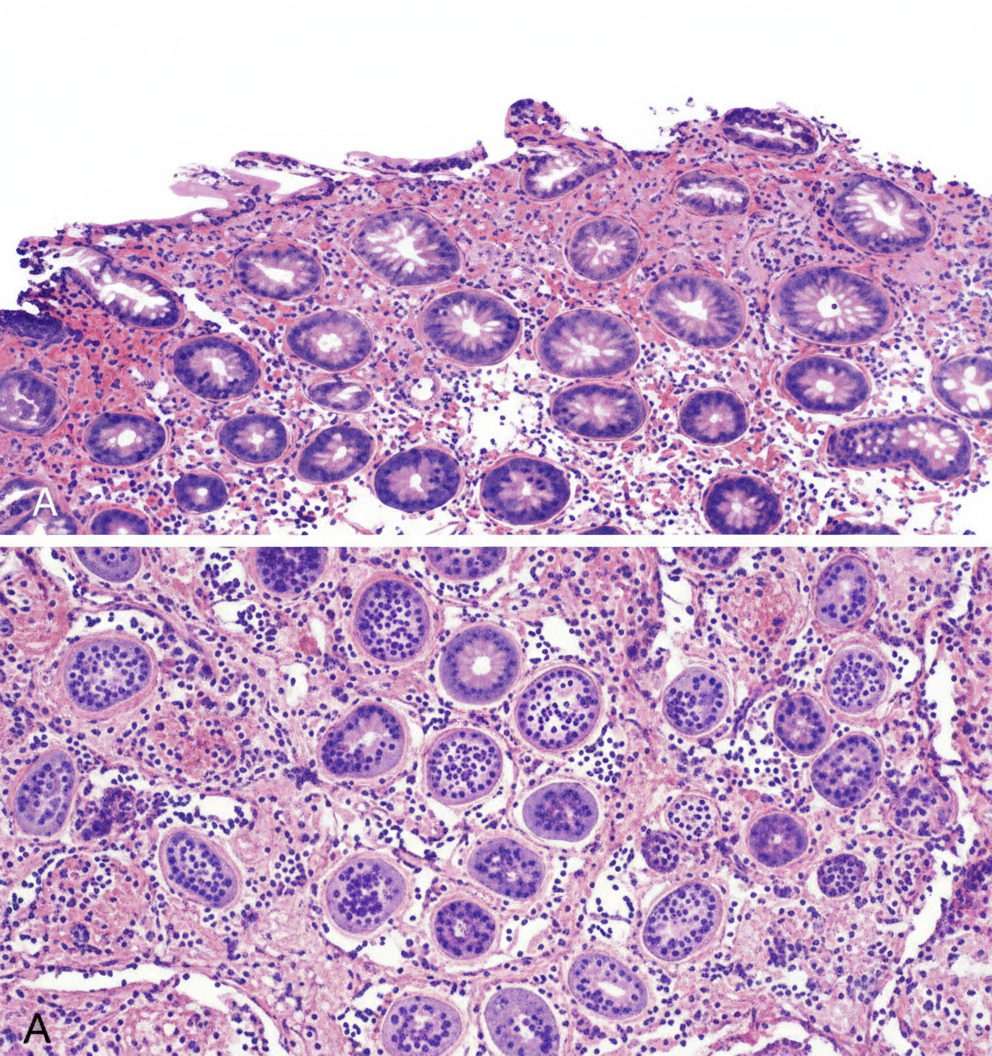
A 27-year-old woman presents to her primary care physician for evaluation of involuntary weight loss and recurrent abdominal pain. She noticed blood in her stool several times. The medical history is significant for the polycystic ovarian syndrome. The vital signs are as follows: temperature, 38.0°C (100.4°F); heart rate, 78/min; respiratory rate, 14/min; and blood pressure, 110/80 mm Hg. The family history is notable for paternal colon cancer. A colonoscopy is performed and is presented in the picture. What findings are expected?
Want unlimited practice?
Get full access to all questions, explanations, and performance tracking.
Scan to download app