
Appendicitis — MCQs

A 1-year-old boy is brought to the emergency room by his parents because of inconsolable crying and diarrhea for the past 6 hours. As the physician is concerned about acute appendicitis, she consults the literature base. She finds a paper with a table that summarizes data regarding the diagnostic accuracy of multiple clinical findings for appendicitis: Clinical finding Sensitivity Specificity Abdominal guarding (in children of all ages) 0.70 0.85 Anorexia (in children of all ages) 0.75 0.50 Abdominal rebound (in children ≥ 5 years of age) 0.85 0.65 Vomiting (in children of all ages) 0.40 0.63 Fever (in children from 1 month to 2 years of age) 0.80 0.80 Based on the table, the absence of which clinical finding would most accurately rule out appendicitis in this patient?
A 19-year-old man comes to the emergency department because of abdominal pain, nausea, and vomiting for 4 hours. Initially, the pain was dull and located diffusely around his umbilicus, but it has now become sharper and moved towards his lower right side. He has no history of serious illness and takes no medications. His temperature is 38.2°C (100.7°F) and blood pressure is 123/80 mm Hg. Physical examination shows severe right lower quadrant tenderness without rebound or guarding; bowel sounds are decreased. His hemoglobin concentration is 14.2 g/dL, leukocyte count is 12,000/mm3, and platelet count is 280,000/mm3. Abdominal ultrasonography shows a dilated noncompressible appendix with distinct wall layers and echogenic periappendiceal fat. Intravenous fluid resuscitation is begun. Which of the following is the most appropriate next step in management?
A 24-year-old woman comes to the emergency department because of abdominal pain, fever, nausea, and vomiting for 12 hours. Her abdominal pain was initially dull and diffuse but has progressed to a sharp pain on the lower right side. Two years ago she had to undergo right salpingo-oophorectomy after an ectopic pregnancy. Her temperature is 38.7°C (101.7°F). Physical examination shows severe right lower quadrant tenderness with rebound tenderness; bowel sounds are decreased. Laboratory studies show leukocytosis with left shift. An abdominal CT scan shows a distended, edematous appendix. The patient is taken to the operating room for an appendectomy. During the surgery, the adhesions from the patient's previous surgery make it difficult for the resident physician to identify the appendix. Her attending mentions that she should use a certain structure for guidance to locate the appendix. The attending is most likely referring to which of the following structures?
A 12-year-old boy is brought to the emergency room by his mother with complaints of abdominal pain and fever that started 24 hours ago. On further questioning, the mother says that her son vomited twice and has constipation that started approximately 1 and one-half days ago. The medical history is benign. The vital signs are as follows: heart rate 103/min, respiratory rate of 20/min, temperature 38.7°C (101.66°F), and blood pressure 109/69 mm Hg. On physical examination, there is severe right lower quadrant abdominal tenderness on palpation. Which of the following is the most likely cause for this patient’s symptoms?
A 28-year-old male presents to his primary care physician with complaints of intermittent abdominal pain and alternating bouts of constipation and diarrhea. His medical chart is not significant for any past medical problems or prior surgeries. He is not prescribed any current medications. Which of the following questions would be the most useful next question in eliciting further history from this patient?
A 34-year-old man presents to the office for evaluation of a lesion on his upper arm that appeared a few months ago and has not healed. The patient appears healthful but has a history of cardiovascular disease. He states that his friend at the industrial ammunition factory where he works told him he should "get it looked at." The patient admits to some nausea, vomiting, and diarrhea over the past year, but he states that he "feels fine now." On physical examination, the lesion is an erythematous, scaly, ulcerated plaque on the flexor surface of his upper arm. The rest of the exam is within normal limits. What is the most likely diagnosis?
In which of the following pathological states would the oxygen content of the trachea resemble the oxygen content in the affected alveoli?
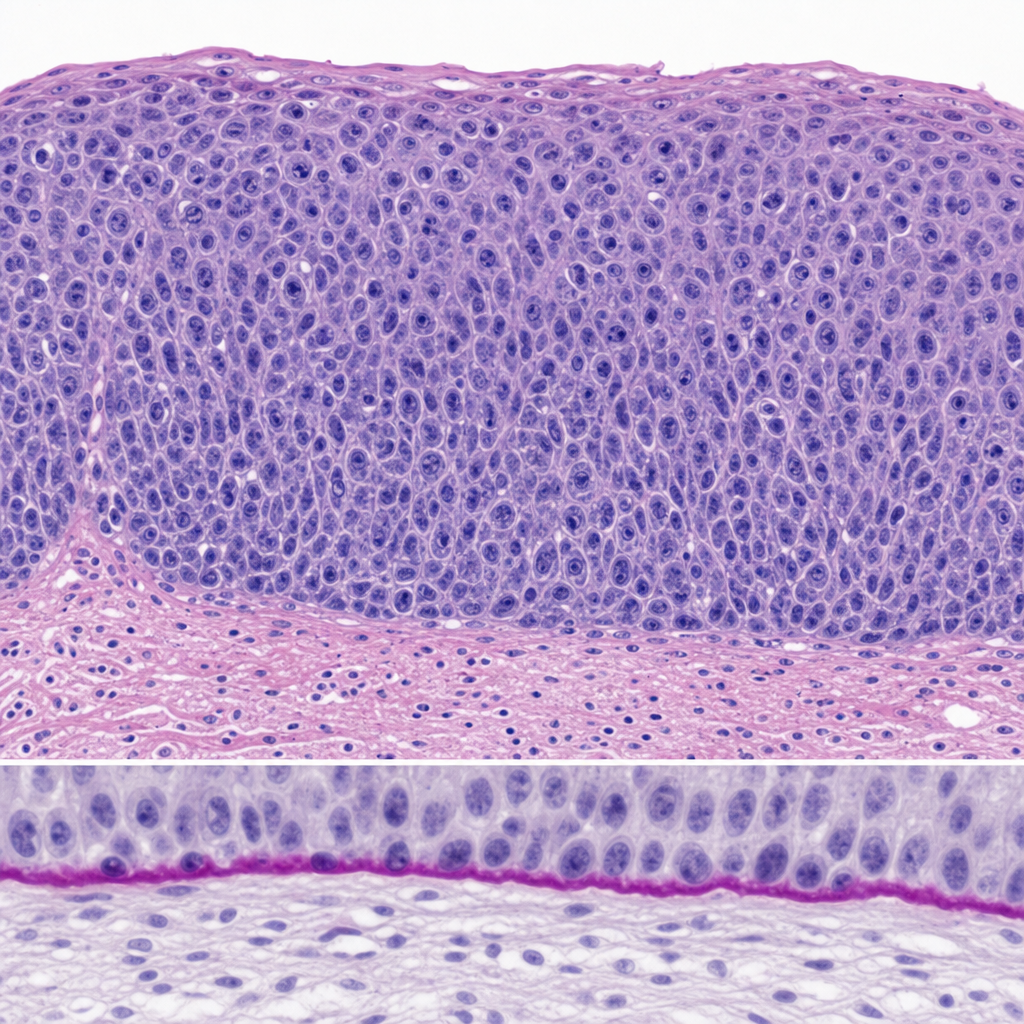
A 34-year-old woman undergoes excisional biopsy of a cervical lesion detected on colposcopy. The photomicrograph demonstrates full-thickness replacement of the squamous epithelium by atypical cells with high nuclear-to-cytoplasmic ratios, loss of polarity, and numerous mitotic figures extending to the surface. The basement membrane appears intact on PAS stain. Which of the following statements most accurately characterizes the biological behavior of this lesion?
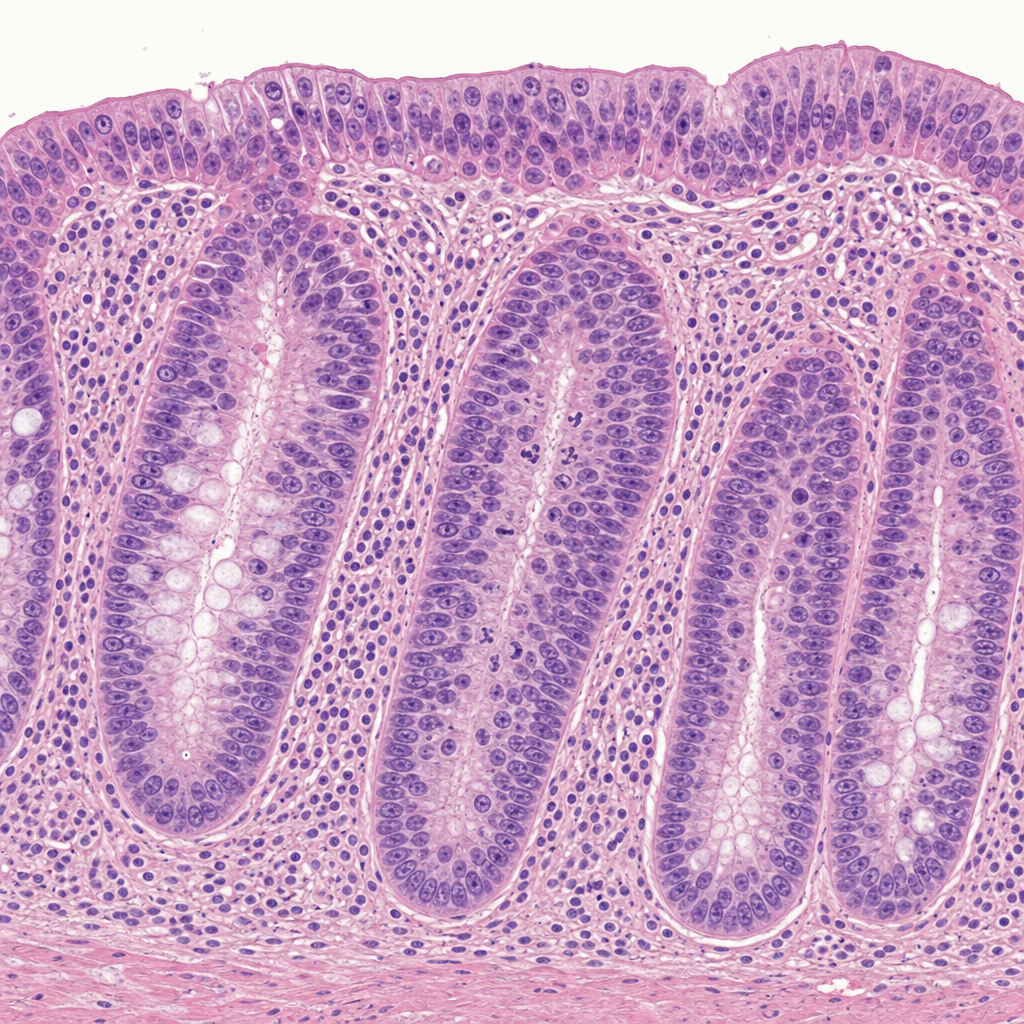
A 38-year-old woman with a history of ulcerative colitis for 12 years undergoes surveillance colonoscopy. A flat mucosal lesion is biopsied from the sigmoid colon. The photomicrograph shows colonic crypts with enlarged, hyperchromatic, stratified nuclei that extend to the luminal surface; nuclear polarity is partially lost; there is increased mitotic activity; and the basement membrane is intact with no extension of atypical cells into the lamina propria. Which of the following statements best characterizes the biological behavior of this lesion?
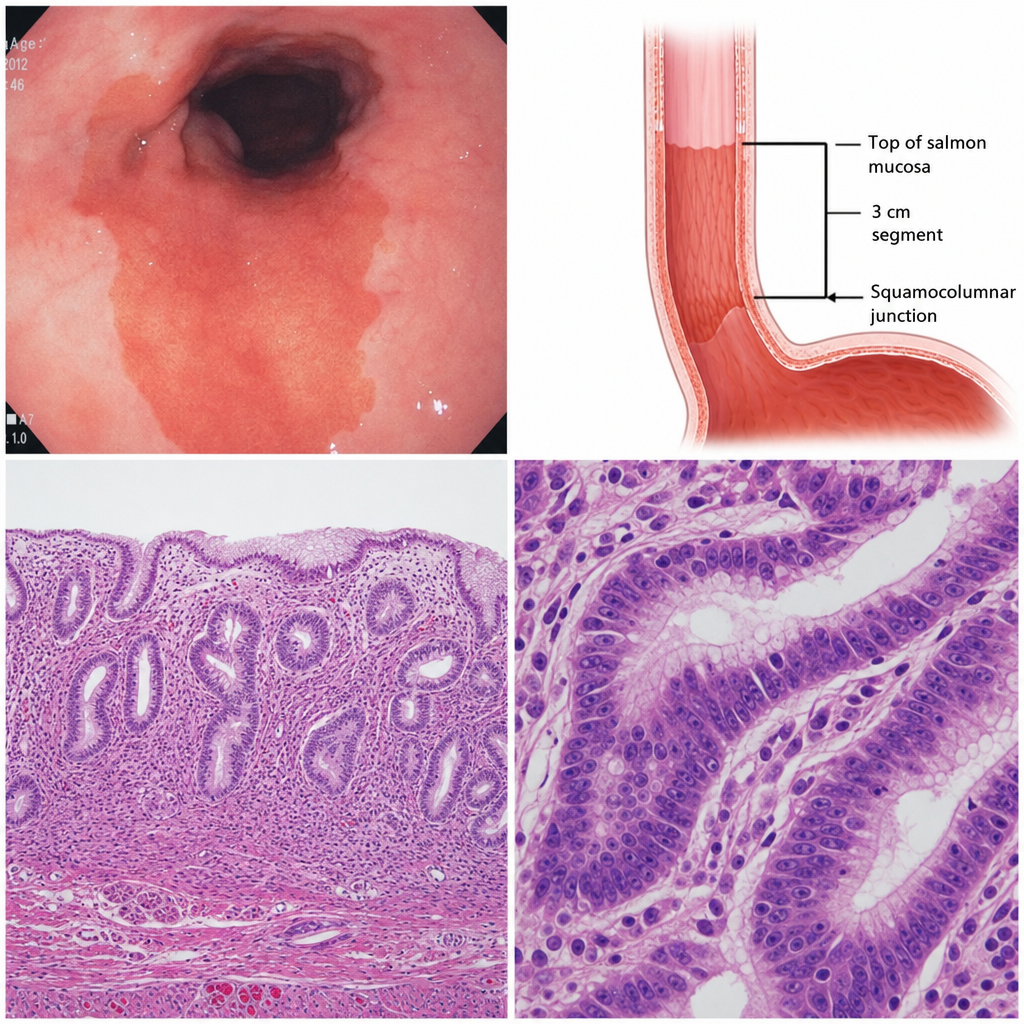
A 45-year-old woman with a history of chronic gastroesophageal reflux disease undergoes upper endoscopy. The gastroesophageal junction mucosa appears salmon-pink and velvety, extending 3 cm above the squamocolumnar junction. Biopsy is taken from this region. A subsequent biopsy taken one year later shows the same columnar epithelium with nuclear crowding, loss of polarity, and architectural complexity confined entirely above the basement membrane. Which of the following correctly describes the biological behavior of the change seen on the second biopsy?
Want unlimited practice?
Get full access to all questions, explanations, and performance tracking.
Scan to download app