
Edema mechanisms — MCQs

A 41-year-old man comes to the emergency department because of fatigue, worsening abdominal discomfort, and progressive swelling of his legs for 3 months. The swelling is worse in the evenings. His only medication is ibuprofen for occasional joint pain. The patient does not smoke and drinks 2–3 beers each weekend. His temperature is 36°C (96.8°F), pulse is 88/min, respirations are 18/min, and blood pressure is 130/80 mm Hg. Pulmonary examination shows no abnormalities. Abdominal examination shows a mildly distended abdomen with shifting dullness. The liver is palpated 2–3 cm below the right costal margin. When pressure is applied to the right upper quadrant, the patient's jugular veins become visibly distended for 15 seconds. The 2nd and 3rd metacarpophalangeal joints of both hands are tender to palpation. There is 2+ edema in the lower extremities. Which of the following is the most likely underlying cause of this patient's edema?
A 65-year-old man comes to the physician for the evaluation of a 2-month history of worsening fatigue and shortness of breath on exertion. While he used to be able to walk 4–5 blocks at a time, he now has to pause every 2 blocks. He also reports waking up from having to urinate at least once every night for the past 5 months. Recently, he has started using 2 pillows to avoid waking up coughing with acute shortness of breath at night. He has a history of hypertension and benign prostatic hyperplasia. His medications include daily amlodipine and prazosin, but he reports having trouble adhering to his medication regimen. His pulse is 72/min, blood pressure is 145/90 mm Hg, and respiratory rate is 20/min. Physical examination shows 2+ bilateral pitting edema of the lower legs. Auscultation shows an S4 gallop and fine bibasilar rales. Further evaluation is most likely to show which of the following pathophysiologic changes in this patient?
Two weeks after undergoing low anterior resection for rectal cancer, a 52-year-old man comes to the physician because of swelling in both feet. He has not had any fever, chills, or shortness of breath. His temperature is 36°C (96.8°F) and pulse is 88/min. Physical examination shows a normal thyroid and no jugular venous distention. Examination of the lower extremities shows bilateral non-pitting edema that extends from the feet to the lower thigh, with deep flexion creases. His skin is warm and dry, and there is no erythema or rash. Microscopic examination of the interstitial space in this patient's lower extremities would be most likely to show the presence of which of the following?
A 72-year-old woman with hypertension comes to the physician because of swelling and pain in both legs for the past year. The symptoms are worse at night and improve in the morning. Current medications include losartan and metoprolol. Her temperature is 36°C (96.8°F), pulse is 67/min, and blood pressure is 142/88 mm Hg. Examination shows normal heart sounds; there is no jugular venous distention. Her abdomen is soft and the liver edge is not palpable. Examination of the lower extremities shows bilateral pitting edema and prominent superficial veins. The skin is warm and there is reddish-brown discoloration of both ankles. Laboratory studies show a normal serum creatinine and normal urinalysis. Which of the following is the most likely underlying cause of this patient's symptoms?
A 70-year-old male presents for an annual exam. His past medical history is notable for shortness of breath when he sleeps, and upon exertion. Recently he has experienced dyspnea and lower extremity edema that seems to be worsening. Both of these symptoms have resolved since he was started on several medications and instructed to weigh himself daily. Which of the following is most likely a component of his medical management?
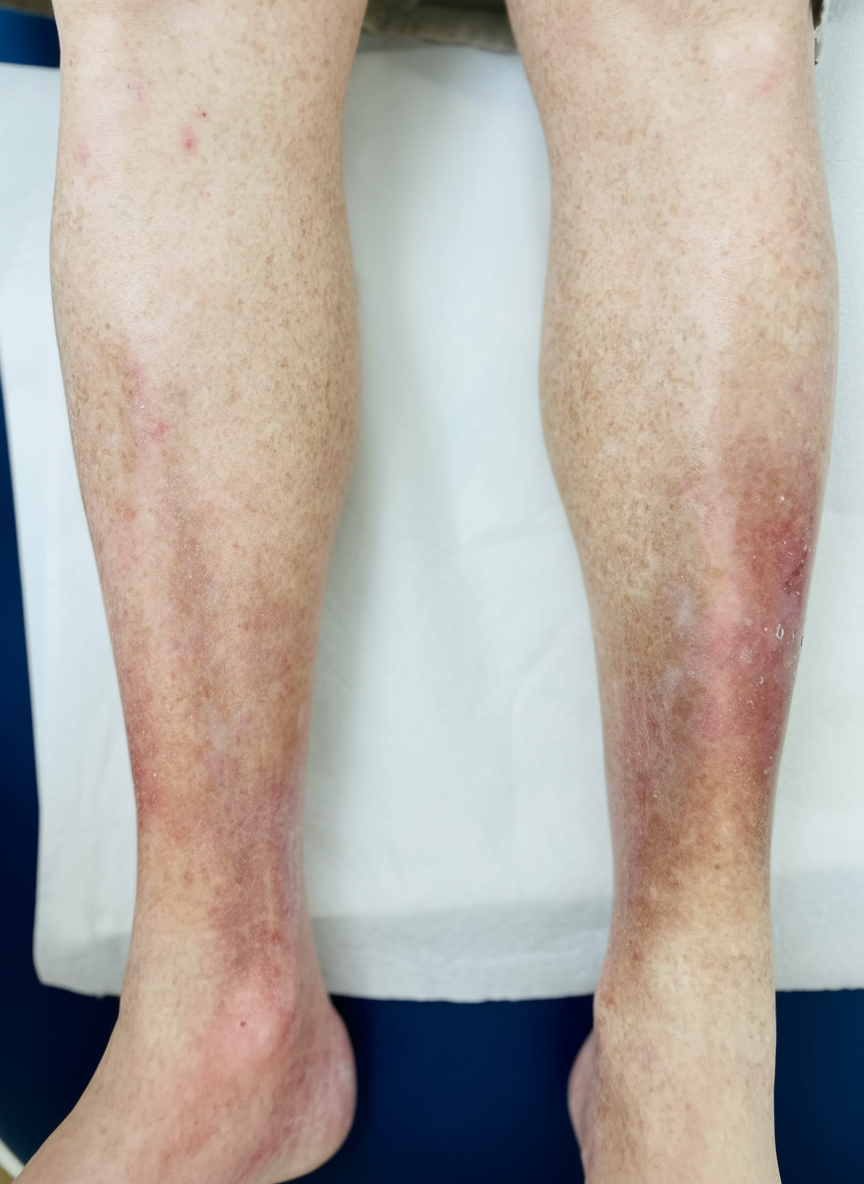
A 67-year-old woman comes to the physician with a 6-month history of pain and swelling of both legs. The symptoms are worst at the end of the day and are associated with itching of the overlying skin. Physical examination shows bilateral pitting ankle edema. An image of one of the ankles is shown. This patient is at greatest risk for which of the following complications?
A 68-year-old man is brought to the emergency department 30 minutes after the onset of uncontrollable jerking movements of his arms and legs followed by loss of consciousness. His wife says that he seemed confused this morning and had a headache. Immediately before the shaking episode, he said that he smelled rotten eggs. He is unresponsive. Cerebrospinal fluid (CSF) analysis shows a leukocyte count of 700/μL (70% lymphocytes), a glucose concentration of 60 mg/dL, and a protein concentration of 80 mg/dL. Despite appropriate lifesaving measures, the man dies. Which of the following is most likely to be found on postmortem examination of this patient?
A 69-year-old white man comes to the physician because of a 15-day history of fatigue and lower leg swelling. Over the past 8 months, he has had a 3.8-kg (8.3-lb) weight loss. He has smoked one pack of cigarettes daily for 48 years. Vital signs are within normal limits. He appears thin. Examination shows 2+ pretibial edema bilaterally. An x-ray of the chest shows a right upper lobe density. Laboratory studies show: Hemoglobin 11.3 g/dL Leukocyte count 8600/mm3 Platelet count 140,000/mm3 Serum Urea nitrogen 25 mg/dL Glucose 79 mg/dL Creatinine 1.7 mg/dL Albumin 1.6 mg/dL Total cholesterol 479 mg/dL Urine Blood negative Glucose negative Protein 4+ WBC 0–1/hpf Fatty casts numerous Light microscopic examination of a kidney biopsy reveals thickening of glomerular capillary loops and the basal membrane. Which of the following is the most likely diagnosis?
A 7-year-old girl is brought to her pediatrician by her mother because of puffiness under both eyes in the morning. The mother reports that the child has just recovered from a seasonal influenza infection a few days ago. Vital signs include: temperature 37°C (98.6°F), blood pressure 100/67 mm Hg, and pulse 95/min. On examination, there is facial edema and bilateral 2+ pitting edema over the legs. Laboratory results are shown: Serum albumin 2.1 g/dL Serum triglycerides 200 mg/dL Serum cholesterol 250 mg/dL Urine dipstick 4+ protein Which of the following casts are more likely to be present in this patient’s urine?
A 36-year-old man comes to the physician for a 4-week history of swollen legs. He has difficulty putting on socks because of the swelling. Two years ago, he was diagnosed with sleep apnea. He takes no medications. He emigrated from Guatemala with his family when he was a child. He is 171 cm (5 ft 6 in) tall and weighs 115 kg (253 lb); BMI is 39 kg/m2. His pulse is 91/min and blood pressure is 135/82 mm Hg. Examination shows periorbital and bilateral lower extremity edema. Serum Albumin 3.1 g/dL Total cholesterol 312 mg/dL Urine Blood negative Protein +4 RBC 1-2/hpf RBC cast negative Fatty casts numerous A renal biopsy is obtained. Which of the following is most likely to be seen under light microscopy of the patient's renal biopsy specimen?
Want unlimited practice?
Get full access to all questions, explanations, and performance tracking.
Scan to download app