
Thyroid neoplasms — MCQs

A 43-year-old female presents to her primary care physician complaining of a gradually enlarging neck mass. She reports that she first developed a firm nodular midline mass on the anterior aspect of her neck two months ago. She is otherwise healthy and takes no medications. A fine-needle aspiration is performed and a histological sample of the specimen is shown. Which of the following is the most likely diagnosis?
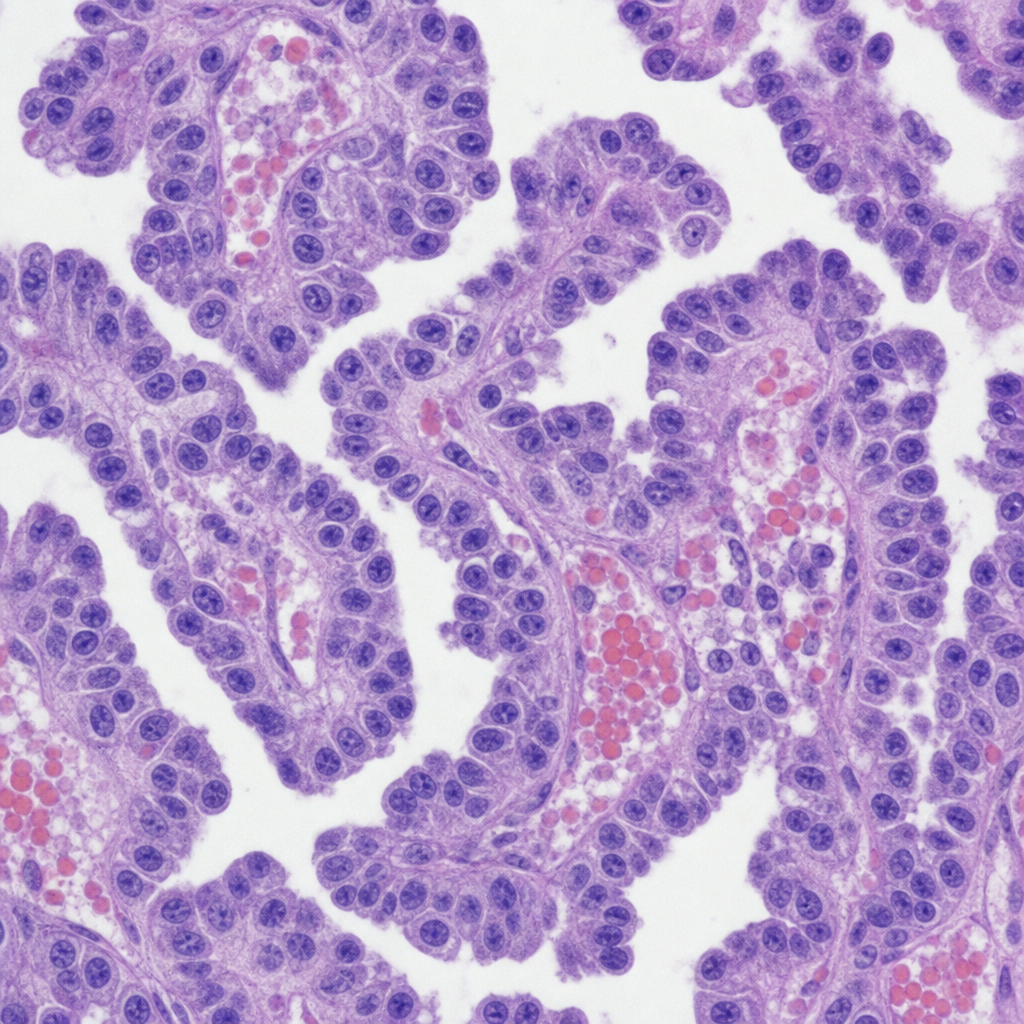
A 25-year-old man presents with a mass on his neck. He says that he first noticed the mass a few weeks ago while taking a shower. Since then, the mass has not increased in size. He denies any pain or difficulty in swallowing. Past medical history is unremarkable. Family history is significant for his father who had his thyroid removed when he was around his age but doesn’t know why. Review of systems is significant for occasional episodes of anxiety that include a pounding headache, racing heart, and sweating. His vital signs include: pulse 88/min, blood pressure 133/87 mm Hg, temperature 37.2°C (99.0°F), and respiratory rate 14/min. He is 183 cm (6 ft 2 in) tall with long extremities. On physical examination, the patient appears cachectic. There is a palpable 4 cm x 4 cm nodule present on the left lobe of the thyroid. Which of the following is the most likely thyroid pathology in this patient?
A 35-year-old man comes to the physician for evaluation of a neck mass and hoarseness. He has no history of major medical illness. Physical examination shows a 2.5-cm fixed, irregular thyroid nodule. His serum calcitonin concentration is elevated. The nodule is most likely comprised of cells that are embryologically derived from which of the following structures?
A 44-year-old woman comes to the physician for the evaluation of a 1-month history of fatigue and difficulty swallowing. During this period, she has also had dry skin, thinning hair, and rounding of her face. She has type 1 diabetes mellitus and rheumatoid arthritis. Her father had a thyroidectomy for papillary thyroid cancer. The patient had smoked one pack of cigarettes daily for 20 years but quit 3 years ago. She drinks 2–3 glasses of wine daily. Her current medications include insulin, omeprazole, and daily ibuprofen. She appears well. Her temperature is 36.3°C (97.3°F), pulse is 62/min, and blood pressure is 102/76 mm Hg. Examination of the neck shows a painless, diffusely enlarged thyroid gland. Cardiopulmonary examination shows no abnormalities. Further evaluation is most likely to show which of the following?
A 36-year-old woman presents with thyroid swelling. She has been healthy until now and follows all the healthcare precautions except for missing a flu shot this year. On physical examination, the thyroid gland is diffusely enlarged and tender to palpation. Laboratory findings show a decreased serum TSH level and elevated erythrocyte sedimentation rate. Which of the following histopathologic findings would most likely be found in the thyroid gland of this patient?
A 55-year-old woman comes to the physician because of a 4-month history of a painless lump on her neck. Examination shows a hard nodule on the left side of her neck. A fine-needle aspiration biopsy shows well-differentiated cuboidal cells arranged spherically around colloid. She undergoes thyroidectomy. Histopathological examination of the surgical specimen shows invasion of the thyroid capsule and blood vessels. Which of the following cellular events is most likely involved in the pathogenesis of this patient's condition?
A 40-year-old woman comes to the physician because of a 3-month history of a lump on her neck. The lump is mildly painful. She appears healthy. Examination shows a swelling on the left side of her neck that moves on swallowing. Cardiopulmonary examination shows no abnormalities. Her TSH is 3.6 μU/mL. Ultrasound shows a 4.0-cm (1.6-in) hypoechoic mass in the left thyroid lobe. Fine-needle aspiration of the mass shows neoplastic follicular cells. Molecular analysis of the aspirate shows a mutation in the RAS gene. Which of the following is the most appropriate next step in management?
A 16-year-old male presents to the emergency department complaining of episodes of pounding headache, chest fluttering, and excessive sweating. He has a past history of kidney stones that are composed of calcium oxalate. He does not smoke or drink alcohol. Family history reveals that his mother died of thyroid cancer. Vital signs reveal a temperature of 37.1°C (98.7°F), blood pressure of 200/110 mm Hg and pulse of 120/min. His 24-hour urine calcium, serum metanephrines, and serum normetanephrines levels are all elevated. Mutation of which of the following genes is responsible for this patient's condition?
A 47-year-old woman comes to the physician because of a 2-month history of a lump on her neck and a 1-week history of hoarseness. Examination shows a 3-cm, firm, non-tender nodule on the anterior neck. Further evaluation confirms a thyroid malignancy, and she undergoes thyroidectomy. Histopathologic examination of the surgical specimen shows lymphatic invasion. Genetic analysis shows an activating mutation in the RET/PTC genes. Microscopic examination of the surgical specimen is most likely to also show which of the following?
A 21-year-old male college student is very anxious about having thyroid cancer as he found a lump in his neck a few days ago. He has also had diarrhea and a feeling of warmth on his face for 3 days now. His father and uncle both have been diagnosed with thyroid cancer. The lump is about 1 cm in diameter and is fixed and nontender on palpation. Physical examination is otherwise unremarkable. Ultrasound shows a non-cystic cold nodule that requires fine needle aspiration for diagnosis. Thyroid functions tests are normal, and his calcitonin level is 346 ug/ml. Which of the following genetic mutations would warrant thyroidectomy in this patient?
Want unlimited practice?
Get full access to all questions, explanations, and performance tracking.
Scan to download app