
Pancreatic endocrine tumors — MCQs

A previously healthy 52-year-old man comes to the physician because of a 4-month history of recurrent abdominal pain, foul-smelling, greasy stools, and a 5-kg (11-lb) weight loss despite no change in appetite. Physical examination shows pain on palpation of the right upper quadrant. His fasting serum glucose concentration is 186 mg/dL. Abdominal ultrasound shows multiple round, echogenic foci within the gallbladder lumen with prominent posterior acoustic shadowing. The serum concentration of which of the following substances is most likely to be increased in this patient?
A 53-year-old patient presents to his primary care provider with a 1-week history of abdominal pain at night and between meals. He has attempted taking antacids, which help briefly, but then the pain returns. The patient has not noticed any changes to the color of his stool but states that he has been having some loose bowel movements. The patient reports that he has had duodenal ulcers in the past and is concerned that this is a recurrence. On exam, his temperature is 98.4°F (36.9°C), blood pressure is 130/84 mmHg, pulse is 64/min, and respirations are 12/min. The abdomen is soft, nontender, and nondistended in clinic today. A fecal occult blood test is positive for blood in the stool. During outpatient workup, H. pylori stool antigen is negative, endoscopy demonstrates duodenal ulcers, and gastrin levels are elevated after a secretin stimulation test. Which of the following should also be examined in this patient?
A 42-year-old man presents to his primary care provider for abdominal pain. He reports that for several months he has been experiencing a stabbing pain above the umbilicus during meals. He denies associated symptoms of nausea, vomiting, or diarrhea. The patient’s past medical history is significant for hypertension and hyperlipidemia for which he takes amlodipine and atorvastatin. His family history is significant for lung cancer in his father. The patient is a current smoker with a 20 pack-year smoking history and drinks 3-5 beers per week. Initial laboratory testing is as follows: Serum: Na+: 141 mEq/L K+: 4.6 mEq/L Cl-: 102 mEq/L HCO3-: 25 mEq/L Urea nitrogen: 14 mg/dL Creatinine: 1.1 mg/dL Glucose: 120 mg/dL Calcium: 8.4 mg/dL Alkaline phosphatase: 66 U/L Aspartate aminotransferase (AST): 40 U/L Alanine aminotransferase (ALT): 52 U/L Gastrin: 96 pg/mL (<100 pg/mL) Lipase: 90 U/L (<160 U/L) The patient is started on a proton pump inhibitor without symptomatic improvement after 6 weeks. He is referred for an upper endoscopy, which demonstrates erosive gastritis, three ulcers in the duodenum, and one ulcer in the jejunum. Biopsy of the gastric mucosa is negative for H. pylori. Which of the following is the best next step in management?
A 28-year-old man is brought in by ambulance to the ER, barely conscious, after feeling drowsy and falling to the floor during a presentation several hours ago. His colleague who accompanied him says he has had similar episodes 5 times in the past 3 months. No significant past medical history. His blood pressure is 110/80 mm Hg and pulse is 114/min. His capillary blood glucose is 15 mg/dL. Immediate IV dextrose with thiamine is started, and he rapidly regains consciousness. A contrast CT of the abdomen is performed which reveals a tumor in the pancreas. Which of the following relative laboratory findings would you most likely expect to find in this patient?
A 53-year-old man comes to the physician because of fatigue, recurrent diarrhea, and an 8-kg (17.6-lb) weight loss over the past 6 months. He has a 4-month history of recurrent blistering rashes on different parts of his body that grow and develop into pruritic, crusty lesions before resolving spontaneously. Physical examination shows scaly lesions in different phases of healing with central, bronze-colored induration around the mouth, perineum, and lower extremities. Laboratory studies show: Hemoglobin 10.1 mg/dL Mean corpuscular volume 85 μm3 Mean corpuscular hemoglobin 30.0 pg/cell Serum Glucose 236 mg/dL Abdominal ultrasonography shows a 3-cm, solid mass located in the upper abdomen. This patient's mass is most likely derived from which of the following types of cells?
A 47-year-old male presents to his primary care physician complaining of upper abdominal pain. He reports a four-month history of gnawing epigastric discomfort that improves with meals. He has lost 10 pounds over that same period. His past medical history is significant for a prolactinoma for which he underwent transphenoidal resection. He does not smoke or drink alcohol. His family history is notable for a paternal uncle and paternal grandmother with parathyroid neoplasms. His temperature is 99°F (37.2°C), blood pressure is 115/80 mmHg, pulse is 80/min, and respirations are 18/min. Upon further diagnostic workup, which of the following sets of laboratory findings is most likely?
A previously healthy 41-year-old woman comes to the physician for the evaluation of recurrent episodes of palpitations and sweating over the past month. Her symptoms typically start after swimming practice and improve after drinking ice tea and eating some candy. She has also had a 5-kg (11-lb) weight gain over the past 3 months. She works as a nurse. Physical examination shows no abnormalities. Fasting serum studies show: Glucose 38 mg/dL Insulin 260 μU/mL (N=11–240) Proinsulin 65 μU/mL (N <20% of total insulin) C-peptide 5.0 ng/mL (N=0.8–3.1) Insulin secretagogues absent Which of the following is the most likely cause of her symptoms?
A 45-year-old woman comes to see you for a second opinion regarding an upcoming surgery for pancreatic insulinoma. While taking a surgical history, she tells you she previously had a pituitary tumor resected. For which additional neoplasms might you consider testing her?
A 36-year-old man is admitted to the hospital because of a 1-day history of epigastric pain and vomiting. He has had similar episodes of epigastric pain in the past. He drinks 8 oz of vodka daily. Five days after admission, the patient develops aspiration pneumonia and sepsis. Despite appropriate therapy, the patient dies. At autopsy, the pancreas appears gray, enlarged, and nodular. Microscopic examination of the pancreas shows localized deposits of calcium. This finding is most similar to an adaptive change that can occur in which of the following conditions?
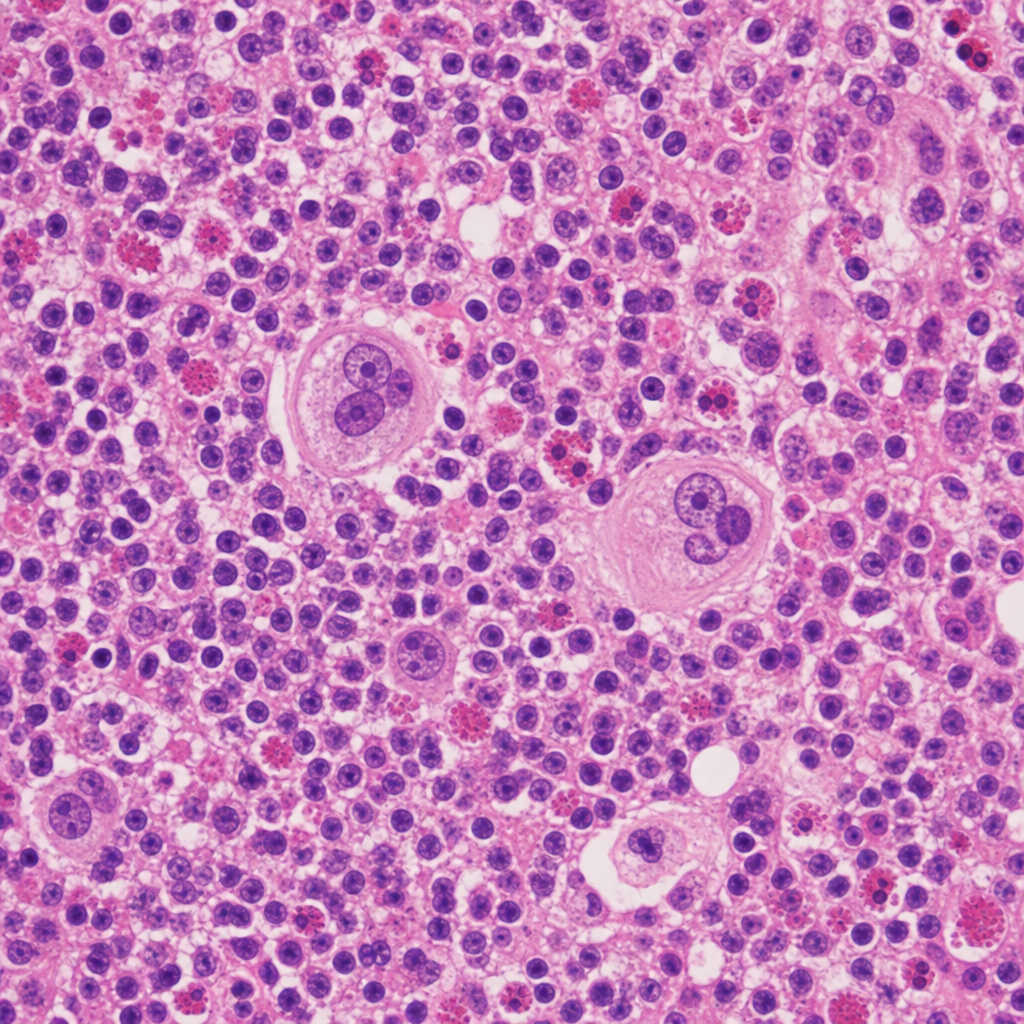
A 28-year-old man presents with painless cervical lymphadenopathy. Excisional lymph node biopsy is performed. The photomicrograph shows effacement of normal nodal architecture by a mixed infiltrate of lymphocytes, plasma cells, eosinophils, and neutrophils. Scattered among the infiltrate are large binucleated cells with prominent eosinophilic 'owl-eye' nucleoli. Immunohistochemistry shows these large cells are CD15+, CD30+, CD20−, and CD45−. Which of the following cell types represents the malignant population in this lesion?
Want unlimited practice?
Get full access to all questions, explanations, and performance tracking.
Scan to download app