
Adrenal medullary disorders — MCQs

A 3-year-old boy presents to the clinic for evaluation of leg pain. This has been persistent for the past 3 days and accompanied by difficulty walking. He has also had some erythema and ecchymoses in the periorbital region over the same time period. The vital signs are unremarkable. The physical exam notes the above findings, as well as some swelling of the upper part of the abdomen. The laboratory results are as follows: Erythrocyte count 3.3 million/mm3 Leukocyte count 3,000/mm3 Neutrophils 54% Eosinophils 1% Basophils 1% Lymphocytes 43% Monocytes 3% Platelet count 80,000/mm3 A magnetic resonance image (MRI) scan of the abdomen shows a mass of adrenal origin. Which of the following is the most likely cause of this patient's symptoms?
A 35-year-old woman presents with increased anxiety and a reeling sensation. Her complaint started 30 minutes ago with increased sweating and palpitations and is gradually worsening. On examination, the blood pressure was found to be 194/114 mm Hg. She had normal blood pressure at the local pharmacy 5 days ago. She currently works as an event manager and her job involves a lot of stress. The family history is significant for thyroid carcinoma in her father. Which of the following is most likely in this person?
A researcher is studying receptors that respond to epinephrine in the body and discovers a particular subset that is expressed in presynaptic adrenergic nerve terminals. She discovers that upon activation, these receptors will lead to decreased sympathetic nervous system activity. She then studies the intracellular second messenger changes that occur when this receptor is activated. She records these changes and begins searching for analogous receptor pathways. Which of the following receptors would cause the most similar set of intracellular second messenger changes?
A newborn is brought to the pediatric clinic by his mother because she has noticed a swelling in the belly while dressing her baby. On physical examination, the newborn is found to have a non-tender upper abdominal mass. The clinician also noticed absent irises and undescended testes in this baby. A magnetic resonance image (MRI) scan of the abdomen shows a mass of intra-renal origin. Which 1 of the following genetic disorders is most probably the cause of this neonate’s symptoms and signs?
A 49-year-old male presents with a primary complaint of several recent episodes of severe headache, sudden anxiety, and a "racing heart". The patient originally attributed these symptoms to stress at work; however, these episodes are becoming more frequent and severe. Laboratory evaluation during such an episode reveals elevated plasma free metanephrines. Which of the following additional findings in this patient is most likely?
A 30-year-old man comes to the physician after receiving a high blood pressure reading of 160/90 mm Hg at an annual employee health check-up. During the past few months, the patient has had occasional headaches and mild abdominal pain, both of which were relieved with ibuprofen. He has also had several episodes of heart palpitations. He has no history of serious illness. His mother and father both have hypertension. He has smoked one pack of cigarettes daily for the past 10 years and drinks one glass of wine daily. He occasionally smokes marijuana. He appears pale. His temperature is 36.8°C (98.2°F), pulse is 103/min, and blood pressure is 164/102 mm Hg. Physical examination shows no abnormalities. Laboratory studies show: Hemoglobin 15.3 g/dL Leukocyte count 7,900/mm3 Platelet count 223,000/mm3 Serum Na+ 138 mEq/L K+ 4.6 mEq/L Cl- 103 mEq/L Urea nitrogen 14 mg/dL Glucose 90 mg/dL Creatinine 0.9 mg/dL Plasma metanephrines 1.2 nmol/L (N < 0.5 nmol/L) Urine toxicology screening is positive for tetrahydrocannabinol (THC). Renal doppler shows no abnormalities. A CT scan of the abdomen shows a mass in the left adrenal gland. Which of the following is the most appropriate next step in management of this patient?
A 43-year-old male with a history of thyroid cancer status post total thyroidectomy presents to his primary care physician after repeated bouts of headaches. His headaches are preceded by periods of anxiety, palpitations, and sweating. The patient says he is unable to pinpoint any precipitating factors and instead says the events occur without warning. Of note, the patient's father and uncle also have a history of thyroid cancer. On exam his vitals are: T 36.8 HR 87, BP 135/93, RR 14, and O2 Sat 100% on room air. The patient's TSH is within normal limits, and he reports taking his levothyroxine as prescribed. What is the next best step in diagnosing this patient's chief complaint?
A 51-year-old African American man with a history of poorly controlled hypertension presents to the emergency room with blurry vision and dyspnea. He reports rapid-onset blurred vision and difficulty breathing 4 hours prior to presentation. He takes lisinopril, hydrochlorothiazide, and spironolactone but has a history of poor medication compliance. He has a 50 pack-year smoking history and drinks 4-6 shots of vodka per day. His temperature is 99.2°F (37.3°C), blood pressure is 195/115 mmHg, pulse is 85/min, and respirations are 20/min. On exam, he is ill-appearing and pale. He is intermittently responsive and oriented to person but not place or time. Fundoscopic examination reveals swelling of the optic disc with blurred margins. A biopsy of this patient’s kidney would most likely reveal which of the following?
A 60-year-old woman comes to the physician because of lower back pain, generalized weakness, and weight loss that has occurred over the past 6 weeks. She also says that her urine has appeared foamy recently. Physical examination shows focal midline tenderness of the lumbar spine and conjunctival pallor. Her temperature is 100.5°F (38°C). A photomicrograph of a bone marrow biopsy specimen is shown. Further evaluation of this patient is most likely to show which of the following findings?
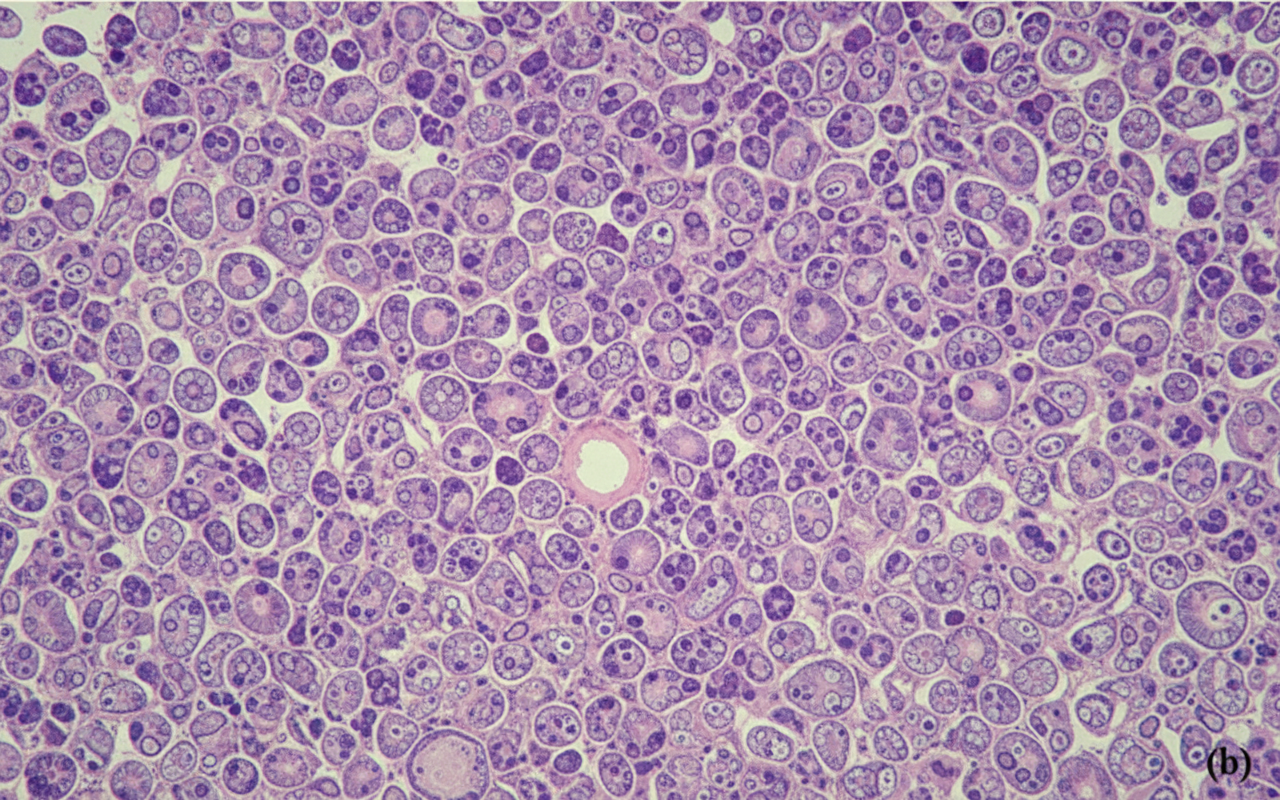
A 28-year-old man presents with painless cervical lymphadenopathy. Excisional lymph node biopsy is performed. The photomicrograph shows effacement of normal nodal architecture by a mixed infiltrate of lymphocytes, plasma cells, eosinophils, and neutrophils. Scattered among the infiltrate are large binucleated cells with prominent eosinophilic 'owl-eye' nucleoli. Immunohistochemistry shows these large cells are CD15+, CD30+, CD20−, and CD45−. Which of the following cell types represents the malignant population in this lesion?
Want unlimited practice?
Get full access to all questions, explanations, and performance tracking.
Scan to download app