
Premalignant skin lesions — MCQs

A 60-year-old white man with a past medical history significant for hypertension and hyperlipidemia presents to his family medicine physician with concerns about a 'spot' on his ear. He has been a construction worker for 35 years and spends most of his time outside. His family history is insignificant. On physical examination, there is a dark lesion on his left ear. The patient states that he has always had a mole in this location but that it has recently become much larger. A review of systems is otherwise negative. Which of the following lesion characteristics would be MOST reassuring among the given options?
A 57-year-old post-menopausal woman comes to the physician because of intermittent, bloody post-coital vaginal discharge for the past month. She does not have pain with intercourse. Eleven years ago, she had LSIL on a routine Pap smear and testing for high-risk HPV strains was positive. Colposcopy showed CIN 1. She has not returned for follow-up Pap smears since then. She is sexually active with her husband only, and they do not use condoms. She has smoked half a pack of cigarettes per day for the past 25 years and does not drink alcohol. On speculum exam, a 1.4 cm, erythematous exophytic mass with ulceration is noted on the posterior wall of the upper third of the vagina. Which of the following is the most probable histopathology of this mass?
A 52-year-old Caucasian man presents to the clinic for evaluation of a mole on his back that he finds concerning. He states that his wife noticed the lesion and believes that it has been getting larger. On inspection, the lesion is 10 mm in diameter with irregular borders. A biopsy is performed. Pathology reveals abnormal melanocytes forming nests at the dermo-epidermal junction and discohesive cell growth into the epidermis. What is the most likely diagnosis?
A 34-year-old man presents to the office for evaluation of a lesion on his upper arm that appeared a few months ago and has not healed. The patient appears healthful but has a history of cardiovascular disease. He states that his friend at the industrial ammunition factory where he works told him he should "get it looked at." The patient admits to some nausea, vomiting, and diarrhea over the past year, but he states that he "feels fine now." On physical examination, the lesion is an erythematous, scaly, ulcerated plaque on the flexor surface of his upper arm. The rest of the exam is within normal limits. What is the most likely diagnosis?
A 74-year-old man comes to the physician for evaluation of a skin lesion on his right arm. The lesion first appeared 3 months ago and has since been slowly enlarging. Physical examination shows a 1.5-centimeter, faintly erythematous, raised lesion with irregular borders on the dorsum of the right forearm. A biopsy specimen is obtained. If present, which of the following histopathological features would be most consistent with carcinoma in situ?
A 66-year-old man presents to his family physician complaining of a sandpaper-like sensation when he touches the lesion on his forehead. His medical history is relevant for hypertension and hypercholesterolemia, for which he is taking losartan and atorvastatin. He used to work as a gardener, but he retired 3 years ago. His vital signs are within normal limits. Physical examination of his forehead reveals male-pattern baldness and thin, adherent, yellow-colored skin lesions that feel rough to the touch (see image). His family physician refers to him to a dermatologist for further management and treatment. Which of the following conditions would the patient most likely develop if this skin condition is left untreated?

A 43-year-old woman presents to your clinic for the evaluation of an abnormal skin lesion on her forearm. The patient is worried because her mother passed away from melanoma. You believe that the lesion warrants biopsy for further evaluation for possible melanoma. Your patient is concerned about her risk for malignant disease. What is the most important prognostic factor of melanoma?
A 52-year-old man presents with a rapidly growing, dome-shaped nodule on his right arm that developed over 6 weeks. Examination reveals a 2 cm, symmetrical, crateriform nodule with a central keratin plug. Which of the following is the most likely diagnosis?
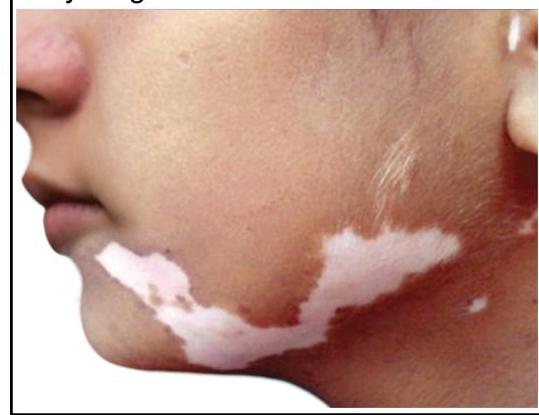
An otherwise healthy 17-year-old girl comes to the physician because of multiple patches on her face, hands, abdomen, and feet that are lighter than the rest of her skin. The patches began to appear 3 years ago and have been gradually increasing in size since. There is no associated itchiness, redness, numbness, or pain. She emigrated from India 2 years ago. An image of the lesions on her face is shown. Which of the following is most likely involved in the pathogenesis of this patient's skin findings?
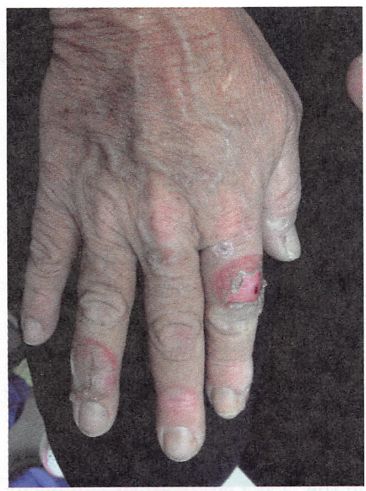
A 62-year-old man seeks evaluation at an outpatient clinic for a single, red, crusty lesion on the shaft of his penis and a similar lesion on the middle finger of his left hand. He recently immigrated to the US from Africa. The lesions are painless and the physicians in his country treated him for syphilis and eczema, with no improvement. He lives with his 4th wife. He smokes 2 packs of cigarette per day and has been doing so for the last 30 years. He is not aware of any family members with malignancies or hereditary diseases. The physical examination is remarkable for an erythematous plaque, with areas of crusting, oozing, and irregular borders on the dorsal surface of the penile shaft and a similar lesion on his left middle finger (shown in the picture). The regional lymph nodes are not affected. A biopsy is obtained and the pathologic evaluation reveals cells with nuclear hyperchromasia, multinucleation, and increased mitotic figures within the epidermis. What is the most likely diagnosis?
Want unlimited practice?
Get full access to all questions, explanations, and performance tracking.
Scan to download app