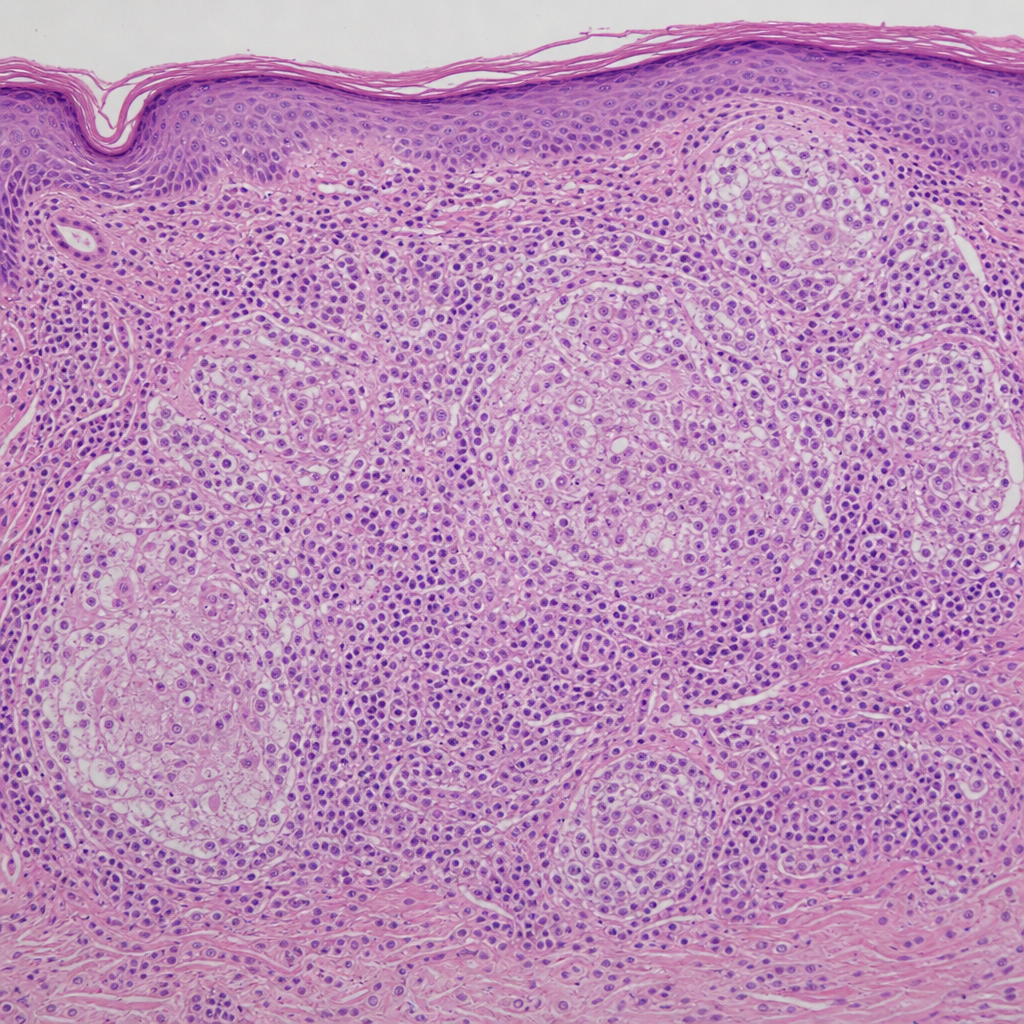
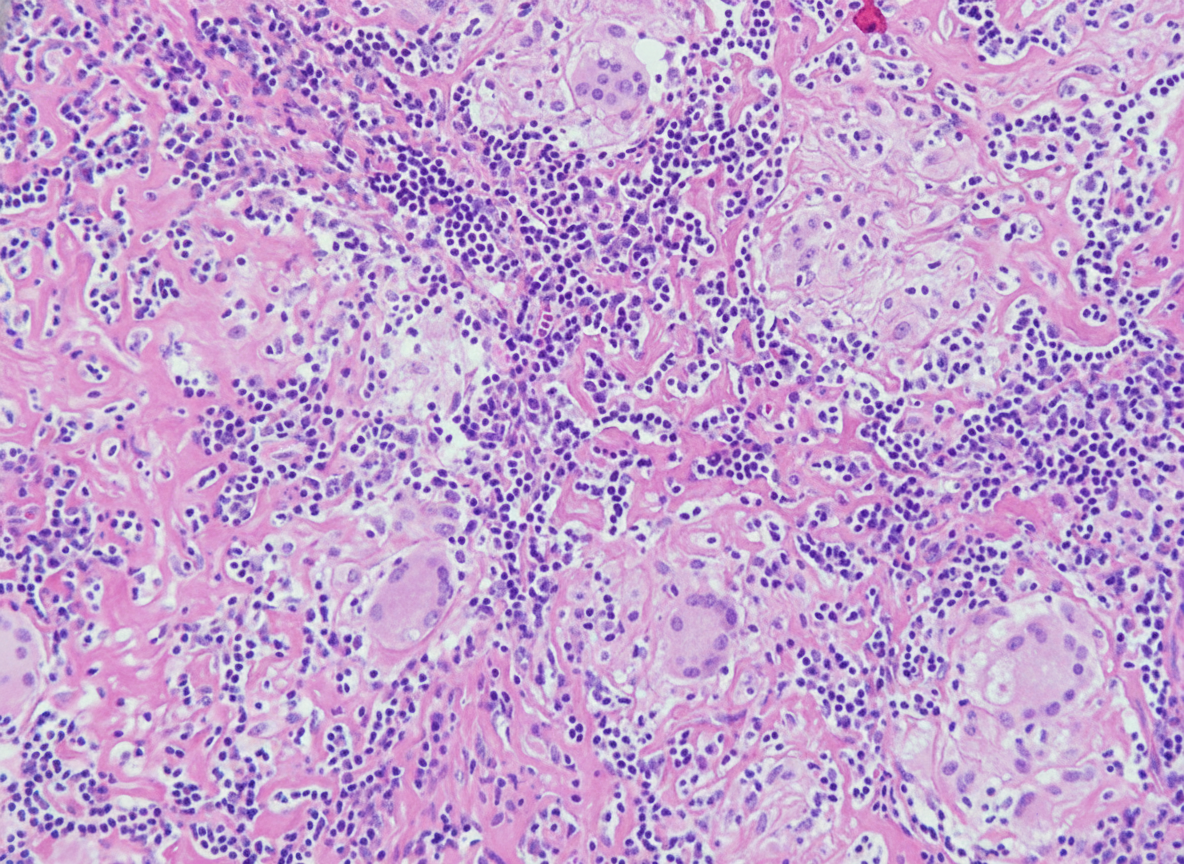
The following skin biopsy from a patient of leprosy is diagnostic of: (Recent NEET Pattern 2016-17)
Q12
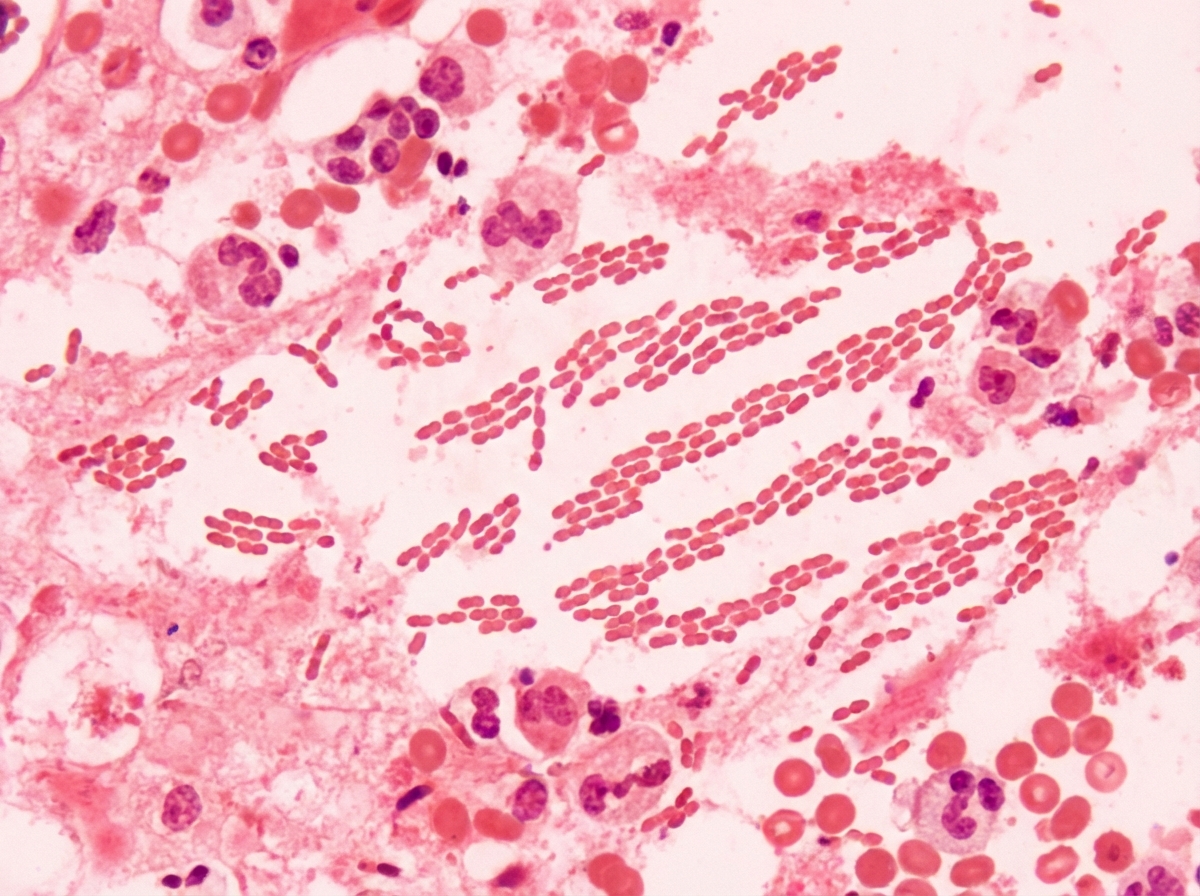
The following is a picture from scrapping of genital ulcer. Comment on the diagnosis. (AIIMS May 2017)
Q13
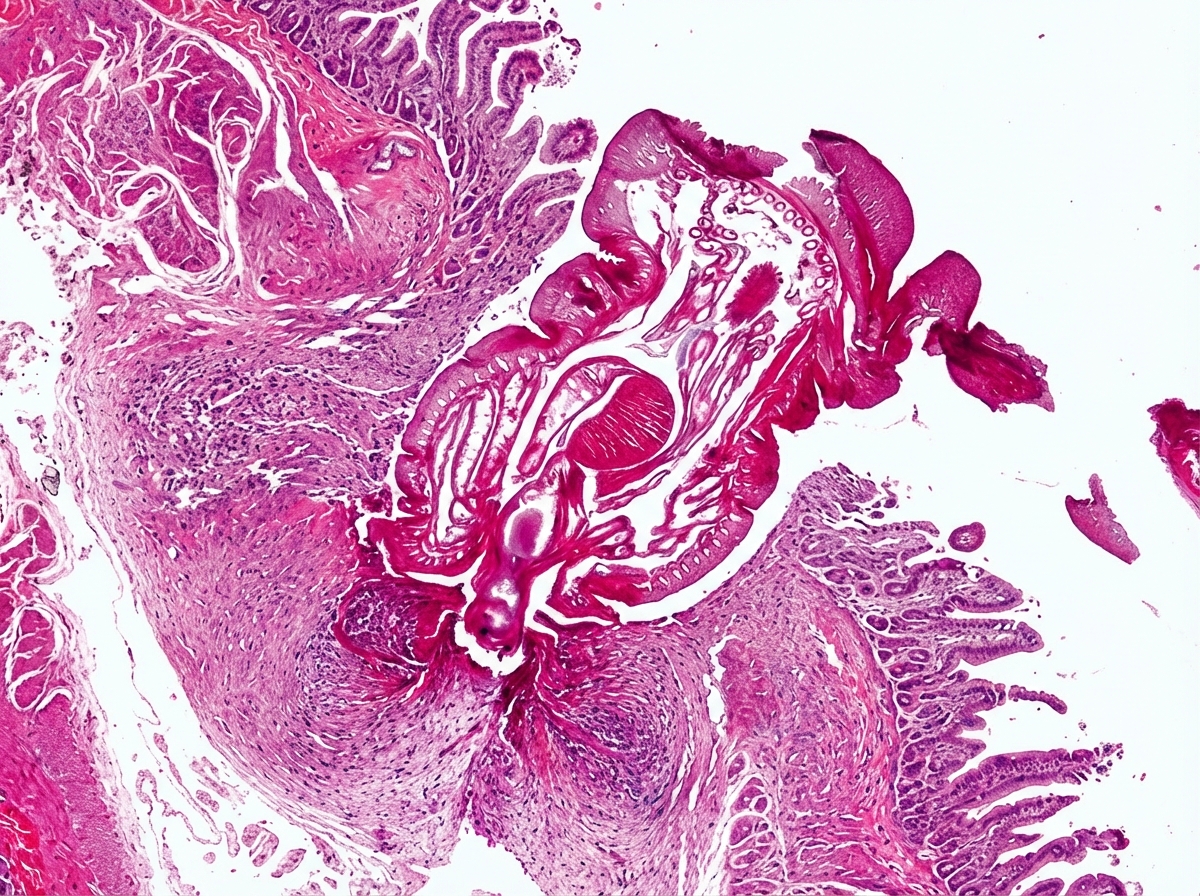
A 12-year-old boy develops multiple lumps in the skin. Biopsy of the lumps is shown below. What is the probable causative agent? (NEET Pattern 2019)
Q14
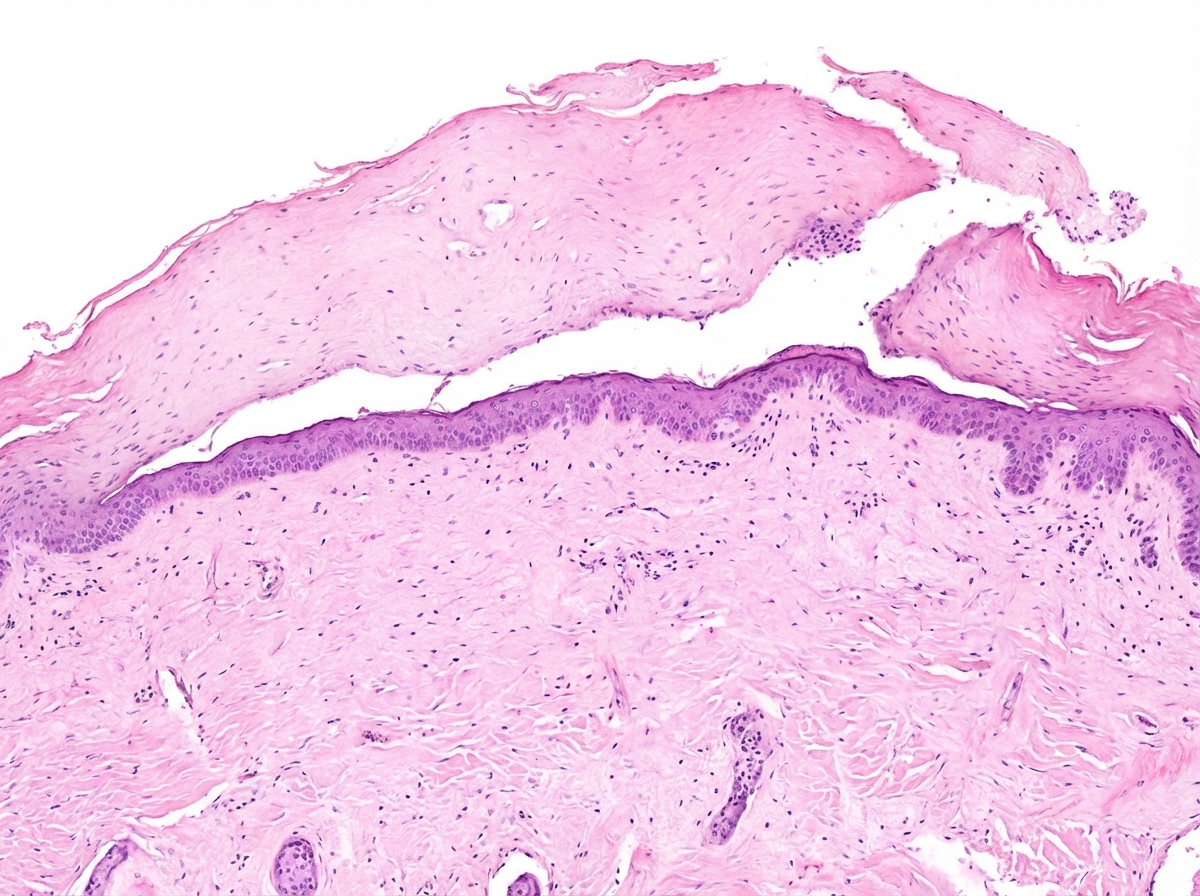
Identify the histopathological slide shown below:
Dermatopathology US Medical PG Practice Questions and MCQs
Question 11: The following skin biopsy from a patient of leprosy is diagnostic of: (Recent NEET Pattern 2016-17)
A. Histoid leprosy
B. Tuberculoid leprosy (Correct Answer)
C. Lepromatous leprosy
D. Borderline leprosy
E. Indeterminate leprosy
Explanation: ***Tuberculoid leprosy***
- The image shows well-formed **granulomas** with **epithelioid cells**, **Langhans giant cells**, and a surrounding lymphocytic infiltrate [2], which are characteristic of a strong cell-mediated immune response against *Mycobacterium leprae* [1].
- **Acid-fast bacilli (AFB)** are typically **sparse or absent** in tuberculoid leprosy due to effective immune containment [1][3].
*Histoid leprosy*
- Characterized by the presence of **spindle-shaped histiocytes** arranged in a storiform or whorled pattern.
- Contains a **large number of AFB**, often arranged in globi, which is not consistent with the described image.
*Lepromatous leprosy*
- Shows a diffuse infiltrate of **foamy macrophages** (Virchow cells) filled with numerous **AFB** (globi) [1].
- **Granulomas are poorly formed or absent** due to a deficient cell-mediated immune response [3].
*Borderline leprosy*
- Represents a spectrum between tuberculoid and lepromatous forms, with features of both.
- Histologically, it shows **granulomas that are less well-defined** than tuberculoid leprosy and contain a variable number of AFB, more than tuberculoid but less than lepromatous.
**References:**
[1] Kumar V, Abbas AK, et al.. Robbins and Cotran Pathologic Basis of Disease. 9th ed. Infectious Diseases, pp. 385-386.
[2] Kumar V, Abbas AK, et al.. Robbins and Cotran Pathologic Basis of Disease. 9th ed. Inflammation and Repair, p. 109.
[3] Cross SS. Underwood's Pathology: A Clinical Approach. 6th ed. Disorders Involving Inflammatory And Haemopoietic Cells, pp. 638-639.
Question 12: The following is a picture from scrapping of genital ulcer. Comment on the diagnosis. (AIIMS May 2017)
A. Klebsiella granulomatosis
B. Neisseria gonorrhoea
C. Chlamydia trachomatis
D. Treponema pallidum
E. Haemophilus ducreyi (Correct Answer)
Explanation: ***Hemophilus ducreyi***
- *Hemophilus ducreyi* causes **chancroid**, characterized by painful genital ulcers with ragged, undermined borders and often associated with painful inguinal lymphadenopathy.
- Microscopic examination of a smear from the ulcer typically shows **Gram-negative coccobacillary rods** arranged in "school of fish" or "railroad track" patterns.
*Klebsiella granulomatosis*
- *Klebsiella granulomatosis* (formerly *Calymmatobacterium granulomatis*) causes **donovanosis** (granuloma inguinale), which presents as painless, beefy red, friable ulcers [1].
- Diagnosis is made by identifying **Donovan bodies** (intracellular bipolar-staining rods) in tissue smears or biopsies [1].
*Neisseria gonorrhoea*
- *Neisseria gonorrhoea* primarily causes **urethritis** in men and **cervicitis** in women, with purulent discharge.
- While it can cause disseminated infection, it typically does not present as a primary genital ulcer.
*Chlamydia trachomatis*
- *Chlamydia trachomatis* causes **lymphogranuloma venereum (LGV)**, which initially presents as a transient, painless papule or ulcer, often unnoticed.
- The characteristic feature of LGV is the subsequent development of **painful inguinal lymphadenopathy** (buboes) and proctitis.
**References:**
[1] Kumar V, Abbas AK, et al.. Robbins and Cotran Pathologic Basis of Disease. 9th ed. Infectious Diseases, pp. 378-379.
Question 13: A 12-year-old boy develops multiple lumps in the skin. Biopsy of the lumps is shown below. What is the probable causative agent? (NEET Pattern 2019)
A. Cysticercus cellulosae (Correct Answer)
B. Cysticercus bovis
C. Echinococcus granulosus
D. Hymenolepis Nana
E. Echinococcus multilocularis
Explanation: ***Cysticercus cellulosae***
- The presence of multiple lumps in the skin, particularly in a child, is highly suggestive of **subcutaneous cysticercosis** [1].
- **_Cysticercus cellulosae_** is the larval stage of **_Taenia solium_** (pork tapeworm), which commonly encysts in subcutaneous tissues, muscles, and the brain in humans [1].
*Cysticercus bovis*
- **_Cysticercus bovis_** is the larval stage of **_Taenia saginata_** (beef tapeworm).
- It primarily infects cattle and is not a common cause of subcutaneous lumps in humans.
*Echinococcus granulosus*
- **_Echinococcus granulosus_** causes **hydatid disease**, forming large cysts primarily in the liver and lungs [1].
- While it can form cysts in other organs, it typically presents as large, solitary cysts rather than multiple small subcutaneous lumps.
*Hymenolepis Nana*
- **_Hymenolepis nana_** is the **dwarf tapeworm** and is the most common cestode infection in humans.
- It is an intestinal parasite and does not form cysts or lumps in the skin.
**References:**
[1] Kumar V, Abbas AK, et al.. Robbins and Cotran Pathologic Basis of Disease. 9th ed. Infectious Diseases, pp. 403-405.
Question 14: Identify the histopathological slide shown below:
A. Toxic epidermal necrolysis (Correct Answer)
B. Lepromatous leprosy
C. Pemphigus vulgaris
D. Mycosis fungoides
E. Bullous pemphigoid
Explanation: ***Toxic epidermal necrolysis***
- Histopathology of **Toxic Epidermal Necrolysis (TEN)** characteristically shows **full-thickness epidermal necrosis** with minimal or no dermal inflammation [1].
- This extensive epidermal death leads to the characteristic **Nikolsky's sign** and widespread skin detachment.
*Lepromatous leprosy*
- Histology of **lepromatous leprosy** typically reveals a large number of **acid-fast bacilli** within macrophages, forming foamy cells.
- There is often a **grenz zone** (a clear zone) separating the inflammatory infiltrate from the overlying epidermis.
*Pemphigus vulgaris*
- **Pemphigus vulgaris** is characterized by **suprabasal acantholysis**, leading to the formation of intraepidermal blisters.
- Immunofluorescence studies show a characteristic **"chicken wire" pattern** of IgG and C3 deposition on the cell surface of keratinocytes.
*Mycosis fungoides*
- **Mycosis fungoides** is a cutaneous T-cell lymphoma, and its histology shows an epidermotropic infiltrate of atypical lymphocytes [2].
- Characteristic findings include **Pautrier microabscesses** (collections of atypical lymphocytes in the epidermis) and cerebriform nuclei of the lymphocytes [2].
**References:**
[1] Kumar V, Abbas AK, et al.. Robbins and Cotran Pathologic Basis of Disease. 9th ed. The Skin, pp. 1166-1168.
[2] Cross SS. Underwood's Pathology: A Clinical Approach. 6th ed. Common Clinical Problems From Diseases Of The Urinary And Male Genital Tracts, pp. 564-565.