An 87-year-old woman is admitted to the intensive care unit after a neighbor found her lying on the floor at her home. Her respirations are 13/min and shallow. Despite appropriate therapy, the patient dies. Gross examination of the brain at autopsy shows neovascularization and liquefactive necrosis without cavitation in the distribution of the left middle cerebral artery. Histological examination of a brain tissue sample from the left temporal lobe shows proliferation of neural cells that stain positive for glial fibrillary acidic protein. Based on these findings, approximately how much time has most likely passed since the initial injury in this patient?
Q2
A 72-year-old female is brought to the emergency department by ambulance because she was unable to walk. She says that she cut her leg while falling about a week ago. Since then, the wound has started draining fluid and become progressively more painful. She is found to have necrotizing fasciitis and is taken emergently to the operating room. Histological examination of cells along the fascial planes reveal cells undergoing necrosis. Which of the following represents the earliest sign that a cell has progressed to irreversible damage in this patient?
Q3
A 62-year-old man presents to the emergency room with an acute myocardial infarction. Twenty-four hours after admission to the cardiac intensive care unit, he develops oliguria. Laboratory tests show that his serum BUN is 59 mg/dL and his serum creatinine is 6.2 mg/dL. Renal biopsy reveals necrosis of the proximal tubules and thick ascending limb of Henle's loop. Which of the following would you most likely observe on a microscopic examination of this patient's urine?
Q4
A 34-year-old woman comes to the physician a week after noticing a lump in her left breast. Three months ago, she was discharged from the hospital after treatment of multiple injuries sustained in a motor vehicle collision. Her only medication is an oral contraceptive. Her mother died of ovarian cancer. Examination shows a 2.5-cm, nontender mass in the upper outer quadrant of the left breast. Mammography shows a circumscribed radiolucent lesion with a rim of peripheral calcification. A photomicrograph of tissue from a biopsy of the mass is shown. Which of the following is the most likely cause of the breast swelling?
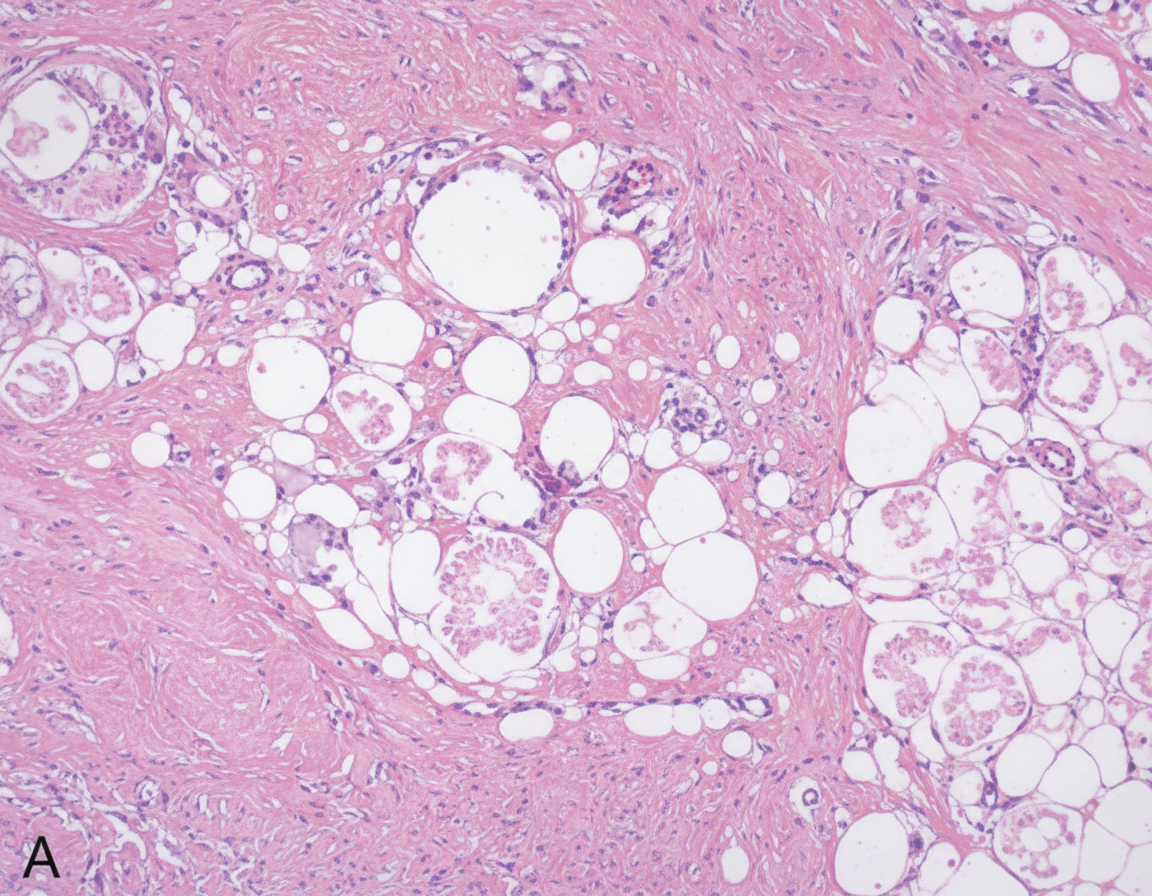
Q5
A patient in a phase 1 trial for a novel epoxide reductase inhibitor, being studied for stroke prophylaxis, develops pain and erythema on the right thigh two days after starting the trial. This rapidly progresses to a purpuric rash with necrotic bullae within 24 hours. Lab results show a PTT of 29 seconds, PT of 28 seconds, and INR of 2.15. What is the most likely pathogenesis of this condition?
Q6
A 38-year-old man is admitted to the hospital because of fever, yellowing of the skin, and nausea for 1 day. He recently returned from a backpacking trip to Brazil and Paraguay, during which he had a 3-day episode of high fever that resolved spontaneously. Physical examination shows jaundice, epigastric tenderness, and petechiae over his trunk. Five hours after admission, he develops dark brown emesis and anuria. Despite appropriate lifesaving measures, he dies. Postmortem liver biopsy shows eosinophilic degeneration of hepatocytes with condensed nuclear chromatin. This patient’s hepatocytes were most likely undergoing which of the following processes?
Q7
A 13-year-old African-American boy is brought to the physician because of a 4-week history of left groin and buttock pain. The pain is worse with activity but also present at rest. He has had many episodes of abdominal, back, and chest pain that required hospitalization in the past. He is at the 20th percentile for height and 25th percentile for weight. His temperature is 36.7°C (98°F), blood pressure is 115/82 mm Hg, and pulse is 84/min. Examination shows tenderness over the lateral aspect of the left hip with no swelling, warmth, or erythema. There is pain with passive abduction and internal rotation of the left hip. Leukocyte count is 8,600/mm3. Which of the following is the most likely cause of this patient's symptoms?
Q8
A 47-year-old woman with a long history of poorly controlled type 2 diabetes and recurrent urinary tract infections presents with complaints of fever, chills, and severe flank pain. On physical exam, she has left-sided costovertebral tenderness. Vitals include a temperature of 39.4°C (103.0°F), blood pressure of 125/84 mm Hg, and pulse of 84/min. She is currently taking metformin daily. Urine dipstick analysis is positive for leukocytes, nitrites, and blood. Laboratory studies show an elevated creatinine of 2.8 mg/dL (baseline 1.0 mg/dL). Urinalysis reveals fragments of tissue. What is the most likely diagnosis?
Q9
A 13-year-old boy is brought to the emergency department by his parents for severe right hip pain that suddenly started about 2 hours ago. The parents are extremely anxious and feel overwhelmed because the boy has been hospitalized several times in the past for similar episodes of pain. The boy was born at 39 weeks of gestation via spontaneous vaginal delivery. He is up to date on all vaccinations and is meeting all developmental milestones. His only medication is hydroxyurea, which he has been receiving for 3 years. His blood pressure is 125/84 mm Hg, the respirations are 23/min, the pulse is 87/min, and the temperature is 36.7°C (98.0°F). On physical examination, the patient is in distress and has severe pain (8/10) elicited by gentle palpation of the right femoral head. Which of the following conditions has the same pathophysiology as the likely diagnosis for the patient described in this case?
Q10
A 52-year-old female was found upon mammography to have branching calcifications in the right lower breast. Physical exam revealed a palpable nodularity in the same location. A tissue biopsy was taken from the lesion, and the pathology report diagnosed the lesion as comedocarcinoma. Which of the following histological findings is most likely present in the lesion?
Types of necrosis (coagulative, liquefactive, etc.) US Medical PG Practice Questions and MCQs
Question 1: An 87-year-old woman is admitted to the intensive care unit after a neighbor found her lying on the floor at her home. Her respirations are 13/min and shallow. Despite appropriate therapy, the patient dies. Gross examination of the brain at autopsy shows neovascularization and liquefactive necrosis without cavitation in the distribution of the left middle cerebral artery. Histological examination of a brain tissue sample from the left temporal lobe shows proliferation of neural cells that stain positive for glial fibrillary acidic protein. Based on these findings, approximately how much time has most likely passed since the initial injury in this patient?
A. 2 days
B. 2 hours
C. 10 days (Correct Answer)
D. 25 days
E. 12 hours
Explanation: ***10 days***
- **Neovascularization** and the absence of cavitation with **liquefactive necrosis** are indicative of a subacute phase of ischemic injury, typically seen around 1-3 weeks.
- The proliferation of **glial fibrillary acidic protein (GFAP)** positive neural cells (astrocytes) signifies **astrogliosis**, a repair response common after approximately one week, peaking around 2-3 weeks post-injury.
*2 days*
- At 2 days, the primary histological findings would be **neutrophilic infiltration** and initial stages of neuronal necrosis.
- **Neovascularization** and significant astrogliosis are generally not prominent until later in the recovery phase.
*2 hours*
- Within 2 hours, there would be minimal to no gross changes, and microscopic examination might show only **red neurons** (eosinophilic neurons with pyknotic nuclei) reflecting early irreversible neuronal damage.
- There would be no signs of inflammation, tissue breakdown, or repair processes like neovascularization or astrogliosis.
*25 days*
- By 25 days (approximately 3-4 weeks), **cavitation** with a **cystic astrocytic glial scar** would likely be prominent at the site of liquefactive necrosis, which is explicitly stated as absent in the question.
- While astrogliosis would still be present, the lack of cavitation points to an earlier stage of repair.
*12 hours*
- At 12 hours, gross changes are typically still absent or subtle, and microscopic findings would primarily involve **edema** and early signs of neuronal injury (e.g., changes in Nissl bodies, mild eosinophilia).
- Inflammatory cell infiltration and reparative processes like neovascularization or astrogliosis would not yet be significant.
Question 2: A 72-year-old female is brought to the emergency department by ambulance because she was unable to walk. She says that she cut her leg while falling about a week ago. Since then, the wound has started draining fluid and become progressively more painful. She is found to have necrotizing fasciitis and is taken emergently to the operating room. Histological examination of cells along the fascial planes reveal cells undergoing necrosis. Which of the following represents the earliest sign that a cell has progressed to irreversible damage in this patient?
A. Fragmentation of the nucleus
B. Membrane blebbing from organelles
C. Chromatin dissolution and disappearance
D. Ribosomal detachment from the endoplasmic reticulum
E. Condensation of DNA into a basophilic mass (Correct Answer)
Explanation: ***Condensation of DNA into a basophilic mass***
- **Karyopyknosis**, or the **condensation of nuclear chromatin into a dense, shrunken mass**, is an early microscopic sign of irreversible cell injury leading to necrosis. It indicates the cell has committed to a death pathway.
- This nuclear change is characterized by the nucleus appearing as a **small, dense, and deeply basophilic structure** due to chromatin clumping.
*Fragmentation of the nucleus*
- **Karyorrhexis**, the fragmentation of the pyknotic nucleus, occurs *after* karyopyknosis, indicating a later stage of irreversible injury.
- This process involves the breakdown of the condensed nuclear fragments, leading to their subsequent disappearance.
*Membrane blebbing from organelles*
- **Membrane blebbing** can occur in both reversible and irreversible injury, but its presence on *organelles* specifically doesn't necessarily represent the *earliest* sign of irreversible damage compared to nuclear changes.
- While significant blebbing points towards severe damage, **nuclear changes** are often considered more definitive early markers of irreversible commitment.
*Chromatin dissolution and disappearance*
- **Karyolysis**, the dissolution and fading of the nucleus due to enzymatic degradation, represents a *later* stage of irreversible injury, occurring after karyopyknosis and karyorrhexis.
- In this stage, the nucleus eventually completely disappears, leaving only an anucleated ghost cell.
*Ribosomal detachment from the endoplasmic reticulum*
- **Ribosomal detachment** from the endoplasmic reticulum is an early sign of **reversible cell injury**, leading to decreased protein synthesis.
- It indicates initial cellular stress but not necessarily a commitment to irreversible damage or necrosis.
Question 3: A 62-year-old man presents to the emergency room with an acute myocardial infarction. Twenty-four hours after admission to the cardiac intensive care unit, he develops oliguria. Laboratory tests show that his serum BUN is 59 mg/dL and his serum creatinine is 6.2 mg/dL. Renal biopsy reveals necrosis of the proximal tubules and thick ascending limb of Henle's loop. Which of the following would you most likely observe on a microscopic examination of this patient's urine?
A. White blood cell casts
B. Broad waxy casts
C. Fatty casts
D. Hyaline casts
E. Muddy brown casts (Correct Answer)
Explanation: ***Muddy brown casts***
- The patient's presentation of **acute myocardial infarction** followed by **oliguria**, elevated **BUN** and **creatinine**, and necrosis of the **proximal tubules** and **thick ascending limb** of Henle's loop is characteristic of **acute tubular necrosis (ATN)**.
- **Muddy brown casts** composed of **granular material** and **renal tubular epithelial cells** are the classic finding in the urine sediment of patients with ATN.
*White blood cell casts*
- **White blood cell casts** are typically associated with **pyelonephritis** or **interstitial nephritis**, indicating renal inflammation or infection.
- While infection can exacerbate kidney injury, the primary pathology described here is **ischemic ATN**, not an infectious process.
*Broad waxy casts*
- **Broad waxy casts** indicate severe, **chronic kidney disease** with significant **tubular dilation** and **stasis**, often end-stage renal disease.
- The patient's clinical picture depicts **acute kidney injury**, not chronic kidney failure.
*Fatty casts*
- **Fatty casts** are characteristic of **nephrotic syndrome**, which involves significant proteinuria and hyperlipidemia.
- This patient's presentation does not describe the features of **nephrotic syndrome**, such as **massive proteinuria** or **edema**.
*Hyaline casts*
- **Hyaline casts** are composed of **Tamm-Horsfall protein** and can be found in healthy individuals, especially after exercise or dehydration.
- While they can be present in various kidney conditions, they are **non-specific** and not indicative of the specific **tubular epithelial cell injury** seen in ATN.
Question 4: A 34-year-old woman comes to the physician a week after noticing a lump in her left breast. Three months ago, she was discharged from the hospital after treatment of multiple injuries sustained in a motor vehicle collision. Her only medication is an oral contraceptive. Her mother died of ovarian cancer. Examination shows a 2.5-cm, nontender mass in the upper outer quadrant of the left breast. Mammography shows a circumscribed radiolucent lesion with a rim of peripheral calcification. A photomicrograph of tissue from a biopsy of the mass is shown. Which of the following is the most likely cause of the breast swelling?
A. Defect in DNA repair
B. Obstruction of lactiferous ducts
C. Stimulation of estrogen receptors
D. Thrombophlebitis of subcutaneous veins
E. Release of cytoplasmic triglycerides (Correct Answer)
Explanation: ***Release of cytoplasmic triglycerides***
- This patient's history of **trauma** followed by a new breast lump and mammographic findings of a **circumscribed radiolucent lesion with peripheral calcification** are classic for **fat necrosis**. The image shows necrotic fat cells, inflammatory infiltrates, and foamy macrophages, consistent with fat necrosis.
- Fat necrosis occurs when **adipocytes** are damaged, causing the release of **triglycerides** and free fatty acids. These then incite an inflammatory response, followed by calcification and fibrosis.
*Defect in DNA repair*
- A defect in DNA repair is associated with an increased risk of **malignancy**, such as breast cancer, especially given the family history of ovarian cancer (BRCA gene mutations). However, the histologic image and the description of a **radiolucent lesion with rim calcification** are not characteristic of malignancy.
- While the family history is relevant for cancer risk, the clinical and histological findings point away from a primary malignancy and towards a benign reactive process.
*Obstruction of lactiferous ducts*
- Obstruction of lactiferous ducts typically leads to conditions like **mastitis**, **duct ectasia**, or **galactocele**. These would present with different radiographic features, often with inflammation or fluid-filled cysts, and different histological patterns.
- The image does not show features of ductal obstruction, such as dilated ducts, inspissated secretions, or periductal inflammation characteristic of duct ectasia.
*Stimulation of estrogen receptors*
- Stimulation of estrogen receptors is relevant in conditions like **fibroadenoma**, **fibrocystic changes**, or certain types of **breast cancer**. While the patient is on oral contraceptives (estrogenic), the clinical picture and biopsy findings are not consistent with these estrogen-mediated conditions.
- Fibroadenomas often appear as well-defined masses on mammography but histologically consist of glandular and stromal proliferation, which is not seen here. Fibrocystic changes involve cysts and fibrosis.
*Thrombophlebitis of subcutaneous veins*
- Thrombophlebitis of subcutaneous veins, also known as **Mondor's disease**, presents as a palpable cord-like structure with pain and tenderness localized along the affected vein. It typically resolves spontaneously.
- This condition is unlikely given the description of a **2.5-cm, nontender mass** and the specific histological findings of necrotic fat and inflammation, which are not characteristic of venous thrombosis.
Question 5: A patient in a phase 1 trial for a novel epoxide reductase inhibitor, being studied for stroke prophylaxis, develops pain and erythema on the right thigh two days after starting the trial. This rapidly progresses to a purpuric rash with necrotic bullae within 24 hours. Lab results show a PTT of 29 seconds, PT of 28 seconds, and INR of 2.15. What is the most likely pathogenesis of this condition?
A. Decreased plasmin activity
B. Decreased platelet count
C. Decreased protein C levels (Correct Answer)
D. Increased factor VIII activity
E. Decreased antithrombin III activity
Explanation: ***Decreased protein C levels***
- The clinical presentation of **pain and erythema progressing to purpuric rash with necrotic bullae** within 2-3 days of starting therapy, along with elevated PT/INR, is **pathognomonic for warfarin-induced skin necrosis**.
- This novel **epoxide reductase inhibitor** works like warfarin by inhibiting **vitamin K epoxide reductase**, which depletes all vitamin K-dependent factors.
- **Protein C and protein S** (natural anticoagulants) have **short half-lives** (6-8 hours) and drop rapidly, while procoagulant factors II, VII, IX, and X have longer half-lives (24-60 hours).
- This creates a **transient hypercoagulable state** in the first 2-3 days of therapy with **low protein C/S** but relatively preserved procoagulant factors, leading to **microvascular thrombosis** and skin necrosis.
- Most common in patients with **hereditary protein C or S deficiency** or those receiving loading doses.
*Decreased antithrombin III activity*
- Antithrombin III is **not a vitamin K-dependent factor** and is not directly affected by epoxide reductase inhibitors.
- Decreased antithrombin III would cause thrombosis but does not explain the **specific temporal relationship** and mechanism of warfarin-induced skin necrosis.
- Antithrombin III deficiency causes **venous thromboembolism**, not the characteristic cutaneous necrosis pattern.
*Decreased plasmin activity*
- Plasmin is involved in **fibrinolysis** and is not affected by vitamin K epoxide reductase inhibitors.
- Decreased plasmin activity would impair clot breakdown but does not explain the **early hypercoagulable state** specific to warfarin initiation.
- This mechanism is not relevant to warfarin-induced skin necrosis.
*Decreased platelet count*
- The lab values provided show **elevated PT/INR**, consistent with coagulation factor depletion, not thrombocytopenia.
- Thrombocytopenia causes **petechiae and mucosal bleeding**, not the large **necrotic bullae** seen here.
- Platelet count is not affected by epoxide reductase inhibitors.
*Increased factor VIII activity*
- Factor VIII is **not a vitamin K-dependent factor** and is not depleted by epoxide reductase inhibitors.
- While elevated factor VIII can contribute to hypercoagulability, it does not explain the **specific mechanism and timeline** of warfarin-induced skin necrosis.
- This is not the primary pathogenesis of this condition.
Question 6: A 38-year-old man is admitted to the hospital because of fever, yellowing of the skin, and nausea for 1 day. He recently returned from a backpacking trip to Brazil and Paraguay, during which he had a 3-day episode of high fever that resolved spontaneously. Physical examination shows jaundice, epigastric tenderness, and petechiae over his trunk. Five hours after admission, he develops dark brown emesis and anuria. Despite appropriate lifesaving measures, he dies. Postmortem liver biopsy shows eosinophilic degeneration of hepatocytes with condensed nuclear chromatin. This patient’s hepatocytes were most likely undergoing which of the following processes?
A. Regeneration
B. Steatosis
C. Necrosis
D. Apoptosis (Correct Answer)
E. Proliferation
Explanation: ***Apoptosis***
- The patient's symptoms (fever, jaundice, epigastric tenderness, petechiae, dark emesis, anuria) and history of travel to endemic areas are highly suggestive of **Yellow Fever**.
- **Eosinophilic degeneration of hepatocytes with condensed nuclear chromatin**, described as **Councilman bodies** or **apoptotic bodies**, is a characteristic histological finding in Yellow Fever and indicates programmed cell death.
*Regeneration*
- This process involves the replacement of damaged tissue with new, healthy tissue, which would contradict the patient's rapidly deteriorating condition and death.
- While regeneration can occur in the liver, the described histological findings of **eosinophilic degeneration** and **condensed nuclear chromatin** are indicative of cell death, not repair.
*Steatosis*
- **Steatosis** refers to the accumulation of fat droplets within hepatocytes, which is usually seen in conditions like alcoholic liver disease or non-alcoholic fatty liver disease.
- This is not consistent with the eosinophilic degeneration and condensed chromatin described, which point to a different type of cellular injury.
*Necrosis*
- **Necrosis** is a form of unregulated cell death often associated with inflammation and cellular swelling; the description of **eosinophilic degeneration** and **condensed nuclear chromatin** points specifically to apoptotic cell death rather than necrotic changes which would typically include cell swelling and rupture.
- While Yellow Fever does cause significant liver damage leading to cell death, the specific histological features (e.g., Councilman bodies) are characteristic of **apoptosis**, not typically seen in necrosis.
*Proliferation*
- **Proliferation** refers to an increase in the number of cells, typically in response to a stimulus or as part of a disease process like cancer.
- The patient's rapid decline and the histological findings of dying cells (eosinophilic degeneration, condensed chromatin) are antithetical to cellular proliferation.
Question 7: A 13-year-old African-American boy is brought to the physician because of a 4-week history of left groin and buttock pain. The pain is worse with activity but also present at rest. He has had many episodes of abdominal, back, and chest pain that required hospitalization in the past. He is at the 20th percentile for height and 25th percentile for weight. His temperature is 36.7°C (98°F), blood pressure is 115/82 mm Hg, and pulse is 84/min. Examination shows tenderness over the lateral aspect of the left hip with no swelling, warmth, or erythema. There is pain with passive abduction and internal rotation of the left hip. Leukocyte count is 8,600/mm3. Which of the following is the most likely cause of this patient's symptoms?
A. Avascular necrosis (Correct Answer)
B. Impaired skeletal growth
C. Transient synovitis
D. Septic arthritis
E. Proximal femoral osteosarcoma
Explanation: ***Avascular necrosis***
- The patient's history of recurrent pain crises (abdominal, back, chest pain) and **African-American ethnicity** strongly suggest **sickle cell disease**, where vascular occlusion can lead to **avascular necrosis (AVN)** of bone.
- The presenting symptoms of chronic groin and buttock pain, particularly with activity and at rest, and pain on hip movement (abduction, internal rotation) are classic for **femoral head AVN**.
*Impaired skeletal growth*
- While patients with chronic diseases like sickle cell can have impaired growth, this option describes a **general growth problem**, not a specific acute cause of severe hip pain.
- Impaired skeletal growth itself does not typically cause **localized, acute groin and buttock pain** that is worsened by movement.
*Transient synovitis*
- This condition is typically **acute and self-limiting**, lasting usually a few days to a week, not 4 weeks, and commonly follows a viral illness.
- It primarily affects younger children (ages 3-8) and is less common in adolescents with a history suggestive of sickle cell disease.
*Septic arthritis*
- Septic arthritis presents with **acute onset of severe pain**, fever, and local signs of inflammation like warmth, swelling, and erythema, which are absent in this case.
- The patient's **leukocyte count is normal** (8,600/mm3), which makes septic arthritis less likely.
*Proximal femoral osteosarcoma*
- Osteosarcoma usually presents with **progressively worsening bone pain** and often a palpable mass or swelling, which is not described here.
- While rare, it's less likely given the patient's strong history suggestive of an underlying condition that predisposes to AVN.
Question 8: A 47-year-old woman with a long history of poorly controlled type 2 diabetes and recurrent urinary tract infections presents with complaints of fever, chills, and severe flank pain. On physical exam, she has left-sided costovertebral tenderness. Vitals include a temperature of 39.4°C (103.0°F), blood pressure of 125/84 mm Hg, and pulse of 84/min. She is currently taking metformin daily. Urine dipstick analysis is positive for leukocytes, nitrites, and blood. Laboratory studies show an elevated creatinine of 2.8 mg/dL (baseline 1.0 mg/dL). Urinalysis reveals fragments of tissue. What is the most likely diagnosis?
A. Acute cystitis
B. Acute glomerulonephritis
C. Acute tubular necrosis
D. Acute interstitial nephritis
E. Acute papillary necrosis (Correct Answer)
Explanation: ***Acute papillary necrosis***
- This patient's presentation with **fever, severe flank pain, costovertebral tenderness**, **elevated creatinine indicating acute kidney injury**, and **tissue fragments in urine** is classic for **acute papillary necrosis**.
- Her **poorly controlled type 2 diabetes** and **recurrent UTIs** are major risk factors. Chronic hyperglycemia causes **renal medullary ischemia**, and recurrent infections further compromise blood supply to the renal papillae.
- The **tissue fragments** represent sloughed papillae, a pathognomonic finding. The combination of **hematuria, acute kidney injury, and systemic symptoms** in a diabetic with recurrent infections strongly points to this diagnosis.
- Other risk factors include analgesic abuse, sickle cell disease, and urinary tract obstruction.
*Acute cystitis*
- **Acute cystitis** presents with **dysuria, frequency, and urgency** but typically **without fever, systemic symptoms, or costovertebral tenderness**.
- It does not cause **acute kidney injury** or **tissue fragments in urine**.
- The severe presentation with AKI and CVA tenderness indicates upper urinary tract pathology.
*Acute glomerulonephritis*
- **Acute glomerulonephritis** presents with **hematuria, proteinuria, hypertension, and edema**, often following streptococcal infection.
- It does not typically cause **fever, severe flank pain, or CVA tenderness**.
- The presence of **nitrites** and **tissue fragments** points to bacterial infection with tissue necrosis, not glomerular inflammation.
*Acute tubular necrosis*
- **Acute tubular necrosis (ATN)** causes acute kidney injury but typically follows **ischemic insult** (hypotension, surgery) or **nephrotoxic exposure** (aminoglycosides, contrast).
- ATN does not present with **fever, chills, severe flank pain, or tissue fragments in urine**.
- Urinalysis in ATN shows muddy brown casts, not tissue fragments with nitrites.
*Acute interstitial nephritis*
- **Acute interstitial nephritis (AIN)** is typically a **drug-induced hypersensitivity reaction** presenting with **fever, rash, eosinophilia**, and AKI.
- The classic triad is fever, rash, and eosinophilia, often occurring days to weeks after drug exposure.
- **Nitrites** (indicating bacterial infection) and **tissue fragments** are not consistent with AIN, which shows sterile pyuria and white blood cell casts.
Question 9: A 13-year-old boy is brought to the emergency department by his parents for severe right hip pain that suddenly started about 2 hours ago. The parents are extremely anxious and feel overwhelmed because the boy has been hospitalized several times in the past for similar episodes of pain. The boy was born at 39 weeks of gestation via spontaneous vaginal delivery. He is up to date on all vaccinations and is meeting all developmental milestones. His only medication is hydroxyurea, which he has been receiving for 3 years. His blood pressure is 125/84 mm Hg, the respirations are 23/min, the pulse is 87/min, and the temperature is 36.7°C (98.0°F). On physical examination, the patient is in distress and has severe pain (8/10) elicited by gentle palpation of the right femoral head. Which of the following conditions has the same pathophysiology as the likely diagnosis for the patient described in this case?
A. Posterior dislocation of the hip
B. Developmental dysplasia of the hip
C. Iliotibial band syndrome
D. Legg-Calve-Perthes disease (Correct Answer)
E. Osgood-Schlatter disease
Explanation: ***Legg-Calve-Perthes disease***
- The patient's history of **sickle cell disease** (implied by hydroxyurea use and recurrent pain crises) puts him at risk for **avascular necrosis** of the femoral head. Legg-Calve-Perthes disease is also a form of avascular necrosis, specifically affecting the femoral head in children.
- Both conditions involve the **interruption of blood supply** to the femoral head, leading to bone death and subsequent collapse, which manifests as severe hip pain.
*Posterior dislocation of the hip*
- While a posterior hip dislocation causes severe pain, it is an acute traumatic injury and does not share the same underlying pathophysiology of **ischemic necrosis** as seen in the patient's likely condition.
- A dislocated hip would typically present with a **visible deformity** and inability to bear weight, which is not primarily described here, although pain is severe.
*Developmental dysplasia of the hip*
- This condition is a **congenital abnormality** involving abnormal development of the hip joint, leading to instability or dislocation.
- Its pathophysiology is related to **joint development**, not an interruption of blood supply to the bone.
*Iliotibial band syndrome*
- This is an **overuse injury** resulting from inflammation and tightness of the iliotibial band, typically causing pain on the lateral aspect of the knee or hip.
- Its pathophysiology is **mechanical irritation and inflammation**, not a vascular disorder leading to bone necrosis.
*Osgood-Schlatter disease*
- This condition is characterized by **tibial tuberosity apophysitis**, an inflammation of the growth plate at the point where the patellar tendon attaches to the shinbone.
- It is an **overuse injury** mainly affecting adolescent athletes and does not involve avascular necrosis of bone.
Question 10: A 52-year-old female was found upon mammography to have branching calcifications in the right lower breast. Physical exam revealed a palpable nodularity in the same location. A tissue biopsy was taken from the lesion, and the pathology report diagnosed the lesion as comedocarcinoma. Which of the following histological findings is most likely present in the lesion?
A. Disordered glandular cells invading the ductal basement membrane
B. Pleomorphic cells surrounding areas of comedonecrosis (Correct Answer)
C. Extensive lymphocytic infiltrate
D. Halo cells in epidermal tissue
E. Orderly rows of cells surrounding lobules
Explanation: ***Pleomorphic cells surrounding areas of comedonecrosis***
- **Comedocarcinoma** specifically refers to a high-grade subtype of **ductal carcinoma in situ (DCIS)** characterized by **central necrosis (comedonecrosis)** surrounded by **pleomorphic epithelial cells**.
- The presence of branching calcifications on mammography is also a classic sign often associated with **comedonecrosis** within the ducts.
*Disordered glandular cells invading the ductal basement membrane*
- This description is characteristic of **invasive ductal carcinoma**, where malignant cells breach the basement membrane and infiltrate surrounding tissues, which is not stated in the diagnosis of comedocarcinoma.
- Comedocarcinoma is a form of **carcinoma in situ**, meaning the cancerous cells are confined within the ductal system and have not yet invaded the basement membrane.
*Extensive lymphocytic infiltrate*
- While immune cell infiltrates can be seen in various cancers, an **extensive lymphocytic infiltrate** is more characteristic of conditions like **medullary carcinoma** of the breast or specific immune responses, not a defining feature of comedocarcinoma.
- It does not directly relate to the characteristic histological appearance of **comedonecrosis** and **pleomorphic cells** seen in comedocarcinoma.
*Halo cells in epidermal tissue*
- **Halo cells** (koilocytes) are characteristic of **human papillomavirus (HPV) infection** and are found in **cervical or anal squamous lesions**, not typically in breast tissue.
- This finding is completely unrelated to breast pathology and specifically to comedocarcinoma.
*Orderly rows of cells surrounding lobules*
- This description is more indicative of **lobular carcinoma in situ (LCIS)** or some benign proliferative lesions, where cellular architecture tends to maintain some order.
- **Comedocarcinoma** involves disordered, pleomorphic cells within ducts, often with central necrosis, and does not form orderly rows surrounding lobules.
Want unlimited practice?
Get full access to all questions, explanations, and performance tracking.