During an experiment, an investigator attempts to determine the rates of apoptosis in various tissue samples. Injecting cytotoxic T cells into the cell culture of one of the samples causes the tissue cells to undergo apoptosis. Apoptosis is most likely due to secretion of which of the following substances in this case?
Q52
A 21-year-old medical student is studying different types of necrosis and tissue injuries. In the pathology laboratory, he observes different dead tissues under the microscope and notices the changes that are occurring as a function of time. After serial observations, he deduced that coagulation necrosis is...?
Q53
A 40-year-old man presents with a rash, oral lesions, and vision problems for 5 days. He says the rash started as a burning feeling on his face and the upper part of his torso, but soon red spots appeared in that same distribution. The spots grew in size and spread to his upper extremities. The patient says the spots are painful but denies any associated pruritus. He says the painful oral lesions appeared about the same time as the rash. For the past 3 days, he also says he has been having double vision and dry, itchy eyes. He reports that he had a mild upper respiratory infection for a few days that preceded his current symptoms. The patient denies any chills, hematuria, abdominal or chest pain, or similar symptoms in the past. Past medical history is significant for a severe urinary tract infection diagnosed 3 weeks ago for which he has been taking trimethoprim-sulfamethoxazole. The vital signs include: temperature 38.3℃ (101.0℉), blood pressure 110/60 mm Hg, respiratory rate 20/min, and pulse 108/min. On physical examination, the patient has severe painful erosions of the oral mucosa. There are multiple fluid-filled vesicles and bullae averaging 3 mm in diameter with a surrounding erythematous ring that involve only the upper torso and extensor surfaces of upper extremities. Several of the lesions have ruptured, resulting in sloughing off of the epidermal layer. There is a prominent conjunctival injection present. Ophthalmic examination reveals mild bilateral corneal abrasions without any evidence of frank ulceration. Laboratory findings are significant for the following:
White blood cell (WBC) count 8,500/mm3
Red blood cell (RBC) count 4.20 x 10⁶/mm3
Hematocrit 41.5%
Hemoglobin 14.0 g/dL
Platelet count 215,000/mm3
C-reactive protein (CRP) 86 mg/L
Urine and blood cultures are pending. Which of the following would confirm the most likely diagnosis in this patient?
Q54
A 50-year-old man arrives to the clinic complaining of progressive weakness. He explains that for 3 months he has had difficulty climbing the stairs, which has now progressed to difficulty getting out of a chair. He denies diplopia, dysphagia, dyspnea, muscle aches, or joint pains. He denies weight loss, weight gain, change in appetite, or heat or cold intolerance. He reports intermittent low-grade fevers. He has a medical history significant for hypertension and hyperlipidemia. He has taken simvastatin and losartan daily for the past 6 years. His temperature is 99.0°F (37.2°C), blood pressure is 135/82 mmHg, and pulse is 76/min. Cardiopulmonary examination is normal. The abdomen is soft, non-tender, non-distended, and without hepatosplenomegaly. Muscle strength is 3/5 in the hip flexors and 4/5 in the deltoids, biceps, triceps, patellar, and Achilles tendon reflexes are 2+ and symmetric. Sensation to pain, light touch, and vibration are intact. Gait is cautious, but grossly normal. There is mild muscle tenderness of his thighs and upper extremities. There is no joint swelling or erythema and no skin rashes. A complete metabolic panel is within normal limits. Additional lab work is obtained as shown below:
Serum:
Na+: 141 mEq/L
Cl-: 100 mEq/L
K+: 4.3 mEq/L
HCO3-: 23 mEq/L
Urea nitrogen: 18 mg/dL
Glucose: 128 mg/dL
Creatinine: 1.0 mg/dL
Alkaline phosphatase: 69 U/L
Aspartate aminotransferase (AST): 302 U/L
Alanine aminotransferase (ALT): 210 U/L
TSH: 6.9 uU/mL
Thyroxine (T4): 5.8 ug/dL
Creatine kinase: 4300 U/L
C-reactive protein: 11.9 mg/L
Erythrocyte sedimentation rate: 37 mm/h
Which of the following is the most accurate diagnostic test?
Q55
An investigator is studying cellular repair mechanisms in various tissues. One of the samples being reviewed is from the anterior horn of the spinal cord of a patient who was involved in a snowboard accident. Pathologic examination of the biopsy specimen shows dispersion of the Nissl bodies, swelling of the neuronal body, and a displacement of the nucleus to the periphery in numerous cells. Which of the following is the most likely explanation for the observed findings?
Q56
A previously healthy 44-year-old man comes to his physician because of frequent urination and increased thirst for several weeks. Physical examination shows darkened skin and a firm mass in the right upper quadrant. His blood glucose is 220 mg/dL. A photomicrograph of a specimen obtained on liver biopsy is shown. Which of the following best describes the pathogenesis of the disease process in this patient?
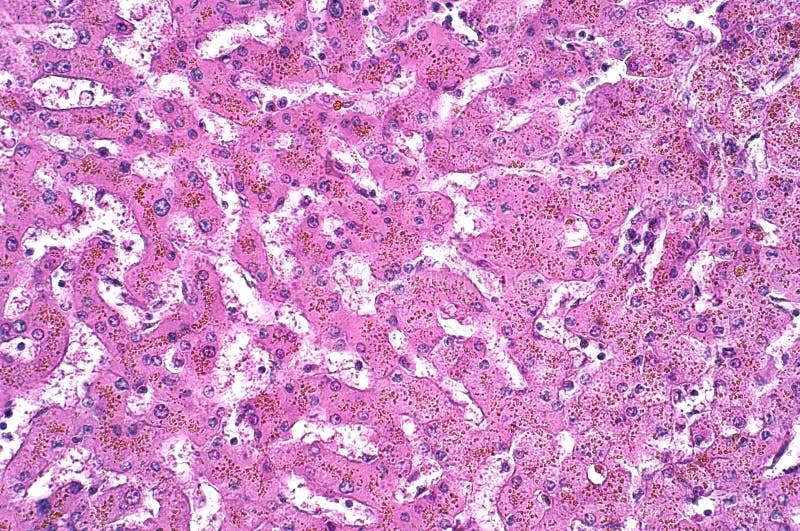
Q57
A 3-year-old boy is brought to the emergency department for nausea and vomiting for 1 day. His maternal uncle had a seizure disorder and died in childhood. He appears fatigued. Respirations are 32/min. Examination shows diffuse weakness in the extremities. Serum studies show a low pH, elevated lactate concentration, and normal blood glucose. A metabolic condition characterized by a defect in oxidative phosphorylation is suspected. Microscopic examination of a muscle biopsy specimen of this patient is most likely to show which of the following findings?
Q58
A 62-year-old man presents to the emergency room with an acute myocardial infarction. Twenty-four hours after admission to the cardiac intensive care unit, he develops oliguria. Laboratory tests show that his serum BUN is 59 mg/dL and his serum creatinine is 6.2 mg/dL. Renal biopsy reveals necrosis of the proximal tubules and thick ascending limb of Henle's loop. Which of the following would you most likely observe on a microscopic examination of this patient's urine?
Q59
A 52-year-old man presents to his primary care physician complaining of an ongoing cough. He reports that the cough started 1 year ago after a "bad cold" and then never resolved. He feels the cough is getting worse, sometimes the cough is dry, but often the cough will bring up a clear to white mucus, especially in the morning. The patient has hypertension and peripheral artery disease. He takes aspirin and lisinopril. He started smoking at age 16, and now smokes 2 packs of cigarettes a day. He has 1-2 beers a couple nights of the week with dinner. He denies illicit drug use. Which of the following cell types within the lung is most likely to undergo metaplasia caused by smoking?
Q60
A 39-year-old male presents with muscle weakness in his upper and lower extremities. The patient has also noticed some trouble with swallowing. On physical exam, signs of hyperreflexia, spasticity, fasciculations, and muscle atrophy are present in an asymmetric fashion. Tongue fasciculations are also present. No sensory loss is noted. The patient does not report any abnormality with his bowel or bladder function. What will most likely be found on muscle biopsy?
Cell injury US Medical PG Practice Questions and MCQs
Question 51: During an experiment, an investigator attempts to determine the rates of apoptosis in various tissue samples. Injecting cytotoxic T cells into the cell culture of one of the samples causes the tissue cells to undergo apoptosis. Apoptosis is most likely due to secretion of which of the following substances in this case?
A. Cytochrome C
B. TNF-α
C. Granzyme B (Correct Answer)
D. Caspases
E. Bcl-2
Explanation: ***Granzyme B***
- **Granzyme B** is a serine protease released by **cytotoxic T cells** and **natural killer cells** that directly initiates apoptosis by cleaving and activating caspases within the target cell.
- Upon entry into the target cell, granzyme B activates executioner caspases, such as caspase-3 and caspase-7, leading to the **proteolytic cascade** that dismantles the cell.
*Cytochrome C*
- **Cytochrome c** is a mitochondrial protein that, when released into the cytoplasm, can trigger the **intrinsic pathway of apoptosis** by forming the apoptosome.
- While it's crucial for the intrinsic pathway, cytotoxic T cells primarily induce the **extrinsic pathway** of apoptosis.
*TNF-α*
- **TNF-α (Tumor Necrosis Factor-alpha)** is a cytokine that can induce apoptosis by binding to its receptor (TNFR1), activating adaptor proteins like TRADD and FADD, and subsequently initiating the extrinsic apoptotic pathway.
- However, while TNF-α can induce apoptosis, the scenario specifically mentions **cytotoxic T cells** as the cause, whose primary mechanism involves granzymes and perforin rather than TNF-α secretion.
*Caspases*
- **Caspases** are a family of cysteine proteases that are central to the apoptotic process, acting as both initiator and executioner enzymes.
- They are the *effectors* of apoptosis but are not the direct substances *secreted by cytotoxic T cells* to initiate the process in the target cell.
*Bcl-2*
- **Bcl-2** is an anti-apoptotic protein that inhibits the release of cytochrome c from mitochondria, thereby preventing the activation of the intrinsic pathway of apoptosis.
- It is a regulator *within the target cell* that prevents apoptosis, not a substance secreted by cytotoxic T cells to *induce* it.
Question 52: A 21-year-old medical student is studying different types of necrosis and tissue injuries. In the pathology laboratory, he observes different dead tissues under the microscope and notices the changes that are occurring as a function of time. After serial observations, he deduced that coagulation necrosis is...?
A. The result of denaturation of glucose
B. Characterized by the preservation of cellular shape (Correct Answer)
C. Characteristic of brain ischemia
D. Commonly associated with acute pancreatic necrosis
E. The result of hydrolytic enzymes
Explanation: ***Characterized by the preservation of cellular shape***
* **Coagulation necrosis** results from **protein denaturation**, which prevents the breakdown of the cell's structural proteins and enzymes.
* This preserves the **outline of the cell** and tissue architecture for a period of time, even after cell death, giving it a ghost-like appearance.
*The result of denaturation of glucose*
* **Glucose** is a simple sugar and does not undergo denaturation in the context of necrosis; rather, **proteins** are denatured.
* Denaturation refers to the disruption of the three-dimensional structure of proteins, not carbohydrates.
*Characteristic of brain ischemia*
* **Brain ischemia** typically results in **liquefactive necrosis**, not coagulation necrosis.
* This is due to the brain's high lipid content and the abundance of hydrolytic enzymes that rapidly digest the tissue.
*Commonly associated with acute pancreatic necrosis*
* **Acute pancreatitis** is primarily associated with **fat necrosis** (due to lipase activity) and **hemorrhagic necrosis**, not classic coagulation necrosis.
* The release of activated pancreatic enzymes leads to the digestion of local adipose tissue and blood vessels.
*The result of hydrolytic enzymes*
* While hydrolytic enzymes are involved in various forms of necrosis, **coagulation necrosis** is characterized by the **denaturation of structural proteins and enzymes**, which initially inhibits their proteolytic activity.
* **Liquefactive necrosis**, conversely, is largely driven by the release of powerful hydrolytic enzymes.
Question 53: A 40-year-old man presents with a rash, oral lesions, and vision problems for 5 days. He says the rash started as a burning feeling on his face and the upper part of his torso, but soon red spots appeared in that same distribution. The spots grew in size and spread to his upper extremities. The patient says the spots are painful but denies any associated pruritus. He says the painful oral lesions appeared about the same time as the rash. For the past 3 days, he also says he has been having double vision and dry, itchy eyes. He reports that he had a mild upper respiratory infection for a few days that preceded his current symptoms. The patient denies any chills, hematuria, abdominal or chest pain, or similar symptoms in the past. Past medical history is significant for a severe urinary tract infection diagnosed 3 weeks ago for which he has been taking trimethoprim-sulfamethoxazole. The vital signs include: temperature 38.3℃ (101.0℉), blood pressure 110/60 mm Hg, respiratory rate 20/min, and pulse 108/min. On physical examination, the patient has severe painful erosions of the oral mucosa. There are multiple fluid-filled vesicles and bullae averaging 3 mm in diameter with a surrounding erythematous ring that involve only the upper torso and extensor surfaces of upper extremities. Several of the lesions have ruptured, resulting in sloughing off of the epidermal layer. There is a prominent conjunctival injection present. Ophthalmic examination reveals mild bilateral corneal abrasions without any evidence of frank ulceration. Laboratory findings are significant for the following:
White blood cell (WBC) count 8,500/mm3
Red blood cell (RBC) count 4.20 x 10⁶/mm3
Hematocrit 41.5%
Hemoglobin 14.0 g/dL
Platelet count 215,000/mm3
C-reactive protein (CRP) 86 mg/L
Urine and blood cultures are pending. Which of the following would confirm the most likely diagnosis in this patient?
A. Gram stain and culture of skin sample
B. Urine collection (24-hour)
C. Biopsy and histopathologic analysis of skin lesions (Correct Answer)
D. Direct immunofluorescence analysis of perilesional skin biopsy
E. Flow cytometry
Explanation: ***Biopsy and histopathologic analysis of skin lesions***
- This patient's presentation of **vesiculobullous rash**, **oral erosions**, and **conjunctivitis** following recent trimethoprim-sulfamethoxazole use is highly suggestive of **Stevens-Johnson Syndrome (SJS)** or **Toxic Epidermal Necrolysis (TEN)**.
- **Skin biopsy with histopathologic analysis** is the **gold standard** for **confirming** SJS/TEN, showing characteristic findings of **full-thickness epidermal necrosis**, **keratinocyte apoptosis**, and **subepidermal blistering** with minimal dermal inflammation.
- These histologic features definitively establish the diagnosis and differentiate SJS/TEN from other vesiculobullous disorders.
*Direct immunofluorescence analysis of perilesional skin biopsy*
- While **direct immunofluorescence (DIF)** can be helpful in the workup, it typically shows **negative or sparse staining** in SJS/TEN, as this is not an autoimmune bullous disease.
- DIF is primarily used to **rule out** conditions like **pemphigus vulgaris** (which shows intercellular IgG/C3) or **bullous pemphigoid** (which shows linear basement membrane IgG/C3).
- A negative DIF supports but does not **confirm** SJS/TEN; it merely excludes autoimmune causes.
*Gram stain and culture of skin sample*
- While secondary bacterial infection can complicate SJS/TEN, a **Gram stain and culture** would only identify superimposed infection, not the underlying etiology.
- The clinical picture points to a severe **drug-induced hypersensitivity reaction**, not a primary bacterial skin infection.
*Flow cytometry*
- **Flow cytometry** analyzes **cell surface markers** and is used for hematologic malignancies, immunodeficiencies, and cell population analysis.
- It has no role in diagnosing **vesiculobullous skin disorders** or drug hypersensitivity reactions.
*Urine collection (24-hour)*
- A **24-hour urine collection** measures urinary excretion of various substances and is used for metabolic or renal assessments.
- It has no diagnostic value for **mucocutaneous drug reactions** like SJS/TEN.
Question 54: A 50-year-old man arrives to the clinic complaining of progressive weakness. He explains that for 3 months he has had difficulty climbing the stairs, which has now progressed to difficulty getting out of a chair. He denies diplopia, dysphagia, dyspnea, muscle aches, or joint pains. He denies weight loss, weight gain, change in appetite, or heat or cold intolerance. He reports intermittent low-grade fevers. He has a medical history significant for hypertension and hyperlipidemia. He has taken simvastatin and losartan daily for the past 6 years. His temperature is 99.0°F (37.2°C), blood pressure is 135/82 mmHg, and pulse is 76/min. Cardiopulmonary examination is normal. The abdomen is soft, non-tender, non-distended, and without hepatosplenomegaly. Muscle strength is 3/5 in the hip flexors and 4/5 in the deltoids, biceps, triceps, patellar, and Achilles tendon reflexes are 2+ and symmetric. Sensation to pain, light touch, and vibration are intact. Gait is cautious, but grossly normal. There is mild muscle tenderness of his thighs and upper extremities. There is no joint swelling or erythema and no skin rashes. A complete metabolic panel is within normal limits. Additional lab work is obtained as shown below:
Serum:
Na+: 141 mEq/L
Cl-: 100 mEq/L
K+: 4.3 mEq/L
HCO3-: 23 mEq/L
Urea nitrogen: 18 mg/dL
Glucose: 128 mg/dL
Creatinine: 1.0 mg/dL
Alkaline phosphatase: 69 U/L
Aspartate aminotransferase (AST): 302 U/L
Alanine aminotransferase (ALT): 210 U/L
TSH: 6.9 uU/mL
Thyroxine (T4): 5.8 ug/dL
Creatine kinase: 4300 U/L
C-reactive protein: 11.9 mg/L
Erythrocyte sedimentation rate: 37 mm/h
Which of the following is the most accurate diagnostic test?
A. Statin cessation
B. Muscle biopsy (Correct Answer)
C. Autoantibodies
D. Electromyography
E. Fine needle aspiration
Explanation: ***Muscle biopsy***
- A **muscle biopsy** is the **most accurate diagnostic test** for establishing the definitive diagnosis of myopathy in this patient with **proximal muscle weakness** and markedly elevated **creatine kinase (CK 4300 U/L)**.
- While the patient is on long-term statin therapy, the **persistently elevated inflammatory markers** (ESR 37, CRP 11.9) and very high CK raise concern for **statin-associated immune-mediated necrotizing myopathy (IMNM)**, not just simple statin myopathy.
- Muscle biopsy can differentiate between **toxic statin myopathy** (which shows minimal inflammation) and **immune-mediated necrotizing myopathy** (which shows necrosis with minimal or patchy inflammatory infiltrates).
- This distinction is **clinically critical** because IMNM requires **immunosuppressive therapy** in addition to statin discontinuation, whereas simple statin myopathy resolves with drug cessation alone.
*Statin cessation*
- While **stopping the statin** is an important **management step**, it is a **therapeutic intervention**, not a diagnostic test.
- The question specifically asks for the "most accurate **diagnostic test**," making this an inappropriate answer despite being good clinical practice.
- In cases of suspected statin-associated IMNM, simply stopping the statin may not resolve symptoms, necessitating a definitive diagnosis.
*Autoantibodies*
- **Anti-HMGCR antibodies** are highly specific for statin-associated immune-mediated necrotizing myopathy and would support the diagnosis.
- However, **muscle biopsy** remains the **gold standard** as it provides direct histopathologic confirmation and can identify the pattern of muscle injury.
- Autoantibody testing would be complementary but not as definitive as tissue diagnosis.
*Electromyography*
- **EMG** can confirm a **myopathic pattern** (short-duration, low-amplitude motor unit potentials) and help exclude neurogenic causes.
- However, it is a **functional test** that shows abnormal electrical activity but does not provide the **specific histopathologic diagnosis** that muscle biopsy offers.
- EMG findings are supportive but not definitive for the underlying etiology.
*Fine needle aspiration*
- **Fine needle aspiration** is used for cytological examination of masses or lymph nodes to diagnose malignancy or infection.
- It is **not applicable** to the diagnosis of myopathy or muscle weakness and would not provide useful information in this clinical scenario.
Question 55: An investigator is studying cellular repair mechanisms in various tissues. One of the samples being reviewed is from the anterior horn of the spinal cord of a patient who was involved in a snowboard accident. Pathologic examination of the biopsy specimen shows dispersion of the Nissl bodies, swelling of the neuronal body, and a displacement of the nucleus to the periphery in numerous cells. Which of the following is the most likely explanation for the observed findings?
A. Neurodegenerative changes
B. Neuronal aging
C. Central chromatolysis (Correct Answer)
D. Reactive astrogliosis
E. Wallerian degeneration
Explanation: ***Central chromatolysis***
- This process is a **response to axonal injury**, where the neuron undergoes characteristic morphological changes to prepare for regeneration.
- Key features include **dispersion of Nissl bodies**, **neuronal swelling**, and **nucleus displacement to the periphery**, all indicative of an attempt at cellular repair.
*Neurodegenerative changes*
- These typically involve **neuronal loss** and accumulation of **abnormal protein deposits**, rather than an attempt at cellular repair.
- The observed features (swelling, Nissl body dispersion) are part of an acute injury response, not chronic degeneration.
*Neuronal aging*
- Though aging neurons can accumulate **lipofuscin** and show some atrophy, they do not typically present with the acute, dramatic changes of cell body swelling and peripheral nucleus displacement described.
- Aging is a slow, progressive process, distinct from an acute response to injury from an accident.
*Reactive astrogliosis*
- This refers to the **proliferation and hypertrophy of astrocytes** in response to CNS injury.
- While it's a component of the injury response, it describes glial cell changes, not the neuronal body changes observed in the question.
*Wallerian degeneration*
- This process describes the **degeneration of the axon distal to the site of injury**, as well as the myelin sheath.
- It does not characterize the **changes occurring within the neuronal cell body** (soma), which are the focus of the question.
Question 56: A previously healthy 44-year-old man comes to his physician because of frequent urination and increased thirst for several weeks. Physical examination shows darkened skin and a firm mass in the right upper quadrant. His blood glucose is 220 mg/dL. A photomicrograph of a specimen obtained on liver biopsy is shown. Which of the following best describes the pathogenesis of the disease process in this patient?
A. Defective serum copper transportation
B. Defective transferrin receptor binding (Correct Answer)
C. Absence of a serine protease inhibitor
D. Upregulation of erythropoietin production
E. Absence of β-globin synthesis
Explanation: ***Defective transferrin receptor binding***
- This patient presents with symptoms of **diabetes mellitus** (frequent urination, increased thirst, elevated blood glucose), **bronze diabetes** (darkened skin), and signs of **liver disease** (firm mass in RUQ, biopsy showing iron deposition). This constellation of symptoms is characteristic of **hereditary hemochromatosis**.
- Hereditary hemochromatosis is an **autosomal recessive disorder** most commonly caused by mutations in the **HFE gene** (especially **C282Y mutation**). The HFE protein normally binds to **transferrin receptor 1 (TfR1)** on cell surfaces to sense iron levels. When HFE is mutated, this **interaction is defective**, impairing the cell's ability to sense iron status.
- This defective HFE-TfR1 binding leads to **inappropriately low hepcidin production** by the liver. With insufficient hepcidin, **ferroportin** (iron exporter) remains active on intestinal enterocytes, resulting in **excessive intestinal iron absorption** and **iron deposition** in multiple organs (liver, pancreas, heart, skin).
- The liver biopsy shows **iron accumulation within hepatocytes**, confirming the diagnosis.
*Defective serum copper transportation*
- This describes **Wilson's disease**, caused by mutations in the **ATP7B gene**, leading to **copper accumulation** in the liver, brain, cornea, and other tissues.
- Clinical features include **neurological symptoms** (tremor, dystonia), **Kayser-Fleischer rings** in the cornea, and **liver cirrhosis**. The presentation differs from iron overload with bronze diabetes.
*Absence of a serine protease inhibitor*
- This refers to **alpha-1 antitrypsin deficiency**, where absence of this serine protease inhibitor leads to **uninhibited neutrophil elastase activity**, primarily causing **early-onset emphysema** and **liver cirrhosis**.
- Liver biopsy would show **PAS-positive, diastase-resistant globules** in hepatocytes, not iron deposition. The clinical presentation would not include bronze skin or secondary diabetes from pancreatic iron overload.
*Upregulation of erythropoietin production*
- **Upregulation of erythropoietin** occurs in response to **hypoxia** and stimulates **increased red blood cell production**, as seen in **polycythemia vera** or high-altitude adaptation.
- This mechanism does not cause the iron overload and multi-organ damage seen in hemochromatosis. While erythropoiesis requires iron, hemochromatosis results from primary defects in iron absorption regulation, not erythropoietin dysregulation.
*Absence of β-globin synthesis*
- This is characteristic of **beta-thalassemia**, where **reduced or absent beta-globin chain synthesis** leads to **ineffective erythropoiesis** and **hemolytic anemia**.
- While beta-thalassemia major can cause **secondary iron overload** (from chronic transfusions and increased GI absorption due to ineffective erythropoiesis), the **primary defect is in hemoglobin synthesis**, not in the iron regulatory pathway as seen in hereditary hemochromatosis.
Question 57: A 3-year-old boy is brought to the emergency department for nausea and vomiting for 1 day. His maternal uncle had a seizure disorder and died in childhood. He appears fatigued. Respirations are 32/min. Examination shows diffuse weakness in the extremities. Serum studies show a low pH, elevated lactate concentration, and normal blood glucose. A metabolic condition characterized by a defect in oxidative phosphorylation is suspected. Microscopic examination of a muscle biopsy specimen of this patient is most likely to show which of the following findings?
A. Intermyofibrillar accumulation of glycogen
B. Endomysial inflammation with T cell infiltration
C. Fibrofatty replacement of normal muscle fibers
D. Subsarcolemmal accumulation of mitochondria (Correct Answer)
E. Muscle atrophy with perimysial inflammation
Explanation: ***Subsarcolemmal accumulation of mitochondria***
- This clinical presentation, including neurological symptoms, fatigue, **lactic acidosis**, and a family history suggestive of a **maternally inherited** disorder, is highly indicative of a **mitochondrial myopathy**.
- **Mitochondrial myopathies** often feature characteristic **ragged red fibers** on muscle biopsy, which are caused by the **subsarcolemmal accumulation of abnormal mitochondria** and appear red due to succinate dehydrogenase staining.
*Intermyofibrillar accumulation of glycogen*
- This finding is characteristic of **glycogen storage diseases**, such as **Pompe disease (Type II glycogenosis)**.
- While Pompe disease can cause muscle weakness and cardiomyopathy, its primary defect is in **lysosomal alpha-glucosidase**, not oxidative phosphorylation, and it typically presents with distinct cardiomyopathy in infancy.
*Endomysial inflammation with T cell infiltration*
- This is a hallmark of **polymyositis**, an inflammatory myopathy.
- Polymyositis is an **autoimmune disorder** and typically presents with subacute proximal muscle weakness and elevated muscle enzymes, without the systemic metabolic derangements seen here.
*Fibrofatty replacement of normal muscle fibers*
- This finding is common in **muscular dystrophies**, particularly **Duchenne muscular dystrophy**.
- Muscular dystrophies are progressive genetic disorders leading to muscle degeneration and replacement by fat and fibrous tissue, but they do not typically present with the acute metabolic crisis and lactic acidosis described.
*Muscle atrophy with perimysial inflammation*
- This pattern can be seen in conditions like **dermatomyositis**, another inflammatory myopathy, where inflammation is often perimysial and perivascular.
- While dermatomyositis causes muscle weakness, it's typically associated with characteristic **skin rashes** and does not typically involve the profound lactic acidosis described, nor does it stem from a primary defect in oxidative phosphorylation.
Question 58: A 62-year-old man presents to the emergency room with an acute myocardial infarction. Twenty-four hours after admission to the cardiac intensive care unit, he develops oliguria. Laboratory tests show that his serum BUN is 59 mg/dL and his serum creatinine is 6.2 mg/dL. Renal biopsy reveals necrosis of the proximal tubules and thick ascending limb of Henle's loop. Which of the following would you most likely observe on a microscopic examination of this patient's urine?
A. White blood cell casts
B. Broad waxy casts
C. Fatty casts
D. Hyaline casts
E. Muddy brown casts (Correct Answer)
Explanation: ***Muddy brown casts***
- The patient's presentation of **acute myocardial infarction** followed by **oliguria**, elevated **BUN** and **creatinine**, and necrosis of the **proximal tubules** and **thick ascending limb** of Henle's loop is characteristic of **acute tubular necrosis (ATN)**.
- **Muddy brown casts** composed of **granular material** and **renal tubular epithelial cells** are the classic finding in the urine sediment of patients with ATN.
*White blood cell casts*
- **White blood cell casts** are typically associated with **pyelonephritis** or **interstitial nephritis**, indicating renal inflammation or infection.
- While infection can exacerbate kidney injury, the primary pathology described here is **ischemic ATN**, not an infectious process.
*Broad waxy casts*
- **Broad waxy casts** indicate severe, **chronic kidney disease** with significant **tubular dilation** and **stasis**, often end-stage renal disease.
- The patient's clinical picture depicts **acute kidney injury**, not chronic kidney failure.
*Fatty casts*
- **Fatty casts** are characteristic of **nephrotic syndrome**, which involves significant proteinuria and hyperlipidemia.
- This patient's presentation does not describe the features of **nephrotic syndrome**, such as **massive proteinuria** or **edema**.
*Hyaline casts*
- **Hyaline casts** are composed of **Tamm-Horsfall protein** and can be found in healthy individuals, especially after exercise or dehydration.
- While they can be present in various kidney conditions, they are **non-specific** and not indicative of the specific **tubular epithelial cell injury** seen in ATN.
Question 59: A 52-year-old man presents to his primary care physician complaining of an ongoing cough. He reports that the cough started 1 year ago after a "bad cold" and then never resolved. He feels the cough is getting worse, sometimes the cough is dry, but often the cough will bring up a clear to white mucus, especially in the morning. The patient has hypertension and peripheral artery disease. He takes aspirin and lisinopril. He started smoking at age 16, and now smokes 2 packs of cigarettes a day. He has 1-2 beers a couple nights of the week with dinner. He denies illicit drug use. Which of the following cell types within the lung is most likely to undergo metaplasia caused by smoking?
A. Pseudostratified columnar (Correct Answer)
B. Simple cuboidal
C. Transitional
D. Simple squamous
E. Stratified squamous
Explanation: ***Pseudostratified columnar***
- The **tracheobronchial tree** is lined with **pseudostratified columnar epithelium** containing cilia and goblet cells, which are crucial for clearing mucus and inhaled particles.
- Exposure to chronic irritants like cigarette smoke causes these cells to undergo **squamous metaplasia**, transforming into more resilient but less functional stratified squamous epithelium.
*Simple cuboidal*
- **Simple cuboidal epithelium** lines the **bronchioles** and is involved in secretion and absorption, but it is not the primary site for metaplastic changes due to smoking.
- While smoking can affect bronchioles, the characteristic metaplasia seen with chronic irritation primarily occurs in the larger airways.
*Transitional*
- **Transitional epithelium** is found in the **urinary bladder** and other parts of the urinary tract, allowing for stretching.
- It is not found in the respiratory tract and thus is not affected by smoking-induced metaplasia in the lungs.
*Simple squamous*
- **Simple squamous epithelium** lines the **alveoli**, facilitating gas exchange due to its thin, flat structure.
- While smoking can damage alveolar cells, the primary metaplastic change in response to chronic irritation occurs in the conducting airways, not in the alveoli.
*Stratified squamous*
- **Stratified squamous epithelium** is the *result* of metaplasia in the airways due to smoking, not the cell type undergoing the initial change.
- **Pseudostratified columnar epithelium** transforms into stratified squamous epithelium as a protective response to chronic irritation.
Question 60: A 39-year-old male presents with muscle weakness in his upper and lower extremities. The patient has also noticed some trouble with swallowing. On physical exam, signs of hyperreflexia, spasticity, fasciculations, and muscle atrophy are present in an asymmetric fashion. Tongue fasciculations are also present. No sensory loss is noted. The patient does not report any abnormality with his bowel or bladder function. What will most likely be found on muscle biopsy?
A. CD8+ infiltrating within the fascicle
B. Larval cysts
C. Denervation and reinnervation of the muscle (Correct Answer)
D. Perimysial CD4+ infiltration and perifascicular atrophy
E. Mitochondrial proliferation leading to ragged appearance in Gomori trichrome stain
Explanation: ***Denervation and reinnervation of the muscle***
- The clinical picture of **upper and lower motor neuron signs** (hyperreflexia, spasticity, fasciculations, muscle atrophy) in an **asymmetric fashion** without sensory loss or bladder/bowel dysfunction is highly characteristic of **Amyotrophic Lateral Sclerosis (ALS)**.
- In ALS, the progressive degeneration of motor neurons leads to **denervation** of muscle fibers, followed by attempts at **reinnervation** by surviving motor neurons, which is a hallmark finding on muscle biopsy and EMG.
*CD8+ infiltrating within the fascicle*
- This finding is characteristic of **polymyositis**, an inflammatory myopathy.
- Polymyositis typically presents with **proximal muscle weakness** but lacks the prominent upper motor neuron signs (hyperreflexia, spasticity) and fasciculations seen in this patient.
*Larval cysts*
- The presence of larval cysts in muscle biopsy would suggest **parasitic infections** such as **cysticercosis** or **trichinellosis**.
- These conditions are not typically associated with the complex presentation of both upper and lower motor neuron signs with bulbar involvement described.
*Perimysial CD4+ infiltration and perifascicular atrophy*
- These findings are characteristic of **dermatomyositis**, another inflammatory myopathy.
- Dermatomyositis shares some muscle weakness features but is usually accompanied by characteristic skin rashes and lacks the prominent upper motor neuron signs and fasciculations.
*Mitochondrial proliferation leading to ragged appearance in Gomori trichrome stain*
- This description is typical of **mitochondrial myopathies**, a group of genetic disorders affecting mitochondrial function.
- While they cause muscle weakness, they do not present with the specific combination of upper and lower motor neuron signs and bulbar symptoms seen in this patient.