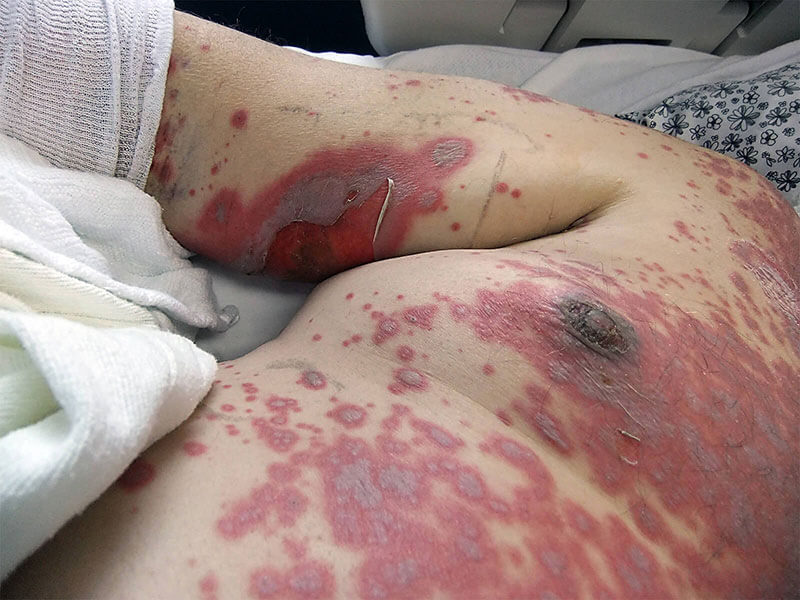
A 50-year-old man presents with a 3-day history of painful peeling of his skin. He says he initially noted small erythematous spots on areas of his neck, but this quickly spread to his torso, face, and buttocks to form flaccid blisters and areas of epidermal detachment involving > 40% of his total body surface area. He describes the associated pain as severe, burning, and generalized over his entire body. The patient does recall having an episode with similar symptoms 10 years ago after taking an unknown antibiotic for community-acquired pneumonia, but the symptoms were nowhere near this severe. He denies any fever, chills, palpitations, dizziness, or trouble breathing. Past medical history is significant for a urinary tract infection (UTI) diagnosed 1 week ago for which he has been taking ciprofloxacin. His vital signs include: blood pressure, 130/90 mm Hg; temperature, 37.7℃ (99.9℉); respiratory, rate 22/min; and pulse, 110/min. On physical examination, the patient is ill-appearing and in acute distress due to pain. The epidermis sloughing involves areas of the face, back, torso, buttocks, and thighs bilaterally, and its appearance is shown in the exhibit (see image). Nikolsky sign is positive. Laboratory findings are unremarkable. Which of the following is the next best diagnostic step in this patient?
Q32
An 87-year-old woman is admitted to the intensive care unit after a neighbor found her lying on the floor at her home. Her respirations are 13/min and shallow. Despite appropriate therapy, the patient dies. Gross examination of the brain at autopsy shows neovascularization and liquefactive necrosis without cavitation in the distribution of the left middle cerebral artery. Histological examination of a brain tissue sample from the left temporal lobe shows proliferation of neural cells that stain positive for glial fibrillary acidic protein. Based on these findings, approximately how much time has most likely passed since the initial injury in this patient?
Q33
A 13-year-old boy is brought to the emergency department by his parents for severe right hip pain that suddenly started about 2 hours ago. The parents are extremely anxious and feel overwhelmed because the boy has been hospitalized several times in the past for similar episodes of pain. The boy was born at 39 weeks of gestation via spontaneous vaginal delivery. He is up to date on all vaccinations and is meeting all developmental milestones. His only medication is hydroxyurea, which he has been receiving for 3 years. His blood pressure is 125/84 mm Hg, the respirations are 23/min, the pulse is 87/min, and the temperature is 36.7°C (98.0°F). On physical examination, the patient is in distress and has severe pain (8/10) elicited by gentle palpation of the right femoral head. Which of the following conditions has the same pathophysiology as the likely diagnosis for the patient described in this case?
Q34
A 53-year-old woman is brought to the physician by her husband for the evaluation of progressive memory loss, which he reports began approximately 2 weeks ago. During this time, she has had problems getting dressed and finding her way back home after running errands. She has also had several episodes of jerky, repetitive, twitching movements that resolved spontaneously. She is oriented only to person and place. She follows commands and speaks fluently. She is unable to read and has difficulty recognizing objects. Which of the following is the most likely underlying cause of this patient's symptoms?
Q35
A 55-year-old man with atrial fibrillation is brought to the emergency department by his wife 6 hours after the acute onset of right arm weakness and slurred speech. An MRI of the brain shows a thrombus in the left middle cerebral artery. Twelve hours later, the patient develops ventricular tachycardia. Despite appropriate care, he dies. Which of the following histopathologic changes are most likely to be seen on a biopsy specimen from the affected brain tissue?
Q36
A previously healthy 24-year-old woman comes to the physician because of a 1-day history of painful rash after spending several hours in the sun. Skin examination shows well-demarcated areas of erythema with some scaling on the face, chest, upper back, and arms. The affected areas are hot and sensitive to touch. The oral mucosa appears normal. Which of the following is the most likely underlying mechanism of this patient's skin findings?
Q37
A 58-year-old man with a history of alcoholism is hospitalized with acute onset nausea and hematemesis. On admission, his vitals are as follows: blood pressure 110/70 mm Hg, heart rate 88/min, respiratory rate 16/min, and temperature 37.8℃ (100.0℉). Physical examination shows jaundice, palmar erythema, widespread spider angiomata, abdominal ascites, and visibly distended superficial epigastric veins. Abdominal ultrasound demonstrates portal vein obstruction caused by liver cirrhosis. Where in the liver would you find the earliest sign of fibrous deposition in this patient?
Q38
A 27-year-old man who recently immigrated to the United States with his family is diagnosed with an autosomal dominant disorder that causes anemia by extravascular hemolysis. The doctor explains that his red blood cells (RBCs) are spherical, which decreases their lifespan and explains that a splenectomy may be required in the future. Which of the following is most likely to be defective in this patient?
Q39
A 45-year-old man with a history of epilepsy comes to the physician for a follow-up examination. He has had trouble moving the right side of his body for 2 weeks. Three weeks ago he was admitted to the hospital for a generalized convulsive seizure. He was treated with intravenous lorazepam and phenytoin; the seizure activity resolved after 50 minutes on EEG monitoring. He was discharged 2 days later after no further epileptic activity occurred. Physical examination at discharge showed no abnormalities. He has had multiple hospitalizations for similar episodes over the past year. His only medication is lamotrigine, though he says that he sometimes forgets to take it. His temperature is 37°C (98.6°F), pulse is 70/min, and blood pressure is 130/80 mm Hg. Physical examination shows right-sided hemiparesis, right homonymous hemianopsia, and receptive aphasia. Which of the following is the most likely underlying cause of this patient's current symptoms?
Q40
An autopsy is performed on a 39-year-old man 5 days after he was found pulseless at his apartment by his neighbor. Examination of the brain shows liquefactive necrosis in the distribution of the right middle cerebral artery with surrounding edema. Immunophenotyping of a sample of the affected brain tissue shows numerous cells that express CD40 on their surface. On further histopathological evaluation, the morphology of these cells is not readily discernible with Nissl stain. These histological findings are most consistent with which of the following cell types?
Cell injury US Medical PG Practice Questions and MCQs
Question 31: A 50-year-old man presents with a 3-day history of painful peeling of his skin. He says he initially noted small erythematous spots on areas of his neck, but this quickly spread to his torso, face, and buttocks to form flaccid blisters and areas of epidermal detachment involving > 40% of his total body surface area. He describes the associated pain as severe, burning, and generalized over his entire body. The patient does recall having an episode with similar symptoms 10 years ago after taking an unknown antibiotic for community-acquired pneumonia, but the symptoms were nowhere near this severe. He denies any fever, chills, palpitations, dizziness, or trouble breathing. Past medical history is significant for a urinary tract infection (UTI) diagnosed 1 week ago for which he has been taking ciprofloxacin. His vital signs include: blood pressure, 130/90 mm Hg; temperature, 37.7℃ (99.9℉); respiratory, rate 22/min; and pulse, 110/min. On physical examination, the patient is ill-appearing and in acute distress due to pain. The epidermis sloughing involves areas of the face, back, torso, buttocks, and thighs bilaterally, and its appearance is shown in the exhibit (see image). Nikolsky sign is positive. Laboratory findings are unremarkable. Which of the following is the next best diagnostic step in this patient?
A. PCR for serum staphylococcal exfoliative toxin
B. Direct immunofluorescence on perilesional biopsy
C. Blood cultures
D. Indirect immunofluorescence on perilesional biopsy
E. Skin biopsy and histopathologic analysis (Correct Answer)
Explanation: ***Skin biopsy and histopathologic analysis***
- The patient's presentation with widespread **epidermal detachment exceeding 40% TBSA**, painful skin, and a **positive Nikolsky sign**, especially with a history of prior drug exposure (ciprofloxacin), is highly suggestive of **Toxic Epidermal Necrolysis (TEN)**. A **skin biopsy** is crucial to confirm the diagnosis and differentiate it from other blistering disorders like pemphigus or staphylococcal scalded skin syndrome.
- Histopathology in TEN would reveal widespread **keratinocyte necrosis** and **dermo-epidermal separation**. This is essential to guide immediate management, which differs significantly from other conditions, given TEN's high mortality rate.
*PCR for serum staphylococcal exfoliative toxin*
- **Staphylococcal scalded skin syndrome (SSSS)** typically affects young children and causes superficial blistering due to an exotoxin, but usually spares mucous membranes and presents with a less severe systemic illness in adults.
- While it presents with blistering, the extensive epidermal detachment, severe pain, and strong drug association point away from SSSS, making this test less likely to yield the primary diagnosis.
*Direct immunofluorescence on perilesional biopsy*
- **Direct immunofluorescence (DIF)** is primarily used to diagnose **autoimmune bullous diseases** like pemphigus (desmosome antibodies) or bullous pemphigoid (hemidesmosome antibodies), which present with autoantibodies deposited at the dermo-epidermal junction or within the epidermis.
- Given the abrupt onset, clear drug association, and widespread epidermal necrosis, an autoimmune etiology like pemphigus is less likely to be the primary diagnosis; therefore, DIF may be performed later to rule it out, but a biopsy for routine histopathology is the initial priority.
*Blood cultures*
- While patients with extensive skin breakdown are at risk of secondary infection, the initial presentation is acutely related to a drug reaction, not a primary bacterial infection causing the skin lesions.
- Although the patient has a mildly elevated pulse and temperature, this is common in severe inflammatory reactions and skin pathology like TEN, where **sepsis** can be a complication, but it is not the primary cause of the skin detachment.
*Indirect immunofluorescence on perilesional biopsy*
- **Indirect immunofluorescence (IIF)** on serum is used to detect circulating autoantibodies against skin components, providing further evidence for autoimmune bullous diseases such as pemphigus or bullous pemphigoid.
- Like DIF, this test is more relevant for autoimmune conditions, and given the strong history of recent new drug exposure and rapid progression of symptoms, it is not the immediate diagnostic step for this patient's likely drug-induced severe cutaneous adverse reaction.
Question 32: An 87-year-old woman is admitted to the intensive care unit after a neighbor found her lying on the floor at her home. Her respirations are 13/min and shallow. Despite appropriate therapy, the patient dies. Gross examination of the brain at autopsy shows neovascularization and liquefactive necrosis without cavitation in the distribution of the left middle cerebral artery. Histological examination of a brain tissue sample from the left temporal lobe shows proliferation of neural cells that stain positive for glial fibrillary acidic protein. Based on these findings, approximately how much time has most likely passed since the initial injury in this patient?
A. 2 days
B. 2 hours
C. 10 days (Correct Answer)
D. 25 days
E. 12 hours
Explanation: ***10 days***
- **Neovascularization** and the absence of cavitation with **liquefactive necrosis** are indicative of a subacute phase of ischemic injury, typically seen around 1-3 weeks.
- The proliferation of **glial fibrillary acidic protein (GFAP)** positive neural cells (astrocytes) signifies **astrogliosis**, a repair response common after approximately one week, peaking around 2-3 weeks post-injury.
*2 days*
- At 2 days, the primary histological findings would be **neutrophilic infiltration** and initial stages of neuronal necrosis.
- **Neovascularization** and significant astrogliosis are generally not prominent until later in the recovery phase.
*2 hours*
- Within 2 hours, there would be minimal to no gross changes, and microscopic examination might show only **red neurons** (eosinophilic neurons with pyknotic nuclei) reflecting early irreversible neuronal damage.
- There would be no signs of inflammation, tissue breakdown, or repair processes like neovascularization or astrogliosis.
*25 days*
- By 25 days (approximately 3-4 weeks), **cavitation** with a **cystic astrocytic glial scar** would likely be prominent at the site of liquefactive necrosis, which is explicitly stated as absent in the question.
- While astrogliosis would still be present, the lack of cavitation points to an earlier stage of repair.
*12 hours*
- At 12 hours, gross changes are typically still absent or subtle, and microscopic findings would primarily involve **edema** and early signs of neuronal injury (e.g., changes in Nissl bodies, mild eosinophilia).
- Inflammatory cell infiltration and reparative processes like neovascularization or astrogliosis would not yet be significant.
Question 33: A 13-year-old boy is brought to the emergency department by his parents for severe right hip pain that suddenly started about 2 hours ago. The parents are extremely anxious and feel overwhelmed because the boy has been hospitalized several times in the past for similar episodes of pain. The boy was born at 39 weeks of gestation via spontaneous vaginal delivery. He is up to date on all vaccinations and is meeting all developmental milestones. His only medication is hydroxyurea, which he has been receiving for 3 years. His blood pressure is 125/84 mm Hg, the respirations are 23/min, the pulse is 87/min, and the temperature is 36.7°C (98.0°F). On physical examination, the patient is in distress and has severe pain (8/10) elicited by gentle palpation of the right femoral head. Which of the following conditions has the same pathophysiology as the likely diagnosis for the patient described in this case?
A. Posterior dislocation of the hip
B. Developmental dysplasia of the hip
C. Iliotibial band syndrome
D. Legg-Calve-Perthes disease (Correct Answer)
E. Osgood-Schlatter disease
Explanation: ***Legg-Calve-Perthes disease***
- The patient's history of **sickle cell disease** (implied by hydroxyurea use and recurrent pain crises) puts him at risk for **avascular necrosis** of the femoral head. Legg-Calve-Perthes disease is also a form of avascular necrosis, specifically affecting the femoral head in children.
- Both conditions involve the **interruption of blood supply** to the femoral head, leading to bone death and subsequent collapse, which manifests as severe hip pain.
*Posterior dislocation of the hip*
- While a posterior hip dislocation causes severe pain, it is an acute traumatic injury and does not share the same underlying pathophysiology of **ischemic necrosis** as seen in the patient's likely condition.
- A dislocated hip would typically present with a **visible deformity** and inability to bear weight, which is not primarily described here, although pain is severe.
*Developmental dysplasia of the hip*
- This condition is a **congenital abnormality** involving abnormal development of the hip joint, leading to instability or dislocation.
- Its pathophysiology is related to **joint development**, not an interruption of blood supply to the bone.
*Iliotibial band syndrome*
- This is an **overuse injury** resulting from inflammation and tightness of the iliotibial band, typically causing pain on the lateral aspect of the knee or hip.
- Its pathophysiology is **mechanical irritation and inflammation**, not a vascular disorder leading to bone necrosis.
*Osgood-Schlatter disease*
- This condition is characterized by **tibial tuberosity apophysitis**, an inflammation of the growth plate at the point where the patellar tendon attaches to the shinbone.
- It is an **overuse injury** mainly affecting adolescent athletes and does not involve avascular necrosis of bone.
Question 34: A 53-year-old woman is brought to the physician by her husband for the evaluation of progressive memory loss, which he reports began approximately 2 weeks ago. During this time, she has had problems getting dressed and finding her way back home after running errands. She has also had several episodes of jerky, repetitive, twitching movements that resolved spontaneously. She is oriented only to person and place. She follows commands and speaks fluently. She is unable to read and has difficulty recognizing objects. Which of the following is the most likely underlying cause of this patient's symptoms?
A. Mutant prion accumulation (Correct Answer)
B. Copper accumulation
C. Severe cerebral ischemia
D. Increased number of CAG repeats
E. Extracellular senile plaques
Explanation: ***Mutant prion accumulation***
- The rapid progression of **dementia** (2 weeks), coupled with **myoclonus** (jerky, repetitive, twitching movements), is highly suggestive of **Creutzfeldt-Jakob disease (CJD)**, which is caused by mutant prion accumulation.
- CJD presents with a **spongiform encephalopathy** characterized by neuronal loss, astrocytosis, and vacuolation in the grey matter.
*Copper accumulation*
- **Copper accumulation** is characteristic of **Wilson's disease**, which typically presents with liver disease, neurological symptoms (e.g., dyskinesias, dystonia, tremor, psychiatric changes), and Kayser-Fleischer rings.
- The onset and rapid progression of symptoms, particularly the presence of myoclonus, are not typical for Wilson's disease.
*Severe cerebral ischemia*
- **Severe cerebral ischemia** can lead to sudden neurological deficits, but a diffuse, rapidly progressive cognitive decline and myoclonus like this is not typical of a single ischemic event.
- While strokes can cause dementia, the presentation here points to a more widespread and rapidly progressive neurodegenerative process.
*Increased number of CAG repeats*
- An increased number of **CAG repeats** is associated with **Huntington's disease**, which typically presents with chorea, psychiatric symptoms, and a more insidious onset of cognitive decline, usually without myoclonus as a prominent early feature.
- The rapid progression described in the patient is not typical of Huntington's disease.
*Extracellular senile plaques*
- **Extracellular senile plaques** (amyloid-beta) are a hallmark of **Alzheimer's disease**, which is characterized by a slowly progressive memory loss and cognitive decline over years, not weeks.
- While Alzheimer's eventually leads to severe cognitive impairment, the rapid onset and myoclonus make this diagnosis unlikely.
Question 35: A 55-year-old man with atrial fibrillation is brought to the emergency department by his wife 6 hours after the acute onset of right arm weakness and slurred speech. An MRI of the brain shows a thrombus in the left middle cerebral artery. Twelve hours later, the patient develops ventricular tachycardia. Despite appropriate care, he dies. Which of the following histopathologic changes are most likely to be seen on a biopsy specimen from the affected brain tissue?
A. Eosinophilic neuronal cytoplasm with pyknotic nuclei (Correct Answer)
B. Neutrophilic infiltration with central necrosis
C. Glial scarring with fibrous tissue hypertrophy
D. Reactive gliosis with vascular proliferation
E. Normal brain parenchyma
Explanation: ***Eosinophilic neuronal cytoplasm with pyknotic nuclei***
- This describes **red neurons**, which are the earliest microscopically detectable change in **cerebral ischemia**, appearing as early as **6-12 hours** after an ischemic event.
- The sudden onset of neurological deficits and the MRI finding of a **thrombus in the left middle cerebral artery** indicate an acute ischemic stroke, aligning with this early histopathologic finding.
*Neutrophilic infiltration with central necrosis*
- **Neutrophilic infiltration** is seen later in the evolution of an ischemic stroke, typically peaking around **24-48 hours** after the event.
- While central necrosis occurs, the **18-hour time frame** (patient died 12 hours after presenting at 6 hours post-onset) makes extensive neutrophilic infiltration less likely to be the *most prominent* finding compared to initial neuronal changes.
*Glial scarring with fibrous tissue hypertrophy*
- **Glial scarring** and **fibrous tissue hypertrophy** are late-stage changes that occur during the **repair phase** of an infarct, weeks to months after the initial ischemic event.
- The patient died **18 hours after symptom onset** (presented at 6 hours + died 12 hours later), making these chronic changes highly improbable.
*Reactive gliosis with vascular proliferation*
- **Reactive gliosis** and **vascular proliferation** are also subacute to chronic changes observed in the brain following an infarct, typically beginning several days and evolving over weeks.
- These changes are part of the **healing process** and would not be the most likely finding in a patient who died within 18 hours of stroke onset.
*Normal brain parenchyma*
- The presence of an **acute onset of neurological deficits**, a **thrombus in the left middle cerebral artery**, and subsequent death after a cerebrovascular event makes normal brain parenchyma highly unlikely.
- Even at 6 hours, **microscopic changes** like red neurons would be present, even if gross changes are not yet fully developed.
Question 36: A previously healthy 24-year-old woman comes to the physician because of a 1-day history of painful rash after spending several hours in the sun. Skin examination shows well-demarcated areas of erythema with some scaling on the face, chest, upper back, and arms. The affected areas are hot and sensitive to touch. The oral mucosa appears normal. Which of the following is the most likely underlying mechanism of this patient's skin findings?
A. T-cell-mediated inflammatory reaction in the dermis
B. Apoptosis of keratinocytes in the epidermis (Correct Answer)
C. Vascular endothelial cell injury in the superficial dermis
D. Immune complex deposits at the dermoepidermal junction
E. Mast cell activation in the superficial dermis
Explanation: ***Apoptosis of keratinocytes in the epidermis***
- This patient's symptoms, including **painful rash**, **erythema with scaling**, warmth, and tenderness after sun exposure, are classic for a **sunburn**.
- **Ultraviolet (UV) radiation** directly damages the DNA in **keratinocytes**, leading to a programmed cell death known as **apoptosis**, which is a key mechanism in sunburn.
*T-cell-mediated inflammatory reaction in the dermis*
- This mechanism is characteristic of **delayed-type hypersensitivity reactions** or certain **autoimmune skin conditions** (e.g., lichen planus), which typically develop over days and don't directly explain an acute sunburn.
- While T-cells are involved in resolving severe sunburn, the initial and primary damage in this acute presentation is directly to the keratinocytes, not a primary T-cell-mediated inflammation.
*Vascular endothelial cell injury in the superficial dermis*
- While capillaries in the dermis do dilate leading to **erythema** in sunburn, the primary cellular damage from UV radiation is to the overlying **epidermal keratinocytes**, not directly to the endothelial cells.
- Endothelial injury is more prominent in conditions like **vasculitis** or severe thermal burns, not typical sunburn.
*Immune complex deposits at the dermoepidermal junction*
- This mechanism is characteristic of **lupus erythematosus** or **bullous skin diseases** (e.g., bullous pemphigoid), which present with distinct blistering and systemic symptoms, unlike this acute sunburn.
- There is no indication of autoimmune disease or immune complex deposition in the patient's presentation.
*Mast cell activation in the superficial dermis*
- Mast cell activation contributes to **urticaria** (hives) or immediate hypersensitivity reactions, characterized by **wheals and intense itching**, which are not the primary symptoms described here.
- While mast cells may play a minor role in the inflammatory cascade of sunburn, they are not the primary underlying mechanism of direct UV damage and keratinocyte death.
Question 37: A 58-year-old man with a history of alcoholism is hospitalized with acute onset nausea and hematemesis. On admission, his vitals are as follows: blood pressure 110/70 mm Hg, heart rate 88/min, respiratory rate 16/min, and temperature 37.8℃ (100.0℉). Physical examination shows jaundice, palmar erythema, widespread spider angiomata, abdominal ascites, and visibly distended superficial epigastric veins. Abdominal ultrasound demonstrates portal vein obstruction caused by liver cirrhosis. Where in the liver would you find the earliest sign of fibrous deposition in this patient?
A. Lumen of sinusoids
B. Lumen of bile ducts
C. Portal field
D. Perisinusoidal space (Correct Answer)
E. Interlobular connective tissue
Explanation: ***Perisinusoidal space***
- In cirrhosis, **hepatic stellate cells** (Ito cells) in the **perisinusoidal space** (space of Disse) are activated by liver injury.
- These activated cells transform into myofibroblast-like cells, leading to increased **collagen production** and fibrous deposition, initially in the space of Disse.
*Lumen of sinusoids*
- The lumen of the sinusoids is where blood from the portal vein and hepatic artery mixes and flows past hepatocytes.
- Fibrous deposition does not typically begin within the **lumen** itself; rather, it occurs in the surrounding tissue.
*Lumen of bile ducts*
- Bile ducts are involved in the transport of bile, and while certain cholangiopathies can cause fibrosis, the primary site of early fibrosis in **alcoholic cirrhosis** is not within the bile duct lumens.
- Fibrosis associated with bile ducts is usually seen in **biliary cirrhosis**, not directly in the lumen.
*Portal field*
- The portal field (or portal triad) contains the portal vein, hepatic artery, and bile duct. While fibrosis eventually extends to and connects portal fields, the **earliest microscopic changes** in alcoholic liver disease begin in the pericentral/perisinusoidal regions.
- Extensive fibrosis in the portal fields is characteristic of later stages of cirrhosis, forming **bridging fibrosis**.
*Interlobular connective tissue*
- Interlobular connective tissue provides structural support between liver lobules.
- While fibrosis can eventually infiltrate and replace this tissue, the **initial deposition** in alcoholic cirrhosis specifically targets the perisinusoidal space.
Question 38: A 27-year-old man who recently immigrated to the United States with his family is diagnosed with an autosomal dominant disorder that causes anemia by extravascular hemolysis. The doctor explains that his red blood cells (RBCs) are spherical, which decreases their lifespan and explains that a splenectomy may be required in the future. Which of the following is most likely to be defective in this patient?
A. Decay accelerating factor
B. Iron absorption
C. Glucose-6-phosphate dehydrogenase
D. Glycosylphosphatidylinositol
E. Spectrin (Correct Answer)
Explanation: ***Spectrin***
- The description of **spherical red blood cells (spherocytes)**, **autosomal dominant inheritance**, **anemia due to extravascular hemolysis**, and potential benefit from **splenectomy** are classic features of **hereditary spherocytosis**.
- **Hereditary spherocytosis** is caused by defects in red blood cell membrane proteins, most commonly **spectrin**, **ankyrin**, band 3, or protein 4.2, which compromise the structural integrity of the cell membrane and lead to the formation of fragile, spherical RBCs.
*Decay accelerating factor*
- **Decay accelerating factor (DAF)**, or CD55, is a cell surface protein that protects cells from complement-mediated lysis.
- A deficiency in DAF, along with **CD59**, is characteristic of **paroxysmal nocturnal hemoglobinuria (PNH)**, which presents with **intravascular hemolysis**, dark urine, and thrombotic tendencies, not primarily extravascular hemolysis with spherocytes.
*Iron absorption*
- Disorders of **iron absorption**, such as **hemochromatosis** (excess iron absorption) or iron deficiency anemia (impaired iron absorption), do not directly cause **spherical red blood cells** or primary hemolytic anemia.
- Hemochromatosis involves iron overload and organ damage, while iron deficiency leads to **microcytic hypochromic anemia**.
*Glucose-6-phosphate dehydrogenase*
- A deficiency in **glucose-6-phosphate dehydrogenase (G6PD)** causes **episodic hemolytic anemia** triggered by oxidative stress (e.g., fava beans, certain drugs, infections).
- This typically presents with **Heinz bodies** and **bite cells** on blood smear, not spherocytes, and is an X-linked recessive disorder, not autosomal dominant.
*Glycosylphosphatidylinositol*
- **Glycosylphosphatidylinositol (GPI)** anchors proteins like DAF and CD59 to the cell surface.
- A defect in the synthesis of the GPI anchor, specifically in the PIGA gene, is the underlying cause of **paroxysmal nocturnal hemoglobinuria (PNH)**, leading to a deficiency of GPI-anchored proteins and complement-mediated **intravascular hemolysis**.
Question 39: A 45-year-old man with a history of epilepsy comes to the physician for a follow-up examination. He has had trouble moving the right side of his body for 2 weeks. Three weeks ago he was admitted to the hospital for a generalized convulsive seizure. He was treated with intravenous lorazepam and phenytoin; the seizure activity resolved after 50 minutes on EEG monitoring. He was discharged 2 days later after no further epileptic activity occurred. Physical examination at discharge showed no abnormalities. He has had multiple hospitalizations for similar episodes over the past year. His only medication is lamotrigine, though he says that he sometimes forgets to take it. His temperature is 37°C (98.6°F), pulse is 70/min, and blood pressure is 130/80 mm Hg. Physical examination shows right-sided hemiparesis, right homonymous hemianopsia, and receptive aphasia. Which of the following is the most likely underlying cause of this patient's current symptoms?
A. Ruptured intracranial aneurysm
B. Lacunar stroke
C. Intraventricular hemorrhage
D. Cortical laminar necrosis (Correct Answer)
E. Brain abscess
Explanation: ***Cortical laminar necrosis***
- This patient's **persistent neurological deficits** (hemiparesis, hemianopsia, aphasia) lasting 2 weeks following a prolonged seizure (50 minutes) indicate **irreversible neuronal damage** from **cortical laminar necrosis**.
- **Status epilepticus** (seizures >5 minutes) causes excitotoxic injury and ischemic damage to neurons, particularly affecting layers 3, 5, and 6 of the cerebral cortex, leading to **permanent structural damage**.
- The time course (persistent deficits beyond 48-72 hours) distinguishes this from transient post-ictal Todd's paralysis, which resolves within hours to 2 days.
- The distribution of deficits (left cortical involvement affecting right body) correlates with cortical injury patterns in status epilepticus.
*Ruptured intracranial aneurysm*
- A ruptured aneurysm typically presents with **sudden onset of severe headache** ("thunderclap headache"), meningismus, and altered consciousness, which is not consistent with this patient's subacute presentation following a witnessed seizure.
- While subarachnoid hemorrhage can cause seizures, the clear temporal relationship to prolonged status epilepticus and absence of acute hemorrhage symptoms make this unlikely.
*Lacunar stroke*
- Lacunar strokes result from occlusion of small penetrating arteries, typically presenting with **pure motor hemiparesis**, pure sensory stroke, ataxic hemiparesis, or dysarthria-clumsy hand syndrome.
- The combination of **hemiparesis, homonymous hemianopsia, and receptive aphasia** indicates a **large cortical territory** insult involving Wernicke's area and optic radiations, not the subcortical structures affected by lacunar infarcts.
*Intraventricular hemorrhage*
- Intraventricular hemorrhage usually presents with **acute neurological deterioration**, altered consciousness, signs of increased intracranial pressure (headache, vomiting), and meningismus, which are not described here.
- The subacute evolution of focal cortical deficits over 2 weeks following documented status epilepticus points away from an acute hemorrhagic event.
*Brain abscess*
- A brain abscess would typically present with **signs of infection** (fever, elevated WBC, elevated inflammatory markers), progressive headache, and focal neurological deficits evolving over days to weeks.
- This patient's **normal temperature**, absence of systemic infection signs, and clear temporal relationship to a prolonged seizure 3 weeks ago make an infectious etiology unlikely.
Question 40: An autopsy is performed on a 39-year-old man 5 days after he was found pulseless at his apartment by his neighbor. Examination of the brain shows liquefactive necrosis in the distribution of the right middle cerebral artery with surrounding edema. Immunophenotyping of a sample of the affected brain tissue shows numerous cells that express CD40 on their surface. On further histopathological evaluation, the morphology of these cells is not readily discernible with Nissl stain. These histological findings are most consistent with which of the following cell types?
A. Astrocytes
B. Oligodendrocytes
C. Microglia (Correct Answer)
D. Neurons
E. Radial glial cells
Explanation: ***Microglia***
- The presence of **liquefactive necrosis** and **edema** indicates a recent **cerebral infarct**, which triggers an inflammatory response. **Microglia** are the primary immune cells of the CNS and become activated macrophages in response to injury, expressing markers like **CD40**.
- Their morphology is usually not well-defined with **Nissl stain** (which highlights neuronal rough endoplasmic reticulum), as they are small, highly motile cells that undergo significant morphological changes upon activation.
*Astrocytes*
- **Astrocytes** are involved in glial scarring after injury and express **GFAP**, but they are not the primary phagocytic cells responsible for clearing debris in **liquefactive necrosis**.
- While they can become reactive (astrogliosis), their main role is structural support and maintenance of the blood-brain barrier, not phagocytosis of necrotic tissue.
*Oligodendrocytes*
- **Oligodendrocytes** are responsible for forming **myelin sheaths** in the CNS and are particularly vulnerable to ischemic injury.
- They are not phagocytic cells and do not express **CD40** as an activation marker in response to necrosis; their primary role does not involve clearing cellular debris.
*Neurons*
- **Neurons** are the cells that primarily undergo **liquefactive necrosis** in an ischemic stroke; they are not the immune cells responding to the injury.
- They are exquisitely sensitive to ischemia and would be dying rather than actively expressing **CD40** to clear debris. Additionally, if these cells were neurons, they **would be readily visible** with **Nissl stain** (which specifically highlights neuronal Nissl substance), contradicting the observation that the cells are **not readily discernible** with this stain.
*Radial glial cells*
- **Radial glial cells** primarily function during **nervous system development** as scaffolding for neuronal migration and as neural stem cells.
- In the adult brain, they are largely absent or function as neural stem cells in specific neurogenic niches, and they are not involved in mediating the acute inflammatory response to an ischemic stroke.