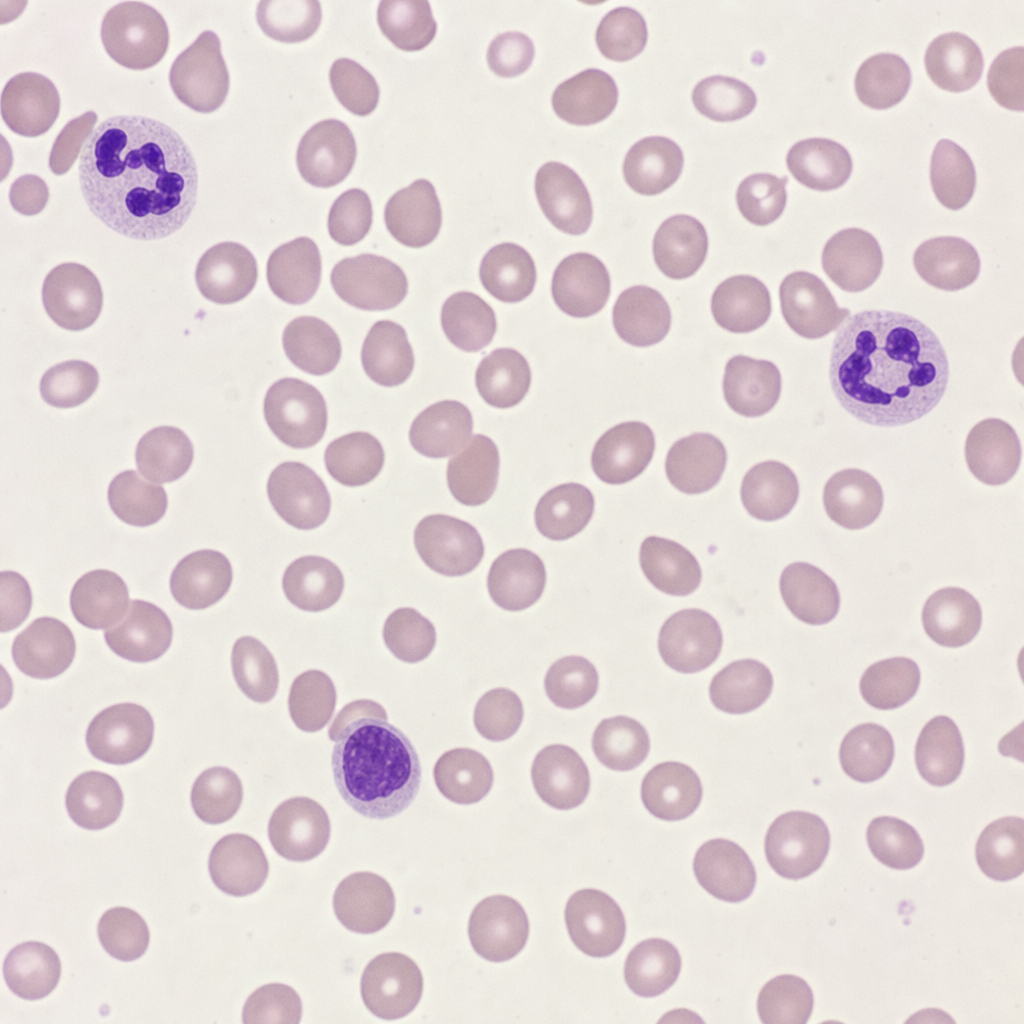
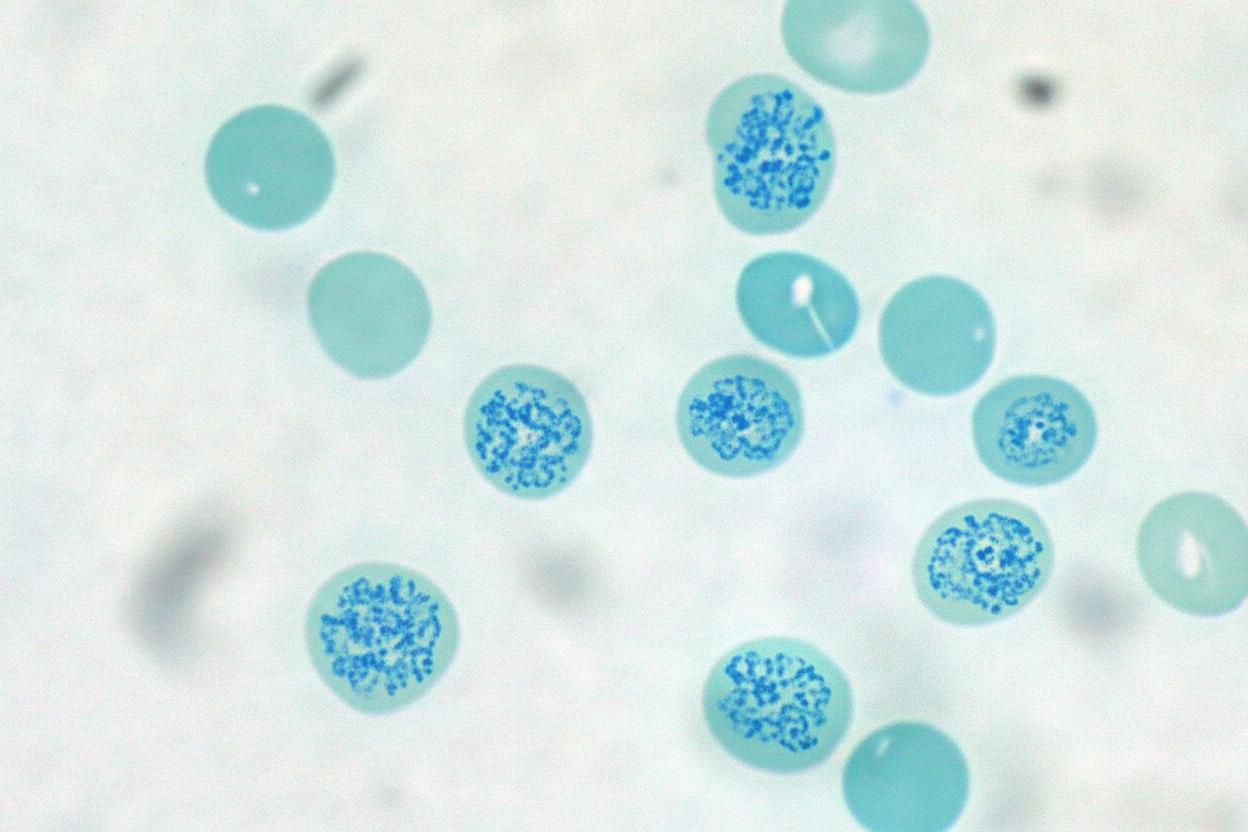
A 59-year-old woman with a history of chronic kidney disease comes to the physician for a 3-month history of easy fatiguability. Physical examination shows subconjunctival pallor. Her hemoglobin concentration is 8.9 g/dL, mean corpuscular volume is 86 μm3, and serum ferritin is 225 ng/mL. Treatment with erythropoietin is begun. A peripheral blood smear is obtained one week after treatment. A photomicrograph of the smear after specialized staining is shown. The prominent color of the intracellular structure in some of the cells is most likely the result of staining which of the following?
Q22
A 30-year-old woman presents to her physician for a routine check-up. She says she is planning to get pregnant. Past medical history is significant for arterial hypertension. Current medications are enalapril. The physician explains that this medication can be teratogenic. He changes her antihypertensive medication to methyldopa, which has no contraindications for pregnant women. A few days later, the patient is admitted to the emergency department with jaundice and dark urine. Her laboratory tests are as follows:
Hemoglobin 0.9 g/dL
Red blood cells 3.2 x 10⁶/µL
White blood cells 5,000/mm3
Platelets 180,000/mm3
Direct Coombs test Positive
This patient is diagnosed with autoimmune hemolytic anemia (AIHA). Which of the following is correct about autoimmune hemolytic anemia in this patient?
Q23
A previously healthy 5-year-old girl is brought to the emergency department by her parents because of a severe headache, nausea, and vomiting for 6 hours. Last week she had fever, myalgias, and a sore throat for several days that resolved with over-the-counter medication. She is oriented only to person. Examination shows bilateral optic disc swelling. Serum studies show:
Glucose 61 mg/dL
Aspartate aminotransferase (AST) 198 U/L
Alanine aminotransferase (ALT) 166 U/L
Prothrombin time 18 sec
Which of the following is the most likely cause of this patient's symptoms?
Q24
An autopsy is being performed on an elderly man who died from a myocardial infarction. Biopsy of the heart is likely to reveal necrosis most similar to necrosis seen in which of the following scenarios?
Q25
A 30-year-old man comes to the physician for a follow-up examination 1 month after sustaining a chemical burn over the dorsum of his right hand and forearm. Physical examination shows hyperextension of the hand at the wrist. The skin over the dorsum of the wrist is tense and there is a thick, epithelialized scar. Range of motion of the right wrist is restricted. This patient's contracture is most likely due to activity of which of the following cells?
Q26
An 8-year-old boy presents with a 7-day history of fever and abdominal pain for the past 4 days. Past medical history is significant for an exchange transfusion for neonatal hyperbilirubinemia and recurrent attacks of pallor during the course of upper respiratory tract infections. His vital signs include: blood pressure 120/70 mm Hg, pulse 105/min, respiratory rate 40/min, and temperature 37.0℃ (98.6℉). On physical examination, the patient is ill-looking. Conjunctivae are pale and the sclera is icteric. The liver is palpable 2 cm below the costal margin and the spleen is palpable 3 cm below the left costal margin. Laboratory findings show hemoglobin of 5.9 gm/dL, Hct of 20%, and haptoglobin of 28 mg/dL. A peripheral blood smear shows hypochromic anemia, polychromasia, anisocytosis, and occasional Heinz bodies. The reticulocyte count was 15%. A direct Coombs test was negative. Which of the following is the most likely diagnosis in this patient?
Q27
A 3-year-old boy is brought to the physician because of a 1-week history of yellowish discoloration of his eyes and skin. He has had generalized fatigue and mild shortness of breath for the past month. Three weeks ago, he was treated for a urinary tract infection with antibiotics. His father underwent a splenectomy during childhood. Examination shows pale conjunctivae and jaundice. The abdomen is soft and nontender; there is nontender splenomegaly. Laboratory studies show:
Hemoglobin 9.1 g/dL
Mean corpuscular volume 89 μm3
Mean corpuscular hemoglobin 32 pg/cell
Mean corpuscular hemoglobin concentration 37.8% Hb/cell
Leukocyte count 7800/mm3
Platelet count 245,000/mm3
Red cell distribution width 22.8% (N=13%–15%)
Serum
Bilirubin
Total 13.8 mg/dL
Direct 1.9 mg/dL
Lactate dehydrogenase 450 U/L
Which of the following is the most likely pathophysiology of these findings?
Q28
A 27-year-old African American man presents to a primary care physician for a routine checkup as a new patient. The patient states that he has been doing well lately and recently was promoted at his job. He states that 2 weeks ago he went to the ED for severe pain and was treated with morphine and oral fluids and discharged home that night. This had happened once before and he was treated similarly. The patient states that he drinks 7 to 8 alcoholic beverages per night and smokes 1 pack of cigarettes per day. The patient states that he has been gaining weight recently due to a diet consisting mostly of fast food. Basic labs are ordered as seen below.
Hemoglobin: 8 g/dL
Hematocrit: 28%
Mean corpuscular volume: 72 um^3
Leukocyte count: 6,500/mm^3 with normal differential
Platelet count: 157,000/mm^3
Serum:
Na+: 139 mEq/L
Cl-: 100 mEq/L
K+: 4.3 mEq/L
HCO3-: 25 mEq/L
BUN: 20 mg/dL
Glucose: 99 mg/dL
Creatinine: 1.1 mg/dL
LDH: 540 U/L
Ca2+: 10.2 mg/dL
AST: 12 U/L
ALT: 10 U/L
Which of the following is the best explanation of this patient's laboratory abnormalities?
Q29
A 3-week-old male infant is brought to the physician for evaluation of poor feeding and recurrent episodes of facial grimacing. He was delivered at term after an uncomplicated pregnancy. He is at the 3rd percentile for length and 5th percentile for weight. Physical examination shows yellow discoloration of skin, a broad nasal bridge, hepatomegaly, and decreased muscle tone in the extremities. Serum studies show increased concentrations of very long-chain fatty acids. Examination of the liver cells from this neonate is most likely to show which of the following findings?
Q30
A 32-year-old woman comes to the physician because of increasing muscle weakness in her shoulders and legs for 6 weeks. She is unable to climb stairs or comb her hair. She has also had difficulty swallowing food for the past week. Her symptoms do not improve with rest. Physical examination shows normal muscle tone. There is bilateral weakness of the iliopsoas, hamstring, deltoid, and biceps muscles. Deep tendon reflexes are 2+ bilaterally. Sensation to pinprick, temperature, and vibration is intact. The remainder of the examination shows no abnormalities. Laboratory studies show:
Hemoglobin 10.7 g/dL
Leukocyte count 10.800/mm3
Erythrocyte sedimentation rate 100 mm/h
Serum
Glucose 60 mg/dL
Creatine kinase 7047 U/L
Lactate dehydrogenase 2785 U/L
Thyroid-stimulating hormone 4.0 μU/mL
Which of the following is the most appropriate next step in management?
Cell injury US Medical PG Practice Questions and MCQs
Question 21: A 59-year-old woman with a history of chronic kidney disease comes to the physician for a 3-month history of easy fatiguability. Physical examination shows subconjunctival pallor. Her hemoglobin concentration is 8.9 g/dL, mean corpuscular volume is 86 μm3, and serum ferritin is 225 ng/mL. Treatment with erythropoietin is begun. A peripheral blood smear is obtained one week after treatment. A photomicrograph of the smear after specialized staining is shown. The prominent color of the intracellular structure in some of the cells is most likely the result of staining which of the following?
A. Golgi apparatus
B. Ribosomal RNA (Correct Answer)
C. Remnants of the nucleus
D. Denatured globin chains
E. Mitochondria
Explanation: ***Ribosomal RNA***
- The patient's presentation of **anemia** in the setting of chronic kidney disease and subsequent treatment with erythropoietin points to a likely increase in **reticulocytes** in the peripheral smear.
- The described prominent intracellular structures are characteristic of **reticulofilamentous material**, which is composed primarily of **RNA (ribosomal RNA)** that precipitates out with supravital stains like **new methylene blue**.
*Golgi apparatus*
- The **Golgi apparatus** is an organelle involved in modifying, sorting, and packaging proteins and lipids.
- It is not visible as prominent intracellular structures with **supravital stains** on a peripheral blood smear and does not contribute to reticulocyte staining.
*Remnants of the nucleus*
- While red blood cell precursors have a nucleus, mature erythrocytes and reticulocytes are **anucleated**.
- **Nuclear remnants** (e.g., Howell-Jolly bodies) are typically **DNA-containing fragments** appearing as dense, basophilic inclusions, which are distinctly different from the reticulofilamentous network.
*Denatured globin chains*
- **Denatured globin chains** (e.g., **Heinz bodies**) are associated with oxidative stress and appear as small, irregular inclusions that require **crystal violet stain** for visualization.
- These are not the prominent basophilic reticulations seen in reticulocytes.
*Mitochondria*
- **Mitochondria** are organelles responsible for cellular respiration and are present in many cell types, including immature red blood cells.
- However, they do not stain in the characteristic reticular pattern observed in reticulocytes using **supravital stains** for RNA.
Question 22: A 30-year-old woman presents to her physician for a routine check-up. She says she is planning to get pregnant. Past medical history is significant for arterial hypertension. Current medications are enalapril. The physician explains that this medication can be teratogenic. He changes her antihypertensive medication to methyldopa, which has no contraindications for pregnant women. A few days later, the patient is admitted to the emergency department with jaundice and dark urine. Her laboratory tests are as follows:
Hemoglobin 0.9 g/dL
Red blood cells 3.2 x 10⁶/µL
White blood cells 5,000/mm3
Platelets 180,000/mm3
Direct Coombs test Positive
This patient is diagnosed with autoimmune hemolytic anemia (AIHA). Which of the following is correct about autoimmune hemolytic anemia in this patient?
A. Parvovirus B19 can trigger AIHA.
B. The indirect Coombs test is positive if red blood cells are coated with antibody or complement.
C. The direct Coombs test is positive if there are antibodies in the serum.
D. Heinz bodies are common findings in blood smear.
E. Typical blood smear findings include spherocytes. (Correct Answer)
Explanation: ***Typical blood smear findings include spherocytes.***
- In autoimmune hemolytic anemia (AIHA), **spherocytes** are characteristic findings on a blood smear due to partial phagocytosis of antibody-coated red blood cells by macrophages.
- Spherocytes are **smaller, denser red blood cells** lacking central pallor, which are more fragile and susceptible to lysis.
*Parvovirus B19 can trigger AIHA.*
- While parvovirus B19 can cause **transient aplastic crisis** in patients with underlying hemolytic conditions, it is not a direct trigger for autoimmune hemolytic anemia where the immune system attacks red blood cells.
- AIHA is characterized by autoimmunity, not by direct viral destruction of red blood cells or suppression of erythropoiesis by parvovirus B19.
*The indirect Coombs test is positive if red blood cells are coated with antibody or complement.*
- The **direct Coombs test** (or direct antiglobulin test) is positive if red blood cells are coated with antibody or complement in vivo.
- The **indirect Coombs test** detects unbound antibodies in the patient's serum that can bind to donor red blood cells, primarily used for cross-matching or antibody screening.
*The direct Coombs test is positive if there are antibodies in the serum.*
- The **direct Coombs test** detects **antibodies or complement components directly bound to the surface of the patient's red blood cells**, indicating in vivo sensitization.
- The presence of free antibodies in the serum is detected by the **indirect Coombs test**, not the direct Coombs test.
*Heinz bodies are common findings in blood smear.*
- **Heinz bodies** are precipitates of denatured hemoglobin, typically seen in conditions like **G6PD deficiency** or unstable hemoglobinopathies, due to oxidative stress.
- They are not characteristic findings in autoimmune hemolytic anemia, which is caused by immune-mediated red blood cell destruction.
Question 23: A previously healthy 5-year-old girl is brought to the emergency department by her parents because of a severe headache, nausea, and vomiting for 6 hours. Last week she had fever, myalgias, and a sore throat for several days that resolved with over-the-counter medication. She is oriented only to person. Examination shows bilateral optic disc swelling. Serum studies show:
Glucose 61 mg/dL
Aspartate aminotransferase (AST) 198 U/L
Alanine aminotransferase (ALT) 166 U/L
Prothrombin time 18 sec
Which of the following is the most likely cause of this patient's symptoms?
A. Hepatic mitochondrial injury (Correct Answer)
B. Acute viral hepatitis
C. Ruptured berry aneurysm
D. Autoimmune destruction of beta cells
E. Ethylene glycol poisoning
Explanation: ***Hepatic mitochondrial injury***
- The patient's history of a recent viral illness treated with over-the-counter medications, followed by acute encephalopathy, liver dysfunction (**elevated AST/ALT**, **prolonged PT**), and cerebral edema (**optic disc swelling**, **severe headache**), is highly indicative of **Reye syndrome**.
- Reye syndrome is characterized by **microvesicular fatty change in the liver** and mitochondrial dysfunction, primarily caused by **aspirin use during viral infections** in children, leading to hepatic and cerebral morbidity.
*Acute viral hepatitis*
- While acute viral hepatitis can cause elevated liver enzymes, it typically does not lead to rapid onset **cerebral edema** and neurological decline (disorientation, severe headache with optic disc swelling) to this extent.
- The constellation of symptoms points more specifically to a systemic metabolic derangement affecting both the brain and liver, rather than primary viral inflammation of the liver only.
*Ruptured berry aneurysm*
- A ruptured berry aneurysm would present with a **sudden-onset severe headache** (thunderclap headache) and signs of **subarachnoid hemorrhage**, such as meningismus.
- While it could cause optic disc swelling due to increased intracranial pressure, it would not explain the **hepatic dysfunction** (elevated AST/ALT, prolonged PT) and would likely not follow a prodromal viral illness in this manner.
*Autoimmune destruction of beta cells*
- **Autoimmune destruction of beta cells** leads to **Type 1 diabetes mellitus**, characterized by **hyperglycemia**, polyuria, polydipsia, and weight loss.
- This condition does not cause acute encephalopathy, elevated liver enzymes, or coagulopathy. The glucose level in this patient is within the normal range, ruling out acute diabetic ketoacidosis.
*Ethylene glycol poisoning*
- Ethylene glycol poisoning can cause **renal failure**, metabolic acidosis with an ** elevated anion gap**, and neurological symptoms (ataxia, confusion, coma).
- Although it can cause altered mental status, it typically features **kidney injury** and severe acidosis, which are not mentioned in this patient presentation, and does not directly cause the observed hepatic enzyme elevations and coagulopathy in this specific pattern.
Question 24: An autopsy is being performed on an elderly man who died from a myocardial infarction. Biopsy of the heart is likely to reveal necrosis most similar to necrosis seen in which of the following scenarios?
A. The central nervous system following a stroke
B. An abscess
C. The lung following a tuberculosis infection
D. A region of kidney where blood flow is obstructed (Correct Answer)
E. Acute pancreatitis resulting from release of enzymatically active enzymes into the pancreas
Explanation: ***A region of kidney where blood flow is obstructed***
- Myocardial infarction leads to **coagulative necrosis**, characterized by the preservation of the cell's outline but with loss of nuclei, often due to **ischemia**.
- **Kidney infarction** also results from obstructed blood flow, causing ischemia and subsequent **coagulative necrosis**, making it histologically similar to a myocardial infarction.
*The central nervous system following a stroke*
- A stroke typically causes **liquefactive necrosis** in the central nervous system, due to the high lipid content and enzymatic digestion of dead cells.
- This type of necrosis leads to the formation of a **cystic space** rather than the preserved architecture seen in coagulative necrosis.
*An abscess*
- An abscess is characterized by **liquefactive necrosis** due to a bacterial infection, involving the accumulation of pus (dead neutrophils and tissue debris).
- The inflammatory response and enzymatic digestion distinguish it from the preserved tissue architecture of coagulative necrosis.
*The lung following a tuberculosis infection*
- Tuberculosis infection typically causes **caseous necrosis** in the lung, which is a combination of coagulative and liquefactive necrosis.
- This appears as **cheesy, amorphous material** grossly, and histologically lacks the clear cell outlines of coagulative necrosis.
*Acute pancreatitis resulting from release of enzymatically active enzymes into the pancreas*
- Acute pancreatitis leads to **fat necrosis**, where pancreatic enzymes (lipase) digest adipose tissue, often forming **chalky white deposits** due to calcium saponification.
- This is distinct from coagulative necrosis, as it specifically targets fat tissue and involves enzymatic destruction rather than ischemic cell death.
Question 25: A 30-year-old man comes to the physician for a follow-up examination 1 month after sustaining a chemical burn over the dorsum of his right hand and forearm. Physical examination shows hyperextension of the hand at the wrist. The skin over the dorsum of the wrist is tense and there is a thick, epithelialized scar. Range of motion of the right wrist is restricted. This patient's contracture is most likely due to activity of which of the following cells?
A. Fibroblasts
B. Myofibroblasts (Correct Answer)
C. Neutrophils
D. Macrophages
E. Endothelial cells
Explanation: ***Myofibroblasts***
- The patient presents with a **contracture** (restricted range of motion and hyperextension of the hand due to a thick scar) after a burn, which is characteristic of the action of **myofibroblasts**.
- Myofibroblasts are specialized cells that possess features of both fibroblasts (synthesizing **collagen** and extracellular matrix) and smooth muscle cells (containing **actin microfilaments**), allowing them to exert contractile force which leads to scar contraction.
*Fibroblasts*
- While fibroblasts are crucial for **wound healing** by producing collagen and other extracellular matrix components, they primarily lay down the foundation for scar tissue.
- They lack the strong contractile capabilities that lead to significant **tissue retraction** and contracture.
*Neutrophils*
- Neutrophils are **acute inflammatory cells** that primarily function in the early stages of wound healing to phagocytose debris and pathogens.
- They do not play a direct role in the formation of **scar tissue** or **contractures**.
*Macrophages*
- Macrophages are important **immune cells** involved in clearing debris, presenting antigens, and releasing growth factors during the later stages of wound healing.
- They also influence fibroblast activity, but they do not directly cause **tissue contraction** or scar formation.
*Endothelial cells*
- Endothelial cells line **blood vessels** and are essential for **angiogenesis** (formation of new blood vessels) during wound healing.
- They are not involved in the **contractile process** that leads to scar contracture.
Question 26: An 8-year-old boy presents with a 7-day history of fever and abdominal pain for the past 4 days. Past medical history is significant for an exchange transfusion for neonatal hyperbilirubinemia and recurrent attacks of pallor during the course of upper respiratory tract infections. His vital signs include: blood pressure 120/70 mm Hg, pulse 105/min, respiratory rate 40/min, and temperature 37.0℃ (98.6℉). On physical examination, the patient is ill-looking. Conjunctivae are pale and the sclera is icteric. The liver is palpable 2 cm below the costal margin and the spleen is palpable 3 cm below the left costal margin. Laboratory findings show hemoglobin of 5.9 gm/dL, Hct of 20%, and haptoglobin of 28 mg/dL. A peripheral blood smear shows hypochromic anemia, polychromasia, anisocytosis, and occasional Heinz bodies. The reticulocyte count was 15%. A direct Coombs test was negative. Which of the following is the most likely diagnosis in this patient?
A. Gilbert syndrome
B. IgG mediated autoimmune hemolytic anemia
C. Hereditary spherocytosis
D. Glucose-6-phosphate-dehydrogenase deficiency (Correct Answer)
E. Sickle cell disease
Explanation: ***Glucose-6-phosphate-dehydrogenase deficiency***
- The recurrent episodes of **hemolytic anemia** triggered by infections (upper respiratory tract infections), the presence of **Heinz bodies** on the peripheral smear, and a **negative direct Coombs test** are highly indicative of G6PD deficiency.
- The history of exchange transfusion for **neonatal hyperbilirubinemia** is also consistent, as G6PD deficiency can cause severe neonatal jaundice.
*Gilbert syndrome*
- This condition is characterized by **unconjugated hyperbilirubinemia** due to reduced UDP-glucuronosyltransferase activity, but it does not cause hemolytic anemia or the other signs and symptoms noted.
- Patients with Gilbert syndrome usually have normal complete blood count results and typically present with intermittent jaundice during stress, fasting, or illness, without evidence of hemolysis.
*Hereditary spherocytosis*
- While it causes hemolytic anemia and can lead to **splenomegaly** and **jaundice**, the peripheral smear would typically show **spherocytes** rather than Heinz bodies.
- Hereditary spherocytosis is diagnosed with an osmotic fragility test.
*IgG mediated autoimmune hemolytic anemia*
- This condition would be characterized by a **positive direct Coombs test**, which is explicitly stated as negative in this patient.
- While it causes hemolytic anemia, the triggers and specific blood smear findings differ.
*Sickle cell disease*
- This condition is characterized by **sickle-shaped red blood cells** on the peripheral smear, which are not mentioned.
- While it causes anemia, jaundice, and can be exacerbated by infections, the presence of Heinz bodies and the specific triggers point away from sickle cell disease.
Question 27: A 3-year-old boy is brought to the physician because of a 1-week history of yellowish discoloration of his eyes and skin. He has had generalized fatigue and mild shortness of breath for the past month. Three weeks ago, he was treated for a urinary tract infection with antibiotics. His father underwent a splenectomy during childhood. Examination shows pale conjunctivae and jaundice. The abdomen is soft and nontender; there is nontender splenomegaly. Laboratory studies show:
Hemoglobin 9.1 g/dL
Mean corpuscular volume 89 μm3
Mean corpuscular hemoglobin 32 pg/cell
Mean corpuscular hemoglobin concentration 37.8% Hb/cell
Leukocyte count 7800/mm3
Platelet count 245,000/mm3
Red cell distribution width 22.8% (N=13%–15%)
Serum
Bilirubin
Total 13.8 mg/dL
Direct 1.9 mg/dL
Lactate dehydrogenase 450 U/L
Which of the following is the most likely pathophysiology of these findings?
A. Deficient glucose-6 phosphate dehydrogenase
B. Decreased synthesis of alpha chains of hemoglobin
C. Increased hemoglobin S
D. Decreased spectrin in the RBC membrane (Correct Answer)
E. Deficiency of pyruvate kinase
Explanation: ***Decreased spectrin in the RBC membrane***
- This presentation is highly suggestive of **hereditary spherocytosis**, characterized by **defects in red blood cell membrane proteins** like **spectrin**, ankyrin, or band 3 protein.
- The patient's features—**jaundice**, **anemia**, **splenomegaly**, elevated **indirect bilirubin**, increased **LDH**, high **MCHC**, and a family history of splenectomy (often a treatment for hereditary spherocytosis)—point to this diagnosis.
*Deficient glucose-6 phosphate dehydrogenase*
- **G6PD deficiency** typically presents with **hemolytic anemia** following exposure to **oxidative stressors** (e.g., certain drugs, fava beans, infections).
- While an infection might trigger hemolysis, the chronic nature of the symptoms, **splenomegaly**, and high MCHC are less typical for G6PD deficiency.
*Decreased synthesis of alpha chains of hemoglobin*
- This describes **alpha thalassemia**, which would present with **microcytic hypochromic anemia** (low MCV, low MCH) rather than the normal MCV and high MCHC seen here.
- While chronic hemolysis can occur in severe forms, the specific lab values do not align with thalassemia.
*Increased hemoglobin S*
- **Sickle cell anemia** involves **hemoglobin S**, leading to sickling of red blood cells under hypoxic conditions.
- Patients typically experience **vaso-occlusive crises** and different RBC morphology (e.g., sickle cells, target cells) and usually a normocytic or macrocytic anemia, which is not fully consistent with the high MCHC seen here in isolation.
*Deficiency of pyruvate kinase*
- **Pyruvate kinase deficiency** causes **hemolytic anemia** due to impaired glycolysis, leading to insufficient ATP production in RBCs.
- While it presents with chronic hemolysis, **splenomegaly**, and jaundice, it typically does not cause the characteristic **high MCHC** seen in hereditary spherocytosis, nor does it typically present with a positive family history of splenectomy in father.
Question 28: A 27-year-old African American man presents to a primary care physician for a routine checkup as a new patient. The patient states that he has been doing well lately and recently was promoted at his job. He states that 2 weeks ago he went to the ED for severe pain and was treated with morphine and oral fluids and discharged home that night. This had happened once before and he was treated similarly. The patient states that he drinks 7 to 8 alcoholic beverages per night and smokes 1 pack of cigarettes per day. The patient states that he has been gaining weight recently due to a diet consisting mostly of fast food. Basic labs are ordered as seen below.
Hemoglobin: 8 g/dL
Hematocrit: 28%
Mean corpuscular volume: 72 um^3
Leukocyte count: 6,500/mm^3 with normal differential
Platelet count: 157,000/mm^3
Serum:
Na+: 139 mEq/L
Cl-: 100 mEq/L
K+: 4.3 mEq/L
HCO3-: 25 mEq/L
BUN: 20 mg/dL
Glucose: 99 mg/dL
Creatinine: 1.1 mg/dL
LDH: 540 U/L
Ca2+: 10.2 mg/dL
AST: 12 U/L
ALT: 10 U/L
Which of the following is the best explanation of this patient's laboratory abnormalities?
A. Folate deficiency
B. Extravascular hemolysis (Correct Answer)
C. Chronic inflammation
D. Ineffective erythropoiesis
E. Vitamin B12 deficiency
Explanation: ***Extravascular hemolysis***
- The patient's presentation with **recurrent severe pain episodes** requiring ED visits, low hemoglobin (8 g/dL), elevated LDH (540 U/L), and normal leukocyte and platelet counts in an African American man strongly suggests **sickle cell disease**.
- In sickle cell disease, abnormal hemoglobin leads to fragile red blood cells that are prematurely destroyed in the **spleen and liver** (extravascular hemolysis), resulting in **anemia** and **elevated LDH**.
- The **microcytic anemia** (MCV 72 um³) is atypical for uncomplicated sickle cell disease and likely represents **concurrent iron deficiency** (from chronic hemoglobinuria and urinary iron loss) or **coexistent thalassemia trait**, both common in patients with chronic hemolytic anemias.
*Folate deficiency*
- Folate deficiency typically causes a **macrocytic anemia** (elevated MCV > 100 um³), which contradicts the patient's **microcytic anemia** (MCV 72 um³).
- While folate requirements can increase in chronic hemolytic states, the primary laboratory abnormality here points away from macrocytic anemia.
*Chronic inflammation*
- Anemia of chronic inflammation usually presents with **normocytic or mildly microcytic anemia** and low serum iron, but it typically does not cause the markedly elevated **LDH** (540 U/L) seen in this patient.
- The recurrent severe pain crises requiring ED visits and morphine are characteristic of **vaso-occlusive crises** in sickle cell disease, not simple anemia of chronic inflammation.
*Ineffective erythropoiesis*
- **Ineffective erythropoiesis** means that red blood cells are produced but are defective and destroyed in the bone marrow before release, often seen in conditions like **myelodysplastic syndromes** or **thalassemia major**.
- While it can cause anemia and elevated LDH, the **episodic severe pain crises** requiring ED visits and morphine are pathognomonic for **sickle cell vaso-occlusive crises**, not ineffective erythropoiesis.
- The clinical presentation strongly points to peripheral hemolysis rather than primarily ineffective production.
*Vitamin B12 deficiency*
- Like folate deficiency, vitamin B12 deficiency results in **macrocytic anemia** (elevated MCV > 100 um³), not the **microcytic anemia** (MCV 72 um³) observed in this patient.
- It's also associated with neurological symptoms (paresthesias, ataxia, dementia), which are not mentioned here.
Question 29: A 3-week-old male infant is brought to the physician for evaluation of poor feeding and recurrent episodes of facial grimacing. He was delivered at term after an uncomplicated pregnancy. He is at the 3rd percentile for length and 5th percentile for weight. Physical examination shows yellow discoloration of skin, a broad nasal bridge, hepatomegaly, and decreased muscle tone in the extremities. Serum studies show increased concentrations of very long-chain fatty acids. Examination of the liver cells from this neonate is most likely to show which of the following findings?
A. Accumulation of foam cells
B. Presence of eosinophilic apoptotic bodies
C. Absence of bile ducts
D. Presence of centrilobular necrosis
E. Absence of peroxisomes (Correct Answer)
Explanation: ***Absence of peroxisomes***
- The clinical picture of **poor feeding**, **facial grimacing**, **hepatomegaly**, **hypotonia**, and **elevated very long-chain fatty acids (VLCFAs)** is classic for **Zellweger syndrome**, a **peroxisomal biogenesis disorder**.
- In Zellweger syndrome, the **absence or reduced number of functional peroxisomes** in liver cells (and other cells) leads to the accumulation of VLCFAs and other metabolic defects.
*Accumulation of foam cells*
- **Foam cells** are typically seen in disorders involving the accumulation of lipids within macrophages, such as **Niemann-Pick disease** or **atherosclerosis**.
- While lipid metabolism is affected in Zellweger, the primary cellular abnormality in liver cells isn't predominantly foam cell formation but rather the absence of peroxisomes.
*Presence of eosinophilic apoptotic bodies*
- **Eosinophilic apoptotic bodies (Councilman bodies)** are characteristic of **acute viral hepatitis**, particularly **hepatitis A** or **B**, indicating hepatocellular necrosis and apoptosis.
- This finding is unrelated to Zellweger syndrome or the metabolic defects described.
*Absence of bile ducts*
- The **absence of bile ducts** is characteristic of **biliary atresia**, a condition causing neonatal cholestasis and obstructive jaundice.
- While this infant has jaundice and hepatomegaly, the presence of specific facial features, hypotonia, and elevated VLCFAs points away from isolated biliary atresia.
*Presence of centrilobular necrosis*
- **Centrilobular necrosis** is often seen in conditions causing **hypoxic liver injury** (e.g., shock, severe heart failure) or certain **toxic/drug-induced liver injuries**.
- This specific pattern of necrosis is not a primary pathological feature of Zellweger syndrome.
Question 30: A 32-year-old woman comes to the physician because of increasing muscle weakness in her shoulders and legs for 6 weeks. She is unable to climb stairs or comb her hair. She has also had difficulty swallowing food for the past week. Her symptoms do not improve with rest. Physical examination shows normal muscle tone. There is bilateral weakness of the iliopsoas, hamstring, deltoid, and biceps muscles. Deep tendon reflexes are 2+ bilaterally. Sensation to pinprick, temperature, and vibration is intact. The remainder of the examination shows no abnormalities. Laboratory studies show:
Hemoglobin 10.7 g/dL
Leukocyte count 10.800/mm3
Erythrocyte sedimentation rate 100 mm/h
Serum
Glucose 60 mg/dL
Creatine kinase 7047 U/L
Lactate dehydrogenase 2785 U/L
Thyroid-stimulating hormone 4.0 μU/mL
Which of the following is the most appropriate next step in management?
A. Temporal artery biopsy
B. Lumbar puncture
C. Tensilon test
D. Electromyography (Correct Answer)
E. Skin biopsy
Explanation: ***Electromyography***
- Electromyography (EMG) can help confirm the diagnosis by demonstrating characteristic **myopathic changes**, such as short-duration, low-amplitude motor unit potentials, and increased insertional activity. This helps differentiate myopathy from other neuromuscular disorders.
- The patient's presentation with **proximal muscle weakness**, dysphagia, and significantly elevated muscle enzymes (CK and LDH) strongly suggests an inflammatory myopathy like polymyositis or dermatomyositis, for which EMG is a crucial diagnostic step.
*Temporal artery biopsy*
- This procedure is primarily used to diagnose **giant cell arteritis**, a condition presenting with headache, jaw claudication, and visual disturbances, which are not described in this patient.
- While an elevated ESR is present, it is a non-specific inflammatory marker and, in this context, points more towards a systemic inflammatory process affecting muscles.
*Lumbar puncture*
- A lumbar puncture is used to analyze **cerebrospinal fluid (CSF)** and is indicated for suspected infections (meningitis, encephalitis) or inflammatory conditions of the central nervous system.
- The patient's symptoms are localized to muscle weakness, with intact sensation and reflexes, making a primary CNS cause less likely at this stage.
*Tensilon test*
- The Tensilon test (edrophonium test) is used to diagnose **myasthenia gravis**, a neuromuscular junction disorder characterized by fluctuating muscle weakness that *improves with rest* and worsens with activity.
- This patient's symptoms do not improve with rest, and the significantly elevated muscle enzymes point away from a neuromuscular junction disorder and towards a primary muscle pathology.
*Skin biopsy*
- A skin biopsy is useful for diagnosing dermatological conditions, including **dermatomyositis**, if a characteristic rash (e.g., heliotrope eruption, Gottron's papules) is present.
- While dermatomyositis is a possibility, the question focuses on muscle weakness and enzyme elevation, suggesting that a muscle-specific investigative tool (like EMG or muscle biopsy) is a more direct next step for characterizing the primary muscle involvement.