
Hyperplasia and metaplasia — MCQs

A 52-year-old Caucasian male presents to your office complaining of black, tarry stool. Which of the following possible causes of this patient's presentation is LEAST associated with the development of carcinoma?
A 34-year-old man with worsening refractory epigastric pain secondary to long-standing gastroesophageal reflux disease presents for endoscopic evaluation. Past medical history is also significant for type 2 diabetes mellitus that was diagnosed 3 years ago, managed medically. Current medications are metformin, metoclopramide, and omeprazole. Which of the following best describes this patient’s most likely endoscopic findings?
A 35-year-old man comes to the physician for evaluation of a neck mass and hoarseness. He has no history of major medical illness. Physical examination shows a 2.5-cm fixed, irregular thyroid nodule. His serum calcitonin concentration is elevated. The nodule is most likely comprised of cells that are embryologically derived from which of the following structures?
A gastroenterology fellow is interested in the relationship between smoking and incidence of Barrett esophagus. At a departmental grand rounds she recently attended, one of the presenters claimed that smokers are only at increased risk for Barrett esophagus in the presence of acid reflux. She decides to design a retrospective cohort study to investigate the association between smoking and Barrett esophagus. After comparing 400 smokers to 400 non-smokers identified via chart review, she finds that smokers were at increased risk of Barrett esophagus at the end of a 10-year follow-up period (RR = 1.82, p < 0.001). Among patients with a history of acid reflux, there was no relationship between smoking and Barrett esophagus (p = 0.52). Likewise, no relationship was found between smoking and Barrett esophagus among patients without a history of acid reflux (p = 0.48). The results of this study are best explained by which of the following?
A 48-year-old man has smoked approximately 3 packs of cigarettes per day for the past 12 years. Which of the following pathologic changes is most likely to occur in his bronchial epithelium?
A 45-year-old African American male presents to his primary care physician complaining of difficulty swallowing that was initially limited to solids but has now progressed to liquids. Biopsy of the esophagus reveals dysplastic cells, but does not show evidence of glands or increased mucin. Which of the following most contributed to his condition?
As part of a clinical research study, microscopic analysis of tissues obtained from surgical specimens is performed. Some of these tissues have microscopic findings of an increase in the size of numerous cells within the tissue with an increase in the amount of cytoplasm, but the nuclei are uniform in size. Which of the following processes shows such microscopic findings?
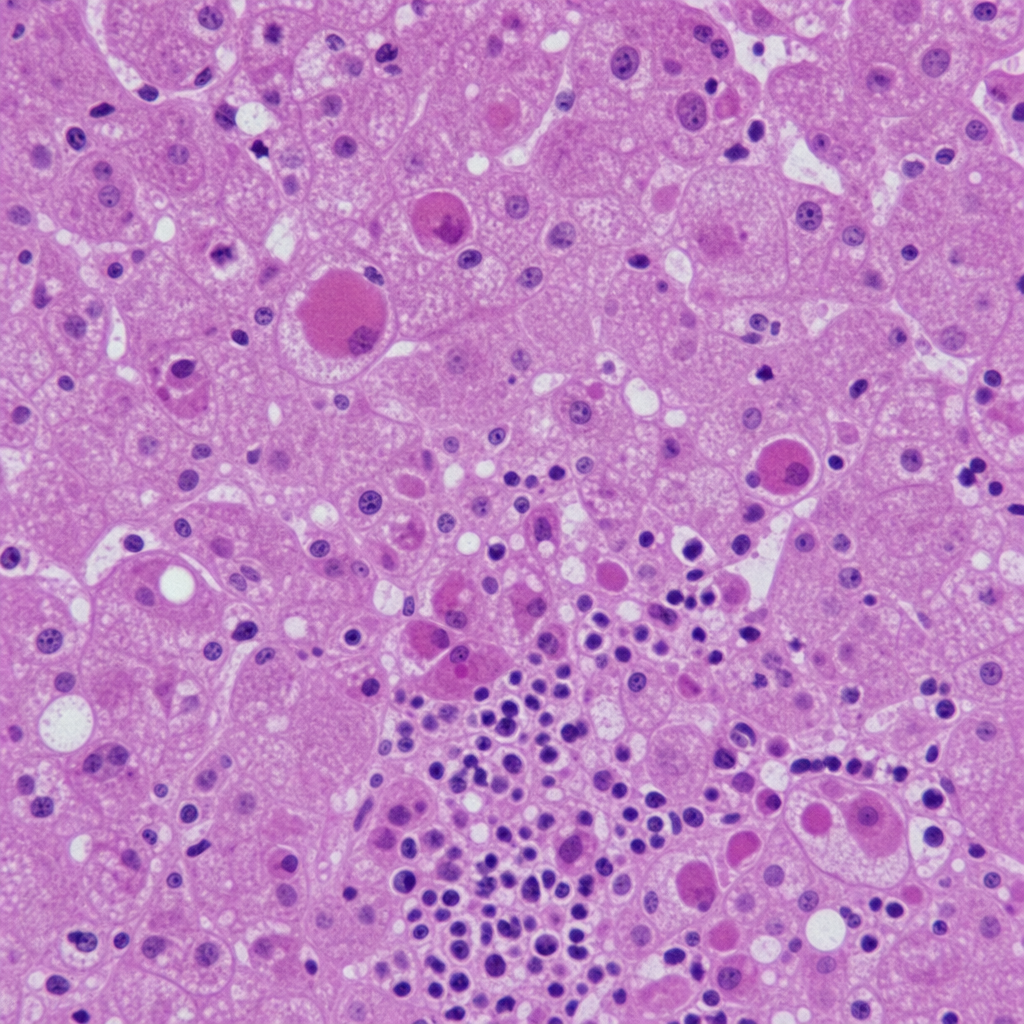
A 55-year-old man with a long history of alcohol use disorder presents with jaundice, tender hepatomegaly, and fever. A liver biopsy is performed. The biopsy demonstrates hepatocytes containing irregular rope-like eosinophilic cytoplasmic inclusions, ballooning degeneration of hepatocytes, neutrophilic infiltration predominantly in zone 3 (centrilobular region), and scattered acidophil bodies. Which of the following best identifies the cytoplasmic inclusions depicted and their composition?
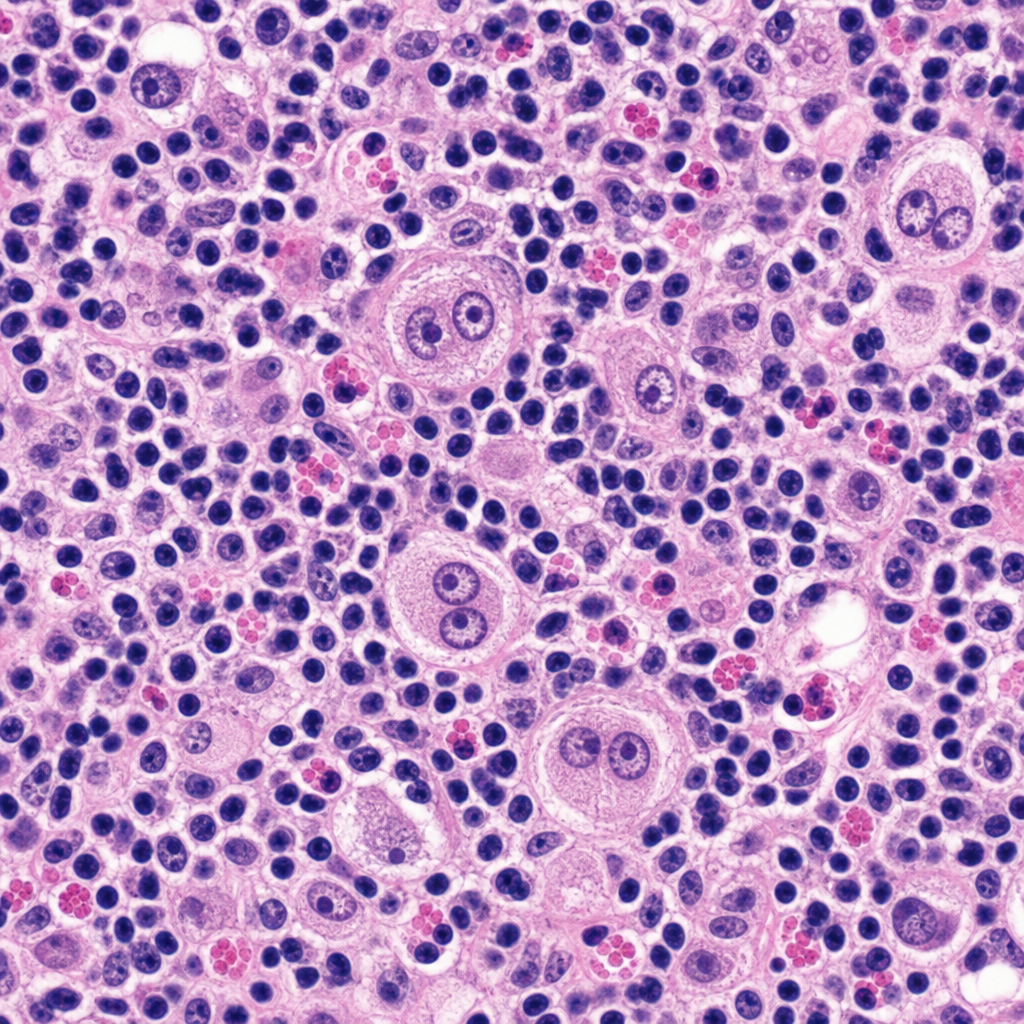
A 34-year-old woman presents with fatigue, night sweats, and a painless cervical lymph node enlargement for 3 months. A lymph node biopsy is performed. The photomicrograph shows a mixed cellular infiltrate of lymphocytes, plasma cells, eosinophils, and scattered large binucleated cells with prominent eosinophilic 'owl-eye' nucleoli; the large cells stain positive for CD15 and CD30 and negative for CD45. Which of the following cell types is the neoplastic cell of origin in this condition?
An 83-year-old woman with a history of atrial fibrillation, multiple ischemic strokes, and early dementia is found unresponsive in her apartment at her retirement community. She is believed to have not refilled any of her medications for a month, and it is determined that she passed away from a stroke nearly 2 weeks ago. The family is adamant that she receive an autopsy. Which of the following findings are most likely on brain histology?
Want unlimited practice?
Get full access to all questions, explanations, and performance tracking.
Scan to download app