
Second stage of labor — MCQs

A 26-year-old primigravid woman at 39 weeks' gestation is admitted to the hospital in active labor. Pregnancy was complicated by mild oligohydramnios detected a week ago, which was managed with hydration. Her pulse is 92/min, respirations are 18/min, and blood pressure is 134/76 mm Hg. Pelvic examination shows 100% cervical effacement and 10 cm cervical dilation; the vertex is at 0 station. Cardiotocography is shown. Which of the following is the most appropriate next step in management?
A 30-year-old woman, gravida 1, para 0, at 40 weeks' gestation is admitted to the hospital in active labor. Pregnancy was complicated by iron deficiency anemia treated with iron supplements. At the beginning of the first stage of labor, there are coordinated, regular, rhythmic contractions of high intensity that occur approximately every 10 minutes. Four hours later, the cervix is 100% effaced and 10 cm dilated; the vertex is at -1 station. Over the next two hours, there is minimal change in fetal descent; vertex is still at -1 station. Fetal birth weight is estimated at the 75th percentile. The fetal heart rate is 145/min and is reactive with no decelerations. Contractions occurs approximately every 2 minutes with adequate pressure. Epidural anesthesia was not given, as the patient is coping well with pain. Which of the following is the most appropriate next step in management?
A 27-year old primigravid woman at 37 weeks' gestation comes to the emergency department because of frequent contractions for 4 hours. Her pregnancy has been complicated by hyperemesis gravidarum which subsided in the second trimester. The contractions occur every 10–15 minutes and have been increasing in intensity and duration since onset. Her temperature is 37.1°C (98.8°F), pulse is 110/min, and blood pressure is 140/85 mm Hg. Uterine contractions are felt on palpation. Pelvic examination shows clear fluid in the vagina. The cervix is 50% effaced and 3 cm dilated. After 4 hours the cervix is 80% effaced and 6 cm dilated. Pelvic examination is inconclusive for the position of the fetal head. The fetal heart rate is reassuring. Which of the following is the most appropriate next step?
A 26-year-old G1P0 woman at 40 weeks estimated gestational age presents after experiencing labor pains. Pregnancy has been uncomplicated so far. Rupture of membranes occurs, and a transvaginal delivery is performed under epidural anesthesia, and the baby is delivered alive and healthy. The patient voids a few hours after the delivery and complains of mild irritation at the injection site on her back. On the second day, she complains of a severe headache over the back of her head. The headache is associated with pain and stiffness in the neck. Her headache is aggravated by sitting up or standing and relieved by lying down. The pain is relieved slightly by acetaminophen and ibuprofen. The patient is afebrile. Her vital signs include: pulse 100/min, respiratory rate 18/min, and blood pressure 128/84 mm Hg. Which of the following statements is the most accurate regarding this patient’s condition?
A 28-year-old primigravid woman at 36 weeks' gestation comes to the emergency department for 2 hours of contractions. Her pregnancy has been uncomplicated. The contractions occur once every 20–30 minutes, last less than 30 seconds, and have been consistent in intensity and duration since onset. During that time there has been an increase in fetal movements. Her temperature is 37.1°C (98.8°F), pulse is 98/min, and blood pressure is 104/76 mm Hg. Pelvic examination shows clear cervical mucus and a firm uterus consistent in size with a 36-week gestation. The cervix is 0% effaced and undilated; the vertex is at -3 station. The fetal heart rate is reassuring. After an hour of monitoring in the emergency department, the character of the contractions and pelvic examination findings remain unchanged. Which of the following is the most appropriate next step?
A 30-year-old woman, gravida 2, para 1, at 38 weeks' gestation comes to the hospital for regular, painful contractions that have been increasing in frequency. Her pregnancy has been complicated by gestational diabetes treated with insulin. Pelvic examination shows the cervix is 50% effaced and 4 cm dilated; the vertex is at -1 station. Ultrasonography shows no abnormalities. A tocometer and Doppler fetal heart monitor are placed on the patient's abdomen. The fetal heart rate monitoring strip shows a baseline heart rate of 145/min with a variability of ≥ 15/min. Within a 20-minute recording, there are 7 uterine contractions, 4 accelerations, and 3 decelerations that have a nadir occurring within half a minute. The decelerations occur at differing intervals relative to the contractions. Which of the following is the most appropriate next step in the management of this patient?
A 31-year-old woman delivers a healthy boy at 38 weeks gestation. The delivery is vaginal and uncomplicated. The pregnancy was unremarkable. On examination of the newborn, it is noted that his head is tilted to the left and his chin is rotated to the right. Palpation reveals no masses or infiltration in the neck. The baby also shows signs of left hip dysplasia. Nevertheless, the baby is active and exhibits no signs of other pathology. What is the most probable cause of this patient's condition?
A 54-year-old male comes to the clinic to initiate care with a new physician. He has no complaints at this time. When taking his history, the patient says his medical history is notable for diabetes and hypertension both of which are well managed on his medications. His medications are metformin and lisinopril. A review of systems is negative. While taking the social history, the patient hesitates when asked about alcohol consumption. Further gentle questioning by the physician leads the patient to admit that he drinks 5-6 beers per night and up to 10-12 drinks per day over the weekend. He says that he has been drinking like this for “years.” He becomes emotional and says that his alcohol is negatively affecting his relationship with his wife and children; however, when asked about efforts to decrease his consumption, the patient says he has not tried in the past and doesn’t think he has “the strength to stop”. Which of the following stages of change most accurately describes this patient’s behavior?
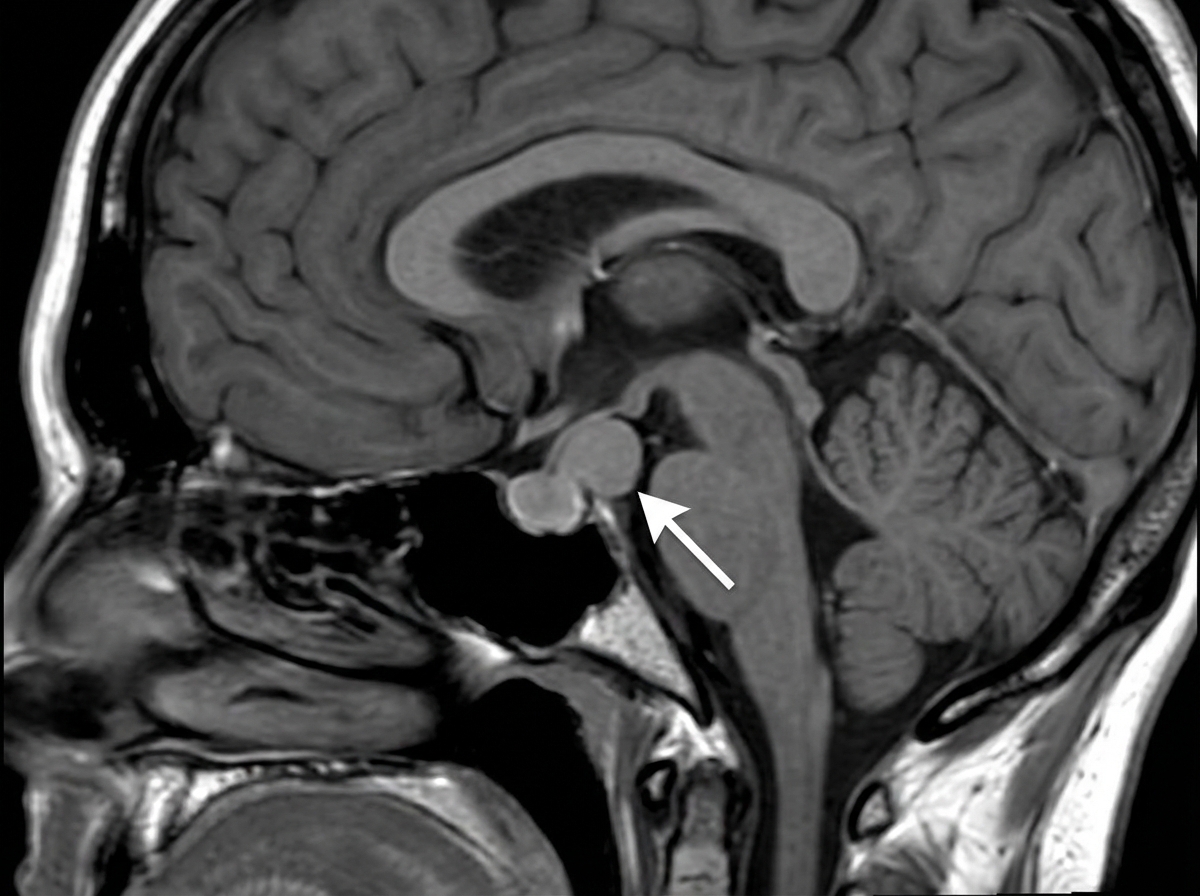
A 17-year-old teenager presents to the clinic with her parents complaining of headaches and loss of vision which began insidiously 3 months ago. She describes her headaches as throbbing, mostly on her forehead, and severe enough to affect her daily activities. She has not experienced menarche. Past medical history is noncontributory. She takes no medication. Both of her parents are alive and well. Today, her blood pressure is 110/70 mm Hg, the heart rate is 90/min, the respiratory rate is 17/min, and the temperature is 37.0°C (98.6°F). Breasts and pubic hair development are in Tanner stage I. Blood work is collected and an MRI is performed (the result is shown). Decreased production of which of the following hormones is the most likely explanation for the patient's signs and symptoms?
A 62-year-old woman makes an appointment with her primary care physician because she recently started experiencing post-menopausal bleeding. She states that she suffered from anorexia as a young adult and has been thin throughout her life. She says that this nutritional deficit is likely what caused her to not experience menarche until age 15. She used oral contraceptive pills for many years, has never been pregnant, and experienced menopause at age 50. A biopsy of tissue inside the uterus reveals foci of both benign and malignant glandular cells. Which of the following was a risk factor for the development of the most likely cause of her symptoms?
Want unlimited practice?
Get full access to all questions, explanations, and performance tracking.
Scan to download app