
Cardinal movements of labor — MCQs

A 34-year-old pregnant woman with unknown medical history is admitted to the hospital at her 36th week of gestation with painful contractions. She received no proper prenatal care during the current pregnancy. On presentation, her vital signs are as follows: blood pressure is 110/60 mm Hg, heart rate is 102/min, respiratory rate is 23/min, and temperature is 37.0℃ (98.6℉). Fetal heart rate is 179/min. Pelvic examination shows a closed non-effaced cervix. During the examination, the patient experiences a strong contraction accompanied by a high-intensity pain after which contractions disappear. The fetal heart rate becomes 85/min and continues to decrease. The fetal head is now floating. Which of the following factors would most likely be present in the patient’s history?
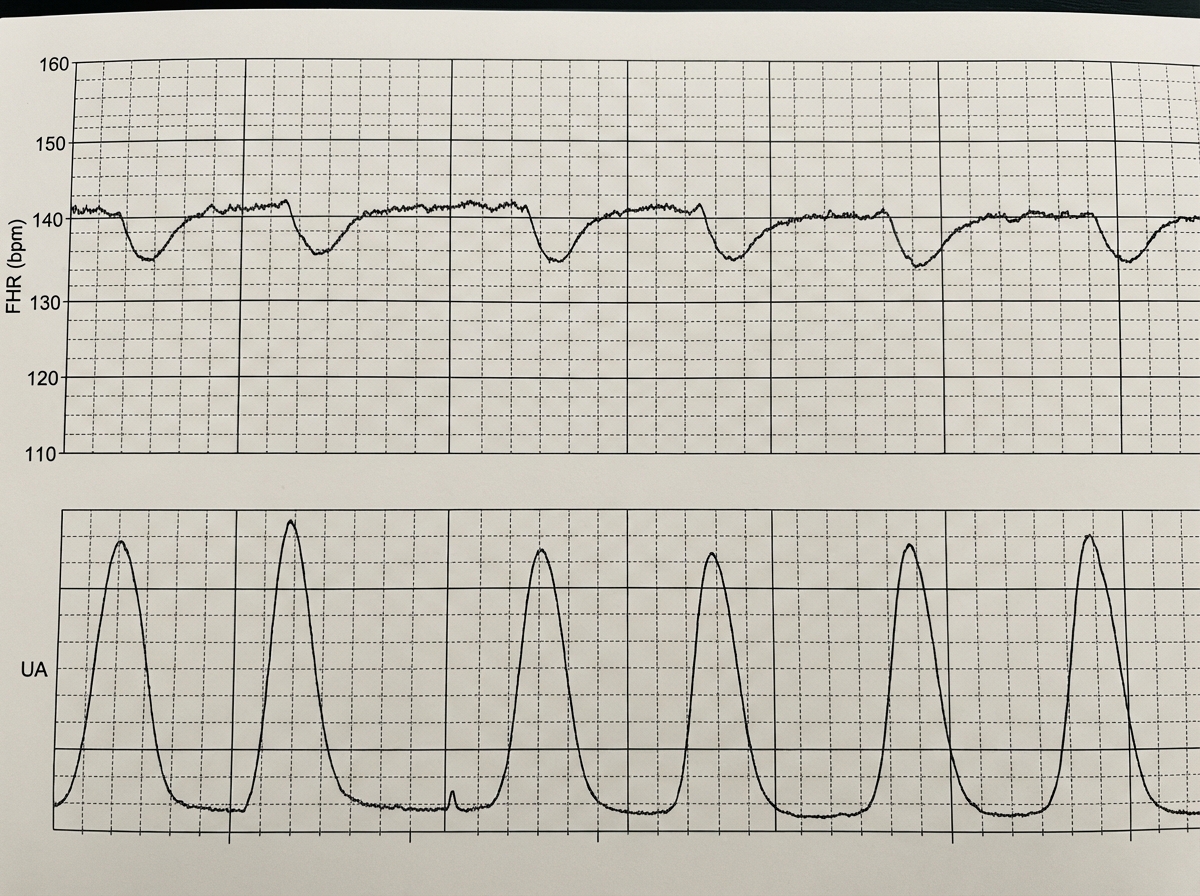
A 39-year-old woman, gravida 5, para 4, at 41 weeks' gestation is brought to the hospital because of regular uterine contractions that started 2 hours ago. Pregnancy has been complicated by iron deficiency anemia treated with iron supplements. Pelvic examination shows the cervix is 90% effaced and 7-cm dilated; the vertex is at -1 station. Fetal heart tracing is shown. The patient is repositioned, O2 therapy is initiated, and amnioinfusion is done. A repeat assessment after 20 minutes shows a similar cervical status, and no changes in the fetal heart tracing, and less than 5 contractions in a period of 10 minutes.What is the most appropriate next step in management?
A 4-month-old boy is brought to the physician for a well-child examination. He was born at 39 weeks gestation via spontaneous vaginal delivery and is exclusively breastfed. He weighed 3,400 g (7 lb 8 oz) at birth. At the physician's office, he appears well. His pulse is 146/min, the respirations are 39/min, and the blood pressure is 78/44 mm Hg. He weighs 7.5 kg (16 lb 9 oz) and measures 65 cm (25.6 in) in length. The remainder of the physical examination is normal. Which of the following developmental milestones has this patient most likely met?
Three hours after the onset of labor, a 39-year-old woman, gravida 2, para 1, at 40 weeks' gestation has sudden worsening of abdominal pain and vaginal bleeding. 18 months ago her first child was delivered by a lower segment transverse cesarean section because of cephalopelvic disproportion. Her temperature is 37.5°C (99.5°F), pulse is 120/min, respirations are 20/min, and blood pressure is 90/50 mm Hg. Examination shows abdominal tenderness and the absence of uterine contractions. The cervix is 100% effaced and 10 cm dilated; the vertex is at -3 station. An hour before, the vertex was at 0 station. Cardiotocography shows fetal bradycardia, late decelerations, and decreased amplitude of uterine contractions. Which of the following is the most specific feature of this patient's condition?
A 22-year-old primigravid woman at 41 weeks' gestation is admitted to the hospital in active labor. Pregnancy has been uncomplicated. She has asthma treated with theophylline and inhaled corticosteroids. She has had 2 surgeries in the past to repair multiple lower limb and pelvis fractures that were the result of a car accident. She is otherwise healthy. Her temperature is 37.2°C (99°F) and blood pressure is 108/70 mm Hg. Examination shows the cervix is 100% effaced and 10 cm dilated; the vertex is at -4 station, with the occiput in the anterior position. Uterine activity is measured at 275 MVUs. Maternal pushing occurs during the contractions. Fetal heart tracing is 166/min and reactive with no decelerations. Epidural anesthesia is initiated for pain relief. After 4 hours of pushing, the vertex is found to be at -4 station, with increasing strength and rate of uterine contractions; fetal heart tracing shows late decelerations. Which of the following is the most likely cause of this patient's prolonged labor?
A 68-year-old woman comes to the physician for the evaluation of loss of urine for the last year. The patient states that she loses control over her bladder when walking or standing up. She reports frequent, small-volume urine losses with no urge to urinate prior to the leakage. She tried to strengthen her pelvic muscles with supervised Kegel exercises and using a continence pessary but her symptoms did not improve. The patient is sexually active with her husband. She has type 2 diabetes mellitus controlled with metformin. She does not smoke or drink alcohol. Vital signs are within normal limits. Her hemoglobin A1c is 6.3% and fingerstick blood glucose concentration is 110 mg/dL. Which of the following is the most appropriate next step in the management of this patient?
A 35-year-old woman, gravida 4, para 3, at 34 weeks' gestation comes to the physician for a prenatal visit. She feels well. She does not note any contractions or fluid from her vagina. Her third child was delivered spontaneously at 35 weeks' gestation; pregnancy and delivery of her other two children were uncomplicated. Vital signs are normal. The abdomen is nontender and no contractions are felt. Pelvic examination shows a uterus consistent in size with a 34-weeks' gestation. Ultrasonography shows the fetus in a breech presentation. The fetal heart rate is 148/min. Which of the following is the most appropriate next step in management?
A 27-year old primigravid woman at 37 weeks' gestation comes to the emergency department because of frequent contractions for 4 hours. Her pregnancy has been complicated by hyperemesis gravidarum which subsided in the second trimester. The contractions occur every 10–15 minutes and have been increasing in intensity and duration since onset. Her temperature is 37.1°C (98.8°F), pulse is 110/min, and blood pressure is 140/85 mm Hg. Uterine contractions are felt on palpation. Pelvic examination shows clear fluid in the vagina. The cervix is 50% effaced and 3 cm dilated. After 4 hours the cervix is 80% effaced and 6 cm dilated. Pelvic examination is inconclusive for the position of the fetal head. The fetal heart rate is reassuring. Which of the following is the most appropriate next step?
A 30-year-old G3P0 woman who is 28 weeks pregnant presents for a prenatal care visit. She reports occasionally feeling her baby move but has not kept count over the past couple weeks. She denies any bleeding, loss of fluid, or contractions. Her previous pregnancies resulted in spontaneous abortions at 12 and 14 weeks. She works as a business executive, has been in excellent health, and has had no surgeries. She states that she hired a nutritionist and pregnancy coach to ensure good prospects for this pregnancy. On physical exam, fetal heart tones are not detected. Abdominal ultrasound shows a 24-week fetal demise. The patient requests an autopsy on the fetus and wishes for the fetus to pass "as naturally as possible." What is the best next step in management?
A 31-year-old woman, G3P2, at 32 weeks of gestation presents with a sudden onset of painless vaginal bleeding. She soaked two pads over the past hour. Vital signs: BP 110/70 mmHg, HR 96 bpm. The fetal heart rate tracing shows a baseline of 150 bpm with moderate variability, accelerations present, and no decelerations. A transabdominal ultrasound obtained at presentation demonstrates the placenta completely covering the internal os. Based on the ultrasound findings, which of the following is the most appropriate management?
Want unlimited practice?
Get full access to all questions, explanations, and performance tracking.
Scan to download app