A 52-year-old woman visits your office complaining about discharge from her left nipple for the past 3 months. The discharge looks like gray greenish and its amount is progressively increasing. She appears to be anxious and extremely uncomfortable with this situation as it is embarrassing for her when it occurs outdoors. Past medical history is insignificant. Her family history is negative for breast and ovarian disorders. She tries to stay active by running for 30 minutes every day on a treadmill, staying away from smoking, and by eating a balanced diet. She drinks alcohol occasionally. During physical examination you find a firm, stable mass under an inverted nipple in her left breast; while on the right breast, dilated subareolar ducts can be noted. There is no lymphadenopathy and remaining of the physical exam is normal. A mammogram is performed which reveals tubular calcifications. Which of the following is the most likely diagnosis?
Q32
A 24-year-old gravida 2 para 0 presents to her physician at 15 weeks gestation to discuss the results of recent screening tests. She has no complaints and the current pregnancy has been uncomplicated. Her previous pregnancy terminated with spontaneous abortion in the first trimester. Her immunizations are up to date. Her vital signs are as follows: blood pressure 110/60 mm Hg, heart rate 78/min, respiratory rate 14/min, and temperature 36.8℃ (98.2℉). The physical examination is within normal limits. The laboratory screening tests show the following results:
HBsAg negative
HBcAg negative
Anti-HBsAg positive
HIV 1/2 AB negative
VDRL positive
What is the proper next step in the management of this patient?
Q33
A 36-year-old woman comes to the physician for an annual pelvic examination and Pap smear. Her last Pap smear was 3 years ago. She has been sexually active with multiple male partners and takes an oral contraceptive. She has smoked one pack of cigarettes daily for 10 years. Pelvic examination shows no abnormalities. A photomicrograph of cervical cells from the Pap smear specimen is shown. Cells similar to the one indicated by the arrow are most likely to be seen in which of the following conditions?
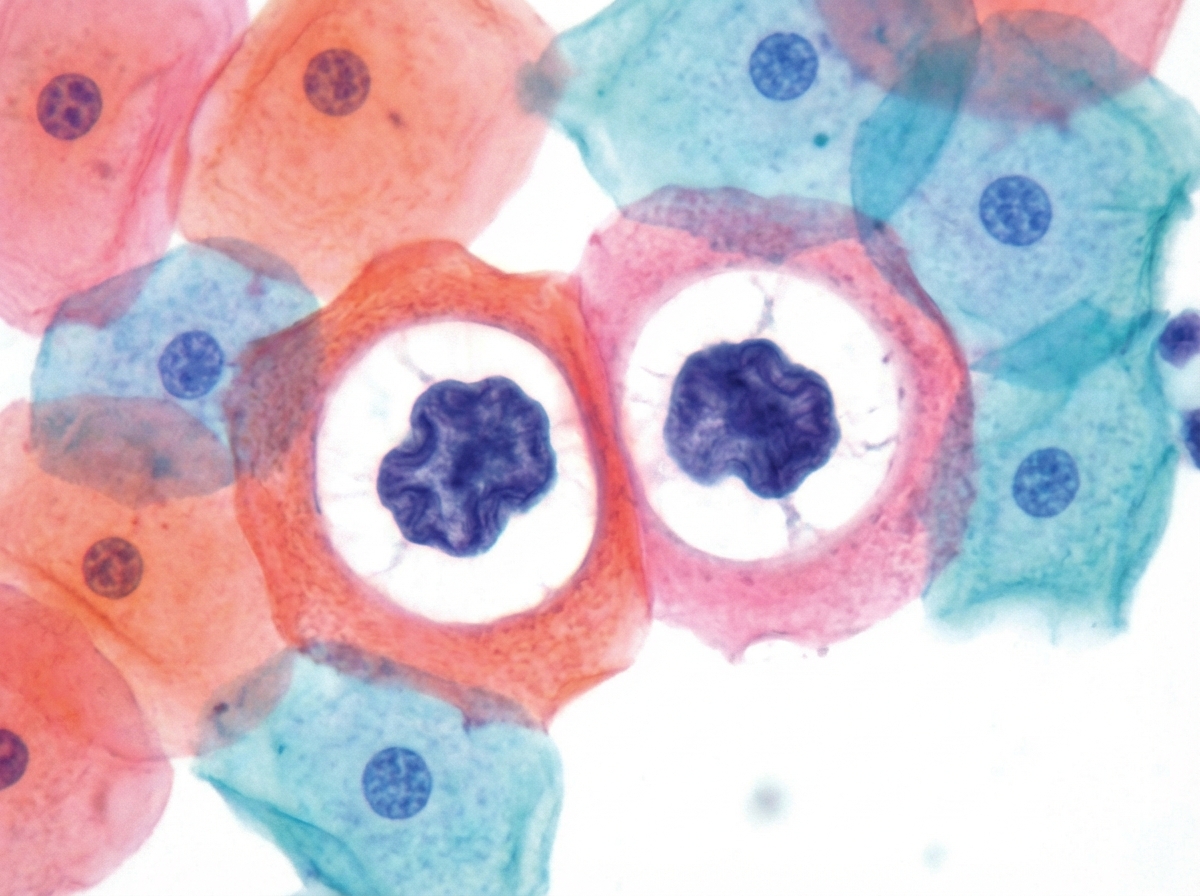
Q34
A 32-year-old woman presented for her annual physical examination. She mentioned that her family history had changed since her last visit: her mother was recently diagnosed with breast cancer and her sister tested positive for the BRCA2 mutation. The patient, therefore, requested testing as well. If the patient tests positive for the BRCA1 or BRCA2 mutation, which of the following is the best screening approach?
Q35
A 62-year-old woman presents to her primary care physician for a routine physical exam. The patient has no specific complaints but does comment on some mild weight gain. She reports that she recently retired from her job as a math teacher and has taken up hiking. Despite the increase in activity, she believes her pants have become "tighter." She denies headaches, urinary symptoms, or joint pains. She has a history of hypertension, type 2 diabetes, and rheumatoid arthritis. Her medications include aspirin, lisinopril, rovastatin, metformin, and methotrexate. She takes her medications as prescribed and is up to date with her vaccinations. A colonoscopy two years ago and a routine mammography last year were both normal. The patient’s last menstrual period was 10 years ago. The patient has a father who died of colon cancer at 71 years of age and a mother who has breast cancer. Her temperature is 98.7°F (37°C), blood pressure is 132/86 mmHg, pulse is 86/min, respirations are 14/min and oxygen saturation is 98% on room air. Physical exam is notable for a mildly distended abdomen and a firm and non-mobile right adnexal mass. What is the next step in the management of this patient?
Q36
A 36-year-old G4P0A3 woman presents at the prenatal diagnostic center at 18 weeks of gestation for the scheduled fetal anomaly scan. The patient's past medical history reveals spontaneous abortions. She reports that her 1st, 2nd, and 3rd pregnancy losses occurred at 8, 10, and 12 weeks of gestation, respectively. Ultrasonography indicates a female fetus with cystic hygroma (measuring 4 cm x 5 cm in size) and fetal hydrops. Which of the following karyotypes does her fetus most likely carry?
Q37
A 23-year-old woman presents to the emergency department with abnormal vaginal discharge and itchiness. She states it started a few days ago and has been worsening. The patient has a past medical history of a medical abortion completed 1 year ago. Her temperature is 98.6°F (37.0°C), blood pressure is 129/68 mmHg, pulse is 80/min, respirations are 14/min, and oxygen saturation is 99% on room air. Physical exam demonstrates an anxious woman. Pelvic exam reveals yellow cervical discharge. Nucleic acid amplification test is negative for Neisseria species. Which of the following is the best next step in management?
Q38
A 34-year-old G2P2 undergoes colposcopy due to high-grade intraepithelial neoplasia detected on a Pap smear. Her 2 previous Pap smears showed low-grade intraepithelial neoplasia. She has had 2 sexual partners in her life, and her husband has been her only sexual partner for the last 10 years. She had her sexual debut at 16 years of age. She had her first pregnancy at 26 years of age. She uses oral contraceptives for birth control. Her medical history is significant for right ovary resection due to a large follicular cyst and cocaine abuse for which she completed a rehabilitation program. Colposcopy reveals an acetowhite lesion with distorted vascularity at 4 o'clock. Which of the following factors present in this patient is a risk factor for the detected condition?
Q39
A 23-year-old pregnant woman (gravida 1, para 0) presents during her 16th week of pregnancy for a check-up. The course of her current pregnancy is unremarkable. She had normal results on the previous ultrasound examination. Her human chorionic gonadotropin (hCG) level measured at week 12 of pregnancy was 0.9 multiples of the normal median (MoM). She is human immunodeficiency virus (HIV), hepatitis B virus (HBV), and hepatitis C virus (HCV)-negative. She undergoes a quadruple test which shows the following results:
Serum alpha-fetoprotein Low
Unconjugated estriol Low
Beta-hCG High
Inhibin A High
The risk of which condition indicates these results?
Q40
A 39-year-old woman comes to the physician because of a 6-month history of vaginal bleeding for 2 to 5 days every 2 to 3 weeks. The flow is heavy with passage of clots. Menarche occurred at the age of 10 years, and menses previously occurred at regular 28- to 32- day intervals and lasted for 5 days with normal flow. Her only medication is a multivitamin. She has no children. Her mother was diagnosed with ovarian cancer at age 60. She is 158 cm (5 ft 2 in) tall and weighs 86 kg (190 lb); BMI is 34 kg/m2. Her temperature is 36.6°C (97.8°F), pulse is 86/min and blood pressure is 110/70 mm Hg. Pelvic examination shows a normal sized uterus. Laboratory studies, including a complete blood count, thyroid function tests, and coagulation studies are within the reference ranges. A urine pregnancy test is negative. The remainder of the examination shows no abnormalities. Which of the following is the most appropriate next step in management?
Screening tests US Medical PG Practice Questions and MCQs
Question 31: A 52-year-old woman visits your office complaining about discharge from her left nipple for the past 3 months. The discharge looks like gray greenish and its amount is progressively increasing. She appears to be anxious and extremely uncomfortable with this situation as it is embarrassing for her when it occurs outdoors. Past medical history is insignificant. Her family history is negative for breast and ovarian disorders. She tries to stay active by running for 30 minutes every day on a treadmill, staying away from smoking, and by eating a balanced diet. She drinks alcohol occasionally. During physical examination you find a firm, stable mass under an inverted nipple in her left breast; while on the right breast, dilated subareolar ducts can be noted. There is no lymphadenopathy and remaining of the physical exam is normal. A mammogram is performed which reveals tubular calcifications. Which of the following is the most likely diagnosis?
A. Duct ectasia (Correct Answer)
B. Periareolar fistula
C. Intraductal papilloma
D. Periductal mastitis
E. Phyllodes tumor
Explanation: ***Duct ectasia***
- The patient's presentation with **gray-green nipple discharge**, an **inverted nipple**, and **tubular calcifications on mammogram** are classic signs of duct ectasia in a postmenopausal woman.
- The presence of **dilated subareolar ducts** in the contralateral breast further supports this diagnosis, as it is a benign condition characterized by widening of the breast ducts.
*Periareolar fistula*
- This condition is typically associated with recurrent **subareolar abscesses** and chronic drainage, often from a nipple piercing or previous infection, which are not described here.
- Periareolar fistulas rarely present solely with gray-green discharge and tubular calcifications without a clear history of infection or abscess.
*Intraductal papilloma*
- Intraductal papillomas usually present with **serous or bloody nipple discharge**, rather than the gray-green discharge seen in this patient.
- While they can cause nipple discharge, they are not typically associated with **inverted nipples** or **tubular calcifications** on mammogram.
*Periductal mastitis*
- Periductal mastitis is an inflammatory condition that can cause nipple inversion and discharge, but the discharge is usually **purulent or inflammatory**, and it is often accompanied by signs of infection like pain, redness, and swelling, which are absent in this case.
- It is more commonly seen in **smokers**, whereas this patient is a non-smoker.
*Phyllodes tumor*
- Phyllodes tumors usually present as a **rapidly growing palpable breast mass**, which may be benign or malignant, but they are not typically associated with nipple discharge or tubular calcifications.
- The description of **gray-green discharge** and **tubular calcifications** does not align with the typical presentation of a phyllodes tumor.
Question 32: A 24-year-old gravida 2 para 0 presents to her physician at 15 weeks gestation to discuss the results of recent screening tests. She has no complaints and the current pregnancy has been uncomplicated. Her previous pregnancy terminated with spontaneous abortion in the first trimester. Her immunizations are up to date. Her vital signs are as follows: blood pressure 110/60 mm Hg, heart rate 78/min, respiratory rate 14/min, and temperature 36.8℃ (98.2℉). The physical examination is within normal limits. The laboratory screening tests show the following results:
HBsAg negative
HBcAg negative
Anti-HBsAg positive
HIV 1/2 AB negative
VDRL positive
What is the proper next step in the management of this patient?
A. Full serum panel for HBV
B. PCR for HBV DNA
C. HBV vaccination
D. Prescription of benzylpenicillin
E. T. pallidum hemagglutination assay (Correct Answer)
Explanation: ***T. pallidum hemagglutination assay***
- A positive **Venereal Disease Research Laboratory (VDRL)** test indicates potential exposure to syphilis, but it is a **non-treponemal test** and can yield false positives.
- A **treponemal test** such as the *T. pallidum* hemagglutination assay (TPHA) or fluorescent treponemal antibody-absorbed (FTA-ABS) is required to confirm the diagnosis of syphilis.
*Full serum panel for HBV*
- The **hepatitis B surface antigen (HBsAg)** is negative, and **anti-HBsAg (HBsAb)** is positive, indicating either prior vaccination or resolved infection with immunity.
- This patient does not have active hepatitis B infection, so a full serum panel for HBV is not necessary.
*PCR for HBV DNA*
- Similar to the above, the serological markers indicate immunity to HBV, not active infection.
- **PCR for HBV DNA** would only be indicated if there were signs of active infection or **occult HBV**.
*HBV vaccination*
- The patient already has **protective antibodies (anti-HBsAg)** against Hepatitis B, indicating immunity.
- Vaccination would be redundant as she is already immune.
*Prescription of benzylpenicillin*
- While **benzylpenicillin** is the treatment for syphilis, a definitive diagnosis has not yet been made.
- Confirmation with a **treponemal test** is crucial before initiating treatment to avoid unnecessary antibiotic exposure.
Question 33: A 36-year-old woman comes to the physician for an annual pelvic examination and Pap smear. Her last Pap smear was 3 years ago. She has been sexually active with multiple male partners and takes an oral contraceptive. She has smoked one pack of cigarettes daily for 10 years. Pelvic examination shows no abnormalities. A photomicrograph of cervical cells from the Pap smear specimen is shown. Cells similar to the one indicated by the arrow are most likely to be seen in which of the following conditions?
A. Condylomata acuminata (Correct Answer)
B. Bacterial vaginosis
C. Trichomoniasis
D. Genital herpes
E. Syphilitic chancre
Explanation: ***Condylomata acuminata***
- The image likely depicts a **koilocyte**, a key indicator of **Human Papillomavirus (HPV) infection**, which causes condylomata acuminata.
- Koilocytes are characterized by **perinuclear cytoplasmic vacuolization** and nuclear atypia, directly linked to HPV.
*Bacterial vaginosis*
- Characterized by a **shift in vaginal flora**, presenting with "clue cells" (vaginal epithelial cells covered in bacteria) and discharge, not koilocytes.
- While common, bacterial vaginosis does not cause the **cytopathic changes** seen with HPV infection.
*Trichomoniasis*
- Caused by the **protozoan parasite** *Trichomonas vaginalis*, leading to a frothy, green-yellow discharge and cervical inflammation (strawberry cervix).
- Diagnosis involves identifying the **motile trichomonads** on wet mount, not koilocytes on a Pap smear.
*Genital herpes*
- Caused by **herpes simplex virus (HSV)**, resulting in painful vesicular lesions that ulcerate.
- Cytologic findings include **multinucleated giant cells** with nuclear molding and intranuclear inclusions, distinctly different from koilocytes.
*Syphilitic chancre*
- A primary lesion of syphilis caused by **_Treponema pallidum_**, presenting as a painless ulcer.
- Diagnosis is made by **darkfield microscopy** or serologic tests; cytology is not used to identify syphilitic chancres.
Question 34: A 32-year-old woman presented for her annual physical examination. She mentioned that her family history had changed since her last visit: her mother was recently diagnosed with breast cancer and her sister tested positive for the BRCA2 mutation. The patient, therefore, requested testing as well. If the patient tests positive for the BRCA1 or BRCA2 mutation, which of the following is the best screening approach?
A. Order magnetic resonance imaging of the breast
B. Annual ultrasound, annual mammography, and monthly self-breast exams
C. Twice-yearly clinical breast exams, annual mammography, annual breast MRI, and breast self-exams (Correct Answer)
D. Annual clinical breast exams, annual mammography, and monthly self-breast exams
E. Refer to radiation therapy
Explanation: ***Twice-yearly clinical breast exams, annual mammography, annual breast MRI, and breast self-exams***
- For patients with **BRCA1 or BRCA2 mutations**, an intensive breast cancer screening protocol is recommended due to their highly increased lifetime risk of breast cancer.
- This typically includes **semiannual clinical breast exams**, **annual mammography**, and **annual breast MRI**, often starting at a young age.
*Order magnetic resonance imaging of the breast*
- While MRI is a crucial part of screening for high-risk individuals, it is **not sufficient as a standalone screening modality**.
- A comprehensive approach combining multiple screening methods is needed to maximize detection rates.
*Annual ultrasound, annual mammography, and monthly self-breast exams*
- **Breast ultrasound** is generally used as an adjunct to mammography when specific abnormalities are found or in women with dense breasts, not as a routine primary screening tool for BRCA carriers.
- While **mammography** and **self-breast exams** are included, this option lacks the crucial **annual MRI** and **twice-yearly clinical breast exams** recommended for BRCA carriers.
*Annual clinical breast exams, annual mammography, and monthly self-breast exams*
- This protocol is **less intensive** than what is recommended for women with BRCA mutations.
- It omits the essential **annual breast MRI** and the **twice-yearly clinical breast exams** that are critical for early detection in this high-risk population.
*Refer to radiation therapy*
- **Radiation therapy** is a treatment modality for existing cancer, not a screening approach for cancer prevention or early detection.
- Referring for radiation therapy would be appropriate only after a diagnosis of breast cancer, not as a primary screening strategy.
Question 35: A 62-year-old woman presents to her primary care physician for a routine physical exam. The patient has no specific complaints but does comment on some mild weight gain. She reports that she recently retired from her job as a math teacher and has taken up hiking. Despite the increase in activity, she believes her pants have become "tighter." She denies headaches, urinary symptoms, or joint pains. She has a history of hypertension, type 2 diabetes, and rheumatoid arthritis. Her medications include aspirin, lisinopril, rovastatin, metformin, and methotrexate. She takes her medications as prescribed and is up to date with her vaccinations. A colonoscopy two years ago and a routine mammography last year were both normal. The patient’s last menstrual period was 10 years ago. The patient has a father who died of colon cancer at 71 years of age and a mother who has breast cancer. Her temperature is 98.7°F (37°C), blood pressure is 132/86 mmHg, pulse is 86/min, respirations are 14/min and oxygen saturation is 98% on room air. Physical exam is notable for a mildly distended abdomen and a firm and non-mobile right adnexal mass. What is the next step in the management of this patient?
A. Pelvic ultrasound (Correct Answer)
B. Abdominal MRI
C. PET-CT
D. Exploratory laparotomy and debulking
E. CA-125 level
Explanation: ***Pelvic ultrasound***
- A **non-mobile right adnexal mass** in a postmenopausal woman, along with vague symptoms like **abdominal distension** and **weight gain**, raises suspicion for **ovarian cancer**.
- A **pelvic ultrasound** is the initial, non-invasive, and cost-effective imaging modality to characterize adnexal masses, assessing size, morphology, and vascularity.
*Abdominal MRI*
- While **MRI** offers excellent soft tissue contrast, it is typically used as a **secondary imaging modality** for further characterization of adnexal masses when ultrasound findings are inconclusive or for surgical planning, not as the initial step.
- Its higher cost and longer scan time make it less suitable for initial screening compared to ultrasound.
*PET-CT*
- **PET-CT** is primarily used for **staging malignancies** and detecting metastatic disease, or in cases of unknown primary, and is not the initial diagnostic test for an adnexal mass.
- It involves radiation exposure and is generally reserved for situations where malignancy is already highly suspected or confirmed.
*Exploratory laparotomy and debulking*
- **Exploratory laparotomy** and **debulking** are surgical procedures performed for the definitive diagnosis, staging, and treatment of ovarian cancer, but only *after* a thorough initial workup has been completed.
- It is an invasive procedure and should not be the first step in the investigation of an adnexal mass.
*CA-125 level*
- Measuring **CA-125** levels is useful as a **tumor marker** in the workup of suspected ovarian cancer, particularly in symptomatic postmenopausal women, and for monitoring treatment response.
- However, it has **low specificity** (can be elevated in benign conditions) and should be ordered in conjunction with imaging, not as the sole initial diagnostic step.
Question 36: A 36-year-old G4P0A3 woman presents at the prenatal diagnostic center at 18 weeks of gestation for the scheduled fetal anomaly scan. The patient's past medical history reveals spontaneous abortions. She reports that her 1st, 2nd, and 3rd pregnancy losses occurred at 8, 10, and 12 weeks of gestation, respectively. Ultrasonography indicates a female fetus with cystic hygroma (measuring 4 cm x 5 cm in size) and fetal hydrops. Which of the following karyotypes does her fetus most likely carry?
A. 45 X0 (Correct Answer)
B. Monosomy 18
C. Trisomy 13
D. Trisomy 21
E. Monosomy 13
Explanation: ***45 X0***
- The presence of **cystic hygroma** and **fetal hydrops** strongly suggests **Turner syndrome (45, X0)**, as these are classic sonographic findings.
- The history of **recurrent early pregnancy losses** is also consistent with chromosomal aneuploidies, with 45, X0 being a common cause of such losses.
*Monosomy 18*
- **Monosomy 18** is a very rare and usually lethal chromosomal abnormality, typically resulting in **early miscarriage**.
- Its clinical presentation, if live-born, is distinct and does not primarily feature **cystic hygroma** or **hydrops** as the main diagnostic clues.
*Trisomy 13*
- **Trisomy 13 (Patau syndrome)** is associated with severe malformations, including **cleft lip/palate**, **polydactyly**, and **holoprosencephaly**.
- While it can cause fetal hydrops and other structural anomalies, **cystic hygroma** is not its most characteristic or common sonographic marker in the way it is for Turner syndrome.
*Trisomy 21*
- **Trisomy 21 (Down syndrome)** is characterized by **nuchal translucency** and **cardiac defects**, but **cystic hygroma** and **hydrops** are less common and less severe than in Turner syndrome.
- The constellation of findings in this case points more strongly to Turner syndrome.
*Monosomy 13*
- **Monosomy 13** is an extremely rare and usually **lethal** chromosomal anomaly, often leading to early spontaneous abortion.
- It would typically result in more severe generalized developmental defects rather than the specific combination of **cystic hygroma** and **hydrops** seen here.
Question 37: A 23-year-old woman presents to the emergency department with abnormal vaginal discharge and itchiness. She states it started a few days ago and has been worsening. The patient has a past medical history of a medical abortion completed 1 year ago. Her temperature is 98.6°F (37.0°C), blood pressure is 129/68 mmHg, pulse is 80/min, respirations are 14/min, and oxygen saturation is 99% on room air. Physical exam demonstrates an anxious woman. Pelvic exam reveals yellow cervical discharge. Nucleic acid amplification test is negative for Neisseria species. Which of the following is the best next step in management?
A. Ceftriaxone
B. Azithromycin and ceftriaxone
C. Fluconazole
D. Azithromycin (Correct Answer)
E. Cervical cultures
Explanation: ***Azithromycin***
- A **yellow cervical discharge** and **negative *Neisseria* species NAAT** strongly suggest a *Chlamydia trachomatis* infection, for which azithromycin is a first-line treatment.
- Given the patient's symptoms of **vaginal discharge and itchiness**, along with the high prevalence of chlamydia, empirical treatment is appropriate while awaiting further test results.
*Ceftriaxone*
- This antibiotic is primarily used to treat **gonorrhea**, which has been ruled out by the negative *Neisseria* NAAT.
- While sometimes given in combination therapy, it is not the best single agent in this scenario.
*Azithromycin and ceftriaxone*
- This combination is typically used for **empirical treatment of cervicitis** when both gonorrhea and chlamydia are suspected.
- However, since **gonorrhea has been excluded** by NAAT, adding ceftriaxone is unnecessary at this point.
*Fluconazole*
- Fluconazole is an **antifungal medication** used to treat **yeast infections** (*Candida* species).
- While the patient reports itchiness, a **yellow discharge** is more characteristic of a bacterial infection like chlamydia, rather than the typically white, cottage-cheese-like discharge of a yeast infection.
*Cervical cultures*
- While collecting cervical cultures for other pathogens (e.g., **Trichomonas**) might be considered, the immediate priority in a symptomatic patient with suspected chlamydia is to **initiate treatment to prevent complications** and reduce transmission.
- **NAATs are highly sensitive and specific** for chlamydia and gonorrhea, making them preferred over traditional cultures for these infections.
Question 38: A 34-year-old G2P2 undergoes colposcopy due to high-grade intraepithelial neoplasia detected on a Pap smear. Her 2 previous Pap smears showed low-grade intraepithelial neoplasia. She has had 2 sexual partners in her life, and her husband has been her only sexual partner for the last 10 years. She had her sexual debut at 16 years of age. She had her first pregnancy at 26 years of age. She uses oral contraceptives for birth control. Her medical history is significant for right ovary resection due to a large follicular cyst and cocaine abuse for which she completed a rehabilitation program. Colposcopy reveals an acetowhite lesion with distorted vascularity at 4 o'clock. Which of the following factors present in this patient is a risk factor for the detected condition?
A. Age of sexual debut (Correct Answer)
B. Ovarian surgery
C. History of cocaine abuse
D. Patient age
E. Age at first pregnancy
Explanation: ***Age of sexual debut***
- An early **age of sexual debut** (before 17 years old) is a significant risk factor for **HPV infection** and subsequently, cervical dysplasia. This patient's sexual debut at 16 years old falls within this high-risk category.
- Early sexual activity, especially with multiple partners, increases the likelihood of exposure to **human papillomavirus (HPV)**, the primary cause of cervical cancer and its precursor lesions.
*Ovarian surgery*
- **Ovarian surgery**, such as a right ovary resection for a follicular cyst, is not a known risk factor for **cervical intraepithelial neoplasia (CIN)** or **cervical cancer**.
- This aspect of her medical history is unrelated to the development of cervical dysplasia.
*History of cocaine abuse*
- While **cocaine abuse** can be associated with other health complications and risky behaviors, it is not a direct or independent **risk factor** for **cervical intraepithelial neoplasia (CIN)**.
- There is no established physiological link between cocaine use and the development of cervical dysplasia.
*Patient age*
- Although the incidence of HPV infection peaks in younger women, the risk of developing **high-grade cervical intraepithelial neoplasia (HGSIL)** and invasive cancer increases with age, particularly after 30 due to persistent HPV infection.
- However, at 34, her age is not as strong a contributing risk factor as an early **age of sexual debut** for the initial development of the underlying condition.
*Age at first pregnancy*
- **Early age at first pregnancy** (before 20) can increase the risk of cervical cancer in some studies, possibly due to hormonal changes in the cervix making it more vulnerable to **HPV infection**.
- This patient's first pregnancy at 26 is not considered an early age at first pregnancy and therefore is not a significant risk factor in this context.
Question 39: A 23-year-old pregnant woman (gravida 1, para 0) presents during her 16th week of pregnancy for a check-up. The course of her current pregnancy is unremarkable. She had normal results on the previous ultrasound examination. Her human chorionic gonadotropin (hCG) level measured at week 12 of pregnancy was 0.9 multiples of the normal median (MoM). She is human immunodeficiency virus (HIV), hepatitis B virus (HBV), and hepatitis C virus (HCV)-negative. She undergoes a quadruple test which shows the following results:
Serum alpha-fetoprotein Low
Unconjugated estriol Low
Beta-hCG High
Inhibin A High
The risk of which condition indicates these results?
A. Trisomy 21 (Correct Answer)
B. Trisomy 18
C. Neural tube defect
D. Congenital toxoplasmosis
E. Trophoblastic disease
Explanation: ***Trisomy 21***
- The quadruple test results of **low alpha-fetoprotein**, **low unconjugated estriol**, **high beta-hCG**, and **high inhibin A** are highly characteristic of **Trisomy 21 (Down syndrome)**.
- These specific maternal serum analyte patterns are used in **second-trimester screening** to assess the risk of chromosomal abnormalities.
*Trisomy 18*
- Trisomy 18 (Edwards syndrome) would typically show **low alpha-fetoprotein**, **low unconjugated estriol**, and **low beta-hCG**, often with **normal or low inhibin A**.
- The elevated beta-hCG and inhibin A in the patient's results make Trisomy 18 less likely.
*Neural tube defect*
- Neural tube defects (NTDs) are associated with **elevated alpha-fetoprotein** levels in maternal serum.
- The patient's results show **low alpha-fetoprotein**, which argues against an NTD.
*Congenital toxoplasmosis*
- Congenital toxoplasmosis is an infection and does not typically present with a specific pattern of abnormal maternal serum markers like those seen in the quadruple test.
- Diagnosis would involve specific **serological testing for Toxoplasma antibodies** or ultrasound findings.
*Trophoblastic disease*
- Trophoblastic disease, such as a **hydatidiform mole**, is associated with **extremely high levels of beta-hCG**, often much higher than what would be seen in Trisomy 21.
- It would also typically be detected earlier in pregnancy and present with distinct ultrasound findings, which were normal in this case.
Question 40: A 39-year-old woman comes to the physician because of a 6-month history of vaginal bleeding for 2 to 5 days every 2 to 3 weeks. The flow is heavy with passage of clots. Menarche occurred at the age of 10 years, and menses previously occurred at regular 28- to 32- day intervals and lasted for 5 days with normal flow. Her only medication is a multivitamin. She has no children. Her mother was diagnosed with ovarian cancer at age 60. She is 158 cm (5 ft 2 in) tall and weighs 86 kg (190 lb); BMI is 34 kg/m2. Her temperature is 36.6°C (97.8°F), pulse is 86/min and blood pressure is 110/70 mm Hg. Pelvic examination shows a normal sized uterus. Laboratory studies, including a complete blood count, thyroid function tests, and coagulation studies are within the reference ranges. A urine pregnancy test is negative. The remainder of the examination shows no abnormalities. Which of the following is the most appropriate next step in management?
A. Endometrial biopsy (Correct Answer)
B. Abdominal ultrasonography
C. Endometrial ablation
D. Combined oral contraceptives
E. Diagnostic laparoscopy
Explanation: **Endometrial biopsy**
- **Abnormal uterine bleeding (AUB)** in an **obese patient over 45 (or 35 with risk factors)** warrants evaluation for **endometrial hyperplasia or carcinoma**.
- The patient's age (39), obesity (BMI 34), and change in bleeding pattern make endometrial biopsy the most appropriate initial diagnostic step to rule out malignancy.
*Abdominal ultrasonography*
- While ultrasound can assess uterine structure and endometrial thickness, it is **not sufficient** to rule out malignancy in cases requiring tissue diagnosis.
- An abnormal ultrasound finding would still likely necessitate an endometrial biopsy for definitive diagnosis.
*Endometrial ablation*
- This is a **treatment** for AUB, not a diagnostic step. It should only be considered after excluding malignancy.
- Performing ablation without a prior biopsy could delay the diagnosis of endometrial cancer.
*Combined oral contraceptives*
- Hormonal therapy can manage AUB symptoms, but it is **not appropriate as an initial step** when there's a concern for endometrial malignancy.
- It would mask symptoms and delay diagnosis without addressing the underlying cause.
*Diagnostic laparoscopy*
- Laparoscopy is an invasive procedure typically used to investigate pelvic pain, endometriosis, or adnexal masses.
- It is **not indicated** as the first step for isolated AUB where the primary concern is endometrial pathology.