
Cervical cancer screening in pregnancy — MCQs

A 56-year-old woman makes an appointment with her physician to discuss the results of her cervical cancer screening. She has been menopausal for 2 years and does not take hormone replacement therapy. Her previous Pap smear showed low-grade squamous intraepithelial lesion (LSIL); no HPV testing was performed. Her gynecologic examination is unremarkable. The results of her current Pap smear is as follows: Specimen adequacy satisfactory for evaluation Interpretation low-grade squamous intraepithelial lesion Notes atrophic pattern Which option is the next best step in the management of this patient?
A 29-year-old G1P0 presents to her obstetrician for her first prenatal care visit at 12 weeks gestation by last menstrual period. She states that her breasts are very tender and swollen, and her exercise endurance has declined. She otherwise feels well. She is concerned about preterm birth, as she heard that certain cervical procedures increase the risk. The patient has a gynecologic history of loop electrosurgical excision procedure (LEEP) for cervical dysplasia several years ago and has had negative Pap smears since then. She also has mild intermittent asthma that is well controlled with occasional use of her albuterol inhaler. At this visit, this patient’s temperature is 98.6°F (37.0°C), pulse is 69/min, blood pressure is 119/61 mmHg, and respirations are 13/min. Cardiopulmonary exam is unremarkable, and the uterine fundus is just palpable at the pelvic brim. Pelvic exam reveals normal female external genitalia, a closed and slightly soft cervix, a 12-week-size uterus, and no adnexal masses. Which of the following is the best method for evaluating for possible cervical incompetence in this patient?
A 39-year-old woman presents to her gynecologist for a routine visit. She has no complaints during this visit. She had an abnormal pap test 6 years ago that showed atypical squamous cells of undetermined significance. The sample was negative for human papillomavirus. On her follow-up Pap test 3 years later, there was no abnormality. The latest pap test results show atypical glandular cells with reactive changes in the cervical epithelium. The gynecologist decides to perform a colposcopy, and some changes are noted in this study of the cervical epithelium. The biopsy shows dysplastic changes in the epithelial cells. Which of the following is the next best step in the management of this patient?
A 38-year-old G2P2 presents to her gynecologist to discuss the results of her diagnostic tests. She has no current complaints or concurrent diseases. She underwent a tubal ligation after her last pregnancy. Her last Pap smear showed a high-grade squamous intraepithelial lesion and a reflex HPV test was positive. Colposcopic examination reveals areas of thin acetowhite epithelium with diffuse borders and fine punctation. The biopsy obtained from the suspicious areas shows CIN 1. Note the discordancy between the cytology (HSIL) and histology (CIN 1) results. Which of the following is an appropriate next step in the management of this patient?
A 31-year-old female presents to her gynecologist for a routine Pap smear. Her last Pap smear was three years ago and was normal. On the current Pap smear, she is found to have atypical squamous cells of unknown significance (ASCUS). Reflex HPV testing is positive. What is the best next step?
A 28-year-old woman comes to the physician because she had a positive pregnancy test at home. She reports feeling nauseated and has vomited several times over the past week. During this period, she has also had increased urinary frequency. She is sexually active with her boyfriend and they use condoms inconsistently. Her last menstrual period was 5 weeks ago. Physical examination shows no abnormalities. A urine pregnancy test is positive. A pap smear is positive for a high-grade squamous intraepithelial lesion. Colposcopy shows cervical intraepithelial neoplasia grade II and III. Which of the following is the most appropriate next step in the management of this patient?
A 19-year-old woman presents for a sports physical. She says she feels healthy and has no concerns. Past medical history is significant for depression and seasonal allergies. Current medications are fluoxetine and oral estrogen/progesterone contraceptive pills. Family history is significant for a sister with polycystic ovarian syndrome (PCOS). The patient denies current or past use of alcohol, recreational drugs, or smoking. She reports that she has been on oral birth control pills since age 14 and uses condoms inconsistently. No history of STDs. She is sexually active with her current boyfriend, who was treated for chlamydia 2 years ago. She received and completed the HPV vaccination series starting at age 11. Her vital signs include: temperature 36.8°C (98.2°F), pulse 97/min, respiratory rate 16/min, blood pressure 120/75 mm Hg. Physical examination is unremarkable. Which of the following are the recommended guidelines for cervical cancer screening for this patient at this time?
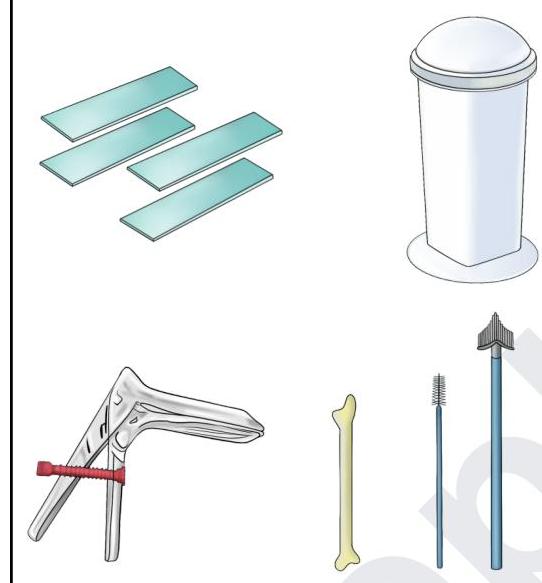
The following set of instruments are used for which procedure?
A 28-year-old woman presents to discuss the results of her Pap smear. Her previous Pap smear 1 year ago showed atypical squamous cells of undetermined significance. This year the Pap smear was negative. She had a single pregnancy with a cesarean delivery. Currently, she and her partner do not use contraception because they are planning another pregnancy. She does not have any concurrent diseases and her family history is unremarkable. The patient is concerned about her previous Pap smear finding. She heard from her friend about a vaccine which can protect her against cervical cancer. She has never had such a vaccine and would like to be vaccinated. Which of the following answers regarding the vaccination in this patient is correct?
A 45-year-old woman presents with a history of cervical erosion and spotting for the past 2 months. What is the next best step?
Want unlimited practice?
Get full access to all questions, explanations, and performance tracking.
Scan to download app