
Anemia in pregnancy — MCQs

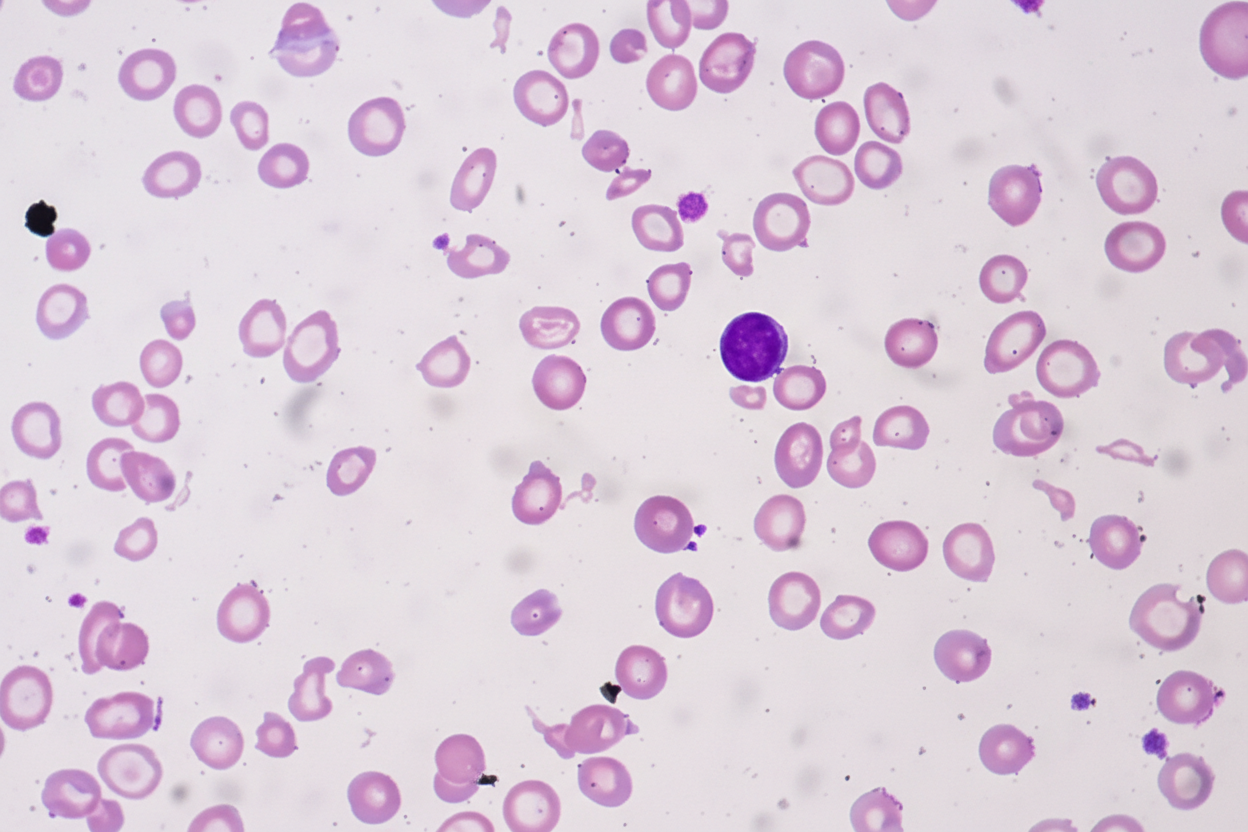
A 25-year-old African-American woman visits the doctor’s office complaining of fatigue for a couple of months. She says that she feels exhausted by the end of the day. She works as a dental assistant and is on her feet most of the time. However, she eats well and also tries to walk for 30 minutes every morning. She also says that she sometimes feels breathless and has to gasp for air, especially when she is walking or jogging. Her past medical history is insignificant, except for occasional bouts of cold during the winters. Her physical exam findings are within normal limits except for moderate conjunctival pallor. Complete blood count results and iron profile are as follows: Hemoglobin 9 g/dL Hematocrit 28.5% RBC count 5.85 x 10⁶/mm3 WBC count 5,500/mm3 Platelet count 212,000/mm3 MCV 56.1 fl MCH 20.9 pg/cell MCHC 25.6 g/dL RDW 11.7% Hb/cell Serum iron 170 mcg/dL Total iron-binding capacity (TIBC) 458 mcg/dL Transferrin saturation 60% A peripheral blood smear is given. When questioned about her family history of anemia, she says that all she remembers is her dad was never allowed to donate blood as he was anemic. Which of the following most likely explains her cell counts and blood smear results?
A 61-year-old woman presents for a routine health visit. She complains of generalized fatigue and lethargy on most days of the week for the past 4 months. She has no significant past medical history and is not taking any medications. She denies any history of smoking or recreational drug use but states that she drinks "socially" approx. 6 nights a week. She says she also enjoys a "nightcap," which is 1–2 glasses of wine before bed every night. The patient is afebrile, and her vital signs are within normal limits. On physical examination, there is significant pallor of the mucous membranes. Laboratory findings are significant for a mean corpuscular volume (MCV) of 72 fL, leukocyte count of 4,800/mL, hemoglobin of 11.0 g/dL, and platelet count of 611,000/mL. Stool guaiac test is negative. She is started on oral ferrous sulfate supplements. On follow-up, her laboratory parameters show no interval change in her MCV or platelet level, and she reports good compliance with the medication. Which of the following is the best next step in the management of this patient?
A 36-year-old primigravid woman who recently immigrated to the United States presents to her gynecologist for the first time during the 28th week of her pregnancy. She hasn’t received any prenatal care or folic acid supplementation. The patient’s history reveals that she has received blood transfusions in the past due to “severe anemia.” Which of the following blood type situations would put the fetus at risk for hemolytic disease of the newborn?
A 36-year-old woman gravida 5, para 4 was admitted at 31 weeks of gestation with worsening fatigue and shortness of breath on exertion for the past month. She also has nausea and loss of appetite. No significant past medical history. The patient denies any smoking history, alcohol or illicit drug use. Her vital signs include: blood pressure 110/60 mm Hg, pulse 120/min, respiratory rate 22/min and temperature 35.1℃ (97.0℉). A complete blood count reveals a macrocytosis with severe pancytopenia, as follows: Hb 7.2 g/dL RBC 3.6 million/uL WBC 4,400/mm3 Neutrophils 40% Lymphocytes 20% Platelets 15,000/mm3 MCV 104 fL Reticulocytes 0.9% Serum ferritin and vitamin B12 levels were within normal limits. There was an elevated homocysteine level and a normal methylmalonic acid level. Which of the following is the most likely diagnosis in this patient?
A 34-year-old woman comes to a physician for a routine health maintenance examination. She moved to Denver 1 week ago after having lived in New York City all her life. She has no history of serious illness and takes no medications. Which of the following sets of changes is most likely on analysis of a blood sample obtained now compared to prior to her move? Erythropoietin level | O2 saturation | Plasma volume
A 27-year-old African-American woman, gravida 1, para 0, at 11 weeks' gestation comes to her physician for a prenatal visit. She feels more fatigued than usual but has no other symptoms. She has no history of serious illness. She takes no medications. Her mother has systemic lupus erythematosus. Her temperature is 37.2°C (98.9°F), pulse is 80/min, respirations are 18/min, and blood pressure is 120/75 mm Hg. Examination shows no abnormalities. Laboratory studies show: Hemoglobin 9.2 g/dL Hematocrit 27.5% Leukocyte count 6,000/mm3 Platelet Count 180,000/mm3 MCV 74 μm3 MCH 24 pg/cell Serum Na+ 138 mEq/L K+ 4.5 mEq/L Cl- 100 mEq/L HCO3- 25 mEq/L Urea Nitrogen 15 mg/dL Creatinine 1.0 mg/dL Total Bilirubin 0.4 mg/dL Iron 67 U/L Ferritin 98 ng/mL Which of the following is the most appropriate next step in management?
A 43-year-old woman presents to her physician’s office complaining of fatigue and light headedness for one month. She has regular periods but notes that they have become heavier in the last year. She endorses increased urination and feels that she has gained weight in her abdomen, but review of systems is otherwise negative. She is a daycare teacher and has a first cousin with von Willebrand disease. Temperature is 98.4°F (36.9°C), pulse is 92/min, blood pressure is 109/72 mmHg, and respirations are 14/min. A CBC demonstrates: Hemoglobin: 9.9 g/dL Leukocyte count: 6,300/mm^3 Platelet count: 180,000/mm^3 Which of the following is the best next step to evaluate the etiology of this patient’s findings?
A 27-year-old woman, gravida 2, para 1, at 36 weeks' gestation comes to the physician for a prenatal visit. She feels well. Fetal movements are adequate. This is her 7th prenatal visit. She had an ultrasound scan performed 1 month ago that showed a live intrauterine pregnancy consistent with a 32-week gestation with no anomalies. She had a Pap smear performed 1 year ago, which was normal. Vital signs are within normal limits. Pelvic examination shows a uterus consistent in size with a 36-week gestation. Her blood group and type is A negative. Which of the following is the most appropriate next step in management?
A 29-year-old G1P0 presents to her obstetrician for her first prenatal care visit at 12 weeks gestation by last menstrual period. She states that her breasts are very tender and swollen, and her exercise endurance has declined. She otherwise feels well. She is concerned about preterm birth, as she heard that certain cervical procedures increase the risk. The patient has a gynecologic history of loop electrosurgical excision procedure (LEEP) for cervical dysplasia several years ago and has had negative Pap smears since then. She also has mild intermittent asthma that is well controlled with occasional use of her albuterol inhaler. At this visit, this patient’s temperature is 98.6°F (37.0°C), pulse is 69/min, blood pressure is 119/61 mmHg, and respirations are 13/min. Cardiopulmonary exam is unremarkable, and the uterine fundus is just palpable at the pelvic brim. Pelvic exam reveals normal female external genitalia, a closed and slightly soft cervix, a 12-week-size uterus, and no adnexal masses. Which of the following is the best method for evaluating for possible cervical incompetence in this patient?
A 26-year-old woman presents to the women’s health clinic with a 9-week delay in menses. The patient has a history of grand mal seizures, and was recently diagnosed with acute sinusitis. She is prescribed lamotrigine and amoxicillin. The patient smokes one-half pack of cigarettes every day for 10 years, and drinks socially a few weekends every month. Her mother died of breast cancer when she was 61 years old. The vital signs are stable during the current office visit. Physical examination is grossly normal. The physician orders a urine beta-hCG that comes back positive. Abdominal ultrasound shows an embryo consistent in dates with the first day of last menstrual period. Given the history of the patient, which of the following would most likely decrease congenital malformations in the newborn?
Want unlimited practice?
Get full access to all questions, explanations, and performance tracking.
Scan to download app