A husband requests paternity testing for his twins. The results show that one twin is biologically his child, but the other twin is not. What is the most likely diagnosis?
Q12
A patient presents with cannonball lesions in the lungs following a recent molar pregnancy evacuation. What is the most appropriate management?
Q13
An elderly female presented with dribbling of urine only on coughing and straining. What type of urinary incontinence is she suffering from
Q14
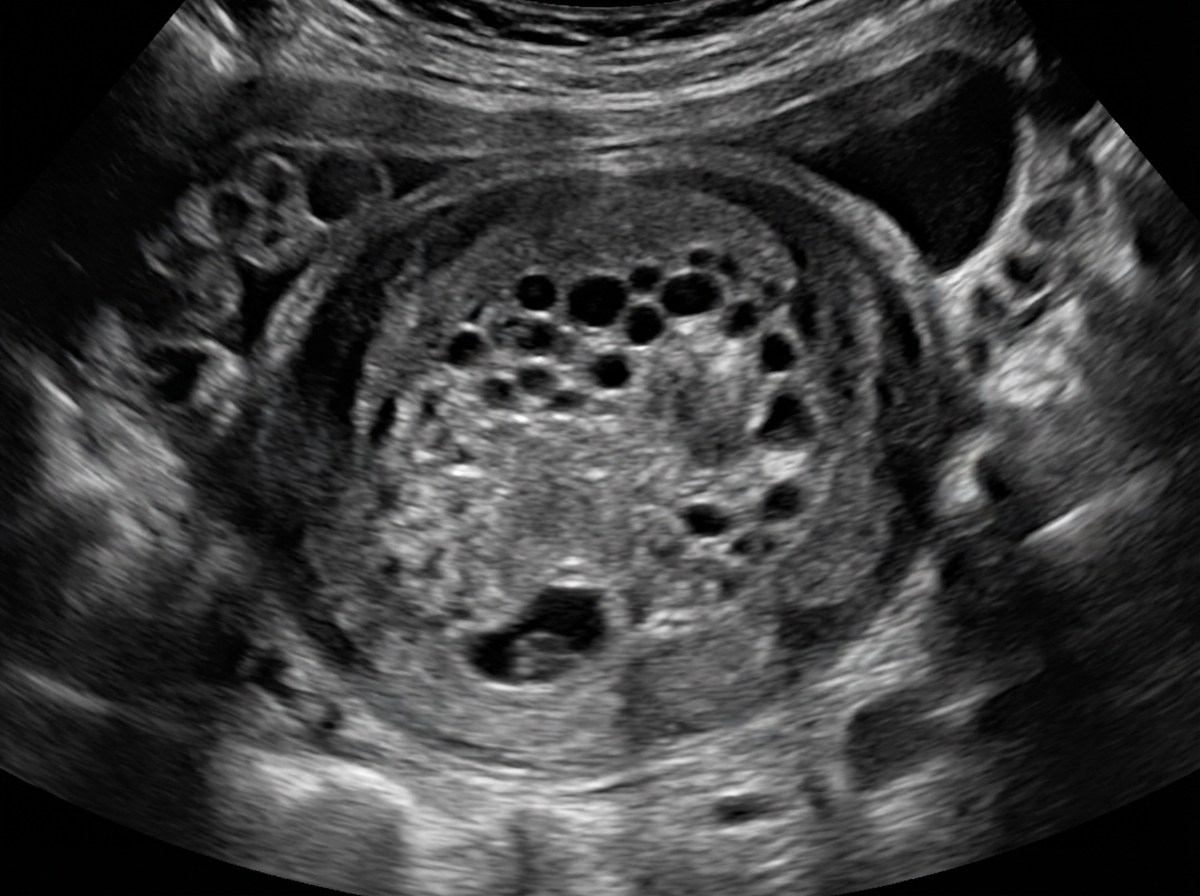
A 26-year-old primigravid woman comes to the emergency department because of a 10-hour history of vaginal bleeding and lower abdominal pain. She also had nausea and fatigue for the past 4 weeks. Her last menstrual period was 9 weeks ago. There is no history of medical illness. Vital signs are within normal limits. Pelvic examination shows a uterus consistent in size with a 9-week gestation. A urine pregnancy test is positive. β-HCG level is 108,000 mIU/mL (N < 5 mIU/mL). Transvaginal ultrasonography shows unclear, amorphous fetal parts and a large placenta with multiple cystic spaces. Which of the following is the most likely cause of this patient's condition?
Q15
A 27-year-old woman seeks an evaluation from her gynecologist complaining of vaginal discharge. She has been sexually active with 3 partners for the past year. Recently, she has been having pain during intercourse. Her temperature is 37.2°C (99.1°F), the blood pressure is 110/80 mm Hg, and the pulse is 78/min. The genital examination is positive for cervical motion tenderness. Even with treatment, which of the following complications is most likely to occur later in this patient's life?
Q16
A 32-year-old woman presents to her gynecologist’s office complaining of increasing fatigue. She mentions that she has been feeling this way over the past few months especially since her menstrual periods started becoming heavier than usual. She denies any abdominal pain, except for cramps during menstruation which are sometimes severe. She has never required medical care in the past except for occasional bouts of flu. She mentions that she is very tired even after a good night's sleep and is unable to do anything around the house once she returns from work in the evening. There are no significant findings other than conjunctival pallor. Her blood test results show a hemoglobin level of 10.3 g/dL, hematocrit of 24%, ferritin of 10 ng/mL and a red cell distribution width of 16.5%. Her peripheral blood smear is shown in the picture. Which of the following is the next best step in the management of this patient?
Q17
A 30-year-old G3P1011 seeks evaluation at the obstetrics clinic for lower abdominal pain and vaginal bleeding. She is 15 weeks pregnant based on a first-trimester ultrasound. She had spotting early in the pregnancy, but has had no other problems. On physical examination she appears mildly anxious. Her vital signs are normal except for a heart rate of 120 beats a minute. No abdominal tenderness is elicited. The cervical os is closed with a small amount of blood pooling in the vagina. No fetal tissue is seen. A blood specimen is sent for quantitative β-hCG level and an ultrasound is performed. A viable fetus is noted with a normal heart rate. The obstetrician sends her home with instructions to rest and avoid any physical activity, including sexual intercourse. She is also instructed to return to the emergency department if the bleeding is excessive. Which of the following did the patient experience today?
Q18
A 32-year-old woman presents to the emergency department with abdominal pain. She states it started last night and has been getting worse during this time frame. She states she is otherwise healthy and does not use drugs. Her temperature is 99.0°F (37.2°C), blood pressure is 120/83 mmHg, pulse is 85/min, respirations are 12/min, and oxygen saturation is 98% on room air. A rectal exam is performed and the patient is subsequently disimpacted. Five kilograms of stool are removed from the patient and she subsequently states her symptoms have resolved. Initial laboratory tests are ordered as seen below.
Urine:
Color: Yellow
Protein: Negative
Red blood cells: Negative
hCG: Positive
A serum hCG is 1,000 mIU/mL. A transvaginal ultrasound does not demonstrate a gestational sac within the uterus. Which of the following is the best next step in management?
Q19
A 38-year-old woman presents to the emergency department with painless vaginal bleeding of sudden onset approx. 1 hour ago. The woman informs the doctor that, currently, she is in the 13th week of pregnancy. She also mentions that she was diagnosed with hyperemesis gravidarum during the 6th week of pregnancy. On physical examination, her temperature is 37.2°C (99.0°F), pulse rate is 110/min, blood pressure is 108/76 mm Hg, and respiratory rate is 20/min. A general examination reveals pallor. Examination of the abdomen suggests that the enlargement of the uterus is greater than expected at 13 weeks of gestation. An ultrasonogram shows the absence of a fetus and the presence of an intrauterine mass with multiple cystic spaces that resembles a bunch of grapes. The patient is admitted to the hospital and her uterine contents are surgically removed. The atypical tissue is sent for genetic analysis, which of the following karyotypes is most likely to be found?
Q20
A 29-year-old African-American woman, gravida 4, para 0, comes to the physician for evaluation of recurrent abortions. Each pregnancy resulted in spontaneous abortion in the second trimester. The patient has a history of joint pain, chronic migraines, and recurrent poorly defined, macular skin rashes. She also reports episodes in which her fingers become pale and cold, and then redden. She is sexually active with her husband and does not use contraceptives. The patient works as a landscape architect. Her mother has a history of endometriosis. The patient takes a daily prenatal multivitamin and occasionally sumatriptan. She appears tired. Temperature is 36.5°C (97.7°F), pulse is 65/min, and blood pressure is 110/65 mm Hg. Examination of the hands shows two ulcerations on the tip of the right index finger and multiple tiny hemorrhages under the nails. There is a purple reticular rash on both calves. Which of the following is most likely to confirm the diagnosis?
High-risk pregnancies US Medical PG Practice Questions and MCQs
Question 11: A husband requests paternity testing for his twins. The results show that one twin is biologically his child, but the other twin is not. What is the most likely diagnosis?
A. Superfetation
B. Posthumous child
C. Superfecundation (Correct Answer)
D. None of the options
Explanation: ***Superfecundation***
- **Superfecundation** occurs when two separate eggs released in the same menstrual cycle are fertilized by sperm from **different sexual acts or different fathers**, leading to dizygotic twins from separate fathers.
- This scenario specifically describes **heteropaternal superfecundation**, where twins are born to one mother but have different biological fathers, making it the most likely diagnosis.
*Superfetation*
- **Superfetation** refers to the rare phenomenon where a second, new pregnancy is established in a female already pregnant, resulting in fetuses of **different gestational ages**.
- This condition is unlikely here as the twins are presumably of similar gestational age, and the issue is paternity, not sequential pregnancies.
*Posthumous child*
- A **posthumous child** is one born after the death of its father; this term refers solely to the father's marital status at the time of birth or conception, not to the biological paternity of the child as tested.
- This option does not explain how one twin could have a different biological father.
*None of the options*
- This option is incorrect because **superfecundation** accurately describes the phenomenon where twins of the same mother have different biological fathers due to fertilization by sperm from two different partners.
Question 12: A patient presents with cannonball lesions in the lungs following a recent molar pregnancy evacuation. What is the most appropriate management?
A. EMACO regimen (Correct Answer)
B. Inj. Methotrexate
C. Hysterectomy
D. Multiple dose of Inj. Methotrexate
Explanation: ***EMACO regimen***
- The presence of **cannonball lesions** in the lungs after a molar pregnancy evacuation suggests **gestational trophoblastic neoplasia (GTN)**, specifically **choriocarcinoma** with pulmonary metastases.
- The **EMACO (etoposide, methotrexate, actinomycin D, cyclophosphamide, vincristine)** regimen is a highly effective multi-agent chemotherapy protocol for **high-risk GTN**, including metastatic disease.
*Inj. Methotrexate*
- Single-agent methotrexate is primarily used for **low-risk GTN** or as a single or double-dose regimen in specific cases of persistent GTN.
- It is generally insufficient for **high-risk GTN** with pulmonary metastases, where more aggressive multi-agent chemotherapy is required.
*Hysterectomy*
- While hysterectomy can be an option in specific cases of **non-metastatic GTN**, especially for older patients desiring definitive treatment, it is not the primary treatment for **metastatic disease**.
- Systemic chemotherapy is essential to address the widespread nature of metastatic gestational trophoblastic neoplasia.
*Multiple dose of Inj. Methotrexate*
- Multiple doses of methotrexate might be considered for intermediate-risk GTN or as part of a multi-agent regimen, but it's often not sufficient as a sole agent for **high-risk metastatic disease** indicated by extensive pulmonary lesions.
- The **EMACO regime** combines several powerful chemotherapeutic agents for a more comprehensive attack on advanced and metastatic GTN.
Question 13: An elderly female presented with dribbling of urine only on coughing and straining. What type of urinary incontinence is she suffering from
A. Overflow incontinence
B. Stress incontinence (Correct Answer)
C. Urge incontinence
D. Neurogenic bladder
Explanation: ***Stress incontinence***
- **Dribbling of urine** specifically with activities that increase intra-abdominal pressure like **coughing or straining** is the hallmark of stress incontinence.
- This type of incontinence results from **weakness of the pelvic floor muscles** and/or intrinsic urethral sphincter deficiency.
*Overflow incontinence*
- This occurs when the bladder is **overfilled and unable to empty**, leading to constant dribbling or leakage.
- Patients typically experience a **poor stream**, hesitancy, and a feeling of incomplete emptying, which are not described here.
*Urge incontinence*
- Characterized by a **sudden, strong urge to urinate** that is difficult to defer, often leading to involuntary leakage before reaching the toilet.
- It is caused by **involuntary contractions of the detrusor muscle** and is not directly related to physical exertion like coughing.
*Neurogenic bladder*
- This refers to bladder dysfunction due to a **neurological condition** affecting bladder control, such as spinal cord injury or multiple sclerosis.
- Symptoms can vary broadly (flaccid or spastic bladder) and are not limited to leakage with coughing alone.
Question 14: A 26-year-old primigravid woman comes to the emergency department because of a 10-hour history of vaginal bleeding and lower abdominal pain. She also had nausea and fatigue for the past 4 weeks. Her last menstrual period was 9 weeks ago. There is no history of medical illness. Vital signs are within normal limits. Pelvic examination shows a uterus consistent in size with a 9-week gestation. A urine pregnancy test is positive. β-HCG level is 108,000 mIU/mL (N < 5 mIU/mL). Transvaginal ultrasonography shows unclear, amorphous fetal parts and a large placenta with multiple cystic spaces. Which of the following is the most likely cause of this patient's condition?
A. Partial molar pregnancy (Correct Answer)
B. Choriocarcinoma
C. Complete molar pregnancy
D. Inevitable abortion
E. Placental abruption
Explanation: ***Partial molar pregnancy***
- This condition is suggested by the presence of **amorphous fetal parts** along with a **large placenta containing multiple cystic spaces** ("swiss cheese" pattern) on ultrasound. The 9-week gestation with symptoms of pregnancy and a high β-HCG level (108,000 mIU/mL) further supports abnormal placental development.
- Unlike a complete mole, a partial mole typically has some development of fetal tissue, albeit abnormal, and the β-HCG levels, while elevated, are usually lower than those seen in complete moles for a comparable gestational age.
*Choriocarcinoma*
- This is a highly **malignant gestational trophoblastic neoplasm** that usually follows a complete molar pregnancy but can occur after any pregnancy.
- While it presents with very high β-HCG levels and uterine bleeding, the ultrasound finding of **amorphous fetal parts** and "multiple cystic spaces" is characteristic of a molar pregnancy, not choriocarcinoma directly.
*Complete molar pregnancy*
- A complete molar pregnancy is characterized by **no fetal parts** whatsoever and the entire uterine cavity filled with **grape-like vesicles** (hydropic villi) with high β-HCG levels, often much higher than 108,000 mIU/mL at 9 weeks (typically >200,000 mIU/mL).
- The presence of "unclear, amorphous fetal parts" on ultrasound differentiates this case from a complete mole.
*Inevitable abortion*
- An inevitable abortion involves **cervical dilation** and often **rupture of membranes** with persistent uterine bleeding and cramping, leading to the expulsion of pregnancy tissue.
- While vaginal bleeding and abdominal pain are present, the **ultrasound findings of amorphous fetal parts** and a **large placenta with multiple cystic spaces** are not typical for an inevitable abortion with a viable fetus or normal placental development.
*Placental abruption*
- Placental abruption involves the **premature separation of a normally implanted placenta** from the uterine wall, leading to vaginal bleeding, abdominal pain, and uterine tenderness.
- The ultrasound findings of **amorphous fetal parts** and a **large placenta with multiple cystic spaces** are inconsistent with placental abruption, which typically involves a normal-appearing placenta that has detached.
Question 15: A 27-year-old woman seeks an evaluation from her gynecologist complaining of vaginal discharge. She has been sexually active with 3 partners for the past year. Recently, she has been having pain during intercourse. Her temperature is 37.2°C (99.1°F), the blood pressure is 110/80 mm Hg, and the pulse is 78/min. The genital examination is positive for cervical motion tenderness. Even with treatment, which of the following complications is most likely to occur later in this patient's life?
A. Small bowel obstruction
B. Condyloma acuminatum
C. Leiomyoma
D. Ectopic pregnancy (Correct Answer)
E. Spontaneous abortion
Explanation: ***Ectopic pregnancy***
- The patient's presentation with **vaginal discharge**, **pain during intercourse**, and **cervical motion tenderness** is highly suggestive of **pelvic inflammatory disease (PID)**.
- **PID** can lead to **scarring of the fallopian tubes**, increasing the risk of an **ectopic pregnancy** later in life due to impaired ovum transport.
*Small bowel obstruction*
- While PID can cause **adhesions**, these are typically centered in the **pelvis** and tend to affect the reproductive organs, not commonly the **small bowel** to cause obstruction.
- **Small bowel obstruction** is more often associated with prior abdominal surgeries or hernias, not directly with PID.
*Condyloma acuminatum*
- **Condyloma acuminatum** (genital warts) is caused by the **human papillomavirus (HPV)** and is a sexually transmitted infection.
- While the patient is sexually active, there is no clinical information to suggest HPV infection, and it is not a direct complication of PID itself.
*Leiomyoma*
- **Leiomyomas (fibroids)** are benign tumors of the **uterine muscle** and are not caused by or related to **pelvic inflammatory disease**.
- Their development is linked to hormonal factors and genetics, not infections.
*Spontaneous abortion*
- While a sexually transmitted infection leading to PID could potentially affect future fertility or increase the risk of some pregnancy complications, **spontaneous abortion** is not a primary or most likely *later* complication directly resulting from PID itself.
- The primary reproductive complication of PID is **tubal factor infertility** and **ectopic pregnancy**.
Question 16: A 32-year-old woman presents to her gynecologist’s office complaining of increasing fatigue. She mentions that she has been feeling this way over the past few months especially since her menstrual periods started becoming heavier than usual. She denies any abdominal pain, except for cramps during menstruation which are sometimes severe. She has never required medical care in the past except for occasional bouts of flu. She mentions that she is very tired even after a good night's sleep and is unable to do anything around the house once she returns from work in the evening. There are no significant findings other than conjunctival pallor. Her blood test results show a hemoglobin level of 10.3 g/dL, hematocrit of 24%, ferritin of 10 ng/mL and a red cell distribution width of 16.5%. Her peripheral blood smear is shown in the picture. Which of the following is the next best step in the management of this patient?
A. Endoscopy
B. Ultrasound of the pelvis
C. Vitamin B12 levels
D. Blood transfusion
E. Iron supplementation (Correct Answer)
Explanation: ***Iron supplementation***
- The patient presents with classic symptoms and lab findings of **iron deficiency anemia (IDA)**, including severe fatigue, heavy menstrual bleeding, and conjunctival pallor, along with low hemoglobin, hematocrit, and ferritin, and elevated RDW.
- **Iron supplementation** directly addresses the underlying deficiency and is the most appropriate initial treatment for IDA.
*Endoscopy*
- Endoscopy would be considered to investigate potential **gastrointestinal blood loss** if the cause of iron deficiency were unclear or if the patient's symptoms suggested a GI source (e.g., melena, unexplained abdominal pain), which is not the case here.
- Given her heavy menstrual periods, the cause of iron deficiency is clearly identifiable as **menorrhagia**, making GI investigation unnecessary as an initial step.
*Ultrasound of the pelvis*
- A pelvic ultrasound could be considered to investigate the cause of **menorrhagia** (e.g., uterine fibroids, polyps).
- While it may be a subsequent step to manage the heavy bleeding, it is not the *next best step* for directly treating the established iron deficiency anemia.
*Vitamin B12 levels*
- **Vitamin B12 deficiency** causes **macrocytic anemia** with megaloblastic features, whereas this patient presents with features consistent with microcytic (low MCV, indirectly suggested by low Hgb/Hct and high RDW) iron deficiency anemia.
- The laboratory findings, particularly the **low ferritin**, specifically point to iron deficiency, not B12 deficiency.
*Blood transfusion*
- A blood transfusion is considered for **severe symptomatic anemia** (e.g., acute hemorrhage, cardiac compromise) or very low hemoglobin levels (typically below 7 g/dL, or 8 g/dL in certain conditions like cardiac disease).
- The patient's hemoglobin of 10.3 g/dL, while low, does not typically warrant a
**blood transfusion** as the *next best step*, especially in a stable patient without acute symptoms of hypovolemia or cardiac instability.
Question 17: A 30-year-old G3P1011 seeks evaluation at the obstetrics clinic for lower abdominal pain and vaginal bleeding. She is 15 weeks pregnant based on a first-trimester ultrasound. She had spotting early in the pregnancy, but has had no other problems. On physical examination she appears mildly anxious. Her vital signs are normal except for a heart rate of 120 beats a minute. No abdominal tenderness is elicited. The cervical os is closed with a small amount of blood pooling in the vagina. No fetal tissue is seen. A blood specimen is sent for quantitative β-hCG level and an ultrasound is performed. A viable fetus is noted with a normal heart rate. The obstetrician sends her home with instructions to rest and avoid any physical activity, including sexual intercourse. She is also instructed to return to the emergency department if the bleeding is excessive. Which of the following did the patient experience today?
A. Missed abortion
B. Threatened abortion (Correct Answer)
C. Incomplete abortion
D. Complete abortion
E. Inevitable abortion
Explanation: ***Threatened abortion***
- The presence of **vaginal bleeding** at 15 weeks gestation with a **closed cervical os** and a **viable fetus** (**normal heart rate**) is the classic definition of a threatened abortion.
- The patient's general good condition, absence of significant abdominal pain or tissue passage, and the presence of a live fetus on ultrasound confirm this diagnosis.
*Missed abortion*
- A missed abortion involves fetal demise (a **non-viable fetus**) within the uterus without expulsion of pregnancy tissue, typically characterized by a **closed cervical os**.
- The ultrasound in this case clearly shows a **viable fetus with a normal heart rate**, ruling out fetal demise.
*Incomplete abortion*
- This diagnosis involves **vaginal bleeding**, a **dilated cervical os**, and the **partial expulsion of pregnancy contents**.
- The patient's **closed cervical os** and the absence of fetal tissue expulsion are inconsistent with an incomplete abortion.
*Complete abortion*
- A complete abortion is characterized by the **expulsion of all pregnancy tissue** from the uterus, resulting in a **closed cervical os** and **minimal bleeding**.
- Although the cervical os is closed, the presence of a **viable fetus** and ongoing pregnancy rule out a complete abortion.
*Inevitable abortion*
- An inevitable abortion presents with **vaginal bleeding** and a **dilated cervical os**, often with **effacement and rupture of membranes**, indicating that pregnancy loss is unavoidable.
- The patient's **closed cervical os** and the **viable fetus** on ultrasound are contrary to the definition of an inevitable abortion.
Question 18: A 32-year-old woman presents to the emergency department with abdominal pain. She states it started last night and has been getting worse during this time frame. She states she is otherwise healthy and does not use drugs. Her temperature is 99.0°F (37.2°C), blood pressure is 120/83 mmHg, pulse is 85/min, respirations are 12/min, and oxygen saturation is 98% on room air. A rectal exam is performed and the patient is subsequently disimpacted. Five kilograms of stool are removed from the patient and she subsequently states her symptoms have resolved. Initial laboratory tests are ordered as seen below.
Urine:
Color: Yellow
Protein: Negative
Red blood cells: Negative
hCG: Positive
A serum hCG is 1,000 mIU/mL. A transvaginal ultrasound does not demonstrate a gestational sac within the uterus. Which of the following is the best next step in management?
A. Laparoscopy
B. Ultrasound and serum hCG in 48 hours (Correct Answer)
C. Salpingectomy
D. Methotrexate
E. Salpingostomy
Explanation: ***Ultrasound and serum hCG in 48 hours***
- A serum hCG level of 1000 mIU/mL without an intrauterine gestational sac is concerning for an **ectopic pregnancy** or a **very early viable intrauterine pregnancy** that is not yet visible on ultrasound.
- Repeating both the **ultrasound and serum hCG in 48 hours** allows for assessment of the hCG doubling time (which should be approximately 35-48 hours in a healthy intrauterine pregnancy) and the potential visualization of an intrauterine gestational sac or an ectopic pregnancy.
*Laparoscopy*
- **Laparoscopy** is an invasive surgical procedure and is typically reserved for cases where there is a strong suspicion of **ectopic pregnancy** (e.g., declining or abnormally rising hCG with an empty uterus, or presence of an adnexal mass), or signs of **rupture**.
- It is not the initial step for diagnosis when hCG levels are still relatively low and a definitive location has not been established.
*Salpingectomy*
- **Salpingectomy** involves surgical removal of the fallopian tube and is a treatment for **ectopic pregnancy**, not a diagnostic step.
- It is typically performed when there is a definitively diagnosed ectopic pregnancy, especially if it is ruptured or large.
*Methotrexate*
- **Methotrexate** is a medical treatment for **unruptured ectopic pregnancies** in stable patients who meet specific criteria (e.g., hCG < 5000 mIU/mL, no fetal cardiac activity, patient compliance).
- However, it should only be administered after a definitive diagnosis of an ectopic pregnancy has been made and other options have been considered. It is not a diagnostic step.
*Salpingostomy*
- **Salpingostomy** is a surgical procedure to remove an ectopic pregnancy while preserving the fallopian tube, often through **laparoscopy**.
- Like salpingectomy, it is a treatment for a diagnosed ectopic pregnancy, not a diagnostic tool, and is considered when fertility preservation is desired and criteria are met.
Question 19: A 38-year-old woman presents to the emergency department with painless vaginal bleeding of sudden onset approx. 1 hour ago. The woman informs the doctor that, currently, she is in the 13th week of pregnancy. She also mentions that she was diagnosed with hyperemesis gravidarum during the 6th week of pregnancy. On physical examination, her temperature is 37.2°C (99.0°F), pulse rate is 110/min, blood pressure is 108/76 mm Hg, and respiratory rate is 20/min. A general examination reveals pallor. Examination of the abdomen suggests that the enlargement of the uterus is greater than expected at 13 weeks of gestation. An ultrasonogram shows the absence of a fetus and the presence of an intrauterine mass with multiple cystic spaces that resembles a bunch of grapes. The patient is admitted to the hospital and her uterine contents are surgically removed. The atypical tissue is sent for genetic analysis, which of the following karyotypes is most likely to be found?
A. 46, XX (Correct Answer)
B. 69, XXY
C. 46, XY
D. 69, XXX
E. 46, YY
Explanation: ***46, XX***
- The patient's presentation with **painless vaginal bleeding**, **uterus larger than expected**, **hyperemesis gravidarum**, and an ultrasound showing an **intrauterine mass with multiple cystic spaces (bunch of grapes appearance)**, along with the **absence of a fetus**, is classic for a **complete hydatidiform mole**.
- In **complete hydatidiform moles**, the karyotype is typically **diploid (46, XX)**, with all chromosomes entirely paternal in origin, often resulting from fertilization of an "empty" egg by a single sperm that then duplicates its chromosomes.
*69, XXY*
- A **triploid karyotype (69, XXY)** is characteristic of a **partial hydatidiform mole**, which usually involves the presence of some fetal tissue and less severe placental abnormalities.
- Partial moles typically result from fertilization of a normal egg by two sperm, leading to one maternal and two paternal sets of chromosomes, and do not present with the "bunch of grapes" appearance as prominently or the complete absence of a fetus.
*46, XY*
- A **46, XY karyotype** would represent a normal male conception or, in the context of a hydatidiform mole, could exceptionally occur in a complete mole if the empty egg is fertilized by an X-bearing and a Y-bearing sperm (very rare, usually 46, XX).
- However, the classic presentation of a complete mole with its specific ultrasound findings and no fetal tissue makes 46, XX the overwhelming choice.
*69, XXX*
- A **triploid karyotype (69, XXX)**, similar to 69, XXY, is also associated with **partial hydatidiform moles** and often some fetal development.
- The clinical findings of **absence of a fetus** and a uterus "larger than expected" strongly favor a **complete mole**, which is typically diploid (46, XX).
*46, YY*
- A **46, YY karyotype** is **not viable** as it lacks an X chromosome, which carries essential genes for life; therefore, such a conception would not progress to form a mole or any fetal tissue.
- This karyotype is biologically impossible for a human conception to develop, even into abnormal placental tissue.
Question 20: A 29-year-old African-American woman, gravida 4, para 0, comes to the physician for evaluation of recurrent abortions. Each pregnancy resulted in spontaneous abortion in the second trimester. The patient has a history of joint pain, chronic migraines, and recurrent poorly defined, macular skin rashes. She also reports episodes in which her fingers become pale and cold, and then redden. She is sexually active with her husband and does not use contraceptives. The patient works as a landscape architect. Her mother has a history of endometriosis. The patient takes a daily prenatal multivitamin and occasionally sumatriptan. She appears tired. Temperature is 36.5°C (97.7°F), pulse is 65/min, and blood pressure is 110/65 mm Hg. Examination of the hands shows two ulcerations on the tip of the right index finger and multiple tiny hemorrhages under the nails. There is a purple reticular rash on both calves. Which of the following is most likely to confirm the diagnosis?
A. Hysteroscopy
B. Test for cryoglobulins
C. Blood smear for sickle cells
D. Test for anticardiolipin antibodies (Correct Answer)
E. Factor V Leiden functional testing
Explanation: ***Test for anticardiolipin antibodies***
- The patient's presentation with **recurrent second-trimester abortions**, a history of **joint pain**, **migraines**, **lacy reticular rash (livedo reticularis)**, **Raynaud's phenomena**, **finger ulcerations**, and **splinter hemorrhages** is highly suggestive of **antiphospholipid syndrome (APS)**.
- **Anticardiolipin antibodies** are one of the key diagnostic criteria for APS, which causes hypercoagulability and is a common cause of recurrent pregnancy loss and thrombotic events.
*Hysteroscopy*
- This procedure visualizes the **uterine cavity** and is used to diagnose **structural abnormalities** such as uterine septa, fibroids, or polyps, which can cause recurrent miscarriages.
- However, it would not explain the patient's systemic symptoms like joint pain, migraines, skin rashes, Raynaud's, or thrombotic phenomena (ulcerations, splinter hemorrhages).
*Test for cryoglobulins*
- **Cryoglobulins** are immunoglobulins that precipitate at cold temperatures and are associated with conditions like **cryoglobulinemic vasculitis**, often linked to **hepatitis C infection** or lymphoid neoplasms.
- While cryoglobulinemia can cause Raynaud's and skin lesions, the constellation of recurrent abortions, migraines, and thrombotic symptoms points more strongly to APS.
*Blood smear for sickle cells*
- A blood smear for **sickle cells** would diagnose **sickle cell anemia**, a hemoglobinopathy common in African-Americans.
- While sickle cell disease can be associated with vaso-occlusive crises, recurrent abortions, and pain, it doesn't typically manifest with the specific skin rashes (livedo reticularis) or the full syndromic presentation pointing to an autoimmune thrombophilia.
*Factor V Leiden functional testing*
- **Factor V Leiden mutation** is a **hereditary thrombophilia** that increases the risk of venous thromboembolism and recurrent pregnancy loss.
- While it could contribute to recurrent abortions, it does not explain the patient's autoimmune features such as joint pain, migraines, specific skin rashes, and Raynaud's phenomena, which are characteristic of APS.