
Herpesviruses (HSV, VZV, CMV, EBV, HHV-6/7/8) — MCQs

A father brings in his 7-year-old twin sons because they have a diffuse rash. They have several papules, vesicles, pustules, and crusts on their scalps, torso, and limbs. The skin lesions are pruritic. Other than that, the boys appear to be well. The father reports that several children in school have a similar rash. The family recently returned from a beach vacation but have not traveled internationally. Both boys have stable vital signs within normal limits. What is the most common complication of the infection the boys appear to have?
A 65-year-old man presents to his primary care physician for a rash. He states that for the past several days he has felt burning and itching around his eye. Yesterday, he noticed that a rash had formed. Review of systems is notable for mild diarrhea for the past week. The patient has a past medical history of diabetes, asthma, seasonal allergies, and hypertension. He is not currently taking any medications. Physical exam is notable for a vesicular rash surrounding the orbit. Which of the following is the best next step in management?
A 15-month-old girl is brought to the physician because of the sudden appearance of a rash on her trunk that started 6 hours ago and subsequently spread to her extremities. Four days ago, she was taken to the emergency department because of a high fever and vomiting. She was treated with acetaminophen and discharged the next day. The fever persisted for several days and abated just prior to appearance of the rash. Physical examination shows a rose-colored, blanching, maculopapular rash, and postauricular lymphadenopathy. Which of the following is the most likely diagnosis?
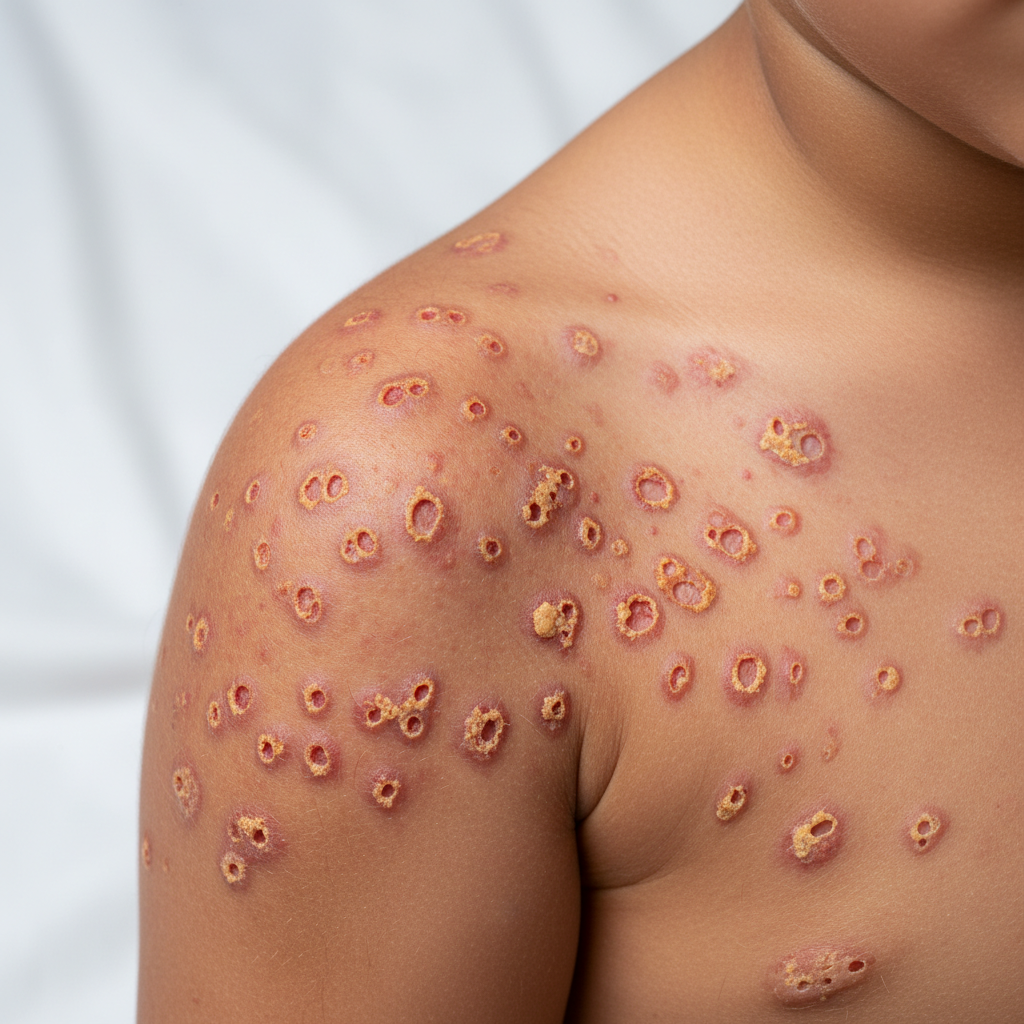
A 12-year-old boy is brought to the physician because of fever, malaise, and a painful, itchy rash on the right shoulder for 2 weeks. The patient's mother says the boy's condition has worsened over the past 4 days. He has a history of atopic dermatitis. He has lived with his mother at several public shelters since she separated from his physically abusive father 2 months ago. His immunizations are up-to-date. There is cervical lymphadenopathy. Laboratory studies show no abnormalities. A photograph of the rash is shown. Which of the following is the most likely diagnosis?
A 63-year-old man presents to his primary care physician because he has been having headaches and hearing loss. In addition, he says that he has been having difficulty opening his jaw to eat and recurrent middle ear infections. Physical exam reveals enlarged neck lymph nodes and a mass in the nasopharynx. Biopsy of the mass reveals undifferentiated squamous epithelial cells. The organism that is most likely associated with this patient's disease is also associated with which of the following disorders?
A 67-year-old man presents to the emergency department with confusion. The patient is generally healthy, but his wife noticed him becoming progressively more confused as the day went on. The patient is not currently taking any medications and has no recent falls or trauma. His temperature is 102°F (38.9°C), blood pressure is 126/64 mmHg, pulse is 120/min, respirations are 17/min, and oxygen saturation is 98% on room air. Physical exam is notable for a confused man who cannot participate in a neurological exam secondary to his confusion. No symptoms are elicited with flexion of the neck and jolt accentuation of headache is negative. Initial laboratory values are unremarkable and the patient's chest radiograph and urinalysis are within normal limits. An initial CT scan of the head is unremarkable. Which of the following is the best next step in management?
A 17-year-old male comes to the physician because of painful genital sores, malaise, and fever for 3 days. He is sexually active with 3 female partners and does not use condoms consistently. His temperature is 38.3°C (101°F). Physical examination shows tender lymphadenopathy in the left inguinal region and multiple, punched-out ulcers over the penile shaft and glans. Microscopic examination of a smear from the ulcer is most likely to show which of the following?
You are seeing an otherwise healthy 66-year-old male in clinic who is complaining of localized back pain and a new rash. On physical exam, his vital signs are within normal limits. You note a vesicular rash restricted to the upper left side of his back. In order to confirm your suspected diagnosis, you perform a diagnostic test. What would you expect to find on the diagnostic test that was performed?
A 16-year-old male is brought to the clinic by his mother for the complaints of fever, nonproductive cough, fatigue, lack of appetite, and sore throat for the past 2 months. Several other students at his high school have had similar symptoms. Physical exam shows a whitish membrane in his oropharynx, bilateral enlarged cervical lymphadenopathy, and mild splenomegaly. Which of the following tests is most likely to diagnose his condition?
A previously healthy 5-year-old boy is brought to the physician because of increasing weakness and a retroauricular rash that started 2 days ago. The rash spread rapidly and involves the trunk and extremities. Last week, he had a mild sore throat, pink eyes, and a headache. His family recently immigrated from Ethiopia. His immunization status is unknown. The patient appears severely ill. His temperature is 38.5°C (101.3°F). Examination shows tender postauricular and suboccipital lymphadenopathy. There is a nonconfluent, maculopapular rash over the torso and extremities. Infection with which of the following is the most likely cause of this patient's symptoms?
Want unlimited practice?
Get full access to all questions, explanations, and performance tracking.
Scan to download app