
Enteroviruses and parechoviruses — MCQs

A 35-year-old woman from San Francisco has been refusing to vaccinate her children due to the claims that vaccinations may cause autism in children. Her 10-year-old male child began developing a low-grade fever with a rash that started on his face; as the rash began to spread to his limbs, it slowly disappeared from his face. When the child was taken to a clinic, the physician noticed swollen lymph nodes behind the ears of the child. Which of the following are characteristics of the virus causing these symptoms?
A 3-year-old boy is brought to the pediatrician by his parents with a presentation of severe diarrhea, vomiting, and fever for the past 2 days. The child is enrolled at a daycare where several other children have had similar symptoms in the past week. On physical exam, the child is noted to have dry mucous membranes. His temperature is 102°F (39°C). Questions regarding previous medical history reveal that the child’s parents pursued vaccine exemption to opt out of most routine vaccinations for their child. The RNA virus that is most likely causing this child’s condition has which of the following structural features?
A 45-year-old man with a history of poorly controlled human immunodeficiency virus (HIV) infection presents to the emergency room complaining of clumsiness and weakness. He reports a 3-month history of worsening balance, asymmetric muscle weakness, and speech difficulties. He recently returned from a trip to Guatemala to visit his family. He has been poorly compliant with his anti-retroviral therapy and his most recent CD4 count was 195. His history is also notable for rheumatoid arthritis and hepatitis C. His temperature is 99°F (37.2°C), blood pressure is 140/90 mmHg, pulse is 95/min, and respirations are 18/min. On exam, he has 4/5 strength in his right upper extremity, 5/5 strength in his left upper extremity, 5/5 strength in his right lower extremity, and 3/5 strength in his left lower extremity. His speech is disjointed with intermittent long pauses between words. Vision is 20/100 in the left eye and 20/40 in his right eye; previously, his eyesight was 20/30 bilaterally. This patient most likely has a condition caused by which of the following types of pathogens?
A 46-year-old Caucasian male with past medical history of HIV (CD4: 77/mm^3), hypertension, hyperlipidemia, and osteoarthritis presents to the emergency department with sudden weakness of his right hand. He reports that the weakness has gradually been getting worse and that this morning he dropped his cup of coffee. He has never had anything like this happen to him before, although he was hospitalized last year for pneumonia. He reports inconsistent adherence to his home medications, which include raltegravir, tenofovir, emtricitabine, TMP-SMX, hydrochlorothiazide, pravastatin, and occasional ibuprofen. His father died of a myocardial infarction at the age of 60, and his mother suffered a stroke at the age of 72. The patient's temperature is 102.6°F (39.2°C), blood pressure is 156/92 mmHg, pulse is 88/min, and respirations are 18/min. On neurological exam, he has 3/5 strength in the distal muscles of the right extremity with preserved sensation. His neurological exam is normal in all other extremities. Which of the following is the best next step in management?
A virology student is asked to identify a sample of virus. When subjected to a nonionic detergent, which disrupts lipid membranes, the virus was shown to lose infectivity. The student then purified the genetic material from the virus and subjected it to treatment with RNase, an enzyme that cleaves the phosphodiester linkages in the RNA backbone. A minute amount of the sample was then injected into a human cell line and was found to produce viral particles a few days later. Which of the following viruses was in the unknown sample?
An investigator studying patients with symptoms of arthritis detects a nonenveloped virus with a single-stranded DNA genome in the serum of a pregnant patient. Fetal infection with this pathogen is most likely to cause which of the following manifestations?
A 24-year-old man comes to the physician with a 2-day history of fever, crampy abdominal pain, and blood-tinged diarrhea. He recently returned from a trip to Mexico. His temperature is 38.2°C (100.8°F). Abdominal examination shows diffuse tenderness to palpation; bowel sounds are hyperactive. Stool cultures grow nonlactose fermenting, oxidase-negative, gram-negative rods that do not produce hydrogen sulfide on triple sugar iron agar. Which of the following processes is most likely involved in the pathogenesis of this patient's condition?
A 3-day-old female newborn delivered vaginally at 36 weeks to a 27-year-old woman has generalized convulsions lasting 3 minutes. Prior to the event, she was lethargic and had difficulty feeding. The infant has two healthy older siblings and the mother's immunizations are up-to-date. The infant appears icteric. The infant's weight and length are at the 5th percentile, and her head circumference is at the 99th percentile for gestational age. There are several purpura of the skin. Ocular examination shows posterior uveitis. Cranial ultrasonography shows ventricular dilatation, as well as hyperechoic foci within the cortex, basal ganglia, and periventricular region. Which of the following is the most likely diagnosis?
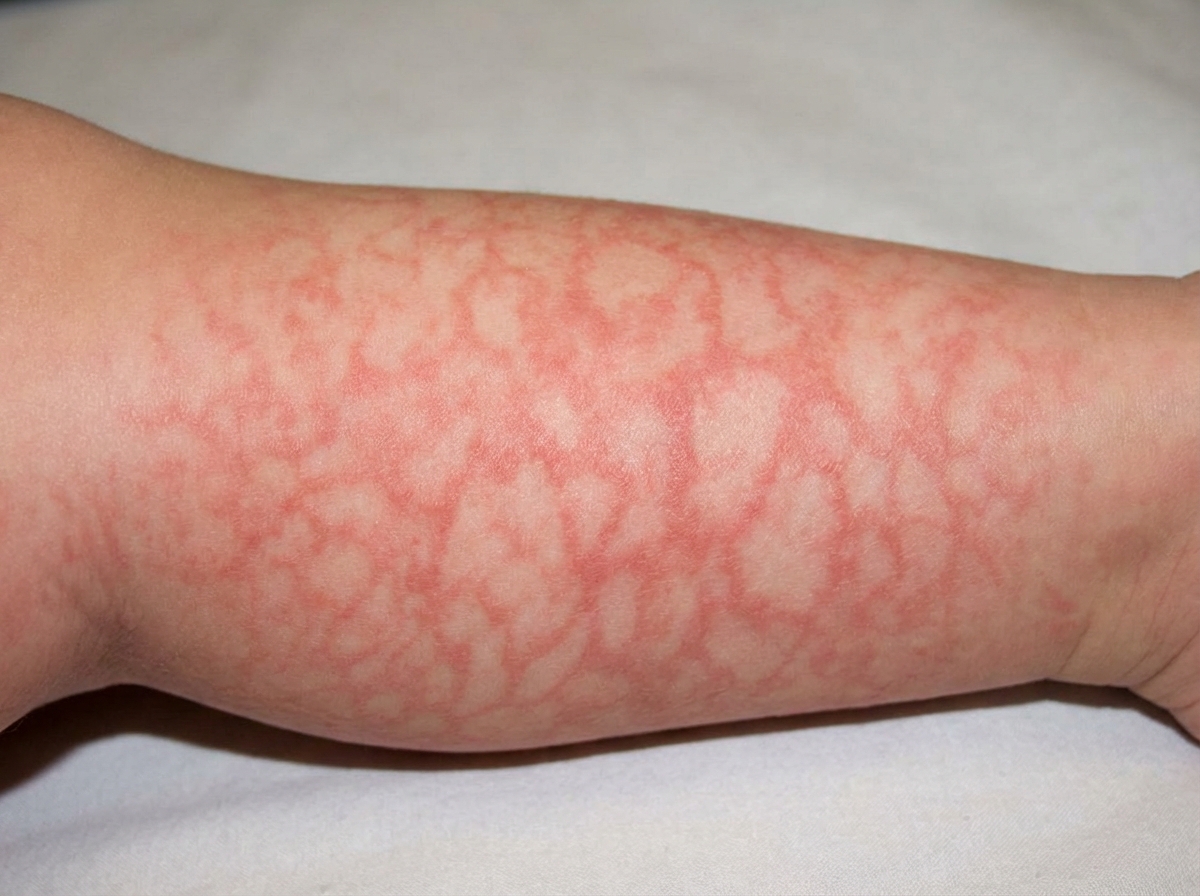
A 3-year-old boy presents with his mother to the family medicine clinic for an itchy rash on the face that started 3 days ago. The mother states that her son had a fever with a runny nose a little more than a week ago. There has been no sore throat or cough according to the mother. No significant medical conditions are noted. No medications are on record. The boy is up-to-date on all immunizations. His heart rate is 102/min, respiratory rate is 24/min, temperature is 36.5°C (97.7°F), and blood pressure is 92/65 mm Hg. The boy appears well-nourished and alert. Auscultation of the heart is without murmurs. Lungs are clear to auscultation bilaterally. An erythematous malar rash extending from the left lateral nasal region to the left medial zygomatic region is present. There is no lymphadenopathy present. A full skin examination reveals an erythematous, reticulated rash on the lower extremities (see image). Which of the following etiologic agents is responsible for the patient's signs and symptoms?
A 31-year-old woman comes to the physician because of a 2-day history of low-grade intermittent fever, dyspnea, and chest pain that worsens on deep inspiration. Over the past 4 weeks, she has had pain in her wrists and the fingers of both hands. During this period, she has also had difficulties working on her computer due to limited range of motion in her fingers, which tends to be more severe in the morning. Her temperature is 37.7°C (99.8°F). Physical examination shows a high-pitched scratching sound over the left sternal border. Further evaluation of this patient is most likely to reveal which of the following findings?
Want unlimited practice?
Get full access to all questions, explanations, and performance tracking.
Scan to download app