
Arboviruses (dengue, Zika, chikungunya) — MCQs

A 45-year-old man with a history of poorly controlled human immunodeficiency virus (HIV) infection presents to the emergency room complaining of clumsiness and weakness. He reports a 3-month history of worsening balance, asymmetric muscle weakness, and speech difficulties. He recently returned from a trip to Guatemala to visit his family. He has been poorly compliant with his anti-retroviral therapy and his most recent CD4 count was 195. His history is also notable for rheumatoid arthritis and hepatitis C. His temperature is 99°F (37.2°C), blood pressure is 140/90 mmHg, pulse is 95/min, and respirations are 18/min. On exam, he has 4/5 strength in his right upper extremity, 5/5 strength in his left upper extremity, 5/5 strength in his right lower extremity, and 3/5 strength in his left lower extremity. His speech is disjointed with intermittent long pauses between words. Vision is 20/100 in the left eye and 20/40 in his right eye; previously, his eyesight was 20/30 bilaterally. This patient most likely has a condition caused by which of the following types of pathogens?
A 30-year-old forest landscape specialist is brought to the emergency department with hematemesis and confusion. One week ago, she was diagnosed with influenza when she had fevers, severe headaches, myalgias, hip and shoulder pain, and a maculopapular rash. After a day of relative remission, she developed abdominal pain, vomiting, and diarrhea. A single episode of hematemesis occurred prior to admission. Two weeks ago she visited rainforests and caves in western Africa where she had direct contact with animals, including apes. She has no history of serious illnesses or use of medications. She is restless and her temperature is 38.0°C (100.4°F); pulse, 95/min; respirations, 20/min; and supine and upright blood pressure, 130/70 mm Hg and 100/65 mm Hg, respectively. Conjunctival suffusion is seen. Ecchymoses are observed on the lower extremities. She is bleeding from one of her intravenous lines. The peripheral blood smear is negative for organisms. The laboratory studies show the following: Hemoglobin 10 g/dL Leukocyte count 1,000/mm3 Segmented neutrophils 65% Lymphocytes 20% Platelet count 50,000/mm3 Partial thromboplastin time (activated) 60 seconds Prothrombin time 25 seconds Fibrin split products positive Serum Alanine aminotransferase (ALT) 85 U/L Aspartate aminotransferase (AST) 120 U/L γ-Glutamyltransferase (GGT) 83 U/L (N = 5–50 U/L) Creatinine 2 mg/dL Which of the following is the most likely causal pathogen?
A 13-year-old girl is brought to the physician because of worsening fever, headache, photophobia, and nausea for 2 days. One week ago, she returned from summer camp. She has received all age-appropriate immunizations. Her temperature is 39.1°C (102.3°F). She is oriented to person, place, and time. Physical examination shows a maculopapular rash. There is rigidity of the neck; forced flexion of the neck results in involuntary flexion of the knees and hips. Cerebrospinal fluid studies show: Opening pressure 120 mm H2O Appearance Clear Protein 47 mg/dL Glucose 68 mg/dL White cell count 280/mm3 Segmented neutrophils 15% Lymphocytes 85% Which of the following is the most likely causal organism?
A previously healthy 5-year-old boy is brought to the physician because of increasing weakness and a retroauricular rash that started 2 days ago. The rash spread rapidly and involves the trunk and extremities. Last week, he had a mild sore throat, pink eyes, and a headache. His family recently immigrated from Ethiopia. His immunization status is unknown. The patient appears severely ill. His temperature is 38.5°C (101.3°F). Examination shows tender postauricular and suboccipital lymphadenopathy. There is a nonconfluent, maculopapular rash over the torso and extremities. Infection with which of the following is the most likely cause of this patient's symptoms?
A 13-year-old boy is brought to a physician with severe fevers and headaches for 3 days. The pain is constant and mainly behind the eyes. He has myalgias, nausea, vomiting, and a rash for one day. Last week, during an academic winter break, he traveled on a tour with his family to several countries, including Brazil, Panama, and Peru. They spent many evenings outdoors without any protection against insect bites. There is no history of contact with pets, serious illness, or use of medications. The temperature is 40.0℃ (104.0℉); the pulse is 110/min; the respiratory rate is 18/min, and the blood pressure is 110/60 mm Hg. A maculopapular rash is seen over the trunk and extremities. Several tender lymph nodes are palpated in the neck on both sides. A peripheral blood smear shows no organisms. Which of the following is most likely responsible for this patient’s presentation?
A 26-year-old woman seeks evaluation at an urgent care clinic with complaints of fever and generalized muscle and joint pain for the past 3 days. She also complains of nausea, but denies vomiting. She does not mention any past similar episodes. Her past medical history is unremarkable, but she returned to the United States 1 week ago after spending 2 weeks in southeast Asia doing charity work. She received all the recommended vaccines prior to traveling. The temperature is 40.0°C (104.0°F), the respirations are 15/min, the pulse is 107/min, and the blood pressure is 98/78 mm Hg. Physical examination shows mild gingival bleeding and a petechial rash over the trunk. Laboratory studies show the following: Laboratory test Leukocyte count 4,000/mm³ Platelet count 100,000/mm³ Partial thromboplastin time (activated) 45 seconds Which of the following is the most likely cause of this patient’s condition?
A 42-year-old man comes to his physician with a history of fever, non-bloody diarrhea, and headache for 10 days. He also complains of anorexia and abdominal pain. He returned from a trip to India 3 weeks ago. His temperature is 40.0°C (104.0°F), pulse is 65/min, respirations are 15/min, and blood pressure is 135/80 mm Hg. He has developed a blanchable rash on his chest and trunk. A photograph of the rash is shown. Examination of the heart, lungs, and abdomen show no abnormalities. Laboratory studies show: Hemoglobin 15 g/dL Mean corpuscular volume 95 μm3 White blood cell count 3400/mm3 Percent segmented neutrophils 40% Which of the following is the most likely diagnosis?
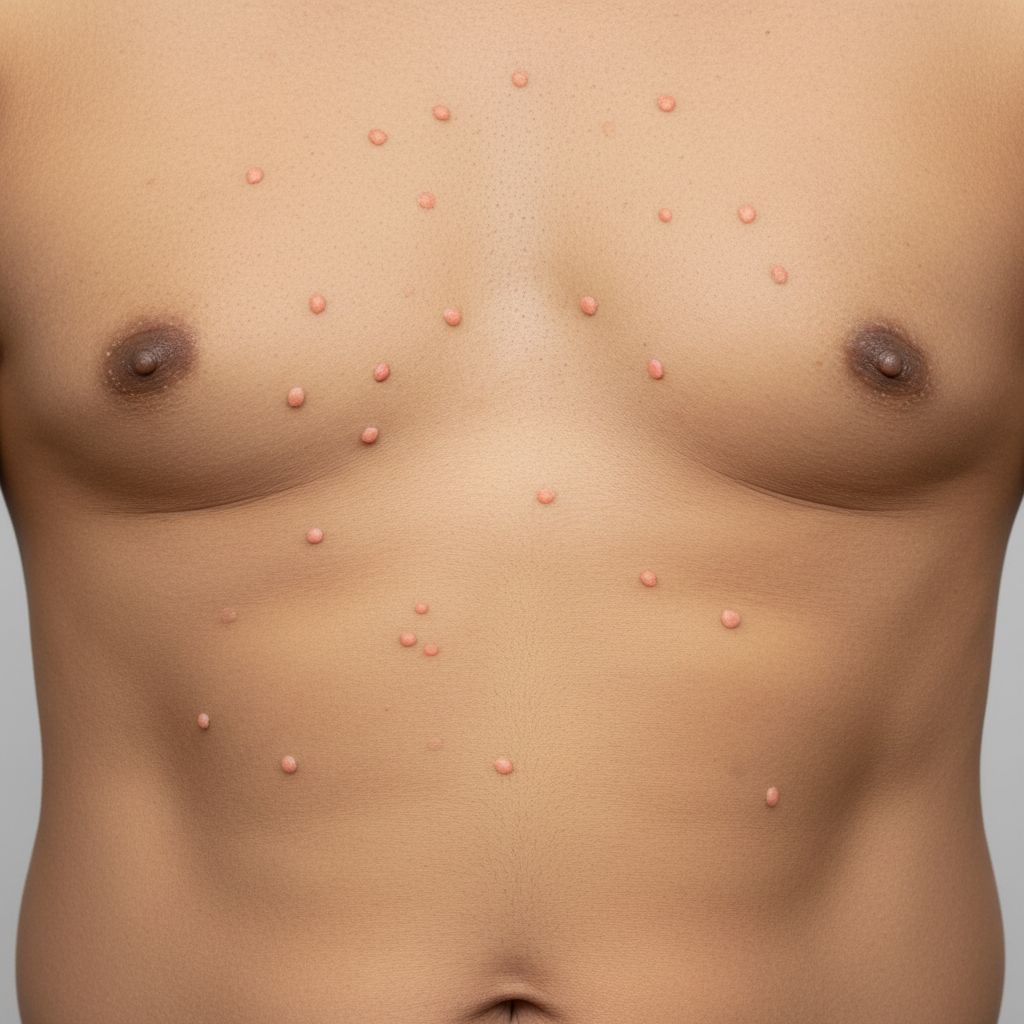
A previously healthy 25-year-old man comes to the physician because of a 4-day history of fever, joint and body pain, diffuse headache, and pain behind the eyes. This morning he noticed that his gums bled when he brushed his teeth. He returned from a backpacking trip to the Philippines 4 days ago. His temperature is 39.4°C (103.0°F). Physical examination shows a diffuse maculopapular rash. His leukocyte count is 3,200/mm3 and platelet count is 89,000/mm3. Further evaluation shows increased serum levels of a flavivirus. Which of the following is the most likely causal pathogen?
A 38-year-old man presents to the physician with fever and malaise for 4 days. He has headaches and joint pain. A pruritic rash appeared on the trunk yesterday. He had blood in his ejaculate twice. His hearing has become partially impaired. There is no history of serious illnesses or the use of medications. Ten days ago, he traveled to Brazil where he spent most of the time outdoors in the evenings. He did not use any control measures for mosquito bites. His temperature is 38.2℃ (100.8℉); the pulse is 88/min; the respiratory rate is 13/min, and the blood pressure is 125/60 mm Hg. Conjunctival suffusion is noted. A maculopapular rash is present over the trunk and proximal extremities without the involvement of the palms or soles. Several joints of the hands are tender to palpation. The abdomen is soft with no organomegaly. A peripheral blood smear shows no pathogenic organisms. Which of the following is the most likely diagnosis?
A 53-year-old man presents to an urgent care center with severe fever that began during the day along with muscle and joint pains. He states that he felt fine the day before but then developed a fever to 103°F (39.4°C) and had to leave work after which he developed a headache and body pains. The patient states that he was recently in South Asia for a business trip and was otherwise feeling well since returning 2 weeks ago. On exam, the patient’s temperature is 103.3°F (39.6°C), blood pressure is 110/84 mmHg, pulse is 94/min, and respirations are 14/min. On physical exam, the patient appears flushed and has a rash that blanches when touched. On laboratory workup, the pathogen was identified as an enveloped virus with an icosahedral capsid and had positive-sense, single-stranded linear RNA. Which of the following is the most likely cause of this patient's presentation?
Want unlimited practice?
Get full access to all questions, explanations, and performance tracking.
Scan to download app