
Diphtheria, tetanus, pertussis — MCQs

A 40-year-old pregnant woman, G4 P3, visits your office at week 30 of gestation. She is very excited about her pregnancy and wants to be the healthiest she can be in preparation for labor and for her baby. What vaccination should she receive at this visit?
A 40-year-old man is brought to an urgent care clinic by his wife with complaints of dizziness and blurring of vision for several hours. His wife adds that he has had slurred speech since this morning and complained of difficulty swallowing last night. His wife mentions that her husband was working outdoors and ate stew with roasted beef and potatoes that had been sitting on the stove for the past 3 days. The patient's past medical history is unremarkable. A physical examination reveals right eye ptosis and palatal weakness with an impaired gag reflex. Cranial nerve examination reveals findings suggestive of multiple cranial nerve involvement. What is the mechanism of action of the toxin that is the most likely cause of this patient's symptoms?
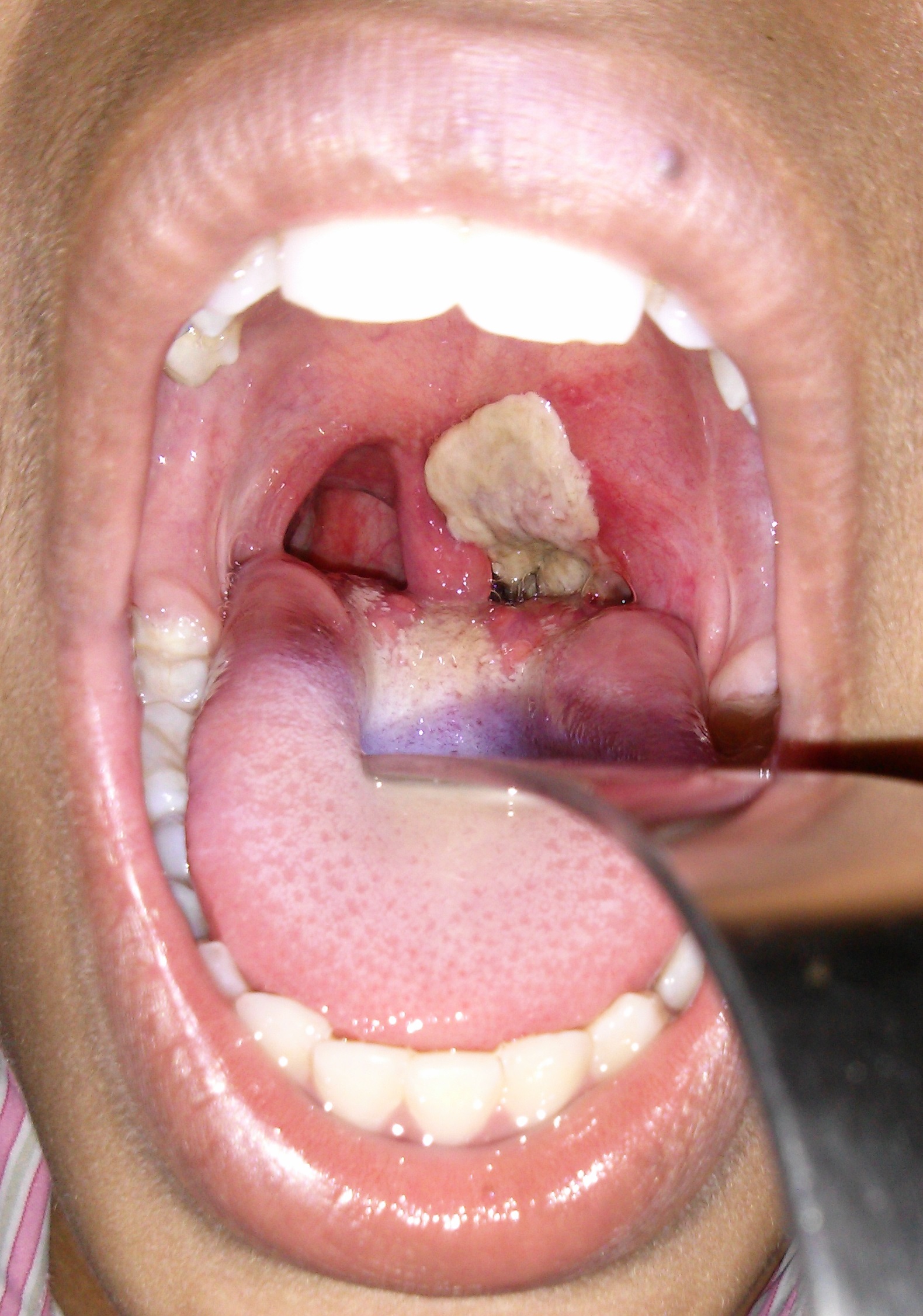
A 12-year-old boy presents to the emergency room with difficulty breathing after several days of severe sore throat. Further history reveals that his family immigrated recently from Eastern Europe and he has never previously seen a doctor. Physical exam shows cervical lymphadenopathy with extensive neck edema as well as the finding shown in the image provided. You suspect a bacteria that causes the disease by producing an AB type exotoxin. Which of the following is the proper medium to culture the most likely cause of this infection?
An 11-year-old boy is brought to his pediatrician by his parents for the routine Tdap immunization booster dose that is given during adolescence. Upon reviewing the patient’s medical records, the pediatrician notes that he was immunized according to CDC recommendations, with the exception that he received a catch-up Tdap immunization at the age of 8 years. When the pediatrician asks the boy’s parents about this delay, they inform the doctor that they immigrated to this country 3 years ago from Southeast Asia, where the child had not been immunized against diphtheria, tetanus, and pertussis. Therefore, he received a catch-up series at 8 years of age, which included the first dose of the Tdap vaccine. Which of the following options should the pediatrician choose to continue the boy’s immunization schedule?
A 12-year-old boy is brought by his father to a pediatrician for evaluation of stiff jaw and swallowing difficulty. He has also developed painful body spasms triggered by loud noise, light, and physical touch. His father says that a few days ago, his son continued to play football, even after falling and bruising his arms and knees. On examination, the boy had a sustained facial smile, stiff arched back, and clamped hands. The toxin responsible for these clinical manifestations that travel retrograde in axons of peripheral motor neurons blocks the release of which of the following?
A 27-year-old man presents to the emergency department with unrelenting muscle spasms for the past several hours. The patient’s girlfriend states that he started having jaw spasms and soreness last night but now his neck, back, and arms are spasming. She also states that he stepped on a nail about 1 week ago. Past medical history is noncontributory. The patient's vaccination status is unknown at this time. Today, the vital signs include temperature 39.1°C (102.4°F), heart rate 115/min, blood pressure 145/110 mm Hg, and respiratory rate 10/min. On exam, the patient is in obvious discomfort, with a clenched jaw and extended neck. Labs are drawn and a basic metabolic panel comes back normal and the white blood cell (WBC) count is moderately elevated. Which of the following is the most likely etiology of this patient’s symptoms?
A 34-year-old gravida 5, para 4 presents to the physician for prenatal care at 32 weeks of pregnancy. She comes from a rural region of Ethiopia and did not have appropriate prenatal care during previous pregnancies. She has no complaints of swelling, contractions, loss of fluid, or bleeding from the vagina. During her current pregnancy, she has received proper care and has completed the required laboratory and instrumental tests, which did not show any pathology. Her blood pressure is 130/70 mm Hg, heart rate is 77/min, respiratory rate is 15/min, and temperature is 36.6°C (97.8°F). Her examination is consistent with a normal 32-weeks’ gestation. The patient tells the physician that she is going to deliver her child at home, without any medical aid. The physician inquires about her tetanus vaccination status. The patient reports that she had tetanus 1 year after her first delivery at the age of 16, and it was managed appropriately. She had no tetanus vaccinations since then. Which of the following statements is true?
A 9-year-old girl presents with a 3-week history of cough. Her mother reports that initially, she had a runny nose and was tired, with a slight cough, but as the runny nose resolved, the cough seemed to get worse. She further states that the cough is dry sounding and occurs during the day and night. She describes having coughing spasms that occasionally end in vomiting, but between episodes of coughing she is fine. She reports that during a coughing spasm, her daughter will gasp for air and sometimes make a “whooping” noise. A nasopharyngeal swab confirms a diagnosis of Bordetella pertussis. Which of the following statements apply to this patient?
A microbiology student was given a swab containing an unknown bacteria taken from the wound of a soldier and asked to identify the causative agent. She determined that the bacteria was a gram-positive, spore-forming bacilli, but had difficulty narrowing it down to the specific bacteria. The next test she performed was the Nagler's test, in which she grew the bacteria on a plate made from egg yolk, which would demonstrate the ability of the bacteria to hydrolyze phospholipids and produce an area of opacity. Half the plate contained a specific antitoxin which prevented hydrolysis of phospholipids while the other half did not contain any antitoxin. The bacteria produced an area of opacity only on half of the plate containing no antitoxin. Which of the following toxins was the antitoxin targeting?
A 23-year-old man presents to student health for a cough. The patient states he has paroxysms of coughing followed by gasping for air. The patient is up to date on his vaccinations and is generally healthy. He states he has felt more stressed lately secondary to exams. His temperature is 101.0°F (38.3°C), blood pressure is 125/65 mmHg, pulse is 105/min, respirations are 14/min, and oxygen saturation is 98% on room air. Laboratory values are notable for the findings below. Hemoglobin: 12 g/dL Hematocrit: 36% Leukocyte count: 13,500/mm^3 with a lymphocytosis Platelet count: 197,000/mm^3 Physical exam is notable for clear breath sounds bilaterally. Which of the following is the best next step in management?
Want unlimited practice?
Get full access to all questions, explanations, and performance tracking.
Scan to download app