
Toxoplasma gondii — MCQs

A 26-year-old man comes to the physician for a follow-up examination. He was diagnosed with HIV infection 2 weeks ago. His CD4+ T-lymphocyte count is 162/mm3 (N ≥ 500). An interferon-gamma release assay is negative. Prophylactic treatment against which of the following pathogens is most appropriate at this time?
A 63-year-old man with non-Hodgkin lymphoma is brought to the emergency department because of fever and confusion that have progressively worsened over the past 3 days. He also has a 3-day history of loose stools. He returned from France 2 weeks ago where he stayed in the countryside and ate typical French cuisine, including frog, snail, and various homemade cheeses. His last chemotherapy cycle was 3 weeks ago. He is oriented to person but not to place or time. His temperature is 39.5°C (103.1°F), pulse is 110/min, and blood pressure is 100/60 mm Hg. Examination shows cervical and axillary lymphadenopathy. The lungs are clear to auscultation. There is involuntary flexion of the bilateral hips and knees with passive flexion of the neck. Neurologic examination shows no focal findings. Laboratory studies show: Hemoglobin 9.3 g/dL Leukocyte count 3600/mm3 Platelet count 151,000/mm3 Serum Na+ 134 mEq/L Cl- 103 mEq/L K+ 3.7 mEq/L Glucose 102 mg/dL Creatinine 1.3 mg/dL A lumbar puncture is performed. Cerebrospinal fluid analysis shows a leukocyte count of 1200/mm3 (76% segmented neutrophils, 24% lymphocytes), a protein concentration of 113 mg/dL, and a glucose concentration of 21 mg/dL. The results of blood cultures are pending. Which of the following is the most appropriate initial pharmacotherapy?
A 44-year-old man is brought to the emergency department by his daughter for a 1-week history of right leg weakness, unsteady gait, and multiple falls. During the past 6 months, he has become more forgetful and has sometimes lost his way along familiar routes. He has been having difficulties operating simple kitchen appliances such as the dishwasher and coffee maker. He has recently become increasingly paranoid, agitated, and restless. He has HIV, hypertension, and type 2 diabetes mellitus. His last visit to a physician was more than 2 years ago, and he has been noncompliant with his medications. His temperature is 37.2°C (99.0°F), blood pressure is 152/68 mm Hg, pulse is 98/min, and respiratory rate is 14/min. He is somnolent and slightly confused. He is oriented to person, but not place or time. There is mild lymphadenopathy in the cervical, axillary, and inguinal areas. Neurological examination shows right lower extremity weakness with normal tone and no other focal deficits. Laboratory studies show: Hemoglobin 9.2 g/dL Leukocyte count 3,600/mm3 Platelet count 140,000/mm3 CD4+ count 56/µL HIV viral load > 100,000 copies/mL Serum Cryptococcal antigen Negative Toxplasma gondii IgG Positive An MRI of the brain is shown below. Which of the following is the most likely diagnosis?
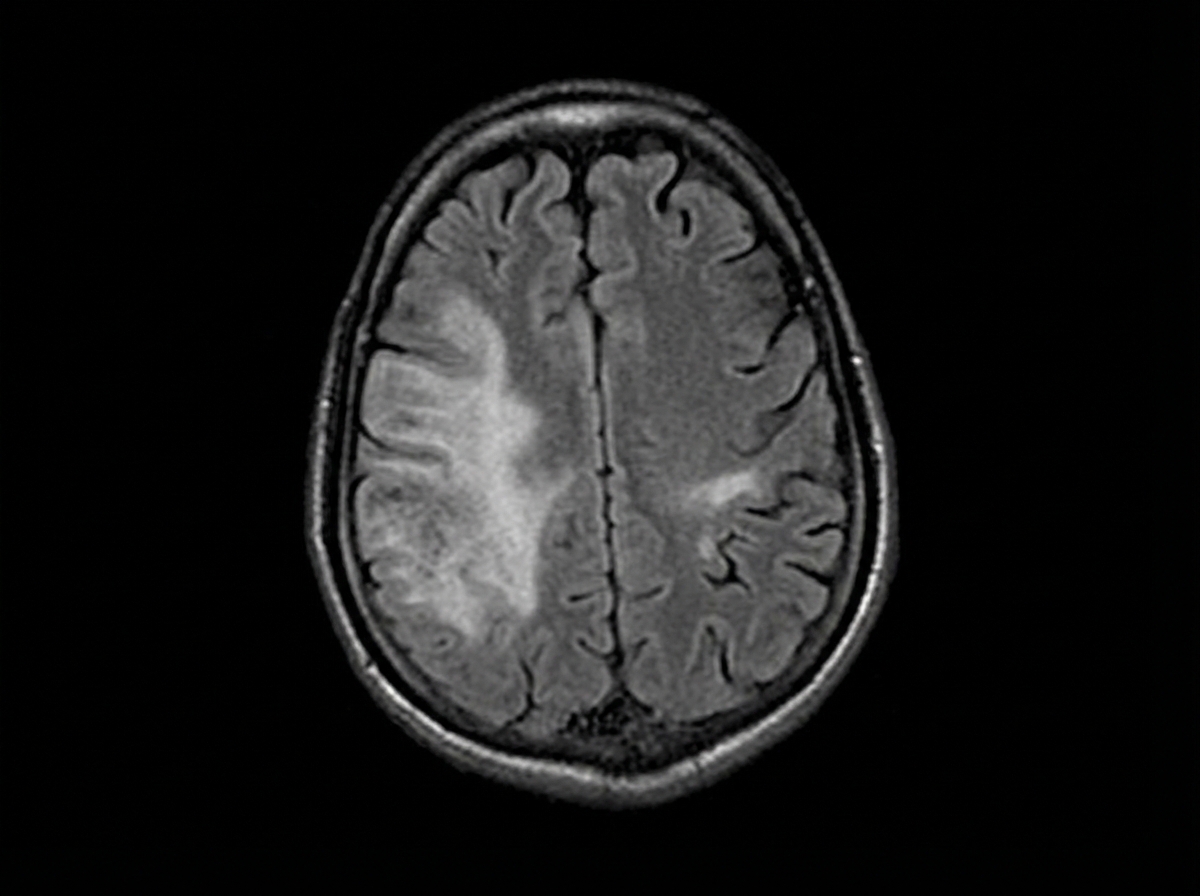
A 26-year-old woman with poor prenatal care and minimal antenatal screening presents to the emergency department in labor. Shortly thereafter, she delivers a baby girl who subsequently demonstrates symptoms of chorioretinitis on examination. A series of postpartum screening questions is significant only for the presence of multiple cats in the mother’s household. The clinical team orders an enhanced MRI examination of the infant’s brain which reveals hydrocephalus, multiple punctate intracranial calcifications, and 2 sub-cortical ring-enhancing lesions. Which is the most likely diagnosis?
A 32-year-old woman presents to your office with abdominal pain and bloating over the last month. She also complains of intermittent, copious, non-bloody diarrhea over the same time. Last month, she had a cough that has since improved but has not completely resolved. She has no sick contacts and has not left the country recently. She denies any myalgias, itching, or rashes. Physical and laboratory evaluations are unremarkable. Examination of her stool reveals the causative organism. This organism is most likely transmitted to the human host through which of the following routes?
A 33-year-old man is brought into the emergency department with fever, lethargy, and confusion. He is a cachectic man in acute distress, unable to respond to questions or follow commands. His friend confides that the patient has been sexually active with multiple male partners and was diagnosed with HIV several months ago, but was lost to follow up. Based on prior records, his most recent CD4 count was 65 cells/uL. Which of the following is the most appropriate next step in management?
A 3-day-old female newborn delivered vaginally at 36 weeks to a 27-year-old woman has generalized convulsions lasting 3 minutes. Prior to the event, she was lethargic and had difficulty feeding. The infant has two healthy older siblings and the mother's immunizations are up-to-date. The infant appears icteric. The infant's weight and length are at the 5th percentile, and her head circumference is at the 99th percentile for gestational age. There are several purpura of the skin. Ocular examination shows posterior uveitis. Cranial ultrasonography shows ventricular dilatation, as well as hyperechoic foci within the cortex, basal ganglia, and periventricular region. Which of the following is the most likely diagnosis?
A 2-day old male newborn delivered vaginally at 36 weeks to a 29-year-old woman, gravida 3, para 2, has generalized convulsions lasting 2 minutes. Previous to the event, he had difficulty feeding and was lethargic. Pregnancy and delivery were uncomplicated. Apgar scores were 7 and 8 at 1 and 5 minutes, respectively. Pregnancy and delivery of the mother's first 2 children were also uncomplicated. Medications of the mother include folic acid and a multivitamin. The mother's immunizations are up-to-date. The infant appears icteric. His vital signs are within normal limits. The infant's weight and length are at the 5th percentile, and his head circumference at the 99th percentile for gestational age. There are several purpura of the skin. Ocular examination shows posterior uveitis. The patient does not pass his auditory screening tests. Cranial ultrasonography shows ventricular dilatation, as well as hyperechoic foci within the cortex, basal ganglia, and periventricular region. Which of the following is the most likely diagnosis?
A pathologist receives a patient sample for analysis. Cells in the sample are first labeled with fluorescent antibodies and then passed across a laser beam in a single file of particles. The light scatter and fluorescent intensity of the particles are plotted on a graph; this information is used to characterize the sample. This laboratory method would be most useful to establish the diagnosis of a patient with which of the following?
A 28-year-old female in the 2nd trimester of pregnancy is diagnosed with primary Toxoplasma gondii infection. Her physician fears that the fetus may be infected in utero. Which of the following are associated with T. gondii infection in neonates?
Want unlimited practice?
Get full access to all questions, explanations, and performance tracking.
Scan to download app