
Cestodes (tapeworms) — MCQs

A 22-year-old man presents with abdominal cramps and diarrhea over the last few weeks. He notes that several of his bowel movements have a small amount of blood. Past medical history is significant for an intermittent cough that has been persistent since returning from Mexico last month. The patient takes no current medications. On physical examination, there is diffuse tenderness to palpation. Which of the following medications is indicated for this patient’s condition?
A 34-year-old man presents with dysphagia. The patient says that he has pain on swallowing which gradually onset 2 weeks ago and has not improved. He denies any change in diet but does say that he recently returned from a prolonged work trip to the Caribbean. No significant past medical history or current medications. On physical examination, the patient looks pale. His tongue is swollen and has a beefy, red appearance. Angular stomatitis is present. Laboratory findings are significant for macrocytic, megaloblastic anemia, decreased serum folate, increased serum homocysteine, and normal methylmalonic acid levels. Which of the following conditions most likely caused this patient’s symptoms?
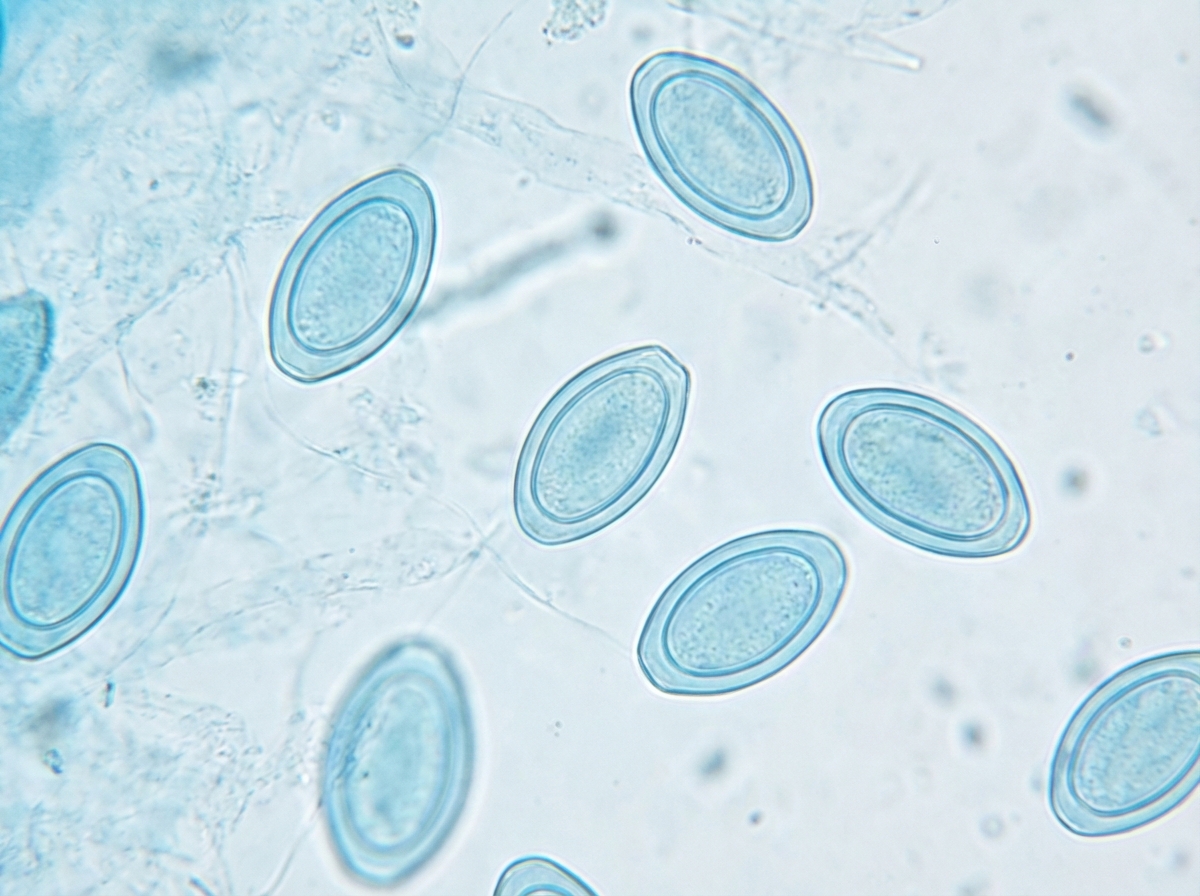
A 2-year-old girl is brought to the doctor by her mother with persistent scratching of her perianal region. The patient’s mother says that symptoms started 3 days ago and have progressively worsened until she is nearly continuously scratching even in public places. She says that the scratching is worse at night and disturbs her sleep. An anal swab and staining with lactophenol cotton blue reveal findings in the image (see image). Which of the following is the organism most likely responsible for this patient’s condition?
An 11-year-old boy is brought to the pediatrician by his mother for vomiting. The patient has been vomiting for the past week, and his symptoms have not been improving. His symptoms are worse in the morning and tend to improve throughout the day. The patient also complains of occasional headaches and had diarrhea several days ago. The patient eats a balanced diet and does not drink soda or juice. The patient's brothers both had diarrhea recently that resolved spontaneously. His temperature is 99.5°F (37.5°C), blood pressure is 80/45 mmHg, pulse is 90/min, respirations are 16/min, and oxygen saturation is 98% on room air. On physical exam, the patient appears to be in no acute distress. Cardiopulmonary exam reveals a minor flow murmur. Neurological exam reveals cranial nerves II-XII as grossly intact with mild narrowing of the patient's visual fields. The patient's gait is stable, and he is able to jump up and down. Which of the following is the most likely direct cause of this patient's presentation?
A 9-year-old girl is admitted to the hospital with a one-day history of acute abdominal pain and vomiting. She also has a two-day history of fever, headache, and neck pain. Her immunizations are up-to-date. She is confused and oriented only to place and person. Her temperature is 39.7°C (103.5°F), pulse is 148/min, blood pressure is 90/50 mm Hg, and respiratory rate is 28/min. Cervical range of motion is limited by pain. The remainder of the neurologic examination shows no abnormalities. Laboratory studies show: Hemoglobin 10.9 g/dL Leukocyte count 44,000/mm3 Serum pH 7.33 Na+ 130 mEq/L Cl- 108 mEq/L K+ 6.1 mEq/L HCO3- 20 mEq/L Urea nitrogen 34 mg/dL Glucose 180 mg/dL Creatinine 2.4 mg/dL Urine ketones negative A CT scan of the head shows enhancement of the arachnoid and pia mater. Cerebrospinal fluid analysis shows a leukocyte count of 3,400/μL (90% neutrophils), a glucose concentration of 50 mg/dL, protein concentration of 81 mg/dL, and no erythrocytes. Gram stain of the CSF shows gram-negative diplococci. This patient is at increased risk for which of the following complications?
A 45-year-old man presents to the emergency department with abdominal distension. The patient states he has had gradually worsening abdominal distension with undulating pain, nausea, and vomiting for the past several months. The patient does not see a physician typically and has no known past medical history. He works as a farmer and interacts with livestock and also breeds dogs. His temperature is 98.7°F (37.1°C), blood pressure is 159/90 mmHg, pulse is 88/min, respirations are 15/min, and oxygen saturation is 99% on room air. Physical exam is notable for mild abdominal distension and discomfort to palpation of the upper abdominal quadrants. Laboratory values are ordered and are notable for a mild eosinophilia. A CT scan of the abdomen demonstrates multiple small eggshell calcifications within the right lobe of the liver. Which of the following is the most likely etiology of this patient's symptoms?
A 28-year-old male presents to his primary care physician with complaints of intermittent abdominal pain and alternating bouts of constipation and diarrhea. His medical chart is not significant for any past medical problems or prior surgeries. He is not prescribed any current medications. Which of the following questions would be the most useful next question in eliciting further history from this patient?
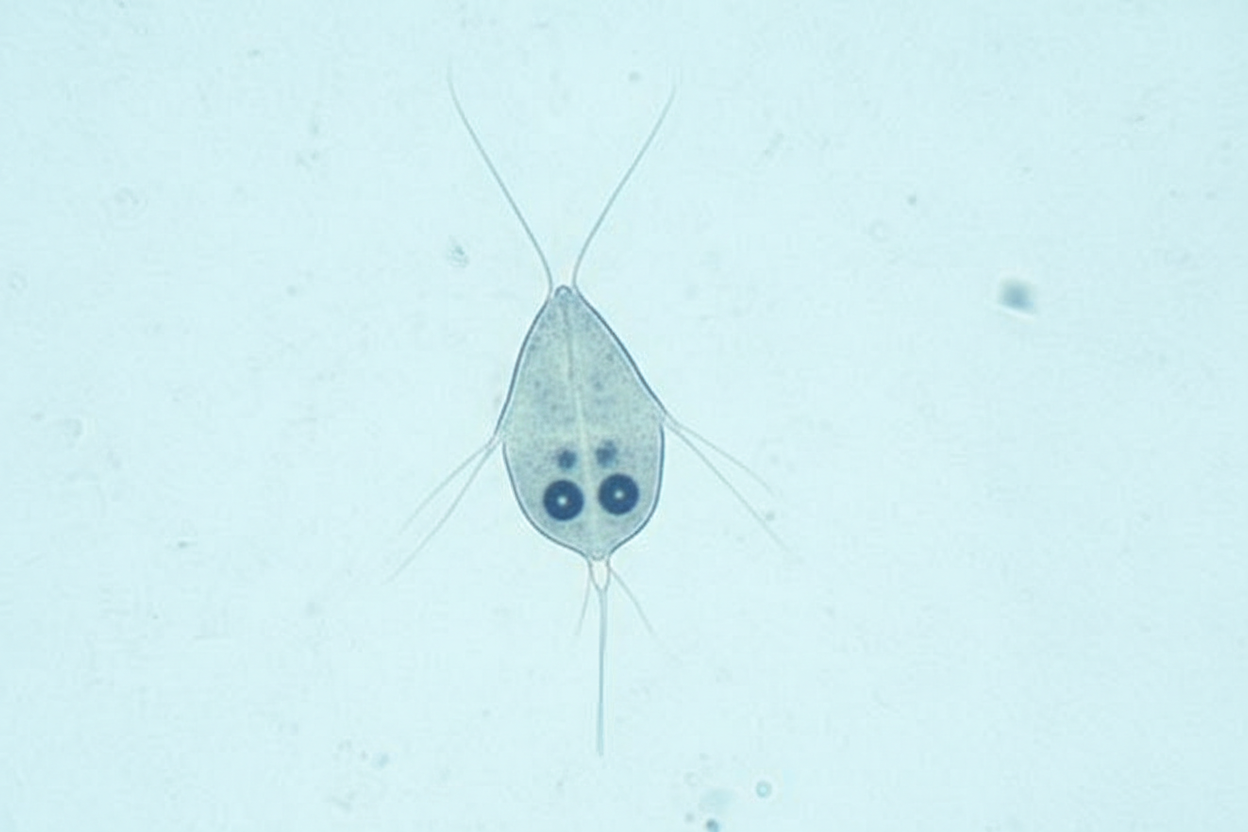
A 42-year-old man presents with unremitting diarrhea that has lasted for 2 weeks. He describes his bowel movements as watery, non-bloody, foul-smelling, and greasy. He also has cramping abdominal pain associated with the diarrhea. He says that his symptoms started right after he returned from a father-son camping trip to the mountains. His son has similar symptoms. His vital signs include: pulse 78/min, respiratory rate 15/min, temperature 37.2°C (99.0°F), and blood pressure 120/70 mm Hg. A stool sample is obtained and microscopic analysis is significant for the findings shown in the image below. Which of the following pathogens is most likely responsible for this patient’s condition?
A 45-year-old man with a history of poorly controlled human immunodeficiency virus (HIV) infection presents to the emergency room complaining of clumsiness and weakness. He reports a 3-month history of worsening balance, asymmetric muscle weakness, and speech difficulties. He recently returned from a trip to Guatemala to visit his family. He has been poorly compliant with his anti-retroviral therapy and his most recent CD4 count was 195. His history is also notable for rheumatoid arthritis and hepatitis C. His temperature is 99°F (37.2°C), blood pressure is 140/90 mmHg, pulse is 95/min, and respirations are 18/min. On exam, he has 4/5 strength in his right upper extremity, 5/5 strength in his left upper extremity, 5/5 strength in his right lower extremity, and 3/5 strength in his left lower extremity. His speech is disjointed with intermittent long pauses between words. Vision is 20/100 in the left eye and 20/40 in his right eye; previously, his eyesight was 20/30 bilaterally. This patient most likely has a condition caused by which of the following types of pathogens?
A 42-year-old woman comes to the physician because of episodic abdominal pain and fullness for 1 month. She works as an assistant at an animal shelter and helps to feed and bathe the animals. Physical examination shows hepatomegaly. Abdominal ultrasound shows a 4-cm calcified cyst with several daughter cysts in the liver. She undergoes CT-guided percutaneous aspiration under general anesthesia. Several minutes into the procedure, one liver cyst spills, and the patient's oxygen saturation decreases from 95% to 64%. Her pulse is 136/min, and blood pressure is 86/58 mm Hg. Which of the following is the most likely causal organism of this patient's condition?
Want unlimited practice?
Get full access to all questions, explanations, and performance tracking.
Scan to download app