
Soil-transmitted helminths — MCQs

A 4-year-old girl presents with recurrent abdominal pain and a low-grade fever for the past 2 months. The patient’s mother says that she has lost her appetite which has caused some recent weight loss. She adds that the patient frequently plays outdoors with their pet dog. The patient is afebrile and vital signs are within normal limits. On physical examination, conjunctival pallor is present. Abdominal examination reveals a diffusely tender abdomen and significant hepatomegaly. There is also a solid mass palpable in the right upper quadrant measuring about 3 x 4 cm. Laboratory findings are significant for the following: Hemoglobin (Hb%) 9.9 g/dL Total count (WBC) 26,300/µL Differential count Neutrophils 36% Lymphocytes 16% Eosinophils 46% Platelets 200,000/mm3 Erythrocyte sedimentation rate 56 mm/h C-reactive protein 2 mg/L Serum globulins 5 g/dL Laparoscopic resection of the mass is performed, and a tissue sample is sent for histopathology. Which of the following is the organism most likely responsible for this patient’s condition?
A 22-year-old man presents with abdominal cramps and diarrhea over the last few weeks. He notes that several of his bowel movements have a small amount of blood. Past medical history is significant for an intermittent cough that has been persistent since returning from Mexico last month. The patient takes no current medications. On physical examination, there is diffuse tenderness to palpation. Which of the following medications is indicated for this patient’s condition?
A 32-year-old woman presents to your office with abdominal pain and bloating over the last month. She also complains of intermittent, copious, non-bloody diarrhea over the same time. Last month, she had a cough that has since improved but has not completely resolved. She has no sick contacts and has not left the country recently. She denies any myalgias, itching, or rashes. Physical and laboratory evaluations are unremarkable. Examination of her stool reveals the causative organism. This organism is most likely transmitted to the human host through which of the following routes?
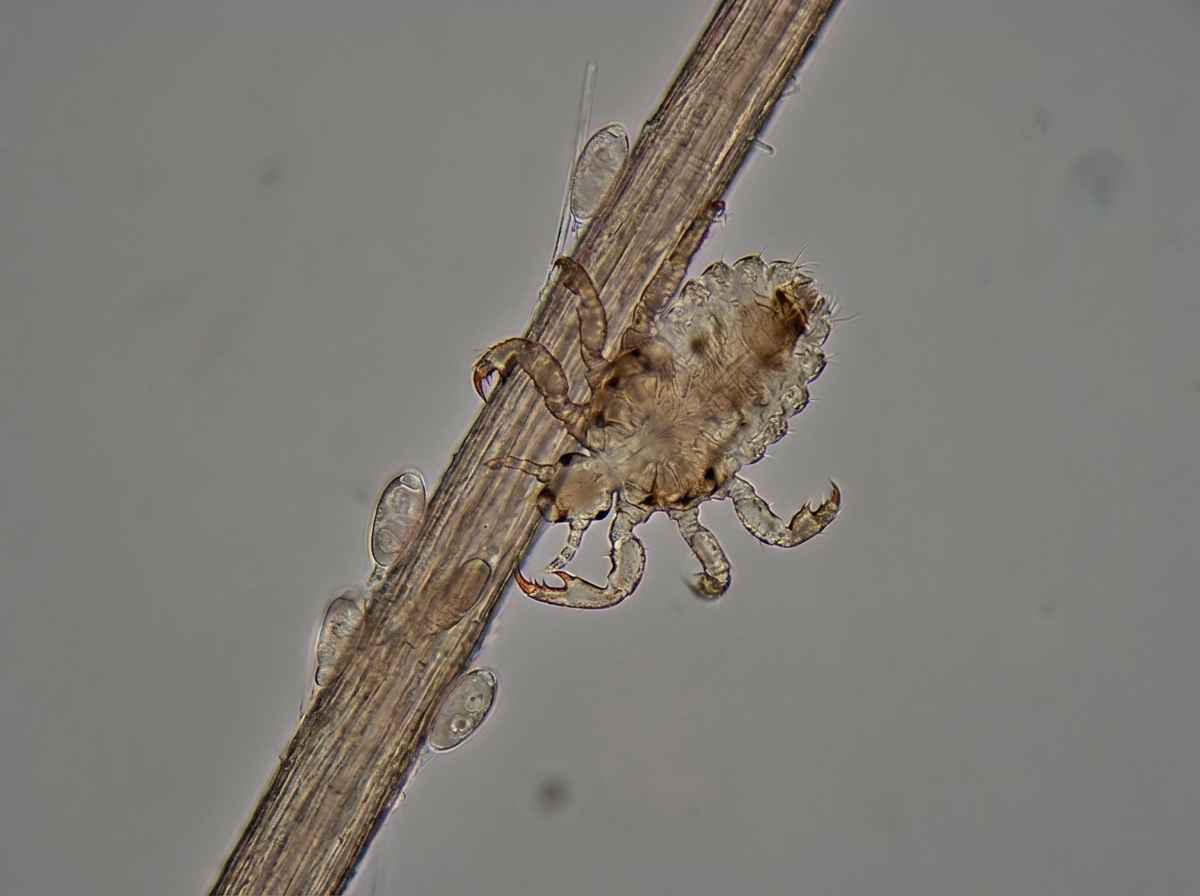
A 17-year-old girl comes to the physician because of a 1-week history of severe itching in the area of her genitals. She reports that the itching is most severe at night. She has been sexually active with three partners over the past year; she uses condoms for contraception. Her current sexual partner is experiencing similar symptoms. Pelvic examination shows vulvar excoriations. A photomicrograph of an epilated pubic hair is shown. Which of the following is the most likely causal organism?
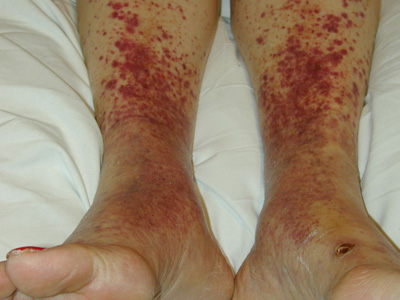
A 26-year-old male with no significant past medical history goes camping with several friends in Virginia. Several days after returning, he begins to experience fevers, headaches, myalgias, and malaise. He also notices a rash on his wrists and ankles (Figure A). Which of following should be initiated for treatment of his condition?
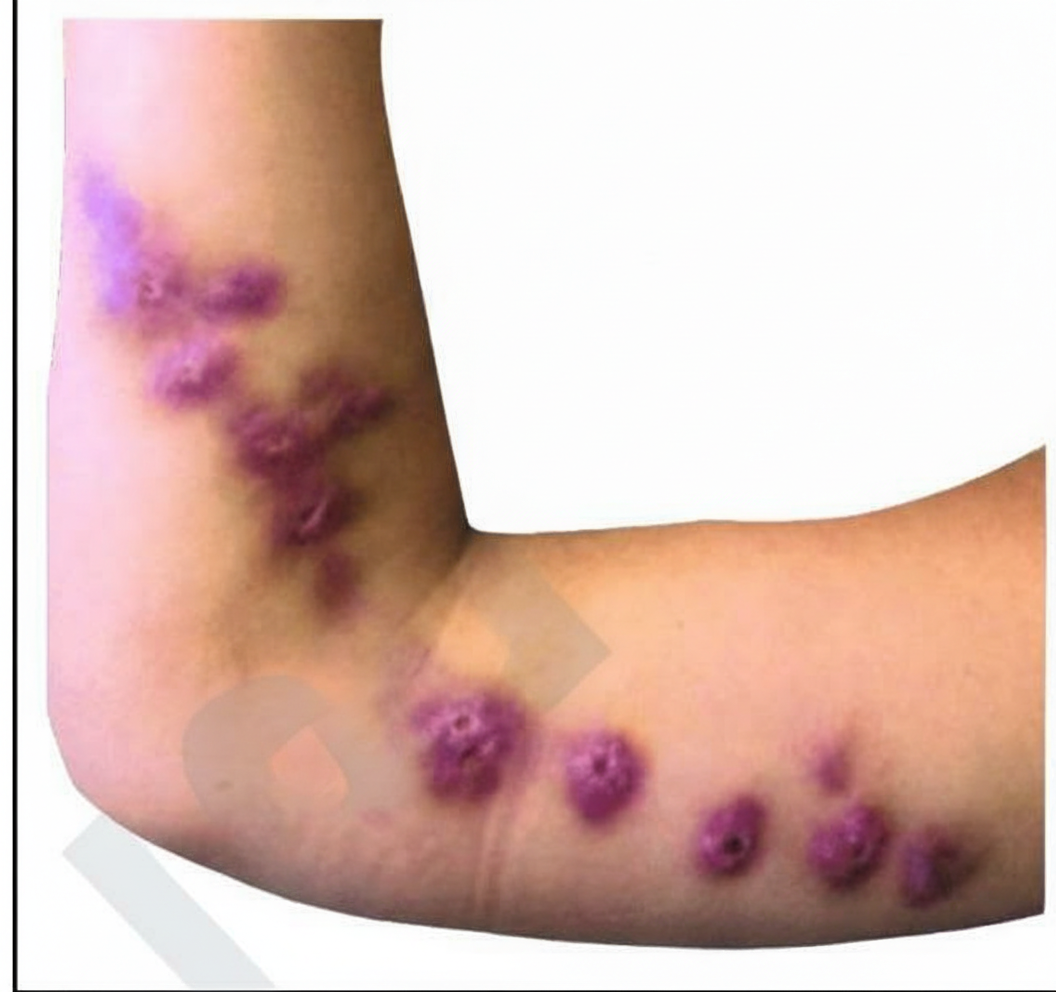
A previously healthy 48-year-old man comes to the physician because of a 2-week history of a nonpruritic rash on his right forearm. The rash began as pustules and progressed to form nodules and ulcers. He works as a gardener. Physical examination shows right axillary lymphadenopathy and the findings in the photograph. Which of the following is the most likely causal organism?
A 38-year-old man comes to the physician because of a 2-week history of abdominal pain and an itchy rash on his buttocks. He also has fever, nausea, and diarrhea with mucoid stools. One week ago, the patient returned from Indonesia, where he went for vacation. Physical examination shows erythematous, serpiginous lesions located in the perianal region and the posterior thighs. His leukocyte count is 9,000/mm3 with 25% eosinophils. Further evaluation is most likely to show which of the following findings?
A 22-year-old man comes to the physician because of abdominal pain, diarrhea, and weight loss that started after a recent backpacking trip in Southeast Asia. He does not smoke or drink alcohol. His leukocyte count is 7,500/mm3 (61% segmented neutrophils, 13% eosinophils, and 26% lymphocytes). Stool microscopy shows rhabditiform larvae. This patient is most likely to develop which of the following?
A 37-year-old man makes an appointment with his primary care physician because he has been feeling tired and is no longer able to play on a recreational soccer team. He also says his coworkers have commented that he appears pale though he has not noticed any changes himself. He says that he has been generally healthy and that the only notable event that happened in the last year is that he went backpacking all over the world. Based on clinical suspicion, a series of blood tests are performed with partial results presented below: Hemoglobin: 9.8 g/dL Platelet count: 174,000/mm^3 Mean corpuscular volume: 72 µm^3 (normal: 80-100 µm^3) Iron: 22 µg/dL (normal: 50-170 µg/dL) Ferritin: 8 ng/mL (normal: 15-200 ng/mL) Lactate dehydrogenase: 57 U/L (normal: 45-90 U/L) Urine hemoglobin: absent Infection with which of the following types of organisms could lead to this pattern of findings?
A 16-year-old boy is brought to the physician by his host parents for evaluation of a progressively pruritic rash over his shoulders and buttocks for the past 6 months. He recently came to the United States from Nigeria to attend a year of high school. He reports that it has been increasingly difficult for him to read the whiteboard during classes. Physical examination shows symmetrically distributed papules 4–8 mm in diameter, excoriation marks, and patchy hyperpigmentation over his shoulders, waist, and buttocks. There is nontender inguinal lymphadenopathy and several firm, nontender subcutaneous nodules along the right iliac crest. Six skin snip biopsies are taken from the pelvic girdle, buttocks, and thigh, and are then incubated in saline. After 24 hours, microscopic examination shows motile microfilariae. Which of the following is the most likely diagnosis?
Want unlimited practice?
Get full access to all questions, explanations, and performance tracking.
Scan to download app