
Therapeutic approaches targeting oncogenic viruses — MCQs

A research team develops a new monoclonal antibody checkpoint inhibitor for advanced melanoma that has shown promise in animal studies as well as high efficacy and low toxicity in early phase human clinical trials. The research team would now like to compare this drug to existing standard of care immunotherapy for advanced melanoma. The research team decides to conduct a non-randomized study where the novel drug will be offered to patients who are deemed to be at risk for toxicity with the current standard of care immunotherapy, while patients without such risk factors will receive the standard treatment. Which of the following best describes the level of evidence that this study can offer?
A 60-year-old man comes to the physician’s office with jaundice. Liver ultrasound reveals a shrunken liver and biopsy reveals cirrhosis. Hepatitis serologies are below: Anti-HAV: negative HBsAg: negative HBsAb: positive HBeAg: negative Anti-HBe: negative Anti-HBc: negative Anti-HCV: positive The hepatitis C viral load is 1,000,000 copies/mL. The patient is started on an antiviral regimen including sofosbuvir. What is the mechanism of action of this drug?
During an experiment, the immunophenotypes of different cells in a sample are determined. The cells are labeled with fluorescent antibodies specific to surface proteins, and a laser is then focused on the samples. The intensity of fluorescence created by the laser beam is then plotted on a scatter plot. The result shows most of the cells in the sample to be positive for CD8 surface protein. Which of the following cell types is most likely represented in this sample?
A group of scientists is conducting an experiment on the human cells involved in the immune response. They genetically modify B cells so they do not express the cluster of differentiation 21 (CD21) on their cell surfaces. The pathogenesis of which of the following organisms would most likely be affected by this genetic modification?
A 1-year-old girl is brought to the physician for a well-child examination. She has no history of serious illness. She receives a vaccine in which a polysaccharide is conjugated to a carrier protein. Which of the following pathogens is the most likely target of this vaccine?
A 45-year-old man with HIV comes to the physician because of multiple lesions on his chest and lower extremities. The lesions have progressively increased in size and are not painful or pruritic. Current medications include abacavir, dolutegravir, and lamivudine. A photograph of the lesions is shown. His CD4+ T-lymphocyte count is 450/mm3 (normal ≥ 500/mm3). A skin biopsy shows multiple spindle-shaped cells and lymphocytic infiltrate. Which of the following is the most appropriate pharmacotherapy?
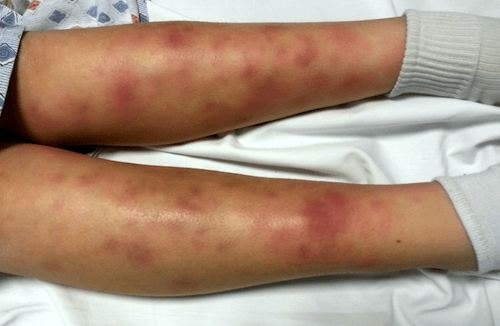
A parent presents to her pediatrician requesting information about immunizations for her newborn. The pediatrician explains about basic principles of immunization, types of vaccines, possible adverse effects, and the immunization schedule. Regarding how immunizations work, the pediatrician explains that there are mainly 2 types of vaccines. The first type of vaccine provides stronger and more lasting immunity as it induces both cellular and humoral immune responses. The second type of vaccine produces mainly a humoral response only, and its overall efficacy is less as compared to the first type. Which of the following vaccines belongs to the first type of vaccine that the pediatrician is talking about?
A 5-year-old boy is brought to the emergency room by his parents due to worsening cough, fever, and difficulty breathing in the past 2 days. Physical exam reveals a barking cough and use of accessory muscles for breathing. After a full clinical workup, he is diagnosed with an upper respiratory infection caused by a parainfluenza virus. Which of the following findings in the clinical workup of this patient supported the diagnosis?
A 16-year-old male is brought to the clinic by his mother for the complaints of fever, nonproductive cough, fatigue, lack of appetite, and sore throat for the past 2 months. Several other students at his high school have had similar symptoms. Physical exam shows a whitish membrane in his oropharynx, bilateral enlarged cervical lymphadenopathy, and mild splenomegaly. Which of the following tests is most likely to diagnose his condition?
A 5-year-old African American female has experienced recurrent respiratory infections. To determine how well her cell-mediated immunity is performing, a Candida skin injection is administered. After 48 hours, there is no evidence of induration at the injection site. Of the following cell types, which one would normally mediate this type of immune reaction?
Want unlimited practice?
Get full access to all questions, explanations, and performance tracking.
Scan to download app