
Hepatitis B and hepatocellular carcinoma — MCQs

A 29-year-old man comes to the physician for a routine health maintenance examination. He feels well. He works as a nurse at a local hospital in the city. Three days ago, he had a needlestick injury from a patient whose serology is positive for hepatitis B. He completed the 3-dose regimen of the hepatitis B vaccine 2 years ago. His other immunizations are up-to-date. He appears healthy. Physical examination shows no abnormalities. He is concerned about his risk of being infected with hepatitis B following his needlestick injury. Serum studies show negative results for hepatitis B surface antigen, hepatitis B surface antibody, and hepatitis C antibody. Which of the following is the most appropriate next step in management?
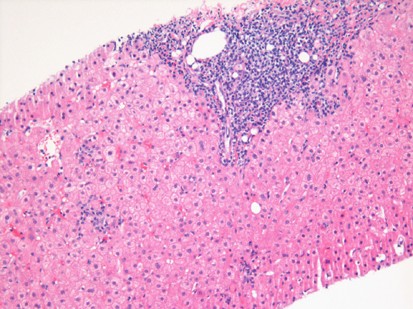
A 57-year-old man comes to the physician for a follow-up visit. Serum studies show: AST 134 U/L ALT 152 U/L Hepatitis B surface antigen Positive A photomicrograph of the microscopic findings of a liver biopsy is shown. These biopsy findings are most characteristic of which of the following types of inflammatory reactions?
Researchers are investigating oncogenes, specifically the KRAS gene that is associated with colon, lung, and pancreatic cancer. They have established that the gain-of-function mutation in this gene increases the chance of cancer development. They are also working to advance the research further to study tumor suppressor genes. Which of the genes below is considered a tumor suppressor gene?
A 52-year-old male patient with chronic alcoholism presents to an ambulatory medical clinic, where the hepatologist elects to perform comprehensive hepatitis B screening, in addition to several other screening and preventative measures. Given the following choices, which serologic marker, if positive, would indicate the patient’s immunity to the hepatitis B virus?
A 28-year-old man presents to the office with complaints of malaise, anorexia, and vomiting for the past 2 weeks. He also says that his urine is dark. The past medical history is unremarkable. The temperature is 36.8°C (98.2°F), the pulse is 72/min, the blood pressure is 118/63 mm Hg, and the respiratory rate is 15/min. The physical examination reveals a slightly enlarged, tender liver. No edema or spider angiomata are noted. Laboratory testing showed the following: HBsAg Positive IgM anti-HBc < 1:1,000 Anti-HBs Negative HBeAg Positive Anti-HBe Negative HBV DNA 2.65 × 10⁹ IU/L Alpha-fetoprotein 125 ng/mL What is the most likely cause of this patient's condition?
A 34-year-old woman, gravida 2, para 0, at 28 weeks' gestation comes to the physician for a prenatal visit. She has not had regular prenatal care. Her most recent ultrasound at 20 weeks of gestation confirmed accurate fetal dates and appropriate fetal development. She takes levothyroxine for hypothyroidism. She used to work as a nurse before she emigrated from Brazil 13 years ago. She lost her immunization records during the move and cannot recall all of her vaccinations. She appears well. Vital signs are within normal limits. Physical examination shows a fundal height of 26 cm and no abnormalities. An ELISA test for HIV is negative. Serology testing shows hepatitis B surface antibody positive, hepatitis B core antibody and surface antigen negative, and hepatitis A antibody negative. Hepatitis C antibody is positive with detectable RNA. Given her incomplete vaccination history and current serologic results, which of the following vaccinations is most appropriate to recommend at this time?
A previously healthy 48-year-old man comes to the physician because of a 2-month history of weight loss and yellowing of the skin. He works as a farmer and cultivates soybean and corn. He does not smoke, drink alcohol, or use illicit drugs. His vital signs are within normal limits. Physical examination shows scleral icterus and tender hepatomegaly. Ultrasonography of the abdomen shows a 5-cm nodular lesion in the right lobe of the liver. Further evaluation of the lesion confirms hepatocellular carcinoma. The activity of which of the following enzymes most likely contributed to the pathogenesis of this patient's condition?
A 25-year-old man presents to the office for a 3-day history of fever and fatigue. Upon further questioning, he says that he also had constant muscular pain, headaches, and fever during these days. He adds additional information by giving a history of regular unprotected sexual relationship with multiple partners. He is a non-smoker and drinks alcohol occasionally. The heart rate is 102/min, respiratory rate is 18/min, temperature is 38.0°C (100.4°F), and blood pressure is 120/80 mm Hg. On physical examination, he is icteric and hepatosplenomegaly is evident with diffuse muscular and abdominal tenderness particularly in the right upper quadrant. The serologic markers show the following pattern: Anti-HAV IgM negative HBsAg positive Anti-HBs negative IgM anti-HBc positive Anti-HCV negative Anti-HDV negative What is the most likely diagnosis?
In a previous experiment infecting hepatocytes, it was shown that viable HDV virions were only produced in the presence of a co-infection with HBV. To better understand which HBV particle was necessary for the production of viable HDV virions, the scientist encoded in separate plasmids the various antigens/proteins of HBV and co-infected the hepatocytes with HDV. In which of the experiments would viable HDV virions be produced in conjunction with the appropriate HBV antigen/protein?
A 63-year-old man presents to his primary care physician because he has been having headaches and hearing loss. In addition, he says that he has been having difficulty opening his jaw to eat and recurrent middle ear infections. Physical exam reveals enlarged neck lymph nodes and a mass in the nasopharynx. Biopsy of the mass reveals undifferentiated squamous epithelial cells. The organism that is most likely associated with this patient's disease is also associated with which of the following disorders?
Want unlimited practice?
Get full access to all questions, explanations, and performance tracking.
Scan to download app