
Acute HIV infection — MCQs

A 19-year-old university student presents to the student clinic with painful joints. He states that over the past week his right wrist has become increasingly stiff. This morning he noticed pain and stiffness in his left ankle and left knee. The patient has celiac disease and takes a daily multivitamin. He says he is sexually active with multiple male and female partners. He smokes marijuana but denies intravenous drug abuse. He recently traveled to Uganda to volunteer at a clinic that specialized in treating patients with human immunodeficiency virus (HIV). He also went on an extended hiking trip last week in New Hampshire. Physical exam reveals swelling of the right wrist and a warm, swollen, erythematous left knee. The left Achilles tendon is tender to palpation. There are also multiple vesicopustular lesions on the dorsum of the right hand. No penile discharge is appreciated. Arthrocentesis of the left knee is performed. Synovial fluid results are shown below: Synovial fluid: Appearance: Cloudy Leukocyte count: 40,000/mm^3 with neutrophil predominance Gram stain is negative. A synovial fluid culture is pending. Which of the following is the patient’s most likely diagnosis?
A 32-year-old man comes to the physician for a follow-up examination 1 week after being admitted to the hospital for oral candidiasis and esophagitis. His CD4+ T lymphocyte count is 180 cells/μL. An HIV antibody test is positive. Genotypic resistance assay shows the virus to be susceptible to all antiretroviral therapy regimens and therapy with dolutegravir, tenofovir, and emtricitabine is initiated. Which of the following sets of laboratory findings would be most likely on follow-up evaluation 3 months later? $$$ CD4 +/CD8 ratio %%% HIV RNA %%% HIV antibody test $$$
A 17-year-old boy comes to the physician because of body aches and sore throat for 1 week. He has no history of serious illness and takes no medications. He lives with his parents; they recently adopted a cat from an animal shelter. He is sexually active with one female partner, and they use condoms consistently. His temperature is 38.7°C (101.7°F), pulse is 99/min, and blood pressure is 110/72 mm Hg. Examination shows bilateral posterior cervical lymphadenopathy. The pharynx is red and swollen. Laboratory studies show: Hemoglobin 15 g/dL Leukocyte count 11,500/mm3 Segmented neutrophils 48% Band forms 2% Basophils 0.5% Eosinophils 1% Lymphocytes 45% Monocytes 3.5% When the patient's serum is added to a sample of horse erythrocytes, the cells aggregate together. Which of the following is the most likely causal pathogen?
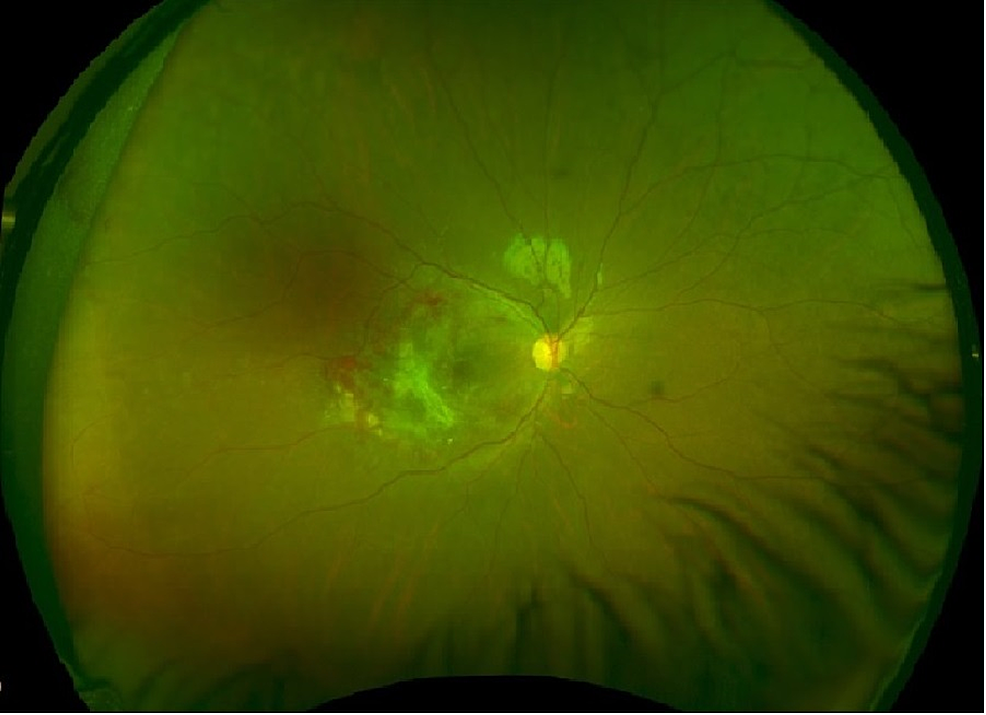
A 40-year-old man presents with problems with his vision. He says he has been experiencing blurred vision and floaters in his left eye for the past few days. He denies any ocular pain, fever, or headaches. Past medical history is significant for HIV infection a few years ago, for which he is noncompliant with his antiretroviral medications and his most recent CD4 count was 100 cells/mm3. His temperature is 36.5°C (97.7°F), the blood pressure is 110/89 mm Hg, the pulse rate is 70/min, and the respiratory rate is 14/min. Ocular exam reveals a decreased vision in the left eye, and a funduscopic examination is shown in the image. The patient is admitted and immediately started on intravenous ganciclovir. A few days after admission he is still complaining of blurry vision and floaters, so he is switched to a different medication. Inhibition of which of the following processes best describes the mechanism of action of the newly added medication?
A 44-year-old man with HIV comes to the physician for a routine follow-up examination. He has been noncompliant with his antiretroviral medication regimen for several years. He appears chronically ill and fatigued. CD4+ T-lymphocyte count is 180/mm³ (N ≥ 500). Further evaluation of this patient is most likely to show which of the following findings?
A 28-year-old G1P0 woman at 16 weeks estimated gestational age presents for prenatal care. Routine prenatal screening tests are performed and reveal a positive HIV antibody test. The patient is extremely concerned about the possible transmission of HIV to her baby and wants to have the baby tested as soon as possible after delivery. Which of the following would be the most appropriate diagnostic test to address this patient’s concern?
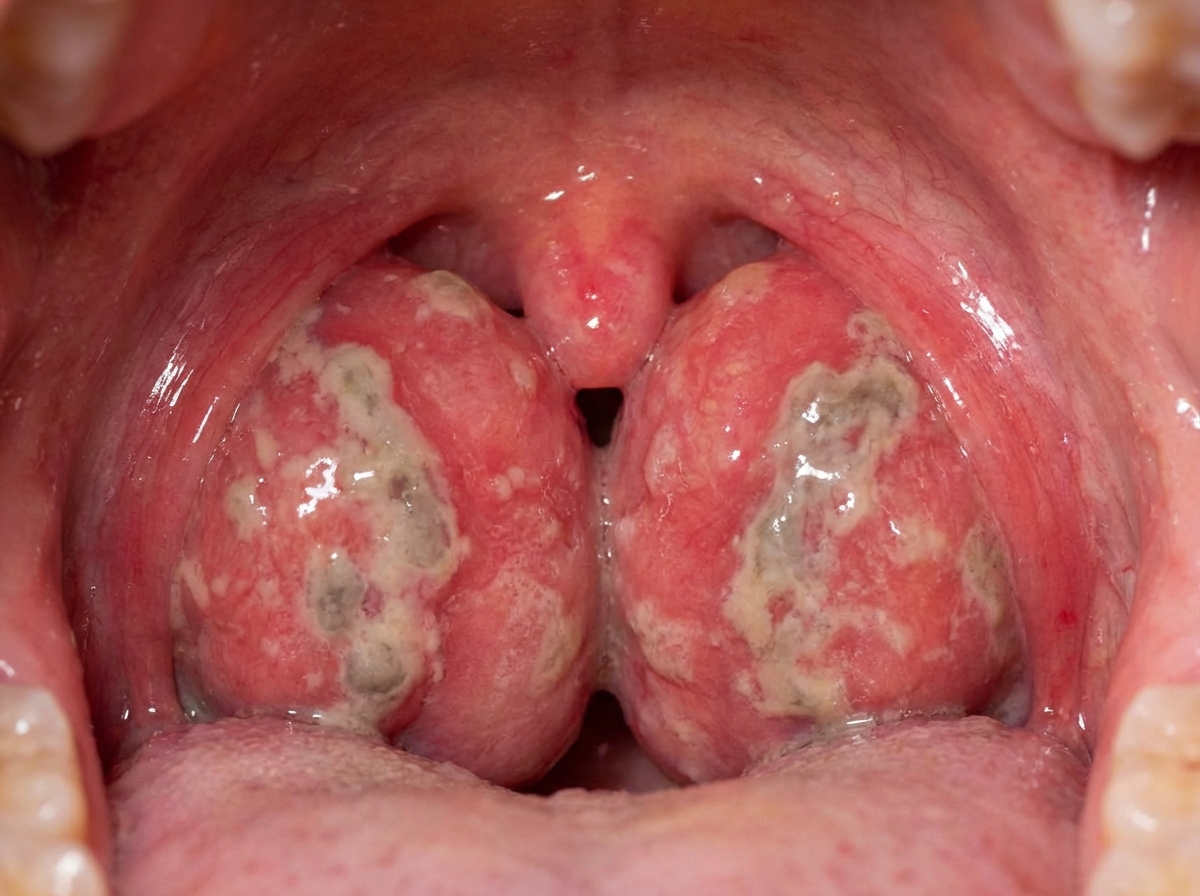
A 19-year-old woman presents to the family medical center with a 2-week history of a sore throat. She says that she has felt increasingly tired during the day and has a difficult time staying awake during her classes at the university. She appears well-nourished with a low energy level. Her vital signs include the following: the heart rate is 82/min, the respiratory rate is 14/min, the temperature is 37.8°C (100.0°F), and the blood pressure is 112/82 mm Hg. Inspection of the pharynx is depicted in the picture. Palpation of the neck reveals posterior cervical lymphadenopathy. The membrane does not bleed upon scraping. What is the most specific finding for detecting the syndrome described in the vignette?
A 35-year-old man comes to the emergency department with fever, chills, dyspnea, and a productive cough. His symptoms began suddenly 2 days ago. He was diagnosed with HIV 4 years ago and has been on triple antiretroviral therapy since then. He smokes one pack of cigarettes daily. He is 181 cm (5 ft 11 in) tall and weighs 70 kg (154 lb); BMI is 21.4 kg/m2. He lives in Illinois and works as a carpenter. His temperature is 38.8°C (101.8°F), pulse is 110/min, respirations are 24/min, and blood pressure is 105/74 mm Hg. Pulse oximetry on room air shows an oxygen saturation of 92%. Examinations reveals crackles over the right lower lung base. The remainder of the examination shows no abnormalities. Laboratory studies show: Hemoglobin 11.5 g/dL Leukocyte count 12,800/mm3 Segmented neutrophils 80% Eosinophils 1% Lymphocytes 17% Monocytes 2% CD4+ T-lymphocytes 520/mm3(N ≥ 500) Platelet count 258,000/mm3 Serum Na+ 137 mEq/L Cl- 102 mEq/L K+ 5.0 mEq/L HCO3- 22 mEq/L Glucose 92 mg/dL An x-ray of the chest shows a right lower-lobe infiltrate of the lung. Which of the following is the most likely causal organism?
A 26-year-old female medical student presents to occupational health after sustaining a needlestick injury. She reports that she was drawing blood from an HIV-positive patient when she stuck herself percutaneously while capping the needle. She immediately washed the puncture wound with betadine. The medical student has a negative HIV serology from the beginning of medical school two years ago. She is monogamous with one male partner and denies any intravenous drug use. The source patient was recently diagnosed with HIV, and has a CD4 count of 550 cells/µL. His most recent viral load is 1,800,000 copies/mL, and he was started on HAART three days ago. Which of the following is the best next step to manage the female medical student’s exposure?
An investigator is studying the mechanism of HIV infection in cells obtained from a human donor. The effect of a drug that impairs viral fusion and entry is being evaluated. This drug acts on a protein that is cleaved off of a larger glycosylated protein in the endoplasmic reticulum of the host cell. The protein that is affected by the drug is most likely encoded by which of the following genes?
Want unlimited practice?
Get full access to all questions, explanations, and performance tracking.
Scan to download app