
HBV serological markers — MCQs

A 23-year-old woman presents with vulvar ulcers and lymphadenopathy. Testing confirms primary HSV infection. Which of the following statements about HSV antibody development is correct?
A 35-year-old male anesthesiologist presents to the occupational health clinic after a needlestick exposure while obtaining an arterial line in a patient with cirrhosis. In addition to a standard bloodborne pathogen laboratory panel sent for all needlestick exposures at his hospital, additional hepatitis panels are ordered upon the patient's request. The patient's results are shown below: HIV 4th generation Ag/Ab: Negative/Negative Hepatitis B surface antigen (HBsAg): Negative Hepatitis C antibody: Negative Anti-hepatitis B surface antibody (HBsAb): Positive Anti-hepatitis B core IgM antibody (HBc IgM): Negative Anti-hepatitis B core IgG antibody (HBc IgG): Positive What is the most likely explanation of the results above?
A 28-year-old man presents to the office with complaints of malaise, anorexia, and vomiting for the past 2 weeks. He also says that his urine is dark. The past medical history is unremarkable. The temperature is 36.8°C (98.2°F), the pulse is 72/min, the blood pressure is 118/63 mm Hg, and the respiratory rate is 15/min. The physical examination reveals a slightly enlarged, tender liver. No edema or spider angiomata are noted. Laboratory testing showed the following: HBsAg Positive IgM anti-HBc < 1:1,000 Anti-HBs Negative HBeAg Positive Anti-HBe Negative HBV DNA 2.65 × 10⁹ IU/L Alpha-fetoprotein 125 ng/mL What is the most likely cause of this patient's condition?
A 26-year-old woman who is a medical student is undergoing evaluation after sticking herself with a needle while drawing blood from a patient. The patient’s medical history is unknown. A blood sample from the medical student is drawn and processed, and the results are presented below: Anti-HAV IgM negative Anti-HAV IgG positive HBsAg negative HBeAg negative Anti-HBs negative Anti-HBc IgG negative Anti-HBc IgM negative Anti-HBe negative Anti-HCV negative What is true about the student’s laboratory findings?
A 25-year-old man presents to the office for a 3-day history of fever and fatigue. Upon further questioning, he says that he also had constant muscular pain, headaches, and fever during these days. He adds additional information by giving a history of regular unprotected sexual relationship with multiple partners. He is a non-smoker and drinks alcohol occasionally. The heart rate is 102/min, respiratory rate is 18/min, temperature is 38.0°C (100.4°F), and blood pressure is 120/80 mm Hg. On physical examination, he is icteric and hepatosplenomegaly is evident with diffuse muscular and abdominal tenderness particularly in the right upper quadrant. The serologic markers show the following pattern: Anti-HAV IgM negative HBsAg positive Anti-HBs negative IgM anti-HBc positive Anti-HCV negative Anti-HDV negative What is the most likely diagnosis?
A 52-year-old male patient with chronic alcoholism presents to an ambulatory medical clinic, where the hepatologist elects to perform comprehensive hepatitis B screening, in addition to several other screening and preventative measures. Given the following choices, which serologic marker, if positive, would indicate the patient’s immunity to the hepatitis B virus?
A 33-year-old female comes to her primary care physician with complaints of fatigue and nausea. She has also noticed that her skin tone is darker than it used to be. On exam, the physician notes that the woman appears to be jaundiced and obtains liver enzymes which demonstrate an elevated AST and ALT. Further testing subsequently confirms the diagnosis of hepatitis B (HBV). The woman is extremely concerned about transmitting this disease to her loved ones and ask how HBV is transmitted. By which of the following routes can HBV be spread? (I) blood, (II) sexual contact, (III) maternal-fetal, and/or (IV) breast milk?
A 35-year-old man with no known past medical history presents to his physician because he is applying for a job as a healthcare worker, which requires screening for the hepatitis B virus (HBV). The patient states that he is in good health and denies any symptoms. His vital signs and physical exam are unremarkable. Labs are drawn, and the patient's HBV serology shows the following: HBsAg: positive anti-HBsAg antibody: negative anti-HBcAg IgM: negative anti-HBcAg IgG: positive HBeAg: negative anti-HBeAg antibody: positive Which of the following best describes this patient's results?
Two viruses, X and Y, infect the same cell and begin to reproduce within the cell. As a result of the co-infection, some viruses are produced where the genome of Y is surrounded by the nucleocapsid of X and vice versa with the genome of X and nucleocapsid of Y. When the virus containing genome X surrounded by the nucleocapsid of Y infects another cell, what is the most likely outcome?
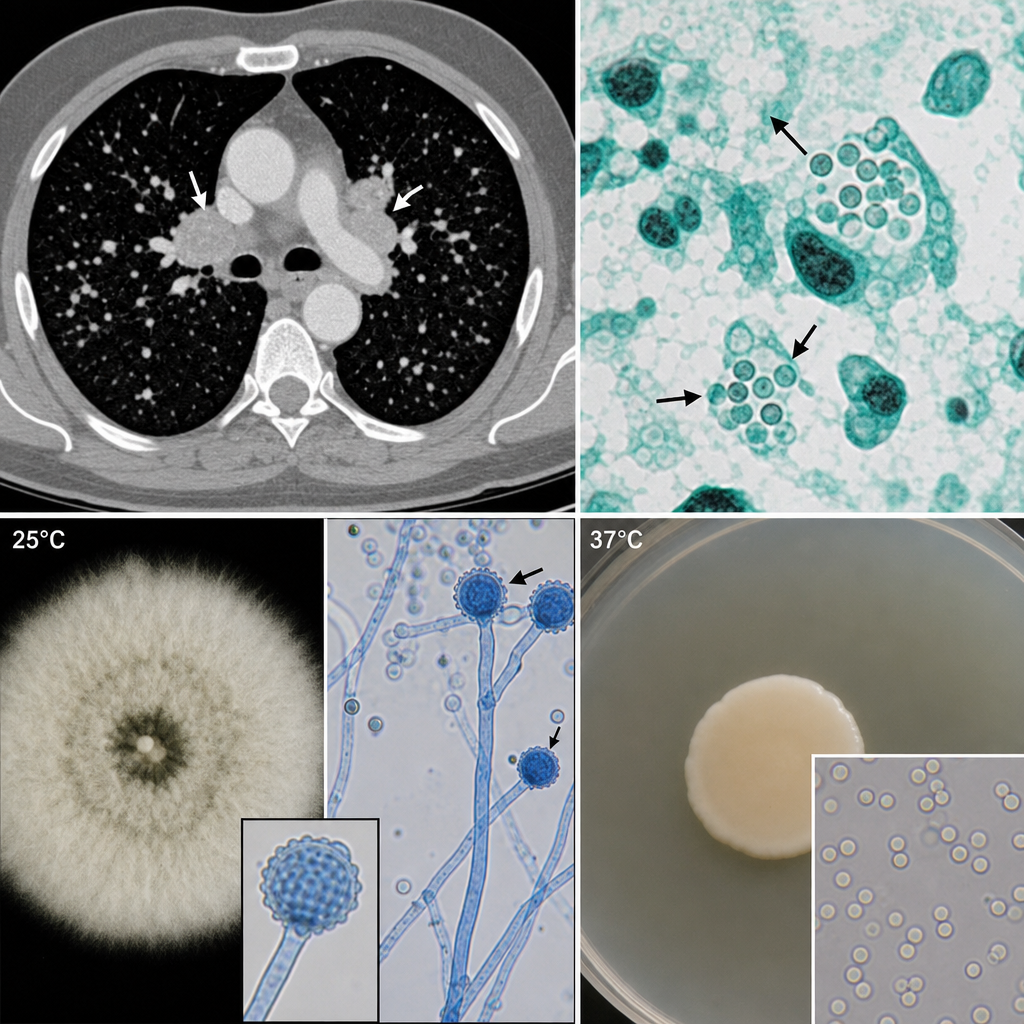
A 45-year-old immunocompetent woman from rural Ohio presents with a 3-week history of low-grade fever, night sweats, and a non-productive cough. She recently helped clean out an old barn near a dried river bed. Chest CT reveals mediastinal lymphadenopathy and multiple small pulmonary nodules. A bronchoalveolar lavage specimen is sent for fungal culture. At 25°C, the organism grows as a mold with tuberculate macroconidia. At 37°C, the same isolate grows as small yeast cells (2–4 µm) found inside macrophages on cytology. A colleague suggests the presentation is more consistent with Blastomyces dermatitidis based on the geographic exposure. Which of the following findings would most definitively argue against the colleague's proposed organism and confirm the correct diagnosis?
Want unlimited practice?
Get full access to all questions, explanations, and performance tracking.
Scan to download app