
Direct-acting antivirals for HCV — MCQs

A 25-year-old sexually active male presents to an internal medicine physician for a routine health check up after having several unprotected sexual encounters. After appropriate testing the physician discusses with the patient that he is HIV+ and must be started on anti-retroviral treatment. Which of the following medications prescribed acts on the gp41 subunit of the HIV envelope glycoprotein?
A 30-year-old woman presents with generalized fatigue, joint pain, and decreased appetite. She says that symptoms onset a year ago and have not improved. The patient’s husband says he has recently noticed that her eyes and skin are yellowish. The patient denies any history of smoking or alcohol use, but she admits to using different kinds of intravenous illicit drugs during her college years. The patient is afebrile and vital signs are within normal limits. Physical examination is unremarkable, except for moderate scleral icterus. A polymerase chain reaction (PCR) of a blood sample is positive for a viral infection that reveals a positive-sense RNA virus, that is small, enveloped, and single-stranded. The patient is started on a drug that resembles a purine RNA nucleotide. She agrees not to get pregnant before or during the use of this medication. Which of the following is the drug that was most likely given to this patient?
A 32-year-old woman comes to the physician because of a 3-month history of fatigue and myalgia. Over the past month, she has had intermittent episodes of nausea. She has a history of intravenous drug use, but she has not used illicit drugs for the past five years. She has smoked one pack of cigarettes daily for 14 years and drinks one alcoholic beverage daily. She takes no medications. Her last visit to a physician was 4 years ago. Her temperature is 37°C (98.6°F), pulse is 90/min, respirations are 20/min, and blood pressure is 110/70 mm Hg. Physical examination shows jaundice and hepatosplenomegaly. There are also blisters and erosions on the dorsum of both hands. The remainder of the examination shows no abnormalities. Laboratory studies show: Hemoglobin 12 g/dL Leukocyte count 8,300/mm3 Platelet count 250,000/mm3 Serum Glucose 170 mg/dL Albumin 3.0 g/dL Total bilirubin 2.2 mg/dL Alkaline phosphatase 80 U/L AST 92 U/L ALT 76 U/L Hepatitis B surface antigen negative Hepatitis B surface antibody positive Hepatitis B core antibody positive Hepatitis C antibody positive Which of the following is the most appropriate next step in diagnosis?
A 52-year-old woman comes to the physician because of abdominal discomfort, anorexia, and mild fatigue. She has systemic lupus erythematosus and takes hydroxychloroquine. She does not drink alcohol or use illicit drugs. Physical examination shows no abnormalities. Laboratory studies show: Alanine aminotransferase 455 U/L Aspartate aminotransferase 205 U/L Hepatitis B surface antigen positive Hepatitis B surface antibody negative Hepatitis B envelope antigen positive Hepatitis B core antigen IgG antibody positive Which of the following is the most appropriate pharmacotherapy for this patient?
An epidemiologist is evaluating the efficacy of Noxbinle in preventing HCC deaths at the population level. A clinical trial shows that over 5 years, the mortality rate from HCC was 25% in the control group and 15% in patients treated with Noxbinle 100 mg daily. Based on this data, how many patients need to be treated with Noxbinle 100 mg to prevent, on average, one death from HCC?
A 45-year-old man presents for follow-up to monitor his chronic hepatitis C treatment. The patient was infected with hepatitis C genotype 1, one year ago. He has been managed on a combination of pegylated interferon-alpha and ribavirin, but a sustained viral response has not been achieved. Past medical history is significant for non-alcoholic fatty liver disease for the last 5 years. Which of the following, if added to the patient’s current treatment regimen, would most likely benefit this patient?
A 57-year-old man comes to the physician because of generalized malaise, yellowish discoloration of the eyes, and pruritus on the back of his hands that worsens when exposed to sunlight for the past several months. He has not seen a physician in 15 years. Physical examination shows scleral icterus and mild jaundice. There is a purpuric rash with several small vesicles and hyperpigmented lesions on the dorsum of both hands. The causal pathogen of this patient's underlying condition was most likely acquired in which of the following ways?
A 6-year-old female from a rural village in Afghanistan presents with her mother to a local health center complaining of leg weakness. Her mother also reports that the patient had a fever, fatigue, and headache a week prior that resolved. The patient has not received any immunizations since being born. Her temperature is 98.6°F (37°C), blood pressure is 110/70 mmHg, pulse is 90/min, and respirations are 18/min. Physical examination reveals 1/5 strength in right hip and knee actions and 0/5 strength in left hip and knee actions. Tone is notably decreased in both lower extremities. Sensation to touch, temperature, and vibration is intact. Patellar and Achilles reflexes are absent bilaterally. The most likely cause of this patient’s condition has which of the following characteristics?
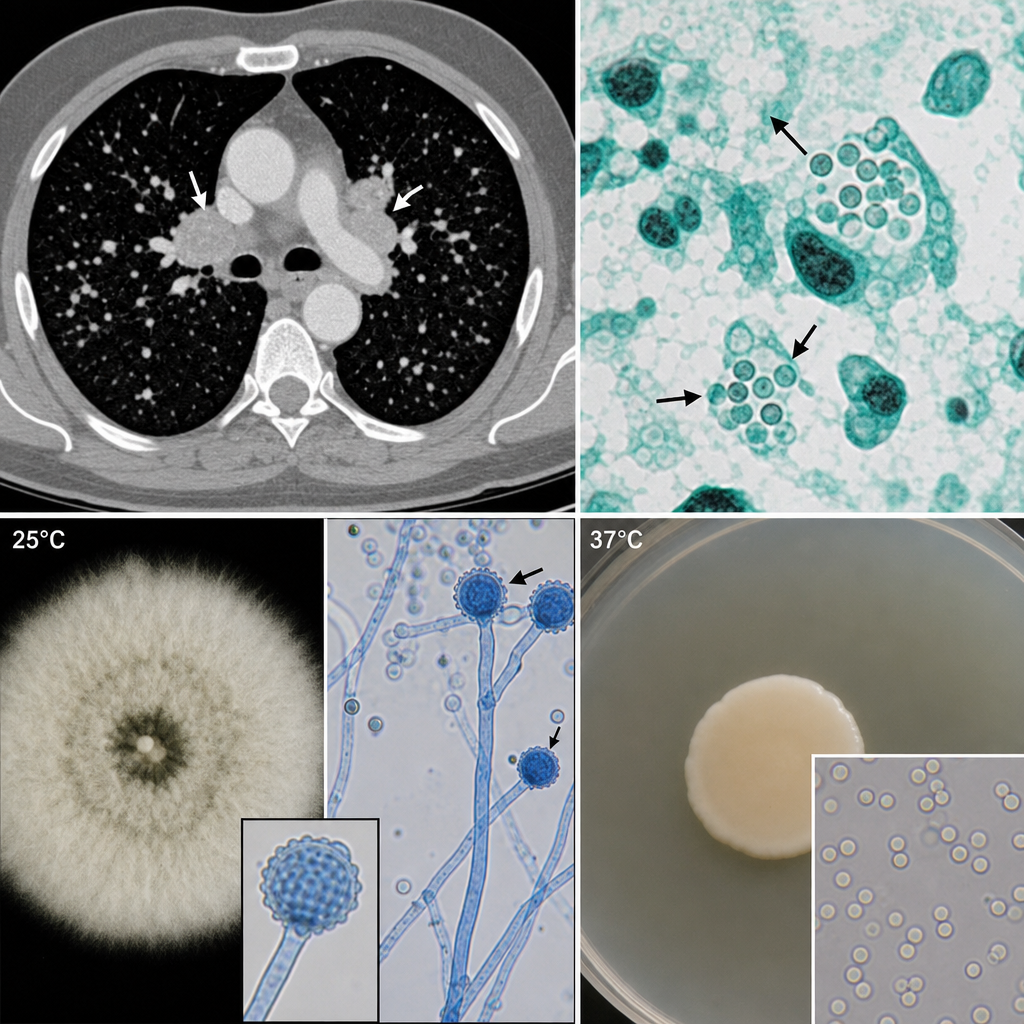
A 45-year-old immunocompetent woman from rural Ohio presents with a 3-week history of low-grade fever, night sweats, and a non-productive cough. She recently helped clean out an old barn near a dried river bed. Chest CT reveals mediastinal lymphadenopathy and multiple small pulmonary nodules. A bronchoalveolar lavage specimen is sent for fungal culture. At 25°C, the organism grows as a mold with tuberculate macroconidia. At 37°C, the same isolate grows as small yeast cells (2–4 µm) found inside macrophages on cytology. A colleague suggests the presentation is more consistent with Blastomyces dermatitidis based on the geographic exposure. Which of the following findings would most definitively argue against the colleague's proposed organism and confirm the correct diagnosis?
A group of researchers conducted various studies on hepatitis C incidence and prevalence. They noticed that there is a high prevalence of hepatitis C in third-world countries, where it has a significant impact on the quality of life of the infected individual. The research group made several attempts to produce a vaccine that prevents hepatitis C infection but all attempts failed. Which of the following would most likely be the reason for the failure to produce a vaccine?
Want unlimited practice?
Get full access to all questions, explanations, and performance tracking.
Scan to download app