
Acute hepatitis B — MCQs

A 29-year-old man comes to the physician for a routine health maintenance examination. He feels well. He works as a nurse at a local hospital in the city. Three days ago, he had a needlestick injury from a patient whose serology is positive for hepatitis B. He completed the 3-dose regimen of the hepatitis B vaccine 2 years ago. His other immunizations are up-to-date. He appears healthy. Physical examination shows no abnormalities. He is concerned about his risk of being infected with hepatitis B following his needlestick injury. Serum studies show negative results for hepatitis B surface antigen, hepatitis B surface antibody, and hepatitis C antibody. Which of the following is the most appropriate next step in management?
Two months after giving birth to a boy, a 27-year-old woman comes to the physician with her infant for a well-child examination. She was not seen by a physician during her pregnancy. Physical examination of the mother and the boy shows no abnormalities. Laboratory studies show elevated titers of hepatitis B surface antigen in both the mother and the boy. Which of the following statements regarding the infant's condition is most accurate?
A 28-year-old man presents to the office with complaints of malaise, anorexia, and vomiting for the past 2 weeks. He also says that his urine is dark. The past medical history is unremarkable. The temperature is 36.8°C (98.2°F), the pulse is 72/min, the blood pressure is 118/63 mm Hg, and the respiratory rate is 15/min. The physical examination reveals a slightly enlarged, tender liver. No edema or spider angiomata are noted. Laboratory testing showed the following: HBsAg Positive IgM anti-HBc < 1:1,000 Anti-HBs Negative HBeAg Positive Anti-HBe Negative HBV DNA 2.65 × 10⁹ IU/L Alpha-fetoprotein 125 ng/mL What is the most likely cause of this patient's condition?
A 27-year-old woman who recently emigrated from Brazil comes to the physician because of fever, fatigue, decreased appetite, and mild abdominal discomfort. She has not seen a physician in several years and her immunization status is unknown. She drinks 2 alcoholic beverages on the weekends and does not use illicit drugs. She is sexually active with several male partners and uses condoms inconsistently. Her temperature is 38°C (99.8°F). Physical examination shows right upper quadrant tenderness and scleral icterus. Serology confirms acute infection with a virus that has partially double-stranded, circular DNA. Which of the following is most likely involved in the replication cycle of this virus?
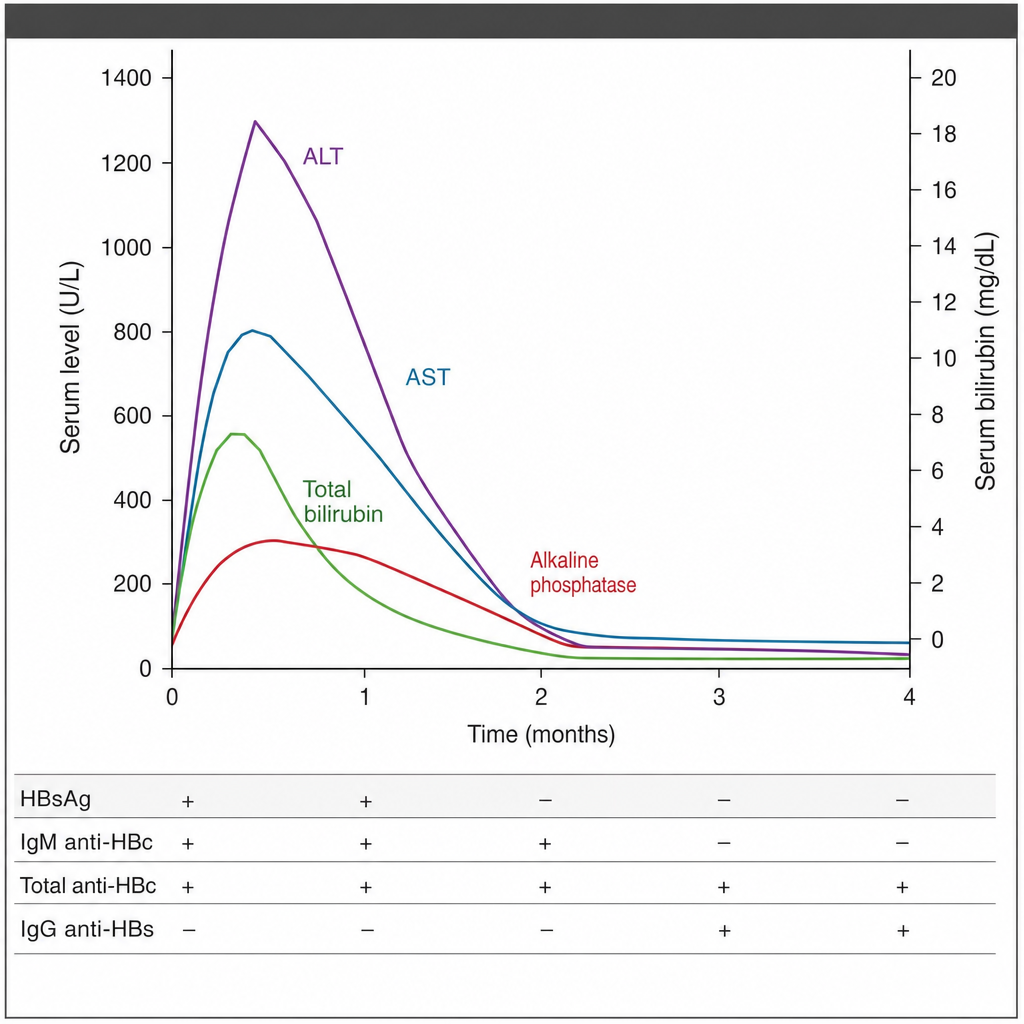
A 37-year-old man comes to the physician because of a 3-day history of fatigue and yellowish discoloration of his eyes and skin. Physical examination shows mild right upper quadrant abdominal tenderness. The course of different serum parameters over the following 4 months is shown. Which of the following is the most likely explanation for the course of this patient's laboratory findings?
A 3255-g (7-lb) female newborn is delivered at term. Pregnancy and delivery were uncomplicated. On the day of her birth, she is given a routine childhood vaccine that contains a noninfectious glycoprotein. This vaccine will most likely help prevent infection by which of the following pathogens?
A scientist is studying the replication sequences of a number of different viruses. He observes that one particular virus he is studying creates a single stranded DNA from an RNA template during its replication sequence. Which of the following viruses is he most likely observing?
A 52-year-old female presents to her primary care physician for medical evaluation prior to an elective hip replacement surgery. She has hypertension and diabetes, both of which are well controlled on oral medications. She also admits to occasional use of recreational injection drugs so a panel of serologies are obtained. Based on the results, the patient is found to have had a previous infection with hepatitis B from which she has fully recovered. Which of the following is a characteristic of the immunoglobulin subtype that most likely binds to hepatitis B core antigen in this patient?
A 33-year-old female comes to her primary care physician with complaints of fatigue and nausea. She has also noticed that her skin tone is darker than it used to be. On exam, the physician notes that the woman appears to be jaundiced and obtains liver enzymes which demonstrate an elevated AST and ALT. Further testing subsequently confirms the diagnosis of hepatitis B (HBV). The woman is extremely concerned about transmitting this disease to her loved ones and ask how HBV is transmitted. By which of the following routes can HBV be spread? (I) blood, (II) sexual contact, (III) maternal-fetal, and/or (IV) breast milk?
A 52-year-old male patient with chronic alcoholism presents to an ambulatory medical clinic, where the hepatologist elects to perform comprehensive hepatitis B screening, in addition to several other screening and preventative measures. Given the following choices, which serologic marker, if positive, would indicate the patient’s immunity to the hepatitis B virus?
Want unlimited practice?
Get full access to all questions, explanations, and performance tracking.
Scan to download app