
Streptococcus pneumoniae — MCQs

A 51-year-old man comes to the physician because of a 4-day history of fever and cough productive of foul-smelling, dark red, gelatinous sputum. He has smoked 1 pack of cigarettes daily for 30 years and drinks two 12-oz bottles of beer daily. An x-ray of the chest shows a cavity with air-fluid levels in the right lower lobe. Sputum culture grows gram-negative rods. Which of the following virulence factors is most likely involved in the pathogenesis of this patient's condition?
A 60-year-old man presents with fever and cough productive of rust-colored sputum and is diagnosed with community acquired pneumonia. The causative organism is isolated, and a Gram stain is shown in Figure 1. Which of the following most correctly describes additional features of the most likely causative organism?
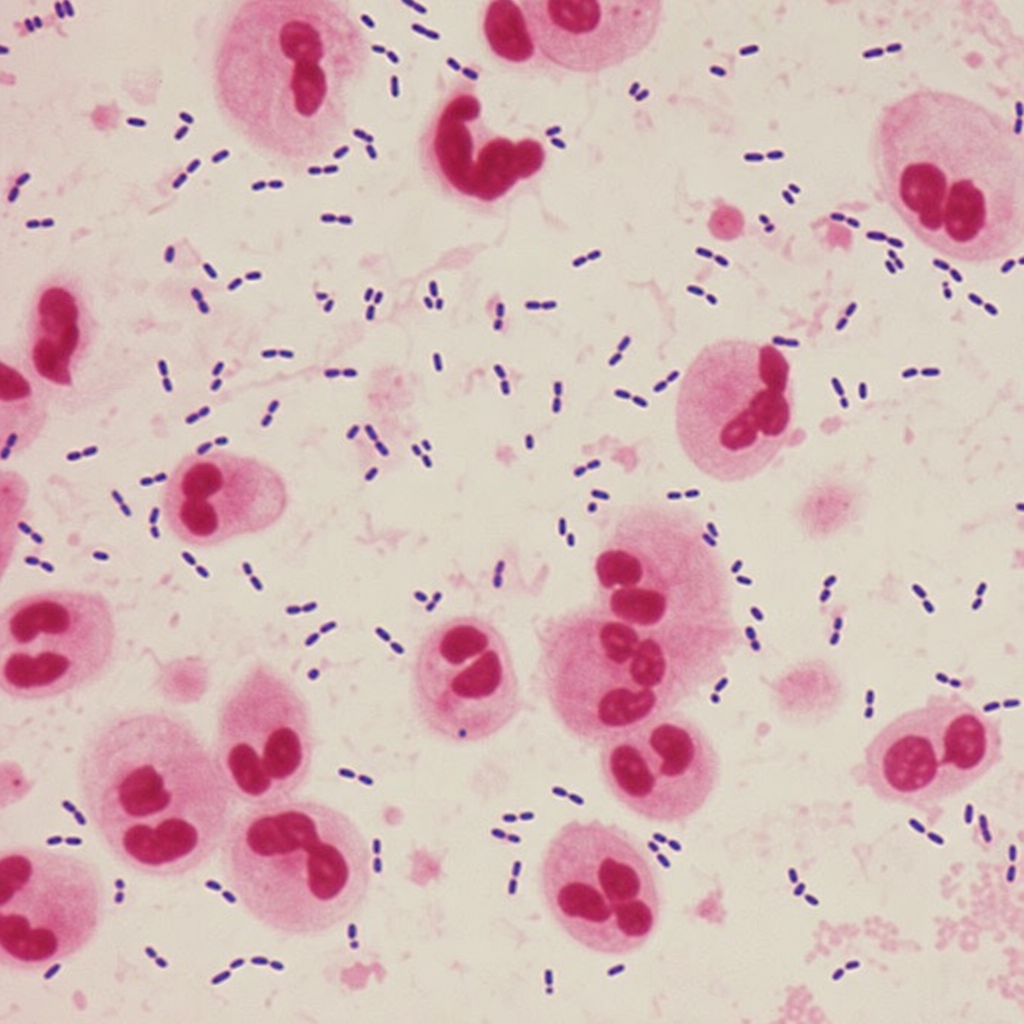
A 2-year-old boy is brought in by his parents to his pediatrician. The boy was born by spontaneous vaginal delivery at 39 weeks and 5 days after a normal pregnancy. The boy has received all age-appropriate vaccinations as of his last visit at 18 months of age. Of note, the boy has confirmed sickle cell disease and the only medication he takes is penicillin prophylaxis. The parents state that they plan on enrolling their son in a daycare, which requires documentation of up-to-date vaccinations. The pediatrician states that their son needs an additional vaccination at this visit, which is a polysaccharide vaccine that is not conjugated to protein. Which of the following matches this description?
A 40-year-old man presents to the office complaining of chills, fever, and productive cough for the past 24 hours. He has a history of smoking since he was 18 years old. His vitals are: heart rate of 85/min, respiratory rate of 20/min, temperature 39.0°C (102.2°F), blood pressure 110/70 mm Hg. On physical examination, there is dullness on percussion on the upper right lobe, as well as bronchial breath sounds and egophony. The plain radiograph reveals an increase in density with an alveolar pattern in the upper right lobe. Which one is the most common etiologic agent of the suspected disease?
You are treating a neonate with meningitis using ampicillin and a second antibiotic, X, that is known to cause ototoxicity. What is the mechanism of antibiotic X?
A 44-year-old woman with type 2 diabetes mellitus comes to the physician with a 3-day history of fever, right calf pain, and swelling. Her temperature is 38.7°C (101.7°F). Physical examination shows a 5 x 6-cm erythematous, warm, raised skin lesion with well-defined margins over the right upper posterior calf. The organism isolated from the lesion forms large mucoid colonies on blood agar. Further evaluation shows that the organism has a thick hyaluronic acid capsule. The causal organism of this patient's condition is most likely to have which of the following additional characteristics?
A 71-year-old woman presents with high-grade fever and chills, difficulty breathing, and a productive cough with rust-colored sputum. She complains of a sharp left-sided chest pain. Physical examination reveals increased fremitus, dullness to percussion, and bronchial breath sounds on the lower left side. A chest X-ray shows left lower lobe consolidation. The offending organism that was cultured from the sputum was catalase-negative and had a positive Quellung reaction. The organism will show which gram stain results?
A 46-year-old woman presents to her primary care physician with complaints of increasing left upper quadrant discomfort. She has a known history of type 1 Gaucher disease. On physical examination, her spleen is palpable 8 cm below the costal margin. Routine laboratory work reveals severe pancytopenia. After consultation with the patient on the risks of her condition, the patient decides to undergo a splenectomy. Which of the following is more likely to occur as a consequence of splenectomy in this patient?
A 6-year-old boy and his parents present to the emergency department with high-grade fever, headache, and projectile vomiting. The boy was born at 39 weeks gestation via spontaneous vaginal delivery. He is up to date on all vaccines and is meeting all developmental milestones. Past medical history is noncontributory. He has had no sick contacts at school or at home. The family has not traveled out of the area recently. He likes school and playing videogames with his younger brother. Today, his blood pressure is 115/76 mm Hg, heart rate is 110/min, respiratory rate is 22/min, and temperature is 38.4°C (101.2°F). On physical exam, the child is disoriented. Kernig’s sign is positive. A head CT was performed followed by a lumbar puncture. Several aliquots of CSF were distributed throughout the lab. Cytology showed high counts of polymorphs, biochemistry showed low glucose and elevated protein levels, and a gram smear shows gram-positive lanceolate-shaped cocci alone and in pairs. A smear is prepared on blood agar in an aerobic environment and grows mucoid colonies with clearly defined edges and alpha hemolysis. On later evaluation they develop a ‘draughtsman’ appearance. Which one of the following is the most likely pathogen?
A 35-year-old man comes to the emergency department with fever, chills, dyspnea, and a productive cough. His symptoms began suddenly 2 days ago. He was diagnosed with HIV 4 years ago and has been on triple antiretroviral therapy since then. He smokes one pack of cigarettes daily. He is 181 cm (5 ft 11 in) tall and weighs 70 kg (154 lb); BMI is 21.4 kg/m2. He lives in Illinois and works as a carpenter. His temperature is 38.8°C (101.8°F), pulse is 110/min, respirations are 24/min, and blood pressure is 105/74 mm Hg. Pulse oximetry on room air shows an oxygen saturation of 92%. Examinations reveals crackles over the right lower lung base. The remainder of the examination shows no abnormalities. Laboratory studies show: Hemoglobin 11.5 g/dL Leukocyte count 12,800/mm3 Segmented neutrophils 80% Eosinophils 1% Lymphocytes 17% Monocytes 2% CD4+ T-lymphocytes 520/mm3(N ≥ 500) Platelet count 258,000/mm3 Serum Na+ 137 mEq/L Cl- 102 mEq/L K+ 5.0 mEq/L HCO3- 22 mEq/L Glucose 92 mg/dL An x-ray of the chest shows a right lower-lobe infiltrate of the lung. Which of the following is the most likely causal organism?
Want unlimited practice?
Get full access to all questions, explanations, and performance tracking.
Scan to download app