
MRSA and VRE — MCQs

A 33-year-old man presents to the emergency department complaining of weakness and fatigue. He states that his symptoms have worsened over the past day. He has a past medical history of IV drug abuse and alcoholism and he currently smells of alcohol. His temperature is 102°F (38.9°C), blood pressure is 111/68 mmHg, pulse is 110/min, respirations are 17/min, and oxygen saturation is 98% on room air. Physical exam is notable for focal tenderness over the lumbar spine. Initial lab values and blood cultures are drawn and are notable for leukocytosis and an elevated C-reactive protein (CRP). Which of the following is the best treatment for this patient?
A 42-year-old homeless man presents to the emergency department complaining of pain in his right knee and fever. The patient is having difficulty walking and looks visibly uncomfortable. On examination, he is disheveled but his behavior is not erratic. The patient’s right knee is erythematous, edematous, and warm, with evidence of a 3 cm wound that is weeping purulent fluid. The patient has a decreased range of motion secondary to pain and swelling. The wound is cultured and empiric antibiotic therapy is initiated. Four minutes into the patient’s antibiotic therapy, he develops a red, pruritic rash on his face and neck. What is the most likely antibiotic this patient is being treated with?
A 77-year-old woman is brought to the emergency department from her nursing home because she was found down overnight. On presentation she was found to be delirious and was unable to answer questions. Chart review shows that she is allergic to cephalosporins. Her temperature is 102.2°F (39°C), blood pressure is 105/52 mmHg, pulse is 94/min, and respirations are 23/min. Physical exam reveals a productive cough. A metabolic panel is obtained with the following results: Serum: Na+: 135 mEq/L Cl-: 95 mEq/L K+: 4 mEq/L HCO3-: 19 mEq/L BUN: 40 mg/dL Creatinine: 2.5 mg/dL Glucose: 150 mg/dL Based on these findings two different drugs are started empirically. Gram stain on a blood sample is performed showing the presence of gram-positive organisms on all samples. One of the drugs is subsequently stopped. The drug that was most likely stopped has which of the following characteristics?
A 31-year-old female with a bacterial infection is prescribed a drug that binds the dipeptide D-Ala-D-Ala. Which of the following drugs was this patient prescribed?
A 64-year-old female with type 2 diabetes mellitus comes to the physician because of a 1-week history of painful red swelling on her left thigh. Examination shows a 3- x 4-cm, tender, fluctuant mass. Incision and drainage of the abscess are performed. Culture of the abscess fluid grows gram-positive, coagulase-positive cocci that are resistant to oxacillin. Which of the following best describes the mechanism of resistance of the causal organism to oxacillin?
A scientist is studying the mechanisms by which bacteria become resistant to antibiotics. She begins by obtaining a culture of vancomycin-resistant Enterococcus faecalis and conducts replicate plating experiments. In these experiments, colonies are inoculated onto a membrane and smeared on 2 separate plates, 1 containing vancomycin and the other with no antibiotics. She finds that all of the bacterial colonies are vancomycin resistant because they grow on both plates. She then maintains the bacteria in liquid culture without vancomycin while she performs her other studies. Fifteen generations of bacteria later, she conducts replicate plating experiments again and finds that 20% of the colonies are now sensitive to vancomycin. Which of the following mechanisms is the most likely explanation for why these colonies have become vancomycin sensitive?
A 27-year-old man presents to the emergency department with weakness and a fever for the past week. The patient is homeless and has a past medical history of alcohol and IV drug abuse. His temperature is 102°F (38.9°C), blood pressure is 107/68 mmHg, pulse is 120/min, respirations are 17/min, and oxygen saturation is 98% on room air. Physical exam is notable for a tremulous patient with antecubital scars and a murmur over the left lower sternal border. Blood cultures are drawn and the patient is started on vancomycin and ceftriaxone and is admitted to the ICU. The patient's fever and symptoms do not improve despite antibiotic therapy for which the initial identified organism is susceptible. Cultures currently reveal MRSA as one of the infective organisms. Which of the following is the best next step in management?
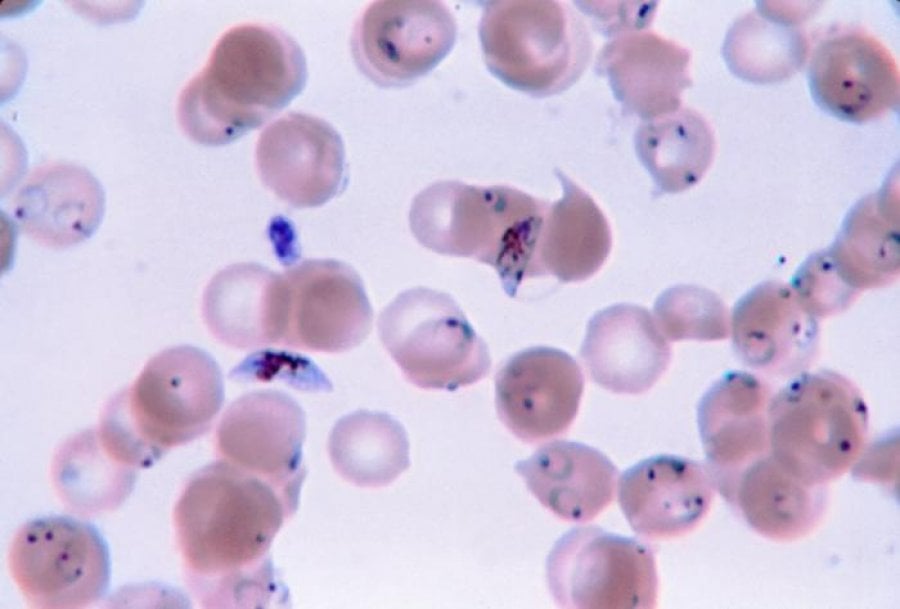
A 46-year-old man comes to the physician because of a 1-week history of headache, muscle pain, and recurrent fever spikes that occur without a noticeable rhythm. Two weeks ago, he returned from a 5-week-long world trip during which he climbed several mountains in India, Africa, and Appalachia. Chemoprophylaxis with chloroquine was initiated one week prior to the trip. Physical examination shows jaundice. The spleen is palpated 2 cm below the left costal margin. His hemoglobin concentration is 10 g/dL. A photomicrograph of a peripheral blood smear is shown. Which of the following agents is the most likely cause of this patient's findings?
An 11-year-old boy presents with a sore throat, fever, chills, and difficulty swallowing for the past 3 days. The patient’s mother says that last night he was short of breath and had a headache. Past medical history is unremarkable. The patient has not been vaccinated as his mother thinks it is "unnecessary". His temperature is 38.3°C (101.0°F), blood pressure is 120/70 mm Hg, pulse is 110/min, and respiratory rate is 18/min. On physical examination, the patient is ill-appearing and dehydrated. A grayish-white membrane and pharyngeal erythema are present in the oropharynx. Significant cervical lymphadenopathy is also present. A throat swab is taken and gram staining shows gram-positive club-shaped bacilli along with few neutrophils. Which of the following would most likely be the result of the bacterial culture of the throat swab in this patient?
A 24-hour-old newborn presents to the emergency department after a home birth because of fever, irritability alternating with lethargy, and poor feeding. The patient’s mother says symptoms acutely onset 12 hours ago and have not improved. No significant past medical history. His mother did not receive any prenatal care, and she had rupture of membranes 20 hours prior to delivery. His vital signs include: heart rate 150/min, respiratory rate 65/min, temperature 39.0°C (102.2°F), and blood pressure 60/40 mm Hg. On physical examination, the patient has delayed capillary refill. Laboratory studies show a pleocytosis and a low glucose level in the patient’s cerebrospinal fluid. Which of the following is the most likely causative organism for this patient’s condition?
Want unlimited practice?
Get full access to all questions, explanations, and performance tracking.
Scan to download app