
Clostridium species — MCQs

A 59-year-old woman comes to the emergency department because of abdominal pain and bloody diarrhea that began 12 hours ago. Three days ago, she ate undercooked chicken at a local restaurant. Blood cultures grow spiral and comma-shaped, oxidase-positive organisms at 42°C. This patient is at greatest risk for which of the following complications?
A 26-year-old man with no past medical history is brought in to the trauma bay by ambulance after sustaining a motorcycle crash against a parked car. The patient is alert and oriented with no focal neurologic defects. The patient has a few lower extremity abrasions but is otherwise healthy and is discharged. One week later, the patient returns to the emergency department with a 2-day history of high fevers and redness on his left lower leg. On exam, his temperature is 102.0°F (38.9°C), blood pressure is 70/44 mmHg, pulse is 108/min, and respirations are 14/min. The patient appears toxic, and his left lower leg is tense, erythematous, and tender to palpation between the ankle and the knee. The exam is notable for tense bullae developing on the lateral calf. Palpation near the bullae is notable for crepitus. Which of the following toxins is likely responsible for this finding?
A 20-week-old infant is brought to an urgent care clinic by her mother because she has not been eating well for the past 2 days. The mother said her daughter has also been "floppy" since yesterday morning and has been unable to move or open her eyes since the afternoon of the same day. The child has recently started solid foods, like cereals sweetened with honey. There is no history of loose, watery stools. On examination, the child is lethargic with lax muscle tone. She does not have a fever or apparent respiratory distress. What is the most likely mode of transmission of the pathogen responsible for this patient’s condition?
A 9-month-old baby boy is brought to his pediatrician due to poor feeding and fewer bowel movements. His father notes that he has been less active and is having difficulty with movements such as rolling over. Vital signs are normal, and physical exam is notable for weak sucking reflex, ptosis, and decreased eye movements. In addition, the baby has generalized weakness and flushed skin. Stool samples are collected, treatment is started immediately, and the baby’s condition improves. The results of the stool studies return several days later and show gram-positive, anaerobic rods. The toxin most likely responsible for this baby’s condition acts through which mechanism?
An otherwise healthy 7-year-old boy is brought to the emergency department because of a 1-day history of involuntary muscle contractions and pain in his back and neck. Two weeks ago, he fell while playing in the sandbox and scraped both his knees. He has not received any vaccinations since birth. His temperature is 38.5°C (101.3°F). He is diaphoretic. Examination shows inability to open his mouth beyond 1 cm. There is hyperextension of the lumbar spine and resistance to neck flexion. Administration of which of the following would most likely have prevented this patient's current condition?
A 47-year-old man comes to the physician because of abdominal pain and foul-smelling, watery diarrhea for several days. He has not had nausea, vomiting, or blood in the stool. He has a history of alcohol use disorder and recently completed a 7-day course of clindamycin for pneumonia. He has not traveled out of the United States. Which of the following toxins is most likely to be involved in the pathogenesis of this patient's symptoms?
A 55-year-old man presents to the physician with complaints of 5 days of watery diarrhea, fever, and bloating. He has not noticed any blood in his stool. He states that his diet has not changed recently, and his family has been spared from diarrhea symptoms despite eating the same foods that he has been cooking at home. He has no history of recent travel outside the United States. His only medication is high-dose omeprazole, which he has been taking daily for the past few months to alleviate his gastroesophageal reflux disease (GERD). Which of the following is the most appropriate initial test to work up this patient’s symptoms?
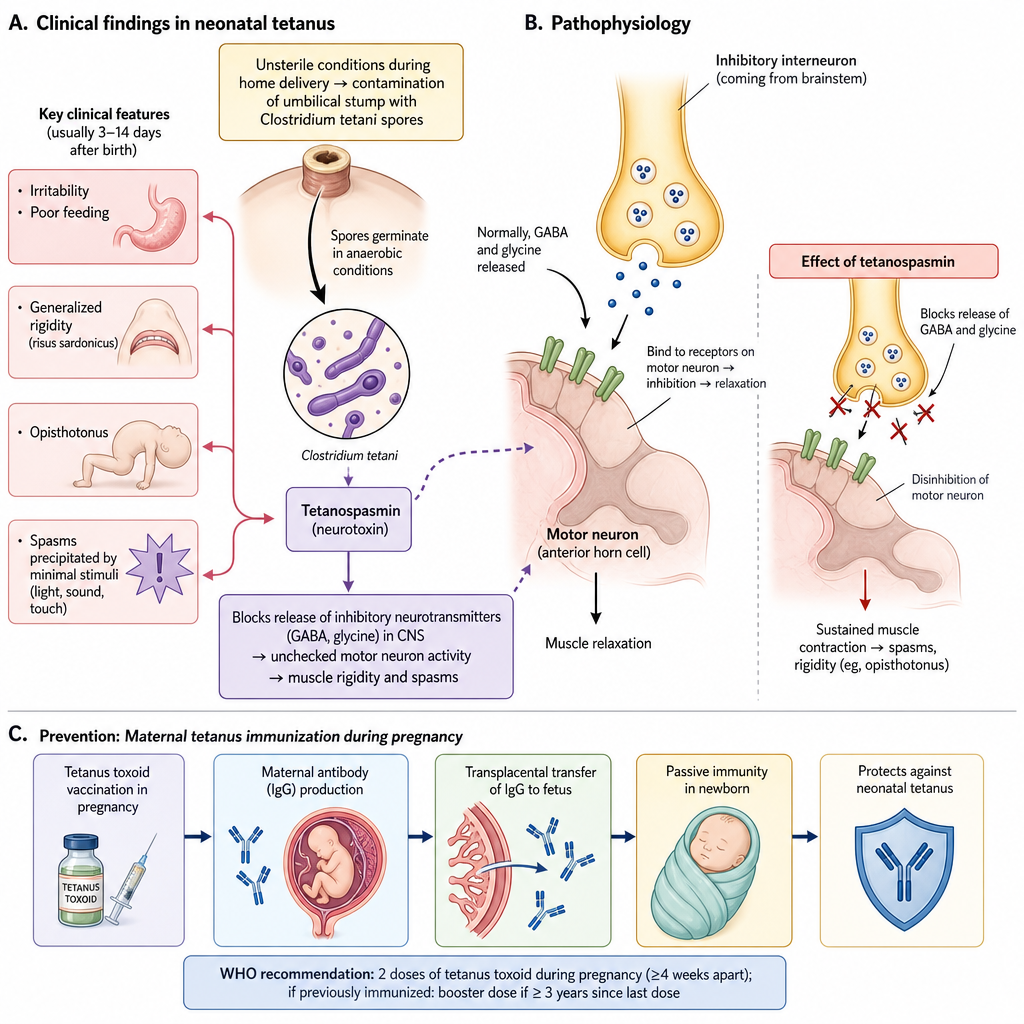
A one-week-old boy is brought to the emergency department by his mother, who recently immigrated to the United States and does not have health insurance. He was born at home, and has not received any medical care since birth. The mother states the boy has become irritable and has been feeding poorly. In the last day, she said he seems "stiff" and is having apparent muscle spasms. On your exam, you note the findings in figure A. Which of the following interventions might have prevented this disease?
A 48-year-old woman comes to the physician for a follow-up examination. Six months ago, she was diagnosed with overactive bladder syndrome and began treatment with oxybutynin. She continues to have involuntary loss of urine with sudden episodes of significant bladder discomfort that is only relieved by voiding. A substance is injected into the detrusor muscle to treat her symptoms. The physician informs the patient that she will have transitory relief for several months before symptoms return and will require repeated treatment. The injected substance is most likely produced by an organism with which of the following microbiological properties?
A 24-year-old college student consumed a container of canned vegetables for dinner. Fourteen hours later, he presents to the E.R. complaining of difficulty swallowing and double-vision. The bacterium leading to these symptoms is:
Want unlimited practice?
Get full access to all questions, explanations, and performance tracking.
Scan to download app