
Escherichia coli — MCQs

A 24-year-old man presents to the emergency department for bloody stools. The patient states that he has had bloody diarrhea for the past 3 days without improvement. He recently returned from a camping trip where he drank stream water and admits to eating undercooked meats which included beef, chicken, pork, and salmon. The patient's father died at age 40 due to colon cancer, and his mother died of breast cancer at the age of 52. The patient lives alone and drinks socially. The patient has unprotected sex with multiple male partners. His temperature is 98.3°F (36.8°C), blood pressure is 107/58 mmHg, pulse is 127/min, respirations are 12/min, and oxygen saturation is 99% on room air. Laboratory values are ordered as seen below. Hemoglobin: 9.2 g/dL Hematocrit: 29% Leukocyte count: 9,500/mm^3 with normal differential Platelet count: 87,000/mm^3 Lactate dehydrogenase: 327 IU/L Haptoglobin: 5 mg/dL Serum: Na+: 139 mEq/L Cl-: 100 mEq/L K+: 5.9 mEq/L HCO3-: 19 mEq/L BUN: 39 mg/dL Glucose: 99 mg/dL Creatinine: 1.1 mg/dL Ca2+: 10.2 mg/dL Which of the following is the most likely cause of this patient's presentation?
A 34-year-old, previously healthy woman is admitted to the hospital with abdominal pain and bloody diarrhea. She reports consuming undercooked beef a day before the onset of her symptoms. Her medical history is unremarkable. Vital signs include: blood pressure 100/70 mm Hg, pulse rate 70/min, respiratory rate 16/min, and temperature 36.6℃ (97.9℉). Physical examination shows paleness, face and leg edema, and abdominal tenderness in the lower right quadrant. Laboratory investigation shows the following findings: Erythrocytes 3 x 10⁶/mm3 Hemoglobin 9.4 g/dL Hematocrit 0.45 (45%) Corrected reticulocyte count 5.5% Platelet count 18,000/mm3 Leukocytes 11,750/mm3 Total bilirubin 2.33 mg/dL (39.8 µmol/L) Direct bilirubin 0.2 mg/dL (3.4 µmol/L) Serum creatinine 4.5 mg/dL (397.8 µmol/L) Blood urea nitrogen 35.4 mg/dL (12.6 mmol/L) E. coli O157: H7 was identified in the patient’s stool. Which toxin is likely responsible for her symptoms?
A 25-year-old woman has dysuria, pyuria, increased frequency of urination, and fever of 1-day duration. She is sexually active. Urine cultures show gram-positive bacteria in clusters that are catalase-positive and coagulase-negative. The patient is started on trimethoprim-sulfamethoxazole. Which of the following characteristics is used to identify the offending organism?
A 32-year-old man presents with a history of diarrhea several days after eating a hot dog at a neighborhood barbeque. He notes that the diarrhea is visibly bloody, but he has not experienced a fever. He adds that several other people from his neighborhood had similar complaints, many of which required hospitalization after eating food at the same barbeque. His temperature is 37°C (98.6°F ), respiratory rate is 16/min, pulse is 77/min, and blood pressure is 100/88 mm Hg. A physical examination is performed and is within normal limits. Blood is drawn for laboratory testing. The results are as follows: Hb%: 12 gm/dL Total count (WBC): 13,100/mm3 Differential count: Neutrophils: 80% Lymphocytes: 15% Monocytes: 5% ESR: 10 mm/hr Glucose, Serum: 90 mg/dL BUN: 21 mg/dL Creatinine, Serum: 1.96 mg/dL Sodium, Serum: 138 mmol/L Potassium, Serum: 5.2 mmol/L Chloride, Serum: 103 mmol/L Bilirubin, Total: 2.5 mg/dL Alkaline Phosphatase, Serum: 66 IU/L Aspartate aminotransferase (AST): 32 IU/L Alanine aminotransferase (ALT): 34 IU/L Urinalysis is normal except for RBC casts. What is the most concerning possible complication?
A 3-day-old boy is brought to the physician by his mother because of irritability and feeding intolerance for 1 day. His temperature is 39.2°C (102.6°F). Physical examination shows a bulging anterior fontanelle. A photomicrograph of a Gram stain of the cerebrospinal fluid is shown. Further evaluation shows that the organism expresses the K1 capsular polysaccharide. Which of the following is the most likely causal pathogen?
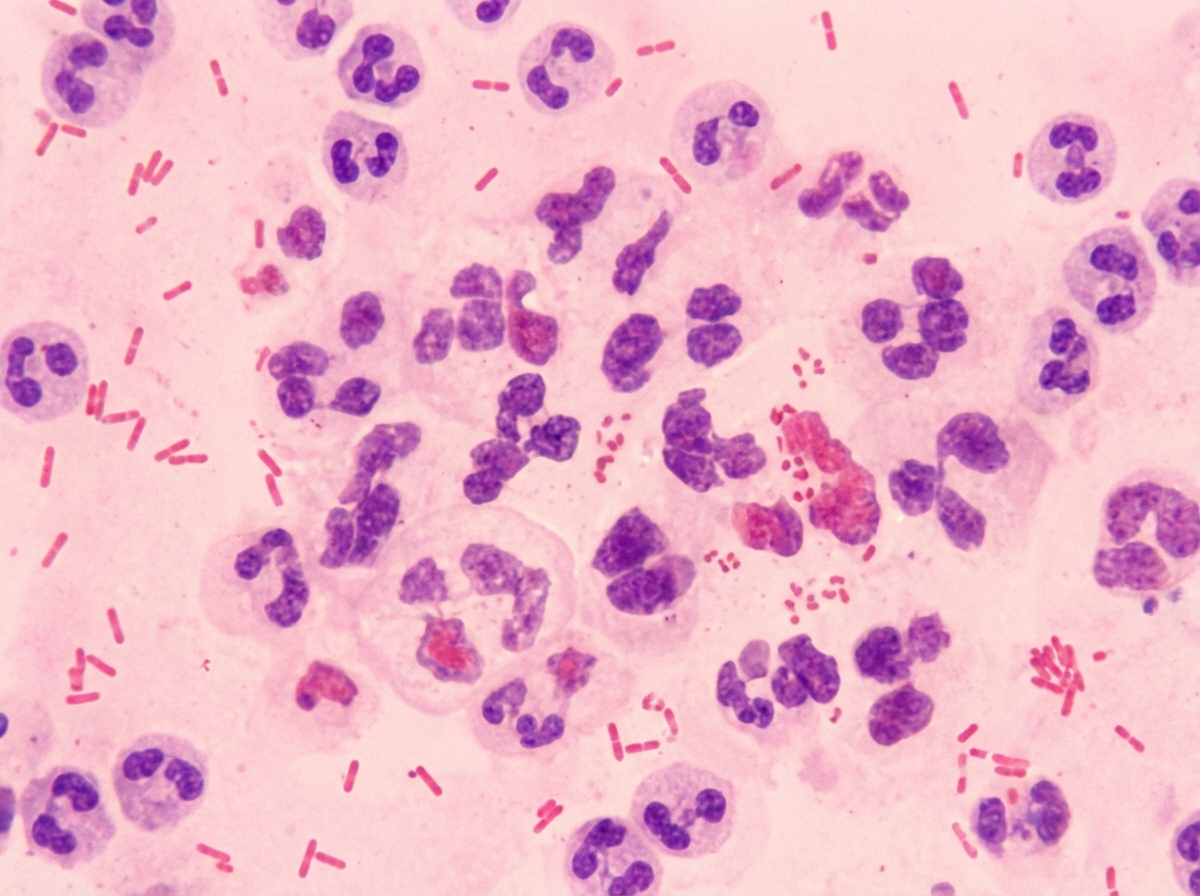
A previously healthy 26-year-old woman comes to the physician because of a 2-day history of pain with urination. She has been sexually active with two partners over the past year. She uses condoms for contraception. Vital signs are within normal limits. Physical examination shows suprapubic tenderness. Urinalysis shows neutrophils and a positive nitrite test. Urine culture grows gram-negative, oxidase-negative rods that form greenish colonies on eosin-methylene blue agar. Which of the following virulence factors of the causal organism increases the risk of infection in this patient?
A previously healthy 29-year-old man comes to the emergency department for a 2-day history of abdominal pain, vomiting, and watery diarrhea. Bowel movements occur every 3 hours and are non-bloody. He recently returned from a backpacking trip in Central America. He does not take any medications. Stool culture shows gram-negative, rod-shaped bacteria that ferment lactose. Which of the following toxins is most likely to be involved in the pathogenesis of this patient's symptoms?
An investigator is studying a strain of bacteria that retains a blue color after crystal violet dye and acetone are applied. The bacteria are inoculated in a petri dish containing hypotonic saline. After the addition of an antibiotic, the bacteria swell and rupture. This antibiotic most likely belongs to which of the following classes?
A 59-year-old man comes to the physician because of urinary frequency and perineal pain for the past 3 days. During this time, he has also had pain with defecation. He is sexually active with his wife only. His temperature is 39.1°C (102.3°F). His penis and scrotum appear normal. Digital rectal examination shows a swollen, exquisitely tender prostate. His leukocyte count is 13,400/mm3. A urine culture obtained prior to initiating treatment is most likely to show which of the following?
An investigator is studying the immune response and the spleen in a mouse model infected with Escherichia coli. Which of the following anatomical sites in the spleen is important for the secondary maturation and affinity maturation of B cells that will ultimately target Escherichia coli?
Want unlimited practice?
Get full access to all questions, explanations, and performance tracking.
Scan to download app