
Bacteria — MCQs

On this page
A group of microbiological investigators is studying bacterial DNA replication in E. coli colonies. While the cells are actively proliferating, the investigators stop the bacterial cell cycle during S phase and isolate an enzyme involved in DNA replication. An assay of the enzyme's exonuclease activity determines that it is active on both intact and demethylated thymine nucleotides. Which of the following enzymes have the investigators most likely isolated?
A 3-year-old girl is brought to the emergency department for 2 days of abdominal pain and watery diarrhea. This morning her stool had a red tint. She and her parents visited a circus 1 week ago. The patient attends daycare. Her immunizations are up-to-date. Her temperature is 38°C (100.4°F), pulse is 140/min, and blood pressure is 80/45 mm Hg. Abdominal examination shows soft abdomen that is tender to palpation in the right lower quadrant with rebound. Stool culture grows Yersinia enterocolitica. Exposure to which of the following was the likely cause of this patient's condition?
A 44-year-old Caucasian male presents with a fever, recent weight loss, and a cough productive of bloody sputum. A chest X-ray and CT scan were performed, revealing cavities near the apex of his lungs. The patient is started on rifampin, isoniazid, ethambutol and pyrazinamide. Formation of the cavities in the patient's lungs is mainly mediated by:
A 24-year-old woman presents to her primary care doctor with a lesion on her labia. She first noticed the lesion 2 days ago. It is not painful. She denies vaginal discharge or dysuria. She has no past medical history and takes no medications. She has had 4 sexual partners in the past 8 months and uses the pull-out method as contraception. She drinks 12-16 alcoholic beverages per week and is a law student. Her temperature is 97.8°F (36.6°C), blood pressure is 121/81 mmHg, pulse is 70/min, and respirations are 16/min. On exam, she has an indurated non-tender ulcer on the left labia majora. There is no appreciable inguinal lymphadenopathy. Multiple tests are ordered and pending. This patient's condition is most likely caused by a pathogen with which of the following characteristics on microscopic examination?
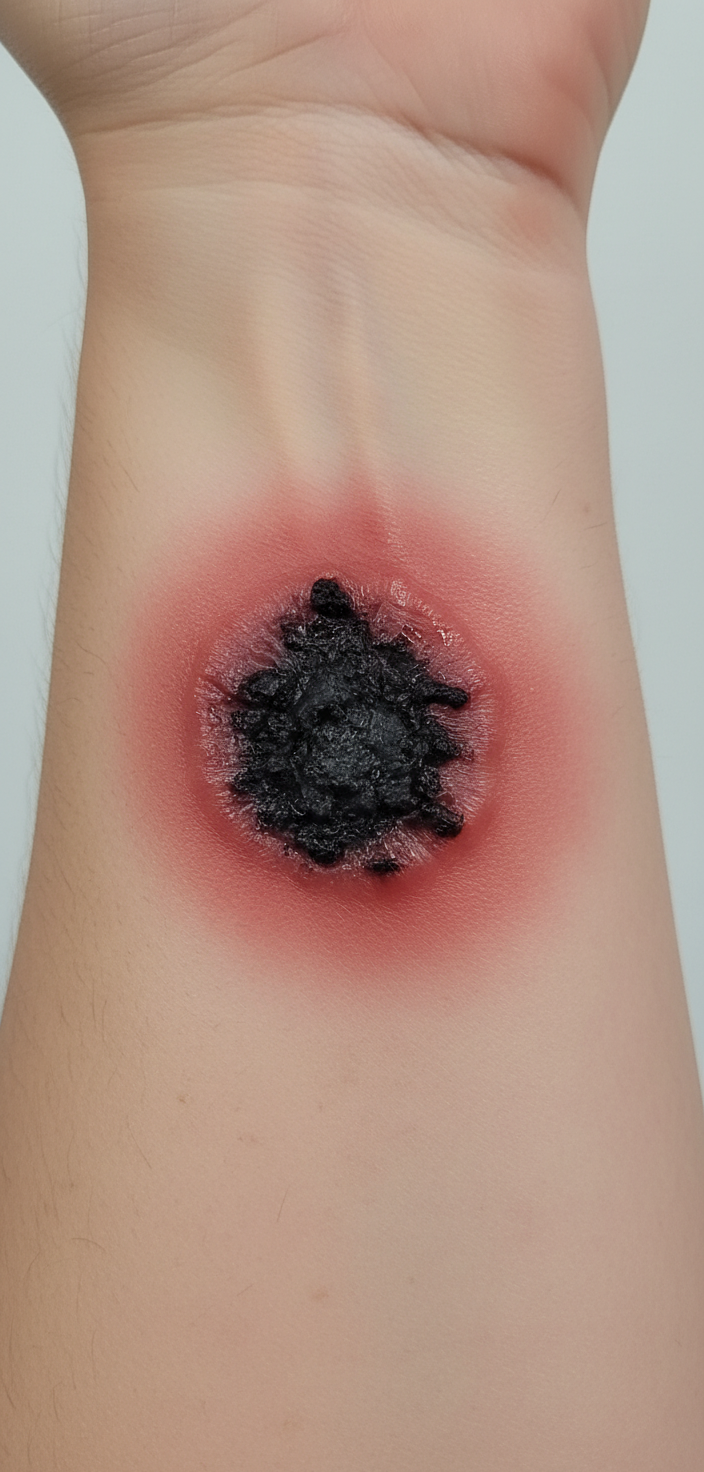
A 49-year-old man comes to the physician for evaluation of several painless, pruritic lesions on his left forearm that he first noticed 4 days ago. They were initially pink marks that progressed into blisters before ulcerating. He has also had a headache for 1 week. His temperature is 38.1°C (100.6°F). A photograph of one of the lesions is shown. There is pronounced edema of the surrounding skin and painless swelling of the left axillary lymph nodes. Which of the following is the greatest risk factor for this patient's condition?
A 36-year-old woman with a past medical history of diabetes comes to the emergency department for abdominal pain. She reports that a long time ago her gynecologist told her that she had “some cysts in her ovaries but not to worry about it.” The pain started last night and has progressively gotten worse. Nothing seems to make it better or worse. She denies headache, dizziness, chest pain, dyspnea, diarrhea, or constipation; she endorses nausea, dysuria for the past 3 days, and chills. Her temperature is 100.7°F (38.2°C), blood pressure is 132/94 mmHg, pulse is 104/min, and respirations are 14/min. Physical examination is significant for right lower quadrant and flank pain with voluntary guarding. What is the most likely pathophysiology of this patient’s condition?
A 24-year-old woman presents with fever, abdominal pain, and bloody bowel movements. She says her symptoms onset 2 days ago and have not improved. She describes the abdominal pain as moderate, cramping in character, and poorly localized. 1 week ago, she says she was on a camping trip with her friends and had barbecued chicken which she thought tasted strange. The patient denies any chills, hemoptysis, hematochezia, or similar symptoms in the past. The vital signs include: pulse 87/min and temperature 37.8°C (100.0°F). Physical examination is significant for moderate tenderness to palpation in the periumbilical region with no rebound or guarding. Stool is guaiac positive. Which of the following is a complication associated with this patient’s most likely diagnosis?
A 47-year-old woman presents to a local medical shelter while on a mission trip with her church to help rebuild homes after a hurricane. She has been experiencing severe nausea, vomiting, and diarrhea for the last 2 days and was feeling too fatigued to walk this morning. On presentation, her temperature is 99.2°F (37.3°C), blood pressure is 95/62 mmHg, pulse is 121/min, and respirations are 17/min. Physical exam reveals decreased skin turgor, and a stool sample reveals off-white watery stools. Gram stain reveals a gram-negative, comma-shaped organism that produces a toxin. Which of the following is consistent with the action of the toxin most likely involved in the development of this patient's symptoms?
A 67-year-old woman comes to the physician because of fever, chills, myalgias, and joint pain 1 month after undergoing aortic prosthetic valve replacement due to high-grade aortic stenosis. She does not drink alcohol or use illicit drugs. Her temperature is 39.3°C (102.8°F). She appears weak and lethargic. Physical examination shows crackles at both lung bases and a grade 2/6, blowing diastolic murmur over the right sternal border. Laboratory studies show leukocytosis and an elevated erythrocyte sedimentation rate. The causal organism is most likely to have which of the following characteristics?
A 28-year-old man comes to the physician for a pre-employment examination. He has no history of serious illness and takes no medications. A screening blood test is performed in which peptides are added to the sample to stimulate in vitro production of interferon-gamma, which is then measured using an enzyme-linked immunosorbent assay. This test is most likely to be helpful in diagnosing infection with which of the following pathogens?
Practice by Chapter
Bacterial cell structure and physiology
Practice Questions
Bacterial genetics
Practice Questions
Bacterial metabolism
Practice Questions
Bacterial virulence factors
Practice Questions
Exotoxins and endotoxins
Practice Questions
Bacterial culture methods
Practice Questions
Antimicrobial susceptibility testing
Practice Questions
Bacterial identification methods
Practice Questions
Bacterial taxonomy and classification
Practice Questions
Zoonotic bacterial infections
Practice Questions
Foodborne bacterial pathogens
Practice Questions
Waterborne bacterial pathogens
Practice Questions
Emerging bacterial pathogens
Practice Questions
Want unlimited practice?
Get full access to all questions, explanations, and performance tracking.
Scan to download app