
Emerging bacterial pathogens — MCQs

A 28-year-old man presents to his primary care provider complaining of intermittent stomach pain, non-bloody diarrhea, and weight loss for the last 3 months. He has occasional abdominal pain and fever. This condition makes studying difficult. He has tried omeprazole and dietary changes with no improvement. Past medical history is significant for occasional pain in the wrists and knees for several years. He takes ibuprofen for pain relief. His temperature is 38°C (100.4°F). On mental status examination, short-term memory is impaired. Attention and concentration are reduced. Examination shows no abnormalities or tenderness of the wrists or knees. There are no abnormalities on heart and lung examinations. Abdominal examination is normal. Upper endoscopy shows normal stomach mucosa but in the duodenum, there is pale yellow mucosa with erythema and ulcerations. Biopsies show infiltration of the lamina propria with periodic acid-Schiff (PAS)-positive macrophages. Which of the following best explains these findings?
A 30-year-old woman comes to the emergency department because of fever, watery diarrhea, and abdominal cramping for the past 24 hours. She recently went to an international food fair. Her temperature is 39°C (102.2°F). Physical examination shows increased bowel sounds. Stool cultures grow gram-positive, spore-forming, anaerobic rods that produce alpha toxin. The responsible organism also causes which of the following physical examination findings?
A 42-year-old woman with a history of multiple sclerosis and recurrent urinary tract infections comes to the emergency department because of flank pain and fever. Her temperature is 38.8°C (101.8°F). Examination shows left-sided costovertebral angle tenderness. She is admitted to the hospital and started on intravenous vancomycin. Three days later, her symptoms have not improved. Urine culture shows growth of Enterococcus faecalis. Which of the following best describes the most likely mechanism of antibiotic resistance in this patient?
A 52-year-old man presents with 2 months of diarrhea, abdominal pain, and fatigue. He reports a weight loss of 4 kg (8 lb). He also says his joints have been hurting recently, as well. Past medical history is unremarkable. Review of systems is significant for problems with concentration and memory. Physical examination is unremarkable. A GI endoscopy is performed with a biopsy of the small bowel. Which of the following histologic finding would most likely be seen in this patient?
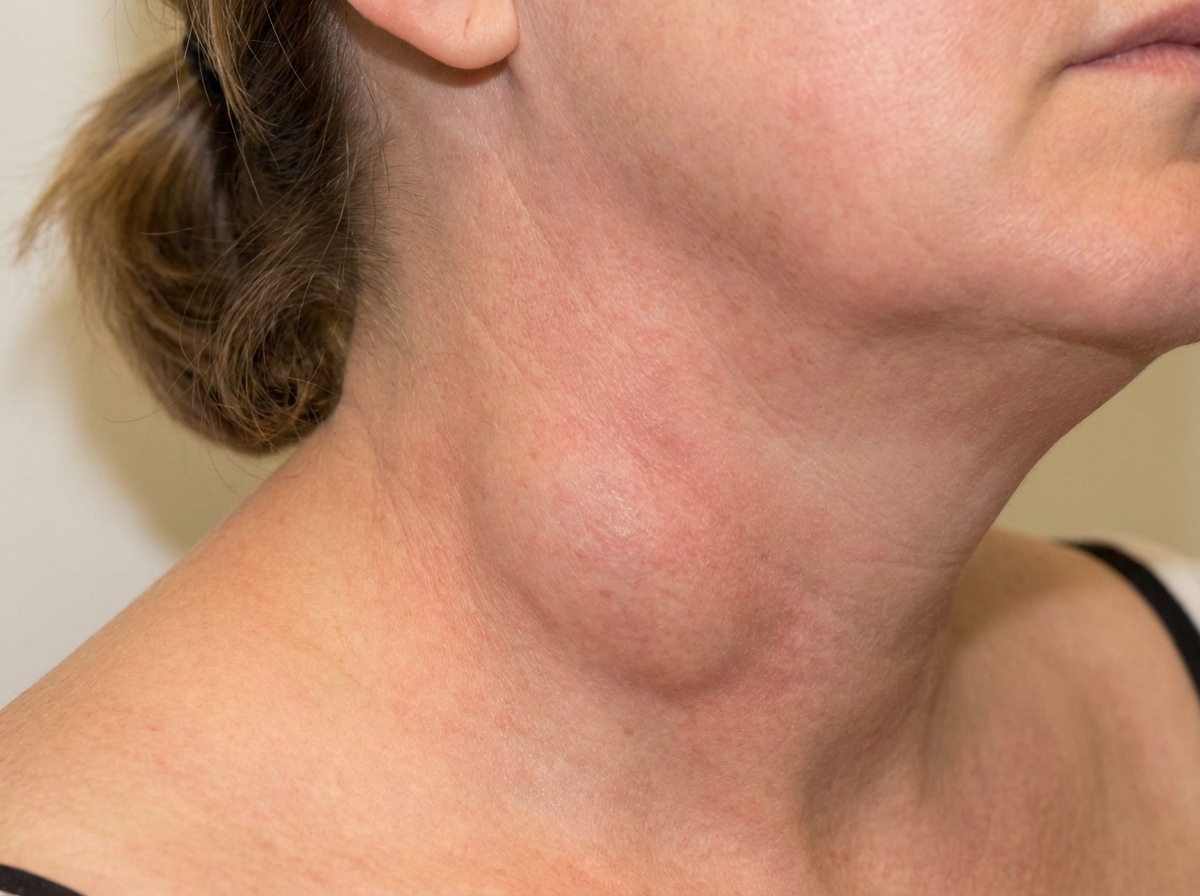
A 42-year-old woman presents because of a painful mass she first noticed on her neck 1 week ago (see image). The mass has grown over the last few days. She has no history of serious illness and takes no medications. On physical exam, her temperature is 38.0°C (100.4°F), pulse is 86/min, respirations are 12/min, blood pressure is 135/80 mm Hg. The mass is tender and relatively soft and mobile. The overlying skin is warm. On her right ear, there is a series of small and healing skin punctures left by the bite of her neighbor's kitten 3 weeks ago. No other mass is detected in the neck, supraclavicular, axillary, or inguinal regions. Oral examination reveals several discolored teeth. Her lungs are clear to auscultation and heart sounds are normal. A biopsy of the neck mass is performed. Which of the following would be most useful in establishing the diagnosis?
A 57-year-old HIV-positive male with a history of intravenous drug abuse presents to the emergency room complaining of arm swelling. He reports that he developed progressively worsening swelling and tenderness over the right antecubital fossa three days prior. He recently returned from a trip to Nicaragua. His past medical history is notable for an anaphylactoid reaction to vancomycin. His temperature is 101.4°F (38.6°C), blood pressure is 140/70 mmHg, pulse is 110/min, and respirations are 20/min. Physical examination reveals an erythematous, fluctuant, and tender mass overlying the right antecubital fossa. Multiple injection marks are noted across both upper extremities. He undergoes incision and drainage and is started on an antibiotic that targets the 50S ribosome. He is discharged with plans to follow up in one week. However, five days later he presents to the same emergency room complaining of abdominal cramps and watery diarrhea. Which of the following classes of pathogens is most likely responsible for this patient’s current symptoms?
A 63-year-old man with aortic valve disease is admitted to the hospital for a 3-week history of progressively worsening fatigue, fever, and night sweats. He does not smoke, drink alcohol, or use illicit drugs. Temperature is 38.2°C (100.8°F). Physical examination shows a systolic murmur and tender, erythematous nodules on the finger pads. Blood cultures show alpha-hemolytic, gram-positive cocci that are catalase-negative and optochin-resistant. Which of the following is the most likely causal organism?
A 44-year-old woman presents to her primary care physician for worsening dysuria, hematuria, and lower abdominal pain. Her symptoms began approximately 2 days ago and have progressively worsened. She denies headache, nausea, vomiting, or diarrhea. She endorses feeling "feverish" and notes to having foul smelling urine. She has a past medical history of Romano-Ward syndrome and is not on any treatment. She experiences profuse diarrhea and nausea when taking carbapenems and develops a severe rash with cephalosporins. Her temperature is 100.4°F (38C), blood pressure is 138/93 mmHg, pulse is 100/min, and respirations are 18/min. On physical exam, the patient appears uncomfortable and there is tenderness to palpation around the bilateral flanks and costovertebral angle. A urinalysis and urine culture is obtained and appropriate antibiotics are administered. On her next clinical visit urine studies and a basic metabolic panel is obtained, which is shown below: Serum: Na+: 140 mEq/L Cl-: 101 mEq/L K+: 4.2 mEq/L HCO3-: 22 mEq/L BUN: 20 mg/dL Glucose: 94 mg/dL Creatinine: 2.4 mg/dL Urinalysis Color: Yellow Appearance: Clear Blood: Negative pH: 7 (Normal 5-8) Protein: Negative Nitrite: Negative Leukocyte esterase: Negative Cast: Epithelial casts FeNa: 3% Urine culture Preliminary report: 10,000 CFU/mL E. coli Which of the following antibiotics was most likely given to this patient?
A group of scientists studied the effects of cytokines on effector cells, including leukocytes. They observed that interleukin-12 (IL-12) is secreted by antigen-presenting cells (APCs) in response to bacterial lipopolysaccharide. When a CD4+ T cell is exposed to this interleukin, which of the following responses will it have?
An 8-year-old child is brought to the emergency department because of profuse diarrhea and vomiting that have lasted for 2 days. The boy was born at 39 weeks gestation via spontaneous vaginal delivery. He is up to date on all vaccines and is meeting all developmental milestones. Past medical history is noncontributory. The family recently made a trip to India to visit relatives. Today, his heart rate is 100/min, respiratory rate is 22/min, blood pressure is 105/65 mm Hg, and temperature is 37.2ºC (99.0°F). On physical examination, he appears unwell with poor skin turgor and dry oral mucosa. His heart has a regular rate and rhythm and his lungs are clear to auscultation bilaterally. His abdomen is sensitive to shallow and deep palpation. A gross examination of the stool reveals a 'rice water' appearance. Diagnostic microbiology results are pending. Which of the following is the best diagnostic test to aid in the identification of this patient's condition?
Want unlimited practice?
Get full access to all questions, explanations, and performance tracking.
Scan to download app