
Bacterial identification methods — MCQs

A 28-year-old man comes to the physician for a pre-employment examination. He has no history of serious illness and takes no medications. A screening blood test is performed in which peptides are added to the sample to stimulate in vitro production of interferon-gamma, which is then measured using an enzyme-linked immunosorbent assay. This test is most likely to be helpful in diagnosing infection with which of the following pathogens?
A 24-year-old woman presents to the ED with symptoms of pelvic inflammatory disease despite being previously treated with azithromycin for chlamydial infection. Based on your clinical understanding about the epidemiology of PID, you decide to obtain a gram stain which shows a gram-negative diplococci. What is the next step in order to confirm the identity of the organism described?
A 50-year-old man comes to the emergency department for evaluation of right-sided facial weakness that he noticed after waking up. One month ago, he also experienced right-sided neck pain and headache that began after returning from a hunting trip to New Hampshire the week before. He took ibuprofen to relieve symptoms, which subsided a week later. He has a 5-year history of hypertension controlled with drug therapy. He has smoked one pack of cigarettes daily for 35 years and he drinks two beers daily. His vital signs are within the normal range. Physical examination shows right-sided drooping of the upper and lower half of the face. The patient has difficulties smiling and he is unable to close his right eye. The remainder of the examination shows no abnormalities. Which of the following is the most appropriate next step in diagnosis?
A 24-year-old woman presents to her primary care physician with a 3 day history of pain with urination. She says that this pain has been accompanied by abdominal pain as well as a feeling like she always needs to use the restroom. She has no past medical history and no family history that she can recall. She is currently sexually active with a new partner but has tested negative for sexually transmitted infections. Physical exam reveals suprapubic tenderness and urine culture reveals gram-positive cocci. Which of the following best describes the organism that is most likely causing this patient's symptoms?
An investigator is processing a blood sample from a human subject. A reagent is added to the sample and the solution is heated to break the hydrogen bonds between complementary base pairs. This solution is then cooled to allow artificial DNA primers in the solution to attach to the separated strands of the sample DNA molecules. An enzyme derived from the thermophilic bacterium Thermus aquaticus is added and the solution is reheated. These steps are repeated multiple times until the aim of the test is achieved. The investigator most likely used which of the following laboratory procedures on the test sample?
A 27-year-old woman visits your office with a 3-day complaint of fever, malaise, myalgias, and headaches associated with vulvar itching, vulvar soreness, dysuria, and urethral discharge. The pain when urinating is so severe that she has attempted to avoid the use of the toilet. She just returned from a spring break in the tropics and explains that she had multiple unprotected sexual encounters with men and women. Upon physical examination, the temperature was 38.7°C (101.6°F) and the heart rate was 90/min. The pelvic examination revealed vulvar ulcers, vulvar excoriations, erythema, vaginal mucosa edema, and ulcerative cervicitis. Which of the following will best aid you in the identification of the specific organism causing the above symptoms?
A young woman from the Ohio River Valley in the United States currently on corticosteroid therapy for ulcerative colitis presented to a clinic complaining of fever, sweat, headache, nonproductive cough, malaise, and general weakness. A chest radiograph revealed patchy pneumonia in the lower lung fields, together with enlarged mediastinal and hilar lymph nodes. Skin changes suggestive of erythema nodosum (i.e. an acute erythematous eruption) were noted. Because the patient was from a region endemic for fungal infections associated with her symptoms and the patient was in close contact with a person presenting similar symptoms, the attending physician suspected that systemic fungal infection might be responsible for this woman’s illness. Which of the following laboratory tests can the physician use to ensure early detection of the disease, and also effectively monitor the treatment response?
A 35-year-old man from Thailand presents with low-grade fever, chronic cough, and night sweats for 3 months. He describes the cough as productive and producing white sputum that is sometimes streaked with blood. He also says he has lost 10 lb in the last 3 months. Past medical history is unremarkable. The patient denies any smoking history, alcohol, or recreational drug use. The vital signs include blood pressure 115/75 mm Hg, heart rate 120/min, respiratory rate 20/min, and temperature 36.6℃ (97.8℉). On physical examination, the patient is ill-looking and thin with no pallor or jaundice. Cardiopulmonary auscultation reveals some fine crackles in the right upper lobe. A chest radiograph reveals a right upper lobe homogeneous density. Which of the following tests would be most helpful in making a definitive diagnosis of active infection in this patient?
A 26-year-old man with HIV and a recent CD4+ count of 800 presents to his PCP with fever, cough, and dyspnea. He notes that he recently lost his job as a construction worker and has not been able to afford his HAART medication. His temperature is 102.6°F (39.2°C), pulse is 75/min, respirations are 24/min, and blood pressure is 135/92 mmHg. Physical exam reveals a tachypneic patient with scattered crackles in both lungs, and labs show a CD4+ count of 145 and an elevated LDH. The chest radiography is notable for bilateral diffuse interstitial infiltrates. For definitive diagnosis, the physician obtains a sputum sample. Which stain should he use to visualize the most likely responsible organism?
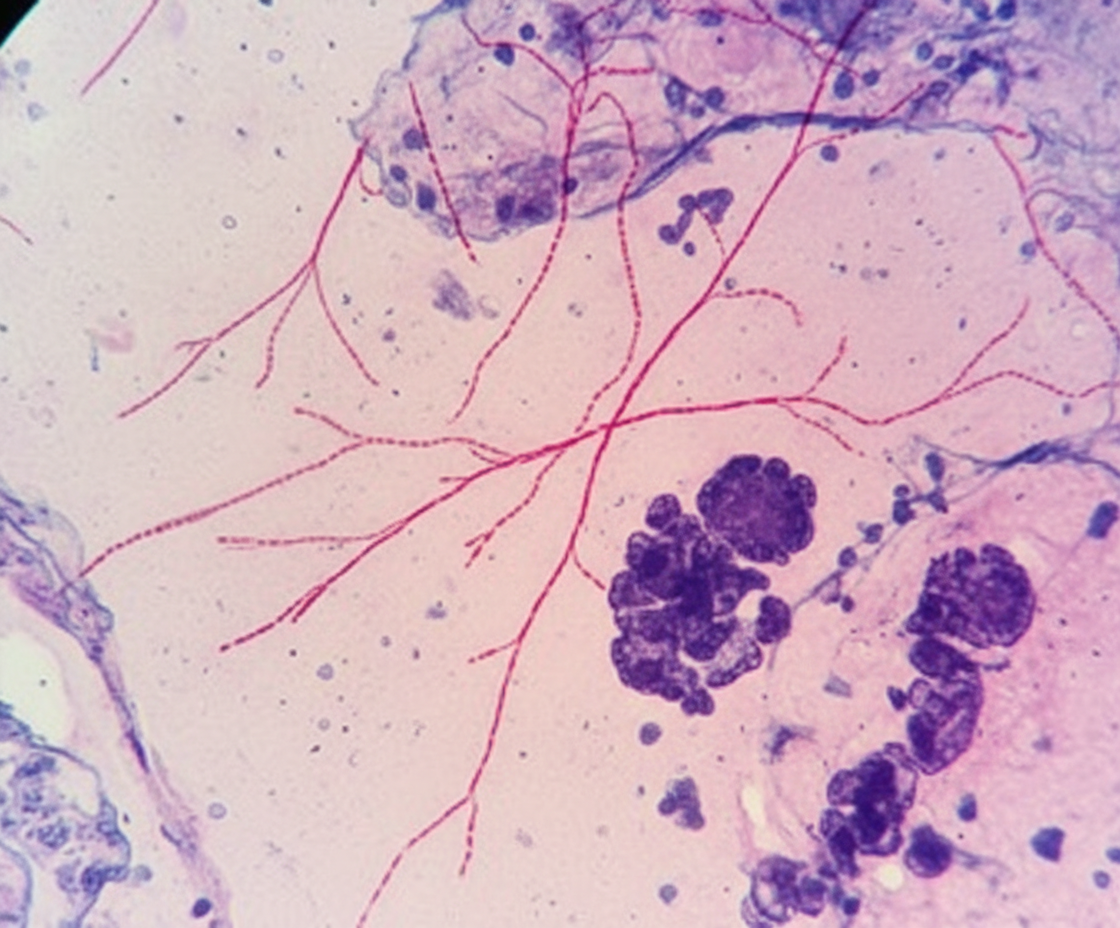
A 68-year-old man comes to the physician because of a 1-month history of fatigue, low-grade fevers, and cough productive of blood-tinged sputum. He has type 2 diabetes mellitus and chronic kidney disease and underwent kidney transplantation 8 months ago. His temperature is 38.9°C (102.1°F) and pulse is 98/min. Examination shows rhonchi in the right lower lung field. An x-ray of the chest shows a right-sided lobar consolidation. A photomicrograph of specialized acid-fast stained tissue from a blood culture is shown. Which of the following is the strongest predisposing factor for this patient's condition?
Want unlimited practice?
Get full access to all questions, explanations, and performance tracking.
Scan to download app